Tag Archives: author

Vanguard’s All-World Ex-US Fund Sounds So Good, But Hasn’t Performed
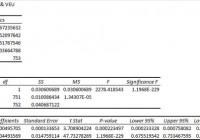
Summary When I’m contemplating funds for my IRA, I like to use Modern Portfolio Theory. The risk level and correlation measured on a daily a basis are unattractive, though the correlation appears much lower in longer scenarios. Despite a great expense ratio and strong dividend yield, I have a hard time getting excited about VEU. It’s a solid ETF, but I’m less excited for it than I usually am for Vanguard funds. Investors should be seeking to improve their risk-adjusted returns. I’m a big fan of using ETFs to achieve the risk-adjusted returns relative to the portfolios that a normal investor can generate for themselves after trading costs. I’m working on building a new portfolio, and I’m going to be analyzing several of the ETFs that I am considering for my personal portfolio. One of the funds that I’m considering is the Vanguard FTSE All-World ex-US Index ETF (NYSEARCA: VEU ). I’ll be performing a substantial portion of my analysis along the lines of Modern Portfolio Theory, so my goal is to find ways to minimize costs, while achieving diversification to reduce my risk level. What does VEU do? VEU uses an indexing approach to track the performance of the FTSE All-World ex-US Index. The first thing I’m looking for is diversification. If the ETF really brings great diversification and can effectively represent all virtually all of the non-US market, then it should be an incredible fit for my portfolio. However, I want to run my own statistics to get a better feel for the performance of the ETF. Does VEU provide diversification benefits to a portfolio? Each investor may hold a different portfolio, but I use the SPDR S&P 500 Trust ETF (NYSEARCA: SPY ) as the basis for my analysis. I believe SPY, or another large cap U.S. fund with similar properties, represents the reasonable first step for many investors designing an ETF portfolio. Therefore, I start my diversification analysis by seeing how it works with SPY. I start with an ANOVA table: (click to enlarge) The correlation measured on a daily basis is higher than I would expect. Given that the ETF is expected to represent all of the non-U.S. market, I was hoping for a correlation closer to 70%. There are plenty of REIT ETFs that have lower levels of correlation. I feel like this ETF may be seeing more of a correlation to the U.S. market than it really should. I want to see low correlations, and this doesn’t seem to offer that. Since it feels wrong for there to be such a strong correlation, I decided to test the statistics against eyeballing the chart. Remember that I’m looking at statistics on a daily basis, so the influences can be money flowing in and out of the market. The image below is a 5-year price chart from Google Finance. (click to enlarge) VEU has performed quite poorly if measured over the entire period. However, it appears clear from the graph that while the correlation of daily returns is high, the overall direction of the lines is not impacted as strongly. Therefore, over a long time period, I would expect the diversification benefits to be better than they are over the short term. In the short term, the ETF moves up and down with SPY, but over the longer term, the performance is dictated by other factors. Standard deviation of daily returns (dividend adjusted, measured since January 2012) The standard deviation is higher than I would expect for an ETF that is expected to be so broad. For VEU, it is .905%. For SPY, it is 0.736% for the same period. The higher volatility, combined with high daily correlation and very unimpressive results over the last 5 years aren’t very attractive to me. I looked back at the numbers since inception, and they aren’t very attractive either. A portfolio split half and half between VEU and SPY, which I’m not recommending, would have scored a .793% for the daily standard deviation. Due to the high correlation and high standard deviation, the daily statistics don’t support the ETF offering much in the way of diversification benefits. Clearly, the long-term price chart shows that there is some substantial diversification. However, I’d be concerned if I allocated a large portion of the portfolio to it. Why I use standard deviation of daily returns I don’t believe historical returns have predictive power for future returns, but I do believe historical values for standard deviations of returns relative to other ETFs have some predictive power on future risks and correlations. Liquidity is great The average trading volume is over 2.4 million shares per day. I have absolutely no liquidity concerns. Yield The distribution yield is 3.52%. That is a fairly attractive yield. This ETF could be worth considering for retiring investors. I like to see strong yields for retiring portfolios, because I don’t want to touch the principal. Higher yields imply lower growth rates (without reinvestment) over the long term, but that is an acceptable trade-off, in my opinion. If the long-term diversification benefits and strong distribution yield encouraged retirees to keep their hands out of the portfolio, that would make the ETF substantially more attractive for investors that needed help in that regard. Expense Ratio The ETF is posting .15% for both gross and net expense ratios. For the expected diversity in the equity securities being held and the risk factors affecting the ETF, that is a very attractive expense ratio. In my opinion, .15% is a fairly attractive expense ratio, regardless of what the ETF is doing. Generally, I think anything less than .20% is doing well for expense ratios. Market-to-NAV The ETF is at a .06% premium to NAV currently. That isn’t large enough to matter for a long-term holder. Check before trading, but I wouldn’t expect to see this ETF deviate from the NAV by a meaningful amount. Largest Holdings The diversification within the holdings looks great. (click to enlarge) Conclusion I’m currently screening a large volume of ETFs for my own portfolio. I have a total of five portfolios that I am personally connected to. My wife and I both have Traditional and Roth IRAs. I also have a solo 401K. The 401K is through Schwab, so I have a preference for ETFs on the OneSource list for that account. The four IRA accounts are with a different brokerage that does offer me any incentives to pick certain ETFs. In those accounts, I will have a preference for using a smaller number of ETFs to achieve my diversification, due to trading costs. Vanguard funds are very attractive, in my opinion, for any accounts that don’t already have commission-free trading. In general, they have low expense ratios and solid diversification. I was given the impression that this ETF would be a strong contender for one or two of the IRA accounts, but so far, I’m not convinced. My current IRA uses some mutual funds that were relatively low-fee, with no trading costs. I want to make some fairly substantial changes. Over the course of a few months, the trading commission on buying into some low-fee ETFs should be covered by the lower expense ratios. The trading costs will encourage me to rebalance less frequently. That makes low volatility even more important to me. I’m stuck in a hard situation with assessing VEU. I love the idea of getting exposure to all the foreign markets with a single ETF, because it reduces trading costs. I don’t like the daily correlation values, but the long-term chart shows that the performance of the VEU isn’t as strongly tied to the S&P 500 as it would appear. For my IRAs (non-Schwab, so no OneSource), the strongest contenders so far for major positions are the Vanguard Total Stock Market ETF (NYSEARCA: VTI ) and Vanguard REIT Index ETF (NYSEARCA: VNQ ). If I can’t find an option that really appeals to me as a single ETF to cover foreign exposure in the IRAs, I may accept going without the foreign exposure. Additional disclosure: Information in this article represents the opinion of the analyst. All statements are represented as opinions, rather than facts, and should not be construed as advice to buy or sell a security. Ratings of “outperform” and “underperform” reflect the analyst’s estimation of a divergence between the market value for a security and the price that would be appropriate given the potential for risks and returns relative to other securities. The analyst does not know your particular objectives for returns or constraints upon investing. All investors are encouraged to do their own research before making any investment decision. Information is regularly obtained from Yahoo Finance, Google Finance, and SEC Database. If Yahoo, Google, or the SEC database contained faulty or old information, it could be incorporated into my analysis. The analyst holds a diversified portfolio, including mutual funds or index funds, which may include a small long exposure to the stock.
Closed-End Funds: What IS A Sustainable Yield?

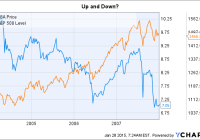
Summary CEFs are great at paying distributions for those seeking income. That said, some CEFs appear to be “too good” at this increasingly desirable trait. What is a sustainable distribution and when should you worry? Try this case study on for size. Closed-end funds, or CEFs, are great at providing investors income, something that most other pooled investment vehicles don’t do as well. However, there’s a fine line between providing investors a nice yield and drawing down net asset value, or NAV, to sustain what might really be an unsustainable distribution. If you are looking to buy and hold a CEF, at what point should you worry about the yield? A tale of two managed distributions How much is too much? That’s a tough question to answer across the entire closed-end fund universe because CEFs do so many different things in so many different ways. For example, a high-yield bond CEF’s distribution is inherently different from a short-term municipal bond CEF’s distribution. And both are different from a stock CEF’s distribution. So, the first thing to consider when looking at CEFs is to make sure you are comparing apples to apples. And that includes taking into consideration such things as leverage and option strategies. That said, let’s look at two funds that are exactly the same in all respects. Fund One has a 10% managed distribution policy, whereby it pays out 2.5% of its NAV every quarter. Fund Two has a 6% managed distribution policy, paying 1.5% of its NAV every quarter. What do the distributions look like? Over a four-year period in a generally rising market, Fund One’s NAV started out at $9.13 a share and ended at $8.07 a share. Over that span, it paid $0.15 a share from income it received, $2.85 from capital gains, and $0.54 from return of capital. Despite the fact that the broader market was heading generally higher over the span, Fund One lost over $1.00 a share in NAV. True, it paid investors handsomely via distributions, but its distribution policy was leading to a shrinking NAV. Fund Two, meanwhile, over a four-year span with a generally rising market, watched its NAV rise from $4.21 a share to $5.35. Over the four years it paid out $0.84 in distributions from income, nothing from capital gains, and $0.44 in return of capital. But, the NAV increased by a touch over $1.00 a share. Note that the market was moving generally higher through both four-year spans. In other words, Fund Two was able to grow its NAV at a time when you would expect it to be growing its NAV – something that Fund One didn’t achieve. The big reveal! The biggest difference between Fund One and Fund Two was their distribution policies, because both funds are the Liberty All-Star Equity Fund (NYSE: USA ). The first set of data came from January 2004 to December 2007, when it had a 10% distribution policy in place. The second set of data came from January 2009 to December 2012 when the fund had shifted to a 6% distribution policy. That move took place in early 2009 . USA data by YCharts USA data by YCharts I chose those end dates specifically because I wanted to track generally rising markets and avoid the disastrous performance the fund had in 2008. In that year, the fund’s NAV fell from $8.07 a share to $4.21. Distributions in 2008 were $0.07 from income and $0.58 from return of capital. Essentially, almost 90% of that year’s distribution was return of capital. It was a rough year for almost all investors and investments, to be sure. And Liberty All-Star Equity Fund wasn’t alone in dipping into capital to maintain its distribution. However, it isn’t a coincidence that the managed distribution plan was adjusted a year later in 2009. According to the fund’s board of directors, The change was adopted primarily to better align the Fund’s distribution rate with historical equity market returns. What does that mean? Historically, the stock market has returned roughly 10% or so a year, on average. If a CEF pays out 10% of its NAV every year, it is, essentially, returning everything that an investor might reasonably expect it to make – every year. That requires the CEF to beat the market in order to increase NAV. Fall short and the NAV will fall, which is pretty much what happened for “Fund One.” If, instead, the target is 6%, the CEF has a cushion. It can fall short of the market’s long-term average return and not eat into NAV when it pays distributions. Moreover, if it does better than 6%, it can actually grow its NAV over time. This is the benefit that “Fund Two” enjoyed above. To be fair, the markets in both periods were very different. And the fund uses a collection of outside mangers, which change over time. So there are factors beyond the distribution policy that impacted performance in both periods. However, this is as close as I think you can get to apples and apples in the investing world. It depends Of course this is just one example from what is, generally speaking, an unremarkable fund. For example, Liberty All-Star Equity Fund underperformed the S&P 500 Index by roughly three percentage points over each of the trailing 3-, 5-, and 10-year periods through year end 2014 on a total return basis (which includes distributions), according to Morningstar. But, it provides food for thought when looking at CEFs with big yields. You need to ask yourself if the level is sustainable over time. That’s particularly true for distributions that are at the complete discretion of the board of directors. In fact, target percentages are easier to deal with in some ways because they will, inherently, adjust up and down as the fund’s NAV and performance change over time. Good years you’ll get more, bad years you’ll get less. A static distribution based on what is, essentially, the board’s whim, will result in increasingly larger yields when the market is heading south and can set up dividend cuts. Of course, there are a host of other factors involved in deciding what CEFs to buy and which ones to avoid. Premiums and discounts, asset class, investment policy, etc. But, if you are looking for income, Liberty All-Star Equity Fund is a good case study in the difference that distribution choices can have on NAV. When all is said and done, the moral of the story is to think long and hard before you simply chase a yield in CEF land.

Will The Fed Bring Down SLV?

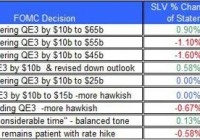
The FOMC’s statement was released on January 28. The price of SLV could come down once the FOMC starts to raise rates. The concerns over the global economy aren’t likely to change the FOMC’s view about raising rates this year. The recent decision of the FOMC didn’t stir up the silver market as shares of iShares Silver Trust ETF (NYSEARCA: SLV ) slightly declined on the day the statement was released. But, the sentiment of the recent statement may suggest the FOMC is still on its road to raise its cash rate in the coming months, which could curb down the recent rally of SLV. Let’s review the latest from the Fed and the potential ramifications of its policy on SLV. The recent FOMC meeting concluded with little changes to the wording of the statement. The FOMC reiterated its stance about being patient over its next rate hike: The Committee judges that it can be patient in beginning to normalize the stance of monetary policy. The FOMC still remains bullish about the U.S. economy mainly when it comes to the labor market – this is partly due to the fall in oil prices. Nonetheless, the FOMC estimates inflation could fall further in the near-term albeit rise back up to its target in the medium-term: Inflation is anticipated to decline further in the near-term, but the Committee expects inflation to rise gradually toward 2 percent over the medium-term as the labor market improves further and the transitory effects of lower energy prices and other factors dissipate. (click to enlarge) Source of data: FOMC’s site and Bloomberg The reaction to the recent decision wasn’t too harsh at first and the price of SLV only slightly declined. The following day, however, SLV tumbled down. In most of the meetings in 2014, the reaction of silver prices to the FOMC statement was mostly negative, because the FOMC’s policy kept turning more hawkish. Lower inflation doesn’t seem to persuade investors that the FOMC is reconsidering not to raise rates later this year. For now, the inflation is likely to keep coming down. Even the 5-year inflation expectations have slowly come down in recent months. (click to enlarge) Chart taken from FRED As you can see, the inflation expectations for the next five years are still not far off the Fed’s 2% target. This figure could decline further in the coming months as low oil prices are likely to pressure it down. But, the Fed still estimates that over the mid-term the inflation will remain around the 2% range – inline with its target. But, the main issue remains whether the drop in U.S. inflation in the near-term and the concerns over the global economy could be enough to persuade FOMC members to push forward the first rate hike and subsequent raises. The progress of the global economy – while it does influence FOMC members’ decisions – isn’t a major factor when it comes to the two mandates the FOMC has – inflation and jobs. When it comes to both cases, the FOMC’s objectives are on the right path. (click to enlarge) Chart taken from FRED This, however, doesn’t include the progress in U.S. wages – they remain relatively low and haven’t picked up in recent months. The little progress in wage could be a factor to tilt the scale towards keeping the Fed’s cash rate low for a longer time than currently estimated. Many still estimate that the FOMC will move forward and raise its cash rate this year. Moreover, most of the FOMC’s voting members also estimate the cash rate will be raised this year – according the December FOMC statement. Finally, it’s worth noticing that unlike the December meeting, in the recent meeting there weren’t any dissenters to the decision. This could be another indication that no major changes were made to rock the boat. If the FOMC remains bullish on the U.S. economy and won’t let the recent drop in U.S. inflation to change its view, then this could mean a rate hike in the coming months. This decision could start to pressure up U.S. treasury yields and thus bring back down the price of SLV. Moreover, the ongoing recovery of the U.S. dollar, which is likely to be boosted by a rate hike, could also adversely impact the price of SLV. In the meantime, even though the price of SLV rose by over 14% during the month, the demand for the silver ETF didn’t rise – the silver holdings of SLV are still around 319 million ounces of silver, which represent a 3.1% drop, year to date. The FOMC’s minutes will be released next month and could provide more insight behind the recent policy meeting. But, until the FOMC starts to raise rates, the concerns over the global economy and the drop in U.S. treasury yields could keep the price of SLV from plummeting again and erasing its gains from earlier this year. For more see: Will Higher Physical Demand for Silver Drive Up SLV?