Tag Archives: author

The Big Lesson From A Bet With Warren Buffett
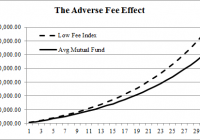
Seven years ago Ted Seides made a bet with Warren Buffett that a fund of hedge funds could outperform the S&P 500 over a ten-year period. As of today, that bet is looking very bad, with the S&P 500 beating the fund of funds by over 40% (63.5% vs. 19.6%). Seides wrote a piece for CFA Institute explaining why the bet has been wrong and some lessons from it. While Seides makes many good points, there’s one lesson that is particularly important in all of this: Seides explains that half of the underperformance is from fees: Just over half (24.4% ÷ 43.9% = 55.6%) of the underperformance by hedge funds can be attributed to fees. A full 19.5% of cumulative underperformance, or approximately 2.6% per annum, must have been caused by something else. That’s not exactly a glowing endorsement for high fee funds. Why would anyone pay more for less? The fact is, the investment world has become dirt cheap. You can get good financial advice for a fraction of the fee that you once had to pay. The entire hedge fund industry is living in the past, hoping to continue to suck 2&20 out of their unwitting clients for as long as they can. The reality is that you don’t have to pay high fees for smart advice any longer. Heck, I offer my asset management service for a measly 0.35% and I’d say I am a pretty “sophisticated” thinker. That’s what my mother tells me anyhow and I believe everything she says. More importantly, we’re entering a world where future returns are likely to be lower in the future. With bonds generating low yields, a balanced portfolio is either going to produce lower returns in the future or higher volatility returns as more of the gain is made up by stocks. This creates a problem for investors. If you’re paying high fees, you’re either paying more for lower risk adjusted returns OR your fees are eating into your returns by an increasingly large margin. If you’re looking at a real return (after inflation) of 6%-7% in stocks, then we have every reason to be mindful of any other frictions like taxes and fees that might reduce that return even further. But what is the average fee effect? To put things in perspective, consider that the average mutual fund charges 0.9% relative to the average low fee index which charges 0.1%. That’s a 0.8% difference. It doesn’t sound like much, but take a 7% compound annual growth rate on $100,000 and extend that over 30 years. Just how much of an impact does it make? The mutual fund ends up with a balance that is 23% lower than the index. In other words, the mutual fund could just mimic the return of the index and reduce your return by $150,000! Either way, the solution is simple. Stop paying high fees. My general rule of thumb is that you should almost never pay more than 0.5% for portfolio management. If you’re paying more than that, then I highly doubt you’re getting your money’s worth. Are you Bullish or Bearish on ? Bullish Bearish Neutral Results for ( ) Thanks for sharing your thoughts. Submit & View Results Skip to results » Share this article with a colleague
Utilities On The Elevator

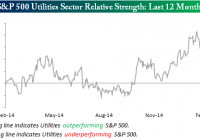
There’s an old saying on the Street that stocks take the stairs up and the elevator down. In other words, gains typically occur over a period of weeks or months, but can be erased in days or even hours. The recent performance of the Utilities is a prime example. For months, investors have been amazed at how even in an up market one of the best performing sectors had been the Utilities sector. Take a look at the chart below, which is from our weekly Sector Snapshots report, though. In the span of two weeks, the sector’s fortunes have turned on a dime, and as of this afternoon, the sector has nearly given up all of its outperformance versus the S&P 500. The fact that the peak of the sector’s relative strength coincided with the trough in Treasury yields just illustrates how sensitive to interest rates the sector is. Are you Bullish or Bearish on ? Bullish Bearish Neutral Results for ( ) Thanks for sharing your thoughts. Submit & View Results Skip to results » Share this article with a colleague

Build America Muni ETFs For Income Generation

Summary Taxable muni bonds are a good alternative to investment-grade corporate debt. Focus on Build America municipal bonds. Comparison of Build America Bond ETFs. Taxable municipal bonds and related exchange traded funds may be a good fixed income alternative to investment-grade corporate debt. According to J.P. Morgan analysts, investors should consider taxable munis over comparable corporate bonds to generate income without sacrificing credit quality, Randall Forsyth reports for Barron’s . AA-rated long-term non-callable taxable munis have a 4.1% yield, showing a spread of 49 basis points above corresponding corporate bonds and 168 basis points over comparable Treasuries. Investors can look at Build America Bond ETFs for diversified exposure to taxable munis. Build America debt obligations were first created under President Barack Obama’s 2009 American Recovery and Reinvestment Act, where municipalities sold $188 billion of the debt before the program expired at the end of 2010. The Build America bonds helped diminish borrowing costs for state and local governments as part of a stimulus package. Local governments used the bonds to pay for infrastructure projects and received a 35% federal subsidy on interest payments. For example, the PowerShares Build America Bond Portfolio ETF (BAB ) has a 9.13-year duration and a 3.54% 30-day SEC yield, and the SPDR Nuveen Barclays Capital Build America Bond ETF (NYSEARCA: BABS ) has a 12.79-year duration and a 3.42% 30-day SEC yield. BAB’s credit quality breakdown includes AAA 10%, AA 41%, A 38% and BBB 1%. BABS’s quality allocations include Ass 11.1%, Aa 44.4%, A 44.1% and Baa 0.5%. In contrast, the iShares 10-20 Year Treasury Bond ETF (NYSEARCA: TLH ) has a 9.72-year duration and a 1.89% 30-day SEC yield, and the iShares 10+ Year Credit Bond ETF (NYSEARCA: CLY ) has a 13.16-year duration and a 3.97% 30-day SEC yield. TLH only tracks high-quality, AAA-rated U.S. Treasuries, while CLY holds a slightly lower-quality tilt, including AAA 2.6%, AA 9.9%, A 37.3% and BBB 49.4%. PowerShares Build America Bond Portfolio ETF (click to enlarge) Max Chen contributed to this article . Disclosure: The author has no positions in any stocks mentioned, and no plans to initiate any positions within the next 72 hours. (More…) The author wrote this article themselves, and it expresses their own opinions. The author is not receiving compensation for it. The author has no business relationship with any company whose stock is mentioned in this article.