Tag Archives: author

EOI Vs. EOS: Not Much Difference Between These CEFs

Summary On the surface, the biggest difference between Eaton Vance’s EOI and EOS appears to be the Roman numeral in EOS’ name. There are, really, more differences when you dig a little bit deeper. In the end, however, the differences aren’t big enough. Eaton Vance has a collection of closed-end funds, or CEFs, that have confusingly similar names. I recently wrote about Eaton Vance Tax-Managed Buy-Write Opportunities Fund (NYSE: ETV ) and Eaton Vance Tax-Managed Buy-Write Income Fund (NYSE: ETB ). The difference between these two funds boils down to the word ” opportunities .” With Eaton Vance Enhanced Equity Income Fund (NYSE: EOI ) and Eaton Vance Enhanced Equity Income Fund II (NYSE: EOS ), there’s even less of a hint at what the difference might be. The same… Other than the names of EOI and EOS being differentiated by little more than a single Roman numeral, there are other confusing similarities that you’ll need to wade through. For example, word for word, the two funds’ objectives are: “The Fund’s primary investment objective is to provide current income, with a secondary objective of capital appreciation.” In fact, the marketing material for each fund provides identical “fund highlights,” as well: The Fund invests in a portfolio of primarily large- and midcap securities that the investment adviser believes have above-average growth and financial strength and writes call options on individual securities to generate current earnings from the option premium. The Fund pays monthly distributions to shareholders pursuant to a managed distribution plan. Meanwhile, they both IPOed within a three month span between late 2004 and early 2005. It looks like Eaton Vance used copy and paste when it introduced these two funds. …But different So, on some level, these two CEFs are very similar offerings. In fact, the managers on EOI are also on EOS, though there are two additional managers rounding out the crew on EOS. And even when you look at the two portfolios, similarities remain. For example, Apple (NASDAQ: AAPL ), Google (NASDAQ: GOOG ) (NASDAQ: GOOGL ), Amazon (NASDAQ: AMZN ), and Microsoft (NASDAQ: MSFT ), taken as a group, account for well over 10% of each fund. And both portfolios have options written on around 45% of their portfolios. But there’s an important distinction between the two funds that starts to show up when you look more closely at the top holdings and more broadly at the overall portfolio. For example, although the four technology stocks above are all heavily represented in the top ten of each portfolio, they are, in fact, weighted differently. Why? Likely because EOI is benchmarked against the S&P 500 Index while EOS is benchmarked against the Russell 1000 Growth Index. So, for example, at the end of 2014, EOI had materially more exposure to financials at 16% of the portfolio versus 6% for EOS. And EOS had more exposure to technology at 31% versus 21% for EOI. There are a couple of other notable differences within the sector exposure, too. That said, both ETFs seem to stay fairly close to their benchmarks, shifting their weightings at the edges rather than making big sector bets. (Vastly different from the situation at ETV and ETB.) Notably, however, they also have roughly similar standard deviations over the trailing decade. That’s not overly surprising since both track close to their broadly-diversified indexes, but it means there’s not much of a risk uptick with either one. Performance wise, EOS has slightly outperformed EOI over the trailing 10 years according to Morningstar, turning in an annualized total return based on net asset value through January of roughly 6.8% versus EOI’s annualized return of 6%. Note that Morningstar’s figures include the reinvestment of dividends. On the income score, EOS and EOI both yield around 7.8% based on their market prices, according to the Closed-End Fund Association. Their discounts are also fairly close and in line with their historical averages. Which one? If I had to pick between just these two funds, I’d probably go with Eaton Vance Enhanced Equity Income Fund II, but only because of the slightly better long-term performance. That said, if you are on the hunt for a fund that tracks the S&P 500, EOS is a bad choice because that isn’t what it’s meant to do. For that, EOI is the right option. Neither, however, is a bad fund. In fact, each of their long-term performances compare quite favorably to Morningstar’s Large Growth category. So, in the end, the big difference is the indexes that EOS and EOI follow. That, however, may not mean all that much to you. And if that’s the case, they are close enough cousins that they almost look like twins. Disclosure: The author is long AAPL. (More…) The author wrote this article themselves, and it expresses their own opinions. The author is not receiving compensation for it (other than from Seeking Alpha). The author has no business relationship with any company whose stock is mentioned in this article.
Currency Wars Offer Unique ETF Opportunities

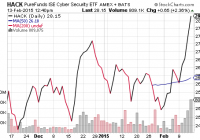
The craziness in currency manipulation is occurring on every continent and in every region. So why are these devaluation endeavors happening on such a massive scale? Investors need to take these activities into account in the assessment of risk versus reward. David Bowie and Mick Jagger may believe that people are dancing on every street corner around the world. In actuality, however, they’re desperately competing with neighbors by devaluing their currencies. The craziness in currency manipulation is occurring on every continent and in every region. Japan’s brazen quantitative easing (QE) program has seen the battered yen hurt China’s export-dependent economy, leading to speculation that the People’s Bank of China (PBOC) may need to weaken its yuan. Europe’s recently launched QE program has decimated the euro at the expense of non-member nations. In response, Denmark and Sweden have put forward negative interest rates to keep the Danish krone and Swedish krona from rising against the euro. And in the Americas? Mexico, Peru, Chile and Venezuela have all come under fire from neighboring countries for rate cut activity that has depreciated their respective currencies. So why are these devaluation endeavors happening on such a massive scale? The most obvious reason is the belief that weaker currencies promote exports that will stimulate a nation or region’s economic well-being. In today’s battle, however, strong currencies also force import prices down and that can create deflation. All across the globe, the threat of deflation-based recessionary pressure has caused central banks to loosen monetary policy. Lowering rates to zero percent, “going negative,” buying assets with electronically-created credits (a.k.a. “quantitative easing”) all lead to lower currencies against rivals. Since every major central bank, and even the minor ones, are now engaged in unusual efforts to stimulate respective economies – since everyone is debasing paper money – investors need to take these activities into account in the assessment of risk versus reward. We know that the U.S. Federal Reserve succeeded in reflating the value of market-based securities as well real estate. Yet we also know that the world’s “strongest economy” is not quite as strong as advertised, and that the dollar’s surge against world rivals has already created exporter hardship domestically. For U.S. stocks, go with the momentum that mega-cap growth and Apple have been serving up. That might mean sticking with the stock uptrend via the Vanguard Mega-Cap Growth ETF (NYSEARCA: MGK ), until and unless it falls below and stays below a 200-day trendline. Also consider thematic/satellite holdings such as the PureFunds ISE Cyber Security ETF (NYSEARCA: HACK ). This exchange-traded tracker has been hitting “higher lows” ever since its recent introduction – a bullish technical sign to accompany the high profile concerns of “cyber-terrorism” and “identity theft.” On the flip side of the ledger, “risk-on” U.S. assets need some insurance against a policy mistake by the Fed (e.g.,raising rates too soon, failing to communicate intentions where credibility is lost, etc.). Not only did the trade deficit soar and consumer confidence drop dramatically in January, but corporate earnings and GDP guidance are both being revised downward. This means investors should buy the long treasury bond dips for protection, relative value and price gain potential . Consider buying a fund like the iShares 10-20 Treasury Bond ETF (NYSEARCA: TLH ) on this reversion to its 50-day MA. Finally, there’s reason to believe that, historically speaking, it makes sense to allocate a portion of one’s risk assets to places where valuations are lower than the U.S. It is true that European equities may struggle to make progress as long as the potential for an ugly divorce between Greece and the euro-zone exists. That said, if a path forward buys time for Greece and, by extension, Spain and Italy, export superstars in the euro-zone should profit immensely from the decimated regional currency. Many of my clients hold the iShares Currency Hedged MSCI Germany ETF (NYSEARCA: HEWG ) or the WisdomTree Europe Hedged Equity ETF (NYSEARCA: HEDJ ) to mitigate the fear of additional euro depreciation. Others might want the other side of that “bet” by picking up the iShares MSCI Germany ETF (NYSEARCA: EWG ). After all, the dollar could fall against the euro if the Fed pushes off interest rate hikes into 2016. Disclosure: Gary Gordon, MS, CFP is the president of Pacific Park Financial, Inc., a Registered Investment Adviser with the SEC. Gary Gordon, Pacific Park Financial, Inc, and/or its clients may hold positions in the ETFs, mutual funds, and/or any investment asset mentioned above. The commentary does not constitute individualized investment advice. The opinions offered herein are not personalized recommendations to buy, sell or hold securities. At times, issuers of exchange-traded products compensate Pacific Park Financial, Inc. or its subsidiaries for advertising at the ETF Expert web site. ETF Expert content is created independently of any advertising relationships.