Tag Archives: author

Reasons Asia Should Be The Focus Of Investors

Asia is a continent with huge potential and a multitude of growth opportunities in various industries. The tech industry in the region is growing at a fast pace, though it is not the only opportunity that can be found. There are many other rising industries, and they remain untapped at this day. One of the many reasons why investors should look more into Asia is because of the continent’s fast-developing high-tech environment. While everyone knows about the innovation coming out of Silicon Valley, companies from tech hubs such as Singapore , Hong Kong and Tokyo are under the radar of many investors and there are many stocks in Asia that are on the cutting edge, yet have a very attractive valuation. Mobile is becoming very big, with some markets’ growth predicted to be hugely reliant on it in the near future. A report from Forrester expects online spending in China to reach US$1 trillion in 4 years through the growing use of mobile apps. An environment where people will use more mobile devices with improved networks, increased application usage, and more e-commerce entails emerging opportunities for every type of business. Another reason Asia should be on any investor’s radar is because of its huge market size. The continent’s population is very large, with an estimated 4.3 billion people living in the Asia-Pacific region in 2014, according to the United Nations Economic and Social Commission for Asia . This represents 60% of the world’s population, not only entailing a huge pool of potential customers, but also for untapped talent that has yet to be discovered. A growing population along with an easier access and an evolving tech industry will enable more talent to grow in the field of engineering and design, adding to the Asian market’s performance. Opportunities in Asia are limitless with this large base of potential customers and promising future talents. There is still a lot of room for creativity, innovation and unique opportunities as most of Asia is not already in the mature stage that the United States and Western Europe is. The startup environment is growing at an incredible speed, making it a very inspiring place to conduct business in. According to CB Insights, Beijing, Tokyo, Shanghai and Bangalore figured in the top 6 cities in the world to grow the fastest in venture-capital deals and dollars last year. Indeed, deals increased by 165% between 2013 and 2014 in Beijing. India is the fastest growing startup ecosystem in the world according to a study conducted by the National Association of Software and Service Companies. India is launching nearly 800 startups per year. Furthermore, the major Asian cities are equipped with advanced and developed infrastructure. This facilitates the process of business creation, and enables rapid growth. Asia has received a lot of investment both in economic and social infrastructure, and improvements are already clearly visible. These investments also help to reduce barriers for trade. Entry of foreign businesses in Asia is easier and more opportunities are rising. For example, Japan now has less demanding requirements for foreigners to start their businesses in the country as they no longer need a permanent residence. A growing trend of economic liberalization, an untapped pool of consumers and talent, great infrastructure and a rapidly growing startup scene all bode well for Asia in the 21st century.
VTSAX: An Excellent Mutual Fund For Passive Investing

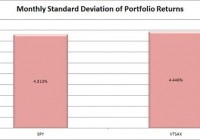
Summary VTSAX offers slightly more diversification than SPY, but it is also slightly more volatile. Because this is a total market fund, it has large weightings for the S&P 500 that create an extremely high correlation. VTSAX is one of the best mutual funds an investor can use for eligible employer-sponsored retirement accounts. Not all plans will offer this fund. VTSAX is the mutual fund version of VTI, which is one of the best total market ETFs available. Investors should be seeking to improve their risk-adjusted returns. Regardless of how they are handling the holdings, the goal is to maximize returns and minimize risks. When it comes to maximizing the returns while maintaining excellent diversification, Vanguard Total Stock Market Index Fund Admiral Shares (MUTF: VTSAX ) is an excellent option. My employer-sponsored retirement accounts are through different brokerages. Mine goes through Schwab, and my wife’s account is with Fidelity. Neither of us is eligible to use VTSAX, but I look for funds that replicate VTSAX, because it embodies most of the things I want in a fund. What does VTSAX do? VTSAX uses an indexing approach to track the performance of the CRSP U.S. Total Market Index. The first thing I’m looking for is diversification, so a total market index seems very attractive. Standard deviation of monthly returns (dividend adjusted, measured since January 2001) The standard deviation is not a problem. Because this is a total market index investors should expect it to be a little more volatile than the S&P 500, and that is exactly what we see. (click to enlarge) Basically, the increase in standard deviation is equivalent to having three percent leverage on a position in SPY. I love low-volatility investments, but when using a retirement account with dollar cost averaging automatically involved, a tiny bit of extra volatility is not problematic as long as the investment is very heavily diversified. Expense Ratio The Admiral shares have an expense ratio of .05%. This is excellent. Largest Holdings The diversification is very good in this mutual fund, and this is easily my favorite thing about the fund. The top 10 holdings appear to be somewhat concentrated, but when you consider that there are over 3800 different securities in the total portfolio, it doesn’t concern me. This is simply a great fund, in my opinion. (click to enlarge) Avoiding Fees There is one downside to Vanguard mutual funds. Vanguard charges a $20 annual account service fee for each mutual fund held in the account with a balance of less than $10,000. If you’re picking VTSAX for a new retirement account and want to save the $20, you can sign up on the Vanguard website for electronic delivery of statements. It appears to me that this fee is largely covering the cost of mailing the investments documents through the postal service. With its huge system in place, being able to send everything by one automated e-mail system saves the company money. I don’t see how it could hold its expense ratio down to .05% without having a way to compel investors to either take electronic delivery or pay for the physical copies. All around, this is a nicely designed system. Want VTSAX from Other Brokerages? You can also effectively invest in the fund using the Vanguard Total Stock Market ETF (NYSEARCA: VTI ), which holds the same assets and has the same expense ratio. Using VTI should automatically avoid the $20 fee and doesn’t require signing up the electronic delivery. The downside about using the ETF is that you would usually be stuck purchasing entire shares. While VTI, shares have been running $107-110; for dollar cost averaging, it is more convenient to be able to buy into a mutual fund with automatic deposits. Conclusion I like VTSAX enough that I’m holding a significant chunk of my portfolio in VTI, the ETF version. Lately, I had been adding to my cash positions rather than my equity positions, because I’m concerned about the market getting a little frothy. Over the last week, I dropped quite a bit of that into buying more broad market ETFs and mREITs when prices dipped. When it comes to long-term investing strategy for the employer-sponsored 401k accounts, my favorite technique is still to use dollar cost averaging on low-fee index funds and to max out (or come close) the contributions every year. If you really want to use VTSAX for your 401k, but are going through Fidelity, I would suggest looking into the Fidelity Spartan® Total Market Index Fund (MUTF: FSTVX ). That is the major mutual fund that I’m using for my wife’s 401k. It has slightly less holdings, with around 3,400 to 3,500 rather than 3,800, but is close enough for my purposes. The correlation between FSTVX and VTSAX is in excess of 99%. Disclosure: I am/we are long VTI, FSTVX. (More…) I wrote this article myself, and it expresses my own opinions. I am not receiving compensation for it (other than from Seeking Alpha). I have no business relationship with any company whose stock is mentioned in this article. Additional disclosure: Information in this article represents the opinion of the analyst. All statements are represented as opinions, rather than facts, and should not be construed as advice to buy or sell a security. Ratings of “outperform” and “underperform” reflect the analyst’s estimation of a divergence between the market value for a security and the price that would be appropriate given the potential for risks and returns relative to other securities. The analyst does not know your particular objectives for returns or constraints upon investing. All investors are encouraged to do their own research before making any investment decision. Information is regularly obtained from Yahoo Finance, Google Finance, and SEC Database. If Yahoo, Google, or the SEC database contained faulty or old information it could be incorporated into my analysis.

I Love This ETF: Vanguard Emerging Markets Government Bond Index ETF

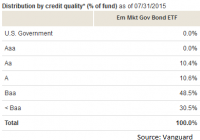
Summary VWOB offers investors exposure to the bond market for government debt in emerging markets. The portfolio has some substantial credit risk, but the yields and duration are solid. When the ETF is combined with other investments in a diversified portfolio, the low correlation is very attractive. I see this as a very solid holding for 3% to 5% of the portfolio. The Vanguard Emerging Markets Government Bond Index ETF (NASDAQ: VWOB ) is a very interesting bond fund. As I’ve been searching for appealing bond funds, I’ve found some of my favorites are from Vanguard. Given my distaste for high expense ratios, it should be no surprise that the Vanguard products would be appealing. After looking through the portfolio, I think the holdings are fairly reasonable for an investor wanting to regularly keep part of their portfolio in a bond fund. However, using only VWOB for bond exposure in a portfolio would be a very unwise decision. VWOB is designed to be an incredible supporting bond fund within a portfolio that already contains other bond investments. Quick Introduction The Vanguard Emerging Markets Government Bond Index ETF is showing a yield to maturity of 5.5% and an average duration of 5.7 years. Given the short duration on the portfolio and the very attractive yield on the bonds, it should be no surprise that the portfolio is carrying a substantial amount of credit risk. The emerging market governments don’t carry stellar credit ratings and there is definitely a material amount of risk in using the bond ETF as an investment. Credit Quality The following chart breaks down the credit quality of the issues being held in the portfolio. Clearly, a substantial portion of the holdings has fairly notable defects in their credit rating; however, the portfolio still offers investors diversification for their portfolio that can be very difficult to acquire in other ways. Emerging Markets and Other The holdings are primarily labeled as Emerging Markets; however, there is also a substantial allocation to a category labeled simply as “Other.” Investors should recognize that areas like Europe have zero allocation in the portfolio. See the chart below: The reason the allocations are so important is this exposure suggests that the portfolio’s correlation with other international bond funds might not be as high. That means even if the ETF is fairly volatile by itself, there could be some very substantial benefits to using it within a highly diversified portfolio that includes equity securities and bond funds allocated to different sectors, regions, and durations. Maturities I grabbed another chart to show the effective maturity on the securities: The maturity profile for the Vanguard Emerging Markets Government Bond Index ETF is fairly reasonable for an investor trying to get a solid diversification across the yield curve. There is a notable amount of exposure to the long-term bonds and the 5- to 10-year range. On the other hand, there is very little exposure to the shortest part of the yield curve. For optimal diversification, an investor may want to include other funds that target the shorter rate part of the yield curve. Risk Measuring returns and statistics since June of 2013 indicates that the portfolio is fairly stable for being invested in emerging markets. The annualized volatility of returns was 5.9%. For comparison, the annualized volatility on the S&P 500 for that period was 11.3% and the annualized volatility for the Vanguard FTSE Emerging Markets ETF (NYSEARCA: VWO ) was 18.3%. Correlation The fund really starts to shine when we consider the correlation in returns between VWOB and other bond funds that the investor might use for a larger portion of their exposure. Look at the correlation matrix below for a comparison: The Vanguard Total International Bond ETF (NASDAQ: BNDX ) is significantly less volatile than VWOB, but the correlation to BNDX is only 28%. BNDX, unlike VWOB, carries a heavy emphasis on Europe, which is entirely absent from the VWOB portfolio. In my opinion, these two ETFs held together in a portfolio are significantly better than either one alone due to the low correlation. Conclusion As far as bond ETFs go, the Vanguard Emerging Markets Government Bond Index ETF is a fairly solid option. An investor that failed to diversify into multiple funds would be taking more risk than necessary to realize returns, but when VWOB is used to enhance the diversification of the portfolio, it is an exceptional ETF. There are only two weaknesses in the entire ETF. One is that the expense ratio of .34% is higher than I want to pay and the other is that the ETF isn’t on the free-to-trade list for Schwab accounts. For investors that have free trading on VWOB through their brokerage and are willing to rebalance their portfolios to take advantage of the low correlations, it would seem that VWOB should be a natural choice for a small portion of the portfolio. My estimate is that the ETF would be a great holding at around 3% to 5% of the total portfolio value. Disclosure: I/we have no positions in any stocks mentioned, and no plans to initiate any positions within the next 72 hours. (More…) I wrote this article myself, and it expresses my own opinions. I am not receiving compensation for it (other than from Seeking Alpha). I have no business relationship with any company whose stock is mentioned in this article. Additional disclosure: Information in this article represents the opinion of the analyst. All statements are represented as opinions, rather than facts, and should not be construed as advice to buy or sell a security. Ratings of “outperform” and “underperform” reflect the analyst’s estimation of a divergence between the market value for a security and the price that would be appropriate given the potential for risks and returns relative to other securities. The analyst does not know your particular objectives for returns or constraints upon investing. All investors are encouraged to do their own research before making any investment decision. Information is regularly obtained from Yahoo Finance, Google Finance, and SEC Database. If Yahoo, Google, or the SEC database contained faulty or old information it could be incorporated into my analysis.