Tag Archives: apple
Long-Term Underperformance Of European Active Management Continues To Play Out In The Active Vs. Passive Debate
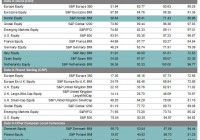
By Daniel Ung Every six months, S&P Dow Jones Indices publishes the S&P Indices Versus Active (SPIVA®) Europe Scorecard, which seeks to compare the performance of actively managed equity funds across different categories, and in the SPIVA Europe Year-End 2015 Scorecard , we expanded it to cover more individual countries and regions. Among the new additions are Italy, the Netherlands, Poland, Spain, Switzerland, and the Nordic region, with specific data for Denmark and Sweden. This is also the first year-end report in which 10-year data is published for Europe. To access the full report, please click here and for the video summarizing the major findings of the report, please click here . Global equity markets, as measured by the S&P Global 1200 , rose 10.4% over the past one-year period, as measured in euros, which could largely be attributed to the European Central Bank’s quantitative easing program. However, this apparently positive performance masked the heightened volatility that the equity markets experienced over the course of the year, which was a consequence of anemic Chinese growth, as well as the collapse in energy and commodity prices. Compared to the S&P Europe 350 , while 68.1% of active managers outperformed the benchmark over the short run, they underperformed the benchmark over longer time horizons. 63.8% of active managers underperformed the benchmark by the end of the three-year period, 80.6% in the five-year period, and 86.3% over the 10-year period. Exhibit 1 shows the new categories highlighted in blue. As for the global, emerging market, and U.S. equity categories, actively managed funds – in both euro and pound sterling – underperformed substantially in the short term (one-year category) and in the long run (10-year category). For instance, 61.2% of global equity funds underperformed their benchmark over a one-year period, and 89.08% of funds underperformed the benchmark over a 10-year period. Disclosure: © S&P Dow Jones Indices LLC 2015. Indexology® is a trademark of S&P Dow Jones Indices LLC (SPDJI). S&P® is a trademark of Standard & Poor’s Financial Services LLC and Dow Jones® is a trademark of Dow Jones Trademark Holdings LLC, and those marks have been licensed to S&P DJI. This material is reproduced with the prior written consent of S&P DJI. For more information on S&P DJI and to see our full disclaimer, visit www.spdji.com/terms-of-use .
PayPal: Solo Payments Vendor Going Back To The Future
New money never sleeps — or so February’s first-ever PayPal ( PYPL ) Super Bowl ad asked viewers to believe. The aggressive spot was an attempt to tell the public that PayPal is the future of money. It was also meant to suggest to investors that good things lie ahead now that the company is once again on its own after being spun off from 13-year parent eBay ( EBAY ). PayPal, however, finds itself surrounded by some big companies with payments technologies that could disrupt its lead. Apple ( AAPL ), Square ( SQ ) and Alphabet ’s ( GOOGL ) Google are among the companies building digital wallet technologies that compete in one way or another with PayPal. “The new campaign is the very positioning we did pre- IPO (in 2002),” Eric Jackson, CEO of business technology company CapLinked, told IBD. Jackson was PayPal’s first director of marketing and wrote a memoir about his time at the company. Companies in the payments sector often do business with one another. Many of the merchants signed up with Apple Pay have their payments processed by PayPal subsidiary Braintree, for example. “As the kids say, there are ‘frenemies’ in payments,” Wedbush analyst Gil Luria told IBD. Still, PayPal stock was down 4.5% in morning trading Friday on news that both Apple and Starbucks ( SBUX ) are expanding the reach of their mobile payment systems, aiming to get a bigger edge on rivals such as PayPal and Google. Apple Pay will be included in Apple’s Safari browser in time for Q4 holiday shopping, reported Re/code . The payment system will continue to work with Apple’s fingerprint ID technology. At least one analyst didn’t see a big impact on PayPal, however. “While this (Apple Pay-Safari) could represent some near-term headline risk for PayPal, we believe the competitive impact introduced by Apple Pay in-browser will be limited due to potential consumer and merchant adoption hurdles,” Jefferies analyst Jason Kupferberg said in a research report. “PayPal’s own expedited checkout process, One Touch, is already in use by more than 250 of the top 500 internet retailers” Meanwhile, in many ways, Braintree’s peer-to-peer payments app Venmo is in a position similar to PayPal in its own very early days. Instead of focusing only on its first market, person-to-person payments, Venmo — like PayPal, which started out as a free service before it built enough heft to charge merchants — is turning to merchant transactions to turn a profit. Targeting merchant transaction fees “is not that much of a leap,” Luria said. “That’s what Elon Musk and Peter Thiel (PayPal co-founders along with Max Levchin) did 15 years ago. It’s not unprecedented to take the Venmo users and turn them into paying customers.” EBay Spinoff Leading To Greater Success? That PayPal would be able to unlock business opportunities previously inaccessible to it with eBay as its owner — other e-commerce rivals didn’t particularly care to give business to a competitor such as eBay — was a notable selling point when the split-up was announced in 2015 . PayPal executives say that the company has advanced in several ways that it couldn’t while it was a part of eBay. The marketing campaign that the Super Bowl ad was designed to support might not have been a priority under eBay, says Juan Benitez, general manager and CTO at Braintree. Braintree powers payments behind fast-growing private companies such as ride hailing app Uber and alternative accommodations provider Airbnb. Analyst Luria says that most of Braintree’s profit comes from those two firms. Uber and Airbnb were Braintree’s top clients when it was part of eBay as well, but the separation has led to at least one marquee client: the fast-growing e-tail startup Jet.com. Its CEO, Marc Lore, aims to compete with Amazon.com by, like Amazon, offering free two-day shipping. EBay is another rival. “Jet is something that maybe would have had a question or two asked before before the split,” Benitez told IBD. In addition, he says that Braintree is expanding its pilot merchant program with China e-commerce leader Alibaba ( BABA ). ITG Investment Research analyst Steve Weinstein told IBD that PayPal’s post-eBay success has much to do with the company bringing on new merchants while part of eBay, “and that moment has continued.” He says that it’s “hard to tell” whether things have changed since the split, since it’s so recent. But according to Wedbush’s Luria, the truth about PayPal’s real post-eBay value is related to the spinoff’s financials. “When the carving out was happening, when the separation was negotiated, the eBay board allocated a lot of the revenue to PayPal and expenses to eBay,” he said. The reasoning, he says, is that PayPal was getting twice the multiple (price-to-earnings ratio), so every dollar of profit they put into PayPal was going to get twice as much market value. Luria said that beyond the financials, the split produced a “freeing effect” that has allowed the deals with Alibaba and Jet.com. “It’s now an easier decision to incorporate PayPal into merchant acceptance,” he said. The split, says Luria, gave PayPal the “power of focus.” PayPal no longer needs approval from eBay executives on important decisions. The Future Vs. Apple Pay, Android Pay No doubt competition with tech titans in payments will remain fierce, but PayPal is in a strong position. With its base of 13 million active merchants, the company can achieve powerful network effects from that critical mass, which makes it a considerable challenge to unseat PayPal as payments king. CEO Jeff Bezos’ mighty e-commerce firm Amazon.com has been competing with PayPal for 10 years via its own payments platform, with negligible results. “Now the subtlety is that Apple Pay and Android Pay have an advantage,” Luria said. Because the companies integrate their payments into iOS and Android, respectively, the payment experience is seamless — which is critical for digital wallets. PayPal executives say that Apple Pay and Android Pay are actually good for their company, since those services often use PayPal’s Braintree to process transactions. Others, however, don’t see PayPal walking arm in arm with Apple or Google. “Embracing the advent of Android Pay and Apple Pay sounds a little hollow,” former PayPal exec Jackson said. “It sounds more like corporate spin than reality.” Both Apple and Google are able to position their payments systems as the default option on their own mobile devices and services, which could make things rougher for PayPal. But even if Apple and Google do it, Weinstein says, that move by itself would not be enough to unseat San Jose, Calif.-based PayPal from the payments lead. “PayPal has a lot of other products,” he said. Analysts and industry watchers aren’t sure how PayPal plans to tackle its challenges. Innovation is one strategy that’s worked well in the past, such as with One Touch , the company’s tech tool to reduce checkout time. Acquisitions have been helpful, too — for example, the $800 million Braintree purchase, which included Venmo. Regardless of how PayPal proceeds, how it separates itself from its competition will be key, says Jackson. As the Super Bowl ad shows, PayPal has its game face on.