Tag Archives: alternative

TransCanada Corporation: Long-Term Value From Growth Projects And MLP Drop-Downs

TransCanada has $45 billion of commercially secured projects and $50 billion of projects under evaluation. Drop-downs to TCP represent efficient capital plan. Energy East stakeholder agreement could serve as catalyst. TransCanada Corporation (NYSE: TRP ) owns several key natural gas pipelines, power generation, and natural gas storage assets in North America. The company owns and operates about 42,000 miles of natural gas pipelines and 406 Bcf of storage capacity. In addition, TRP has 11,800 MW of power generation operations in place and under development across hydro, gas, nuclear, and coal. We believe that TRP’s organic developments, aside from Keystone XL, multi-billion portfolio of commercially secured projects, and ability to deploy capital into attractive new projects provide for about 15% upside from current prices. Due to TRP’s large scale and expansive network, the firm has access to some of the most attractive growth projects, which we think are not accounted for in the stock’s current valuation. Currently, TransCanada has $45 billion of commercially secured projects and $50 billion of projects under evaluation. In particular, we think that the new long-term contracts for ANR and higher capacity prices for Ravenswood signal positive developments that would benefit long-term earnings. The ANR Pipeline is one of the largest natural gas pipelines in North America, connecting Wisconsin, Michigan, Illinois, and Ohio with supply in Texas, Oklahoma, and the Gulf of Mexico. We would note that the new contracts demonstrate ANR’s quality even during times of low commodity prices. On the power generation side, Ravenswood Generating Station is a 2,480 MW power plant located in Queens, NY that has the capability to serve 21% of New York City’s peak load. In addition, the plant possesses advanced technology that can be used to reduce nitrogen oxide emissions. We believe that drawn-out Keystone XL process poses headlines risk that is currently depressing TRP’s valuation. On Monday, the Department of State restarted the national interest review on the Keystone XL projects. Despite these efforts, the White House is expected to veto the project and the House and Senate are not expected to reach the two-thirds super-majority needed to override the veto. We feel that current sentiments pose a buying opportunity for longer term investors given the company’s other prospects. We also think stakeholder agreements for Energy East would serve as a catalyst for TRP. In the most recent quarter, TransCanada filed for US government approval for the construction and operation of the Energy East Pipeline and terminal facilities with the National Energy Board. The firm is proposing a marine terminal near Cacouna, Quebec, which could impact the beluga whale population. We believe that a successful agreement regarding the impact on wildlife will likely be reached by quarter-end. In addition, we are pleased that the company completed a successful binding open season for the $600 million Upland Pipeline. The proposed pipeline would begin near the northwestern North Dakota oil hub of Williston and go north into Canada about 200 miles. It would transport up to 300,000 Bpd of oil, connecting with other pipelines including Energy East. We would also highlight TransCanada management’s statement that the decline in commodity prices have not had any impact on TRP’s cash flows. In terms of valuation, we believe that the highlighted growth projects combined with the capacity for over $1 billion in annual drop-downs to TC PipeLines, L.P. (NYSE: TCP ), should allow TRP to be re-rated to a 20x forward multiple, more in-lined with peers, Enbridge (NYSE: ENB ) and Fortis (OTCPK: FRTSF ). In the meantime, investors are paid a 3.6% dividend to wait for the projects to be developed. Disclosure: The author has no positions in any stocks mentioned, and no plans to initiate any positions within the next 72 hours. (More…) The author wrote this article themselves, and it expresses their own opinions. The author is not receiving compensation for it (other than from Seeking Alpha). The author has no business relationship with any company whose stock is mentioned in this article.
Wintergreen Takes An Evergreen Approach To Stock Selection

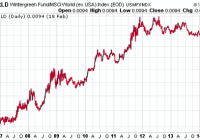
Summary WGRNX is a go anywhere fund with a current focus on Asia’s emerging middle class. Manager David Winters looks for companies showing a trifecta of strong management, improving situation and undervalued shares. The biggest drawback to the fund is the 1.85% expense ratio. Established in 2005, the two-star Morningstar rated Wintergreen Investor Fund (MUTF: WGRNX ) is a world stock category fund that seeks capital appreciation. The fund invests in stocks or convertible securities that manager David Winters believes are available at a discount to their intrinsic value. The fund invests in domestic and foreign issues of any size, including those from emerging markets. Investment Strategy Investment manager David Winters identifies securities through extensive analysis that includes book value, cash flow and earnings multiples. The goal is to select stocks that constitute what the fund manager calls a “trifecta.” These are stocks with good value issued by companies with shareholder-oriented management that are demonstrating improved business operations. The portfolio typically holds around 30 individual positions for the long-term while attempting to minimize turnover. This strategy often leads to owning shares in cash-rich companies that pay dividends or buy back shares. Shares are sold when valuation targets are met. The fund typically maintains 10 percent cash in order to capitalize on opportunities as they occur. WGRNX may invest in arbitrage opportunities that result from mergers, acquisitions, spin offs and consolidations as well as tender offers and liquidations. In addition to arbitrage opportunities, the fund may also take an activist role if the team anticipates that this position will benefit the investment. To minimize risk, the manager may engage in hedging strategies, such as owning gold and foreign currency swaps, purchasing put or call options and shorting stocks. Portfolio Composition The $1.5 billion fund held 14.91 percent of assets in cash as well as 33.01 percent in domestic stocks and 51.79 percent in foreign issues at the end of 2014. Mr. Winters believes that U.S. stocks are overvalued. As a result, the fund’s foreign stock and cash positions are higher relative to the category average and the domestic stock position is lower. The foreign issues have a slight tilt toward Developed Europe. The Asian share portion of the portfolio includes emerging and developed markets minus Japan. The portfolio has a market cap distribution on 55.95 percent giant, 34.49 percent large and 4.87 mid-cap stocks as well as a total 4.72 percent stake in small and micro-cap stocks. The fund is overweight consumer cyclical and consumer defensive stocks and underweight financials and healthcare. It does not hold any shares in the telecom or utility sectors. The fund’s aggressive and concentrated portfolio is a reflection of Mr. Winter’s belief that few companies meet Wintergreen’s stringent investment criteria. Only one category fund has a lower average debt/capital ratio and a higher average return on equity. The portfolio has a P/E ratio of 17.21, a price-to-book ratio of 2.70 and a dividend yield of 2.02 percent. Historical Performance and Risk WGRNX has beaten the MSCI World ex-USA Index since inception. Morningstar gives the fund a downside capture ratio of 57.22 percent over the past 5 years, and this performance reflects the fund’s resilience during down markets due to its preference for low-debt companies that have high relative cash positions. WGRNX has a low return rating from Morningstar. It has delivered 1-, 3- and 5-year total returns of 2.37 percent, 6.40 percent and 9.23 percent respectively. This compares to the index averages of 0.77 percent, 6.76 percent and 6.29 percent for the same periods. WGRNX has a below average risk rating from Morningstar as well as a three-year beta and standard deviation of 1.70 and 10.44. The category beta and standard deviation for the same period are 0.76 and 10.85. (click to enlarge) Fees and Expenses With a 1.85 percent total expense ratio, WGRNX is an expensive fund. This expense ratio is higher than 95 percent of funds in the no-load world stock category. The fund also has a 60-day redemption fee of 2 percent and a 12b-1 fee of 0.25 percent. Initial minimum investments are $10,000 for taxable accounts, $3,000 for an IRA and $2,000 for a Coverdell ESA. Fund Outlook WGRNX has a high quality portfolio and strong cash position that makes it well prepared for the next market correction. Winters also keeps turnover low at 12 percent of assets, but this buy-and-hold approach has cost it in the short-term. The fund remains focused on Asia with a concentration on consumer-oriented shares. Top 10 holdings Wynn Macau and Swiss timepiece manufacturer Swatch are plays on Asia’s emerging middle class, and the crackdown on corruption in China, as well as the ongoing economic slowdown there, weighed on results in 2014 as luxury sales declined. Another top 10 holding, Canadian Natural Resources (NYSE: CNQ ), has been battered by the plunge in oil prices. WGRNX should continue to be less volatile than other funds in the world stock fund category. Wintergreen’s continued focus on a sound investment strategy relative to strong business franchises with little debt and Mr. Winters’ conservative stock-picking acumen should enable WGRNX to sustain its strong relative performance in the long-term. A positive not captured in financial data is David Winters’ shareholder advocacy. He’s been a vocal critic of Coca-Cola (NYSE: KO ) management (see his recent interview on Fox Business ) over issues such as compensation and poor operating results. Investors in WGRNX are getting a manager who looks out for their interests all the way to the boardroom. The big stumbling block is the fees, which are too high at 1.85 percent of assets. Investors are starting each year nearly 2 percent behind the category and index, and performance hasn’t been consistently strong enough to justify those fees yet. Unfortunately, there aren’t similar portfolios out there. A fund such as Matthews Asian Growth and Income Fund (MUTF: MACSX ) offers exposure to Asia’s rising middle class, but it doesn’t offer the same exposure via blue chip multinationals offered by WGRNX. Some ETFs such as the iShares MSCI Emerging Markets Consumer Discretionary Sector Index ETF (NASDAQ: EMDI ) also tap into similar themes, but without an Asian focus. The Guggenheim China Small Cap ETF (NYSEARCA: HAO ) offers exposure to Chinese consumers, but only Chinese consumers. Investors can replicate some of the exposure in WGRNX with ETFs such as the iShares Global Consumer Staples ETF (NYSEARCA: KXI ) and the Market Vectors Gaming ETF (NYSEARCA: BJK ). Disclosure: The author has no positions in any stocks mentioned, and no plans to initiate any positions within the next 72 hours. (More…) The author wrote this article themselves, and it expresses their own opinions. The author is not receiving compensation for it (other than from Seeking Alpha). The author has no business relationship with any company whose stock is mentioned in this article.

Do These 9 Stocks Represent Your Portfolio?

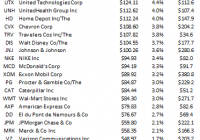
The oft referenced Dow closed at its all-time high on Friday. The Dow, which uses a price weighting methodology, might not be representative of your portfolio. Broadly diversified, capitalization-weighted indices should correlate more with a highly diversified portfolio. The Dow Jones Industrial Average (NYSEARCA: DIA ) closed at its all-time high on Friday of 18,144. This new record will be a talking point on the nightly news, and around the dinner table this weekend. My sister-in-law, knowing that I work in investment management, brought Dow 18,000 up to me in the last week. While it is very nice of her to engage me in conversation about one of my favorite topics – the financial markets – talk of the Dow to me is like nails on a chalkboard. Why? The Dow got its start in the late 1800s as a means of synthesizing the movements of industrial stocks into a single number. While its price-weighting and narrow coverage universe of thirty stocks are now anachronistic in the days of computerized calculations and alternative weightings, the Dow has retained its status as a stock market bellwether. To understand my aversion to references about the Dow, I have tabled the current thirty constituents with their market price, market capitalization, and index weight below: Source: Dow Jones, Bloomberg You will notice above that the index weights are based on the stock price. A company worth $100B could have a stock price worth $1 and 100 billion shares outstanding, or have a stock price worth $1B and one hundred shares outstanding. A company with a stock price of $1B would dominate a price-weighted index. Exxon Mobil (NYSE: XOM ) has the largest market capitalization of any of the index constituents, but has only the fifteenth largest weighting amongst the constituents. General Electric (NYSE: GE ) has the smallest weighting in the Dow despite having the fifth largest capitalization. Exxon is the second largest constituent amongst the five hundred companies that make up the S&P 500. General Electric is the seventh largest constituent in that index. In fact, the nine companies tabled below make up half of the weight of the Dow. Source: Dow Jones, Bloomberg In the capitalization-weighted S&P 500, these same nine companies make up just over six percent of the index. Source: Standard and Poor’s, Bloomberg Half of the daily movement in the Dow is going to be driven by just these nine companies. Those same companies are going to account for just six percent of the variability of the S&P 500 (NYSEARCA: SPY ). Despite its analytical shortcomings, the Dow is still an oft referenced benchmark. Unless your portfolio is heavily weighted to the largest Dow components and their relatively high share prices, it is probably a bad representation of your domestic equity exposure. I will have to send this article to my sister-in-law. Disclaimer: My articles may contain statements and projections that are forward-looking in nature, and therefore inherently subject to numerous risks, uncertainties and assumptions. While my articles focus on generating long-term risk-adjusted returns, investment decisions necessarily involve the risk of loss of principal. Individual investor circumstances vary significantly, and information gleaned from my articles should be applied to your own unique investment situation, objectives, risk tolerance, and investment horizon. Disclosure: The author is long SPY. (More…) The author wrote this article themselves, and it expresses their own opinions. The author is not receiving compensation for it (other than from Seeking Alpha). The author has no business relationship with any company whose stock is mentioned in this article.