Tag Archives: alt-investing

Dominion Resources: Strong Business Fundamentals
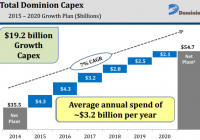
Summary Company’s strong business fundamentals will support future performance. Robust planned growth investments for next five years will allow D to expand and optimize its generational fleet. Planned investments will support company’s future EPS growth of 6%-7% and dividend growth of 8%. Dominion Resources (NYSE: D ) has a positive fundamental outlook and I think the company will enjoy above industry average earnings and dividend growth in the next five years, which makes it an attractive prospect for income-seeking investors. Going forward, the company’s growth will be mainly driven by the successful execution of its planned Cove Point LNG export facility. Also, the creation of MLP Dominion Midstream Partnership will add value for the company’s shareholders wealth through the ownership of General Partnership shares. Furthermore, I think the monetization of the merchant solar portfolio to YieldCos will also positively affect the stock price. Given the company’s strong growth prospects, I think the stock should trade at premium valuations in comparison to its competitors. Also, a pullback in the stock presents a good entry point for long-term investors to buy the stock; the stock price is down almost 13.5% year-to-date. Positive Fundamental Outlook The company has a strong business fundamental outlook, which is supported by its growth projects, including the construction of combined-cycle natural gas plants and expansion of midstream business. The company is expected to grow its earnings in a range of 6%-7% in the long run, which will be mainly driven by its robust capital spending of $19 billion from 2015-2020. The chart below reflects the company’s planned capital expenditure profile. (click to enlarge) Source: Company’s Report The company is aiming to monetize its merchant solar portfolio to YieldCos, which will positively affect shareholder wealth and will optimize cash flows from its contracted solar assets. The company’s management has stated that several YieldCos have shown an interest in its contracted solar portfolio. The company is expected to form a partnership that will allow Dominion to contribute a partial stake in solar assets to JV in exchange for cash proceeds, followed by a total sale after tax restrictions expire. Moreover, the company plans to grow its contracted solar assets from 384MW to 450MW by the end of 2015 and to 625MW by the end of 2016. The company is expected to provide an update on the merchant solar portfolio monetization in late summer or fall 2015. Given the highly competitive current merger and acquisition environment for renewables in the industry, I think there will be no shortage of interest in the company’s solar assets. The monetization of the assets will help to alleviate growth investment needs going forward, and allow it to achieve the long-term EPS growth target. Furthermore, the company announced another 11,000 acreage farmout agreement in Marcellus, extending it for two years, which will be accretive to EPS. The company is negotiating with producers to expand its farmout business into Utica. Dominion has already completed 125,000 acres, which will contribute almost $270 million of pre-tax earnings over the next five years, and the company expects an additional 180,000 acres of Utica mineral rights through 2020. Given its efforts to expand its farmout business, Dominion expects its farmout business to generate EBIT of $450-$500 million from 2015-2020, which will fuel its consolidated earnings growth in the coming years. Separately, the construction of the company’s Cove Point and ACP (Atlantic Coast Pipeline) facilities stays on track. The construction of Cove Point stays in the planned timeframe, with an expected in service date of late 2017; engineering at Cove Point Facility is almost 80% complete. Also, the construction of the company’s ACP facility is progressing nicely and is expected to be in service by November 2018. The completion of both facilities will allow the company to expand its operations, which will in return fuel earnings growth. In future years, given the healthy cash flow profile of IDR payments under its General Partnership structure with its MLP and low maintenance capital expenditure requirement for the assets, I think the company will direct cash flows not only towards growth investments, but will also use cash to grow its dividends and undertake share repurchases, which will bode well for its stock price. The company’s target dividend growth rate of 8% from 2015-2020 will be mainly driven by its growth initiatives. Also, I think the company’s future cash flows will stay strong and support its dividend growth. Dominion’s healthy dividend yield of 3.9% , along with robust expected dividend growth rate of 8%, makes it a good investment option for income-hunting investors. The stock is currently trading at a forward P/E of 17.5x , higher than the sector average forward P/E of 15.75x , which I believe is justified, given the company’s strong growth prospects. Given the company’s robust growth outlook, I believe the stock warrants premium valuation. Summation The company’s business fundamentals stay strong, which will support its future performance. The company’s robust planned growth investments for the next five years will allow it to expand and optimize its generational fleet. Also, the planned investments will support the company’s future EPS growth of 6%-7% and dividend growth of 8%. Also, once completed and operational, Cove Point and ACP facilities will increase the company’s revenues and earnings stability, which will improve the company’s risk profile. And given the company’s robust growth outlook for the next five years, I believe the stock’s premium valuation is justified. Disclosure: I/we have no positions in any stocks mentioned, and no plans to initiate any positions within the next 72 hours. (More…) I wrote this article myself, and it expresses my own opinions. I am not receiving compensation for it (other than from Seeking Alpha). I have no business relationship with any company whose stock is mentioned in this article.

ALPS Adds New Twist To Equal-Weighted ETF Products

By DailyAlts Staff ALPS Holdings has been a leader in providing innovative investment products and customized solutions since its founding in 1985. On July 1, the firm added two new products to its repertoire: The ALPS Sector Leaders ETF (NYSEARCA: SLDR ) and the ALPS Sector Low Volatility ETF (NYSEARCA: SLOW ), both of which are equal-sector weighted, to avoid the loss of diversification benefits associated with over- or under-weighting particular sectors. Equal-Weighted Investing One of the major knocks against market capitalization-weighted indexes is that they inherently overweight overvalued stocks, and underweight undervalued stocks. In addition, they have a significant bias toward the largest companies in their respective universe. For instance, if the S&P 500 Index were equal-weighted, Apple would account for just 1/500 of the index’s total, as opposed to the roughly 4% it constitutes on a cap-weighted basis. Smart beta products provide an alternative approach to weighting investments. Most smart beta strategies use “factors” such as value, momentum, quality or low volatility to determine their investment weights, but a simpler approach is to weight all investments within an index or fund equally. Thus, equal weighting ends up avoiding the large-cap, or even mega-cap bias that many capitalization weighted indices have. The ALPS ETF Approach The new ALPS ETFs are part of the ALPS Factor Series. They’re “smart beta” products in that they select investments according to fundamental factors, including growth, quality, and low volatility. But investments held by the ETFs are weighted so that each business sector has equal representation – this mitigates the risk of being overly concentrated in an overheated sector, or being underweight an undervalued sector. “Rather than investing in pure market-cap indexes, which are usually tilted towards specific sectors, our equal sector weighting methodology may provide a better foundation for building diversified portfolios,” said portfolio manager Michael Akins, in a recent statement. “As a result, investors and advisors may achieve better risk adjusted returns.” Both ETFs will track S-Network indexes, which are designed to provide equal-weight exposure of selected investments across sectors and across securities. Both funds exclude REITs, and when evaluating sectors, combine the telecommunications sector with the information technology sector to form a single sector of the two. The ALPS Sector Leaders ETF will track the S-Network Sector Leaders Index – this index picks the 5 stocks from each of nine GICS sectors which, per the prospectus, demonstrate the best growth potential based on key characteristics associated with growth and quality, then equal weights all 45 stocks in the portfolio. The ALPS Sector Low Volatility ETF will track the S-Network Sector Low Volatility Index – this index picks the 5 stocks from each of nine GICS sectors that that have the lowest trailing twelve-month volatility as of the last trading day of November, then equal weights all 45 stocks in the portfolio. “It’s become clear that there’s an important place for the equal sector weighting strategies in most investment portfolios, particularly in volatile markets,” said Mr. Akins, who is also a Senior VP at ALPS Advisors and its Director of ETFs. “We’re excited at the prospect of applying the approach toward these historically proven factors and markets.” The management fee and expense ratio for each fund is 0.40%. For more information, visit alpsfunds.com .

Long The S&P 500 But Feeling A Little Uneasy? PUTX May Be Your Answer

Summary Investors in the broad U.S. equity market feeling uneasy or anticipating a correction may buy put options on the S&P 500 for protection. If the timing is right this “insurance” can be valuable. A better way to provide downside protection while also providing upside potential returns is by selling cash collateralized puts on the S&P 500. Investors in the broad U.S. equity market feeling uneasy or anticipating a correction may buy put options on the S&P 500 for protection. If the timing is right this “insurance” can be valuable. However, more often than not, we see the cost of this insurance, buying these puts, reduces returns. A better way to provide downside protection while also providing upside potential returns is by selling cash collateralized puts on the S&P 500. This is exactly the strategy of the recently launched ALPS Enhanced Put Write Strategy ETF (NYSEMKT: PUTX ). PUTX was spearheaded and developed by Rich Investment Solutions, which is a sub-adviser to the new fund. Kevin Rich, founder and CEO of Rich Investment Solutions, came from Deutsche Bank where he created and launched the commodity and currency-based ETFs: the PowerShares DB Commodity Index Tracking Fund (NYSEARCA: DBC ), the PowerShares DB Agriculture Fund (NYSEARCA: DBA ), the PowerShares DB U.S. Dollar Index Bullish Fund (NYSEARCA: UUP ), and the PowerShares DB U.S. Dollar Index Bearish Fund (NYSEARCA: UDN ), among others. In 2013 ALPS and Rich launched the first put writing ETF called the ALPS U.S. Equity High Volatility Put Write Index Fund (NYSEARCA: HVPW ). For many years CBOE has published two benchmark indices on at-the-money monthly put and call writing: the CBOE S&P 500 Put Write Index (PUT), and the CBOE S&P 500 BuyWrite Index (BXM). There have been ETFs in the market tracking BXM for some time but not on PUT. As PUT has shown historically superior returns compared to BXM, there is recent renewed interest and new products coming to market offering investors access via ETFs. With that in mind, we asked Kevin Rich a few questions about their new fund they just launched with ALPS. Dave Fry: Good to talk with you again Rich, can you please tell us a about PUTX? Kevin Rich: Thanks. PUTX is the first broad based put write strategy ETF. PUTX will sell one month at-the-money put options on the S&P 500 every month, or twelve times a year. It’s designed for investors looking for a defensive investment in the in the S&P 500. Selling monthly, at-the-money puts on the S&P 500 has historically generated 18% – 21% option premium per year. While this premium represents close to the maximum upside return of the PUTX strategy, it represents the possible downside protection over the course of a year in a declining market. Dave Fry: Interesting, so is it tracking the CBOE PUT index, which hypothetically sells puts monthly as I understand? Kevin Rich: No, PUTX is not a passive index tracking fund, so it will not replicate the PUT index or strategy. PUTX will look to sell options on a monthly basis not only on the SPX am settled options that the PUT index uses, but PUTX but will also be able to sell options on the SPX pm settled options or on the American style options on the S&P 500® Trust ETF (NYSEARCA: SPY ). PUTX should be able to pick up additional premium over the benchmark index by expanding the underlying options it uses. Dave Fry: Any other differences between PUTX and the CBOE PUT index? Kevin Rich: Yes, PUTX will not simply go long short term U.S. T-bill like the PUT index; rather PUTX will its cash in short duration investment grade fixed income securities. Further, PUTX will have the ability to bring in additional premium intra-month when we see there is an opportunity to roll some strikes up without taking material additional risk for the fund. Dave Fry: Not to harp on the comparison, but do you expect PUTX to track the CBOE PUT index closely? Kevin Rich: Yes, our expectation is we will have a high correlation and beta to the PUT index, but with the strategy differences described earlier we believe PUTX should be able to generate additional returns over the benchmark. Dave Fry: I would expect to have seen the BXM and PUT indices have identical returns over time but PUT has outperformed. Why do you feel selling puts offers and advantage over selling calls? Theoretically they should be the same, but there are 2 main reasons why PUT has outperformed. First, PUT sells ATM or slightly OTM of the money puts, while BXM sells ATM or slightly OTM calls. OTM puts not only provide some additional downside protection to a declining market (OTM calls by definition do not), they also tend to be priced more richly than OTM calls providing more premium. Second, PUT collateralizes its short put position by investing in TBills, while BXM covers its short call positions by investing in the S&P 500. As a result, PUT performance benefits from interest income while BXM only benefits from dividend income. Dave Fry: I know you have just launched, but who do you expect to use PUTX and where might it fit in a portfolio? Kevin Rich: Initially we would expect RIAs, funds and institutions familiar with the mechanics and benefits of broad based put writing strategies to adopt PUTX. Really any holder of the S&P 500 should consider diversifying into PUTX because of its defensive potential. Others may hold PUTX in their liquid alternative bucket. Advisers in the larger wire house firms will recognize the potential for PUTX to diversify and add returns over their existing buy write investments, so we expect pick up form these firms; some initially, and others over time. Dave Fry is founder and publisher of ETF Digest and has been covering U.S. and global ETFs since 2001. ETF Digest was named one of the most informative ETF websites in the 10th Annual Global ETF Awards. Disclosure: I/we have no positions in any stocks mentioned, and no plans to initiate any positions within the next 72 hours. (More…) I wrote this article myself, and it expresses my own opinions. I am not receiving compensation for it. I have no business relationship with any company whose stock is mentioned in this article.