Tag Archives: utility

Unitil’s (UTL) CEO Bob Schoenberger on Q4 2014 Results – Earnings Call Transcript

Unitil Corporation (NYSE: UTL ) Q4 2014 Earnings Conference Call January 28, 2015 14:00 ET Executives David Chong – Director, Finance and Assistance Treasurer Bob Schoenberger – Chairman, President and Chief Executive Officer Mark Collin – Senior Vice President, Chief Financial Officer and Treasurer Tom Meissner – Senior Vice President and Chief Operating Officer Larry Brock – Chief Accounting Officer and Controller Analysts Shelby Tucker – RBC Capital Markets Dave Parker – Robert W. Baird & Company Operator Good day, ladies and gentlemen and welcome to the Fourth Quarter 2014 Unitil Earnings Conference Call. My name is Tony and I will be your moderator for today. At this time, all participants are in listen-only mode. Later, we will conduct a question-and-answer session. [Operator Instructions] As a reminder, this conference is being recorded for replay purposes. I would now like to turn the conference over to Mr. David Chong, Director of Finance. Please proceed. David Chong Good afternoon and thank you for joining us to discuss Unitil Corporation’s fourth quarter 2014 financial results. With me today are Bob Schoenberger, Chairman, President and Chief Executive Officer; Mark Collin, Senior Vice President, Chief Financial Officer and Treasurer; Tom Meissner, Senior Vice President and Chief Operating Officer; and Larry Brock, Chief Accounting Officer and Controller. We will discuss financial and other information about our fourth quarter on this call. As we mentioned in the press release announcing the call, we have posted that information, including a presentation to the Investor section of our website at www.unitil.com. We will refer to that information during this call. Before we start, please note that comments made on this conference call may contain statements that are commonly referred to as forward-looking statements, which are made pursuant to the Safe Harbor provisions of the Private Securities Litigation Reform Act of 1995. These forward-looking statements include statements regarding the company’s financial condition, results of operations, capital expenditures and other expenses, regulatory environment and strategy, market opportunities and other plans and objectives. In some cases, forward-looking statements can be identified by terminology such as may, will, should, estimate, expect or believe, the negative of such terms or other comparable terminology. These forward-looking statements are neither promises nor guarantees, but involve risks and uncertainties, and the company’s actual results could differ materially. Those risks and uncertainties include those listed or referred to on Slide 1 of the presentation and those detailed in the company’s filings with the Securities and Exchange Commission, including the company’s Form 10-K for the year ended December 31, 2014. Forward-looking statements speak only as of the date they are made. The company undertakes no obligation to update any forward-looking statements. With that said, I will now turn the call over to Bob. Bob Schoenberger Thanks, David. I would also like to thank everyone for joining us today. I will give a summary of our year end financial performance. If you turn to Slide 4 of our presentation, today we announced 2014 net income of $24.7 million or $1.79 per share, an increase of $3.1 million or $0.22 per share compared to 2013. This 14% increase in earnings in 2014 over prior year was driven by higher natural gas and electric sales margins partially offset by higher net operating expenses. Turning to Slide 5, the graph shows that our financial results have increased sharply over the past few years. The continued growth of our natural gas business along with recently completed gas and electric rate cases helped the company to achieve strong financial results in 2014. As we look forward to 2015, the continued expansion of our natural gas utility business and investments in the company’s gas and electric distribution infrastructure will provide a strong foundation for sustained future growth. On Slide 6, we are benefiting from improved economic activity underlying our service areas. Currently, average unemployment is just above 5% in the three states served by Unitil and signs of an improving economy are everywhere. We estimate that there is approximately $0.5 billion of new commercial construction underway in two of the largest cities we serve, Portland, Maine and Portsmouth, New Hampshire. We are benefiting from this economic growth and our focus on converting more and more of our customers to natural gas. Since 2010, our weather normalized gas unit sales have grown annually at 4.7%. And in 2014, our gas customer count grew 2.6%. Slide 7 highlights our historic annual return on equity. Strong customer growth paired with successful base rate cases continues to drive the company’s return on equity. In 2014, we earned a 9.2% return on equity, which is in line with the ROEs allowed by our regulators. As Mark will discuss later, we have long-term capital cost trackers in place to recover a significant portion of current and future capital spending, which we expect will help to maintain the level of earnings across our subsidiaries. Finally, on Slide 8, as you may have already seen, we recently announced an increase to our quarterly dividend from $0.345 to $0.35 a share. This equates to an annual increase in the dividend of $0.02 per share. We recognized the importance of the dividend to our shareholders. This increase reflects the confidence we have in our business. Going forward, we will continue to assess our dividend level to provide this continuing source of value to our shareholders. So, I will turn the call over to Tom Meissner, our Chief Operating Officer, to discuss details of our capital budget for 2015 and other operational highlights. Tom Meissner Thanks, Bob and good afternoon. As Bob mentioned, we have seen significant growth in our gas distribution business both in terms of the number of customers served in sales growth as well as the increased level of investment we are making to modernize and expand the reach of our system. Over the next few slides, I will go through our 2015 capital budget highlighting our growth spending, infrastructure replacement programs and our electric substation construction plans. If you turn to Slide 9, we have provided a more detailed look at our 2015 capital budget and our historical growth in rate base. We plan to spend about $58 million on gas projects, $31 million on electric projects, and $9 million on business systems and supporting technology for a total of $98 million of spending in 2015. Spending on new customer additions will be a significant component of this budget. In 2015, we plan to spend about $35 million or 36% of our total capital budget on expansion of our gas and electric distribution systems to achieve new customer growth. Of this, $21 million will be spent on expansion of our natural gas delivery system targeting new customers and increased sales, while on the electric side we plan to spend about $14 million on growth in expansion. Our capital spending plan continues to drive growth in our gas and electric rate base, which has resulted in annual growth rates of 10% and 3% respectively since 2009. We expect our gas rate base to continue to grow on the order of 10% in the future given our system expansion initiatives and infrastructure replacement programs. Now, turning to Slide 10, this slide highlights our infrastructure replacement programs, which consists primarily of cast iron and bare steel placement. We plan to spend about $22 million on infrastructure replacement programs in 2015 and we will be replacing about 14 miles of cast iron and bare steel gas mains annually through 2017. After 2017, our New Hampshire pipe replacement program will be finished and we expect to level out at about 9 miles per year thereafter. As a result of our infrastructure replacement programs, our customers currently enjoy a modern system with over 90% of our gas mains consisting of plastic or protected steel. Lastly, as a reminder, the majority of our infrastructure replacement projects are recovered under a capital cost recovery tracking mechanism, which provides for annual recovery of capital spending. Slide 11 provides an overview of our current electric distribution substation projects in New Hampshire. Construction began in 2014 on two new substations that will be completed over the next three years. These electric substations will be completed at an estimated cost of $12 million and $11 million respectively and will provide the capacity needed for continued load growth on our New Hampshire systems while addressing constraints at existing substations and improving reliability. Now, I will turn the call over to Mark Collin who will discus our financial results for the quarter and year end. Mark Collin Thanks, Tom. Good afternoon. As Bob stated earlier, net income increased by $3.1 million or 14% to $24.7 million for this past year ended December 31, 2014. Results were positively affected by higher natural gas and electric sales margins partially offset by higher net operating expenses. For the quarter, net income was $9.4 million or $0.69 per share compared to net income of $10.3 million or $0.75 per share for the same period in 2013. Earnings in the fourth quarter reflect warmer weather than the fourth quarter of the prior year as well as lower gas margins due to an increase in the amount of margin recovered through fixed charges, which results in less seasonality in our gas margins. That is more of our gas margin is now recovered during the non-heating period of the year. Turning to Slide 12, natural gas sales margins were $97.4 million in 2014, an increase of $12.2 million or 14.3% compared to 2013. Natural gas sales margin in 2014 were positively affected by higher therm unit sales, a growing customer base and recently approved distribution rates. Therm sales of natural gas were up 7.7% in 2014 driven by colder winter weather in the first quarter of 2014 and new customer additions in 2014 compared to 2013. There were 5.9% more heating degree days in 2014 compared to the prior year, which we estimate positively impacted earnings by about $0.06 per share. Excluding the effect of weather on sales, weather normalized gas therm sales in 2014 are estimated to be up a very healthy 5.2% compared to the prior year. Slide 13 highlights our electric business sales and margin. Electric sales margins were $80.8 million in 2014, an increase of $4.6 million or 6% compared to 2013. These increases reflect recently approved electric distribution rates and higher electric kilowatt hour sales and billing demands. Total electric kilowatt hour sales increased 0.6% in 2014 compared to the prior year. Commercial and industrial customer kilowatt hour sales were up 1.4% and billing demands were also up slightly for this customer group year-over-year. Turning to Slide 14, operation and maintenance expenses increased $4.4 million in 2014 compared to 2013. The change in O&M expenses reflects higher compensation and benefit cost of $2.8 million and higher utility operating cost of $1.6 million. The increase in utility operating costs included $0.7 million in higher electric and natural gas maintenance cost, $0.6 million in higher bad debt expense, and higher all other utility operating costs net of $0.3 million. Depreciation and amortization expense increased $3.6 million in 2014 compared to the prior year reflecting higher depreciation of $2.2 million on higher utility plant assets in service, higher amortization of major storm restoration costs of $1.3 million, and an increase in all other amortization of $0.1 million. The increase to major storm restoration cost amortization is currently recovered in electric rates. Taxes other than income taxes increased $2.2 million in 2014 compared to 2013 primarily reflecting higher local property taxes on higher levels of utility plant in service. Net interest expense increased $2.1 million in 2014 compared to the prior year reflecting lower interest income on regulatory assets and higher interest on long-term debt related to the issuance of $50 million of new long-term debt in October 2014. We also announced in December 2014 that Standard & Poor’s assigned a BBB+ issuer rating to Unitil Corporation and its utility subsidiaries. Now, turning to Slide 15, we have provided an update on our financial results at the utility operating company level. The chart shows the trailing 12 months actual earned return on equity in each of our regulatory jurisdictions. Unitil Corporation on a consolidated basis earned a total return on equity of 9.2% in 2014. Also as we discussed in the past and as shown on the table on the right, we have constructive regulatory rate plans and long-term capital cost trackers in place to recover a significant portion of current and future capital spending, which we expect will help to maintain the level of earnings across our subsidiaries. Now, this concludes our summary of our financial performance for the period. I will turn the call over to the operator who will coordinate questions. Thank you. Question-and-Answer Session Operator [Operator Instructions] Your first question comes from the line of Shelby Tucker of RBC Capital Markets. Please proceed. Shelby Tucker Good afternoon guys. I have a question on the dividend and first of all, congratulations on increasing the dividend. Bob, could you maybe go through your policy on the dividend or how you are thinking about the dividend as you continue to grow your gas business? Bob Schoenberger Yes, first, how you are doing, Shelby? Shelby Tucker Good, thank you. Bob Schoenberger Yes, I mean, over the last couple of years, we have been telling our shareholders that as we began to realize the earnings power of the assets that we operate that it was our intent to return to a dividend policy where we would target a payout ratio of 70% to 75%. And once we have achieved that, it was our intent and desire to begin to implement a dividend policy with regular annual dividend increases. So, this $0.02 increase is really kind of a signal that we have full confidence in our business plan. And as we achieve that payout ratio over the next couple of years, our intent is to again begin to implement regular annual dividend increases and the Board will consider that each year based on our forecast. Shelby Tucker So, one of the things about this 2014 was you had the benefit of the first quarter weather. If that does not repeat in fact if weather does not go in your favor in ‘15, does that change how you look at the dividend or are you looking at a consistent level year-in, year-out irrespective of weather? Bob Schoenberger Yes. Again, I think we feel very good about 2015 again the year from a weather point of view, January has been cold. As you may have seen the forecast for the end of January and the beginning of February is very cold that may not rise to the level of last year, but we expect that, that’s going to have a positive impact. We will be bringing on a number of large customers that we connected to our system late last year, which we will begin to see the revenues from that. So, again, we feel good about 2015 and obviously, the Board will consider on a going forward basis how the company is doing compared to its forecast, but again our goal is to get back to a policy of regular dividend increases. And again, I think we can grow our EPS 6% to 8% a year for the next 3 to 5 years and the policy on our dividends will reflect that. Shelby Tucker Great. And then on the – just an update on the storm we just went through, anything should be aware of on your system? Bob Schoenberger Yes, lots of snow up to 3 feet at my house, but zero outages. We had no outages anywhere in our system. So, we came to the storm with flying colors and again, largely because it was light fluffy snow, but we did have good wins that were forecasted, but again, I think part of what we are seeing is not only the fact that the snow was light and fluffy, but also I think we are beginning to see the benefit of the enhanced tree trimming program that we have been implementing over the last 3 or 4 years. Shelby Tucker Great. Congratulations guys. Bob Schoenberger Thank you. Mark Collin Thank you, Shelby. Operator Your next question comes from the line of Dave Parker of Robert W. Baird & Company. Please proceed. Dave Parker Good afternoon. I will echo Shelby’s comments. Congratulations on a good year, good couple of years. Bob Schoenberger Thank you, Dave. Mark Collin Thanks, Dave. Dave Parker A couple of questions just on the presentation, thanks for dialing up for us what the continued opportunity is here to grow earnings. If we look past ‘15, I hate to put words in your mouth, but with the pipe replacement program and some of the upgrades you have got going on the electric system that this kind of CapEx rate of close to $100 million is probably sustainable for the next couple of years? Is that a fair observation or fair assessment? Bob Schoenberger Yes. I think obviously you are right about the amount of spending in 2015. In that amount, there is probably $15 million, $20 million of one-time items to two electric substations Tom referred to before and the change out of our customer information system. So, on a going forward basis beyond 2015, I’d say probably our core and correct me if I am wrong, Mark – our core capital spend is probably going to be more on the order of $80 million, $85 million little higher. Tom Meissner Yes, I am not sure it’s going to drop significantly over the next couple of years until we get through 2017. Bob Schoenberger So, same level of spending over the next couple of years. Dave Parker Okay, alright. Alright, good. And then I assume if economic activity continues to expand obviously post ‘17, I know it’s kind of up for grabs, but if your crystal ball is better than mine, then please if you can share with me? But it sounds good enough for me. Another with weather being pretty favorable and obviously you had some benefit for earned ROEs and your trend kind of being for what you earned last year on a combined basis close to the bottom end of the authorized range, do we expect a downdraft do you think in ‘15 from an earned ROE basis or now that you have got rate relief, is it actually – may we see better earned ROEs in the future? Mark Collin Yes, I think there is a couple of aspects to that. One is as we talked about before, the Fitchburg rate cases were completed on the electric side was completed for rates effective June 1, 2014. So, we only got a partial year of that rate case. And that was an important one for us to get the Fitchburg operating subsidiary back up to a more reasonable rate of return. So, we will get a full year of that in ‘15. We will also have some additional cost trackers as part of our rate plans in northern utilities. And we also have a scheduled filing for our Granite pipeline. So, I think when you bring all that together, our goal is to continue to achieve at or about what our authorized rate of return is. And I think we are in that range. I don’t think you are going to see any deterioration of that in the near-term. I think if anything we will be trying to improve upon that. Dave Parker Alright, great. Thanks. Good answer. And on a Granite State, absent that rate filing, any other anticipated regulatory filings in the next couple of years? Mark Collin Well, in addition as I said, we do have the trackers, particularly on the infrastructure replacement. In northern utilities, there is a new tracker that we filed for our gas division in Massachusetts under new legislation there for infrastructure replacement that we expect to be a rate filing that will have regular increases for infrastructure replacement in Massachusetts. And then our rate plan for the electric division in New Hampshire is essentially coming to an end and we would expect to be looking at going back in ‘16 relative to our New Hampshire operations to reestablish a longer term rate plan there, because that’s worked very well for us. And I think it will be good to kind of renew that effort and get on a longer term plan for that. Dave Parker Great, thanks for the update and again congratulations. Mark Collin Thank you. Bob Schoenberger Thank you too. Operator [Operator Instructions] There are no further questions in the queue at the moment. Bob Schoenberger Thank you for joining us for the fourth quarter conference call. We look forward to talking to you next quarter. Thank you and goodbye. Operator Ladies and gentlemen, thank you. That concludes today’s presentation. You may now disconnect and everyone have a great day. Copyright policy: All transcripts on this site are the copyright of Seeking Alpha. However, we view them as an important resource for bloggers and journalists, and are excited to contribute to the democratization of financial information on the Internet. (Until now investors have had to pay thousands of dollars in subscription fees for transcripts.) So our reproduction policy is as follows: You may quote up to 400 words of any transcript on the condition that you attribute the transcript to Seeking Alpha and either link to the original transcript or to www.SeekingAlpha.com. All other use is prohibited. THE INFORMATION CONTAINED HERE IS A TEXTUAL REPRESENTATION OF THE APPLICABLE COMPANY’S CONFERENCE CALL, CONFERENCE PRESENTATION OR OTHER AUDIO PRESENTATION, AND WHILE EFFORTS ARE MADE TO PROVIDE AN ACCURATE TRANSCRIPTION, THERE MAY BE MATERIAL ERRORS, OMISSIONS, OR INACCURACIES IN THE REPORTING OF THE SUBSTANCE OF THE AUDIO PRESENTATIONS. IN NO WAY DOES SEEKING ALPHA ASSUME ANY RESPONSIBILITY FOR ANY INVESTMENT OR OTHER DECISIONS MADE BASED UPON THE INFORMATION PROVIDED ON THIS WEB SITE OR IN ANY TRANSCRIPT. USERS ARE ADVISED TO REVIEW THE APPLICABLE COMPANY’S AUDIO PRESENTATION ITSELF AND THE APPLICABLE COMPANY’S SEC FILINGS BEFORE MAKING ANY INVESTMENT OR OTHER DECISIONS. If you have any additional questions about our online transcripts, please contact us at: transcripts@seekingalpha.com . Thank you!
An Interesting Contrarian Utility Selection

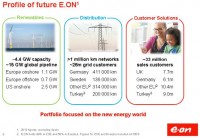
E.ON is Germany’s largest electric utility and has announced it is splitting into two separate companies. Low commodity pricing since 2009 has decimated earnings and dividends. Analysts are warming up to the companies after the split, but for dramatically different reasons. If you think our electric utility sector is a mess with the potential of disruptive alternative power and distributed power, Germany is in worse shape. According to government goals, all nuclear power plants are to be shuttered by 2022 and coal plants are being phased out as well. Replacing this generating capacity, the German authorities are mandating an increase of renewable generating capacity to 40% of total generating capacity. In addition, the government has found another source of income for taxes – electric bills. According to the US Energy Information Agency, Germany has the second highest residential electricity rate in Europe, with 50% of the residential bill representing taxes and fees collected by the government. Of the $0.39 per kWh average residential price in Germany for 2013, $0.20 is taxes levied by the government to subsidize renewable power generation. The US, for comparison, has a national average residential electricity price of $0.12/kWh including taxes. E.ON SE ADR ( OTCQX:EONGY ) is the largest electric utility in Germany and could be considered a contrary selection facing insurmountable headwinds from several directions. However, management is splitting the company into two separate firms, much like a “good” utility and a “not-so-good” utility. The “good” utility will own the company’s renewable and natural gas power generation assets, its transmission business and its retail electricity and gas business including technology such as smart meters, also known as “customer solutions”. The “not-so-good” utility will own the nuclear, coal and hydro power plants, LNG terminals, oil and gas production, and energy trading. The former will carry the E.ON brand and the latter will be renamed. The split is anticipated in mid-2016 with a majority of the spin-off being distributed to shareholders. E.ON will carry all the debt (expected to be about €18 billion after reduction from recent asset sales proceeds). The new company will initially carry no debt, but a huge contingent liability of about €14 billion for closing the remaining nuclear and coal power plants. Turkish assets will go with E.ON while Russian and Brazilian assets will be transferred to the new company. Ms. Venkateswaran, an analyst at Royal Bank of Canada, estimates of the €9.3 billion in pretax profits in 2013, nearly €5 billion, or 53%, is from the greener, more predictable business that will retain the E.ON brand and €4.4 billion, or 47%, is from business units under the new company. E.ON said it expects to post a net loss in 2014 on expected impairment charges of €4.5 billion in the fourth quarter because of its operations in southern Europe and its conventional generation assets. Underlying 2014 profits before one-time charges are expected to be between €1.5 billion and €1.9 billion. A graphic depiction of the split is offered in their presentation outlining the proposal, with a general profile of each entity. (click to enlarge) (click to enlarge) A detailed explanation is offered on E.ON website through the investor’s presentation linked above. Investors should review this presentation prior to investing as it lays out the future path for E.ON. Much like Exelon (NYSE: EXC ), E.ON’s massive power generation capacity is sold utilizing shorter-term power agreements, with the longest usually 4 years, and puts E.ON at the mercy of commodity power pricing. In the US, long-term power purchase agreements are used, except in the Northeast, Mid-Atlantic, and eastern Midwest. Below is a graph of power prices in Germany going back to 2002. As shown, Day-Ahead Base Load pricing has fallen from €70 in 2008 to €31 currently. (click to enlarge) Source: ISE Fraunhofer pdf Power prices are directly impacted by the low fuel costs of wind and solar, and renewables take a top priority in delivery. Renewables usually comprise an average of 27% of total demand and ranges daily between 10% and 50%. On May 11, 2014, there was a record reached – of sorts. At mid-day, Germany generated the highest percentage of total demand using renewable power at 73% of its electrical needs. It is important to realize that a few days earlier, renewables generated only 12% of customer demand. A description of this event is offered by energytransition.de: Wind power peaked at around 21.3 GW at 1 PM on Sunday, with solar simultaneously coming in at 15.2 GW. Add in the roughly 3.1 GW of hydropower and 3.7 GW of electricity from biomass that Germany usually has, and the output of conventional power plants was pushed down to 26 GW at 1 PM on Sunday. Power demand, however, was only at 59.2 GW, meaning that only 15.9 GW of conventional power was needed to serve domestic demand. The remaining more than 10 GW was for export – a clear indication of how foreign demand for German power is rescuing the conventional sector. However, the article goes on to report wholesale power prices turned negative and power companies were paying customers €65 MWh to consume electricity. It is difficult to make a profit when a company is paying customers to take its product. More information on how the power markets operate in Germany can be found here . Negative power pricing is not just an issue in Germany. In 2013, an Exelon official commented that its two northern Illinois nuclear power plants operate 8% to 15% of off-peak hours with a negative pricing model. German power prices are low, and could go lower. E.ON management has hedged its production for this year and next in anticipation of low prices. 12-month forward pricing is at 10-yr lows of €31, and Germany has 18 gigawatts of unprofitable power plants, according to Sanford C Bernstein Ltd. According to Bloomberg, the 12-month benchmark could drop 4.6 % this month to below 30 euros, a level not seen since late 2003, according to trading companies from Mainova AG in Frankfurt to CF Partners U.K. LLP in London. Last year, power prices in Europe’s biggest economy dropped for a fourth consecutive year, sliding 10 percent in 2014. Low wholesale prices are hurting the utility’s bottom line and E.ON needed an action plan to counter the dramatic turn in profits. As Germany turns to higher and higher amounts of renewables, replacing core base-load with intermittent-load, fast-starting power generation will be at a premium. Nuclear and coal require too much time to ramp up production after being idled, leaving mainly natural gas as the preferred fuel source. Splitting the company is management’s answer to the problem. Earnings and dividends have been falling the past few years. Operating EPS in 2013 were €1.12, is expected to be €0.66 in 2014, and is estimated to rebound this year to €0.92, but fall in 2016 to €0.85. However, the company is expecting to write-down assets in the fourth qtr. 2014 by €4.6 billion and will report a net loss for the year. Just a few years ago, the dividend was €1.33, but management has announced a dividend distribution for this year and next of €0.50. The corporate split is receiving mixed reviews in the media. Morningstar, which has a 5 Star rating on E.ON, recaps the differing of opinions in its unique analysis: Bulls Say: Creative share swaps, divestitures, and cuts in its investment program in response to the European recession suggest that management is intently focused on value-creating growth. Before E.ON’s 33% dividend cut in 2011, dividends had increased an average of nearly 13% per year since 2004. Management is taking steps such as selling non-core assets, cutting back investment, and targeting operating cost cuts to preserve the current dividend. Bears Say: We estimate the German nuclear plant shutdowns will result in about EUR 2.1 billion of lost after-tax profits by 2022. European Union regulators and nationalist interests have limited E.ON’s worldwide growth opportunities and distorted wholesale power markets. Any investments that do not meet the company’s double-digit return on capital hurdle rate will destroy shareholder value. Forbes published an article examining the split. Their take on the move is: It is a compelling plan for many reasons. The first, of course, is that E.ON had to do something. Declining wholesale power prices in Germany, among other factors, has eviscerated the company’s margins. The company will take a $5.6 billion in the fourth quarter and report for the year “substantial negative net income,” which I think is the German phrase for loss. Last year, it reported a net income of $3.1 billion on revenue of $154 billion. The prevalence of solar at peak power times combined with increased efficiency have made large capital projects riskier. But just as important, it’s an interesting deal because it presents a living lab for viewing the future of the energy industry. The “fossil” side of E.ON will now be unencumbered by debates over efficiency. It will be free to sell as much power as it can across Europe. If traditional energy advocates are correct, these assets will grow in value over time. Renewables will prove to be too intermittent, efficiency measures won’t work as promised and the dwindling base of centralized power plants will make these assets even more valuable. Etc. etc. On other hand, If renewable advocates are correct, you will see the Triumvirate of S-software, storage and solar-continue to get cheaper and more reliable. People will use less and not notice the inconvenience. Meanwhile, E.ON will enjoy a better return on investment on these modular assets. Management provided an update just after the announcement to split. From an article on 4-Tradrs.com: UBS analyst Patrick Hummel said he believed that a EUR7 billion cash transfer into the unit with the nuclear plants would be needed to back up nuclear liabilities and ensure an investment-grade rating. Markus Wessel, an energy lawyer in private practice, said the concerns that the costs of decommissioning nuclear power plants will be dumped on taxpayers are unfounded. “Only if there’s an insolvency would there be a risk that the costs would fall on the taxpayers, though an insolvency is very improbable,” Mr. Wessel said. Companies are obliged by the law to prove that they have the necessary financial security to pay for the costs of dismantling and decommissioning to receive a license to operate the nuclear power plant. Mr. Wessel said that because the permission is tied to the company itself, E.ON’s new company would have to go through this same process to have the permits transferred. “If they want to be smart about it, the government will make both of E.ON’s companies liable for the costs before they allow the transfer of permits,” Mr. Wessel added. Mr. Teyssen, CEO of E.ON, said that both companies will be “highly attractive for investors” after the split. For the new entity, “we see strategic potential because small companies will withdraw” from the fossil and nuclear power market and “there will be a world in which one can consolidate and reach market leadership,” he added. As well as the power plants in Germany, the new company would also own large water power assets, natural gas plants, lignite plants, pipelines, the largest system of natural gas storage facilities in Europe and one of the Continent’s largest trading houses, the chief executive said. A big concern is the unprecedented nature of tasks that lie ahead for E.ON. “There are a lot of uncertainties as to the cost of the liabilities,” said Equinet analyst Michael Schaefer. “We also don’t have much experience when it comes to shutting down nuclear reactors over a span of a decade and the costs include all phases of dismantling and decommissioning, including cooling and storage.” “The real question is whether the new company will have sufficient assets in the long-term to generate cash flows that would cover future obligations,” Mr. Schaefer said. “If wholesale prices for conventional energy remain low, will be hard to cover cash outflows.” Reuters offers an interest perspective in its opinion that the split makes the new E.ON more attractive as an acquisition target. Institutional investors are seeking investments that balances government regulated utilities and high dividend payout potential. Following the spin-off in 2016, nearly two thirds of E.ON’s profits will come from distribution assets – grids whose returns are set by regulators and usually move within the mid to high single-digit percentage range. Roughly a quarter will come from end-customer services and the rest from solar and wind power, the fastest-growing sector within the energy industry. “The bottom line is that pension funds could certainly live with this kind of earnings profile,” said Torsten Graf, fund manager at Frankfurt-based MainFirst and a holder of 61,000 E.ON shares. Macquarie estimates that under the new set-up E.ON will have an equity value of 19.6 billion euros and net debt of about 18.6 billion, with an enterprise value to forecast core earnings (EV/EBITDA) ratio of 8.4, a premium to E.ON’s current 7.8 as well as to the 6.9 of its biggest European peers. The company will own 4.4 gigawatts (GW) of renewable capacity, equal to about four nuclear plants, control more than 1 million kilometres in distribution grids in Europe and have 33 million customers. Core earnings of the future E.ON group are expected to grow by nearly a fifth to 5.5 billion euros by 2020, according to Deutsche Bank estimates. In contrast, the unit to be spun off is seen trading at a much lower 5.6 times EV/EBITDA, mainly due to concerns over the quality of its assets, most notably 51 GW of conventional generation capacity, that have earned it the label of a “bad utility”. Bankers estimate that even though the unit to be spun off will be initially debt-free, it will have a much harder time attracting investors, mainly due to the 14.5 billion euros in provisions it will have to shoulder for nuclear decommissioning. According to 4-traders.com , timeliness consensus from analysts is improving. Of the 31 analysts that follow E.ON, consensus recommendations are: Buy or Outperform 32%; Hold 42%; Underperform or Sell 26%. The graphic below outlines these recommendations. The consensus price goal is €15.20 with a range of €12 to €19, vs. a current price of €13.60. At the high target, capital appreciation could be up 49%; at the consensus, appreciation could be up 15%; and the low target would represent share prices down 9.4%. The second graphic compares share prices and consensus price target going back two years. As shown, the share price decline over the past year coupled with the rise in price targets offers the best potential opportunity in the past two years. Stock price is in black, consensus target is in green Source: 4-traders.com Fastgraph depicts the pain suffered by E.ON shareholders since its peak in share price in 2008. Share prices for EONGY has dropped from $75.65 to a current $15.36. Source; fastgraph.com Return on invested capital ROIC is in line with US-based industry peers. Over the previous 5-years, E.ON has generated an average 4.9% ROIC. Below is a 15-yr graph of ROIC, courtesy of fastgraphs.com. (click to enlarge) Source: fastgraph.com The headwinds for E.ON are many, with some stronger than others. In order for E.ON to do well over the next few years, the following events most likely need to transpire: 1) The dollar declines against the euro. The higher the USD goes, the lower the share price and dividend are when converted back to USD. 2) The euro has to survive the current financial crisis of low growth and pre-recession data. The Greek elections empower those that are anti-austerity and endorse more government spending. 3) Electricity prices need to improve in Germany, probably in tandem with a reduction of additional base-load capacity and a premium paid for reliability. 4) The issues of higher distributed generation and a heavy intermittent generation profile are reconciled with the base load needs of customers. 5) Demand for electricity picks up. Investors need to appreciate the impact of a falling euro/rising USD. At the current €1.12 = $1 USD, the annual €0.50 dividend is worth $0.56, and share prices are $15.32. If the euro were to drop to parity, as predicted by some, the dividend would be worth $0.50 and share prices would be $13.62, based on today’s close in Europe. With the current uncertainty, taking a small position would be advisable as there could be better opportunities over the next 12 months. Author’s Note: Please review full disclosure on Author’s profile. Editor’s Note: This article discusses one or more securities that do not trade on a major exchange. Please be aware of the risks associated with these stocks.

Duke Energy: A Utility Stock For Your Income Portfolio For 2015

Summary Company’s long-term performance will be positively affected by planned growth investments. Growth investments will drive its rate base and earnings growth in the long run. DUK remains committed to achieving its targeted dividend payout ratio of 65%-70%. I reiterate my bullish stance on Duke Energy (NYSE: DUK ). In this article, I will discuss in more detail the ongoing capital expenditures that the company is making, which will portend well for its financial performance. Also, I will briefly discuss the 4Q’14 earnings outlook. DUK has been progressing well with its healthy capital expenditures in regulated operations. The company’s planned capital expenditures for the next five years remain healthy, and I believe DUK will deliver decent earnings growth in the long run. Moreover, the effect of the healthy earnings growth will improve its cash flow base, due to which the company will make hefty dividend payments in the long run. The stock offers an attractive dividend yield of 3.6%, which makes it a good investment option for dividend-seeking investors. Smart Growth Investments set to Improve DUK’s Financial Performance U.S. utility stocks delivered healthy performances in 2014. Moving forward, I believe 2015 will be another good year for the utility sector. As far as DUK is concerned, the company has carved out its plans to deliver a healthy performance in the long term through acceleration in capital expenditure for long-term growth generating projects. As per its growth plans, focused on regulated operations, the company is planning to spend approximately $16-$20 billion on several growth projects from 2014 to 2018, focused on its new power generation projects. The company revealed that it will be constructing three major generation projects in Florida, with an investment of approximately $1.9 billion . Also, DUK is planning to build a 1,640MW joint cycle plant worth $1.5 billion. In addition, the company has been making progress with its two new combustion turbine plants in Suwannee, which are expected to be in service by the end of 2018. Moreover, regulators have approved DUK’s project to build a 750MW Lee natural gas plant in South Carolina, which will start providing services by the end of 2017. The value of these growth investments lies in the betterment of the company’s power generation capacity due to a significant improvement in regulated operations, which will portend well for its rate base and earnings growth in the long run. Along with power generation projects, DUK has been gradually increasing its renewable energy portfolio. So far, the company is progressing well with the constructions of its 400MW wind energy project and 100MW solar project. DUK has recently acquired a 20MW solar project from Geenex and ET solar Energy Corporation; the project’s site, being located in Dominion North Carolina Power’s service area, will allow the company to generate revenue by selling electricity generated from the project for a period of 15 years. In future, DUK will be making more investments in its renewable generation projects. All these renewable energy generation investments will not only diversify the company’s generation mix, but will help it meet environmental standards. I believe DUK’s increased focus on renewable energy sources will deliver a significant upside to the company’s financial performance in the long run. In addition, DUK is actively evaluating all growth opportunities in international markets to generate growth in the long run. Also, DUK is conducting a strategic examination of international operations to get tax benefits of approximately $1.7 billion . The company’s strategic overview of international operations is still in progress, but by the time DUK will start pursuing tax saving initiatives for its international operations, its stock price will be positively affected. Owing to DUK’s healthy capital expenditures for the next five years, active investments in renewable energy resources and international growth opportunities, I believe the company’s earnings will be positively affected in the long term. Analysts are expecting that DUK’s long-term earnings will grow at approximately 4.76% , better than Southern Company’s (NYSE: SO ) earnings growth of 3.63% . The company is scheduled to report its 4Q’14 earnings next month. The company will provide an update on its future capital expenditure outlook; any increases in planned capital expenditures will positively affect the company’s growth potential and stock price. Also, the company will provide the 1Q’15 and full year 2015 earnings guidance. Analysts are expecting DUK to report an EPS of $0.88 for 4Q’14. In the last four quarters, the company reported three earnings beats. The one earnings miss was due to an impairment charge related to Midwest assets. I believe that as the company has finalized the sale of Midwest assets, it will report strong earnings for 4Q’15. The following table shows the actual EPS and consensus EPS estimates for the last four quarters. (click to enlarge) Source: Yahoofinance.com Healthy Returns DUK has been sharing its success with shareholders through dividends. The company recently announced a quarterly dividend payment of $0.795 , which marked its 85th consecutive year of dividend payments. The company currently offers a healthy dividend yield of 3.60% . The company’s impressive cash flows have been backing these impressive dividend payments, as shown below. DUK’s healthy growth prospects indicate that its cash flow productivity will improve in the years ahead, helping it affirm its commitment to rewarding shareholders through dividend payments. Owing to its ability to pay dividends consistently in upcoming years, I believe DUK remains a good investment option for shareholders. Moreover, the company can use $2.8 billion in cash proceeds from the Midwest assets sale to repurchase shares or boost dividends. Owing to DUK’s shareholder-friendly cash return policy, I believe the company will utilize all growth prospects that could support its healthy cash return policy in order to ensure consistent dividend increases in the years ahead. The following table shows the ongoing increases in dividend per share, ROE, dividend payout ratio and dividend coverage for the company, for 2012 and 2013. The table also includes my estimated figures for 2014 and 2015. (Note *Dividend Coverage Ratio = Operating Cash Flow/Annual Dividends) Dividend Per Share Dividend Payout Dividend Coverage ROE 2012 $3.03 70% 3x 9.5% 2013 $3.12 71.7% 2.9x 6.3% 2014(E) $3.15 69.6% 3.2x 7.6% 2015(E) $3.25 68.7% 3.8x 7.7% Source: Company’s Reports and Equity watch’s Calculations Using Estimates Conclusion DUK’s long-term performance will be positively affected by planned growth investments. The growth investments, directed at improving the company’s operational performance, will drive its rate base and earnings growth in the long run. Also, DUK’s healthy growth prospects will portend well for the betterment of its cash flow base, which will allow the company to consistently increase dividends. Moreover, DUK remains committed to achieving its targeted dividend payout ratio of 65%-70% . Due to the aforementioned factors, I remain bullish on DUK.