Tag Archives: undefined

Prediction Is Difficult. Especially About The Future
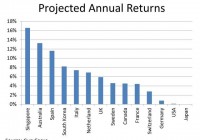
In the immortal words of the physicist Niels Bohr, “Prediction is very difficult. Especially if it’s about the future.” I rarely make firm market forecasts. But I do like to look at broad valuation numbers and see what they imply about future returns. You know the refrain: Past performance is no guarantee of future results. But the following returns estimates, courtesy of data site GuruFocus , give us a little historical perspective. GuruFocus bases its estimates on three factors: Expected economic growth, based on the average growth over the last business cycle. Expected dividend returns, based on the average dividend yield of the past five years. Change in market valuation (the assumption is that the ratio of market cap-to-GDP will revert to its average over a full market cycle, or 7-8 years). So, what do the numbers suggest? (click to enlarge) I’ll start with the good news. Several world markets are priced to deliver solid returns over the next eight years. In particular, Singapore, Australia and Spain are priced particularly attractively, with implied future returns well over 10% per year. Now, keep in mind that Singapore’s economic growth is highly dependent on trade flows between China and the West, Australia is highly dependent on selling commodities to China, and Spain is at the center of the eurozone sovereign debt crisis. All of these countries have murky near-term outlooks, and the projections for economic growth based on the past might not be realistic for the future. But once the dust settles, all might make for attractive “fishing ponds” for investment. Now for the bad news. The US market – where you’re most likely to have the bulk of your assets invested – is priced to deliver annual returns of approximately zero over the next eight years. And it’s not just the market cap-to-GDP ratio that suggests this. As I wrote recently , other metrics, such as the cyclically-adjusted price/earnings ratio (“CAPE”), point to similarly disappointing returns going forward. And allocating your funds to European or Asia-Pacific funds might not help you much. Germany and Japan, which tend to dominate European and Asian-Pacific funds, are priced to deliver equally disappointing returns going forward. So, what’s the takeaway here? In order to avoid lousy returns over the next several years, you’re going to have to invest differently than you might have in the past. You’re going to have to look more aggressively overseas, and within the overseas universe, you’ll need to underweight the most common international markets. This article first appeared on Sizemore Insights as Prediction is Difficult. Especially About the Future Disclaimer: This article is for informational purposes only and should not be considered specific investment advice or as a solicitation to buy or sell any securities. Sizemore Capital personnel and clients will often have an interest in the securities mentioned. There is risk in any investment in traded securities, and all Sizemore Capital investment strategies have the possibility of loss. Past performance is no guarantee of future results. Original Post

3 China ETFs That Survived The Recent Slump

After delivering a phenomenal return in the first half of 2015, China A-shares and ETFs saw their worst ” weekly drop ” in seven years last week. The space had been an investors’ darling since last year on growing hopes for policy easing (read: Policy Easing Puts China ETFs in Focus ). Notably, downbeat economic data kept coming out of China for quite some time now, with the GDP growth rate falling to a 24-year low in 2014 and credit crunch concerns, a property market slowdown and persistently lagging manufacturing sector adding to policy makers’ concerns. To inject fresh blood into the ailing economy, the People’s Bank of China (PBOC) has gone into an accommodative policy mode since last year, having cut interest rates thrice in just six months, announcing a mini stimulus package mainly targeted at railways and other construction investments, declaring a tax relief for small enterprises and so on. Special attention was paid to shore up the country’s rural sectors as policy makers focused on domestic consumption rather than spurring exports. However, as all these measures have proved insufficient to boost the anemic economy so far, speculations over further policy easing became stronger. This sentiment attracted foreign investors to pour money into the stocks of the region, which led the best-performing China A-Shares ETF Market Vectors ChinaAMC SME-ChiNext ETF (NYSEARCA: CNXT ) to return around 90% so far this year. Sell-Off Takes a Bite Out of Chinese Securities After such a steep rise, Chinese stocks were definitely due for a correction. Chinese securities’ regulators also warned retail investors at a regular interval about the market’s overvaluation status and rolled out a host of measures including tightening of rules for margin lending, which led to sell-offs. Last week’s correction was also the result of new tightening steps on margin lending. Moreover, a flurry of IPOs, which were scheduled to hit the market last week, threatened market liquidity and triggered the sell-off, per CNBC . CNXT was off as much as 12.3% last week (read: 4 Buy Ranked China A-Shares ETFs Still Worth a Look ). China ETFs Surviving the Correction Against such a backdrop, investors might want to know about if there were any exceptions in the China equities ETF space which managed to stay afloat in the stock carnage. Below, we highlight three ETFs which were able to wait out the volatility last week and could be in focus should there be any repetition of Chinese market correction going ahead. Investors should note that most of the winners hail from the H-Shares space, which is trading at a compelling valuation at present unlike A-shares (read: Cross the Wall of China, Invest in Hong Kong ETFs ). iShares MSCI Hong Kong ETF (NYSEARCA: EWH ) For a broader exposure to the Hong Kong market, investors should consider EWH as it is the longest standing and most popular ETF tracking the Hong Kong market. The fund looks to track the MSCI Hong Kong Index. This $3.79 billion ETF is invested in a small basket of 40 companies trading in the Hong Kong equity market. The fund appears to be highly concentrated in the top 10 stocks. Real Estate (27.94%), Insurance (18.62%) and Utilities (10.96%) are the top three sectors of the fund. The fund charges 48 bps in fees. The fund was up 2.2% last week (as of June 19, 2015). So far this year, the fund has added about 16%. The fund has a Zacks ETF Rank #3 (Hold). iShares MSCI Hong Kong Small-Cap ETF (NYSEARCA: EWHS ) This is a small-cap centric fund. It is unpopular and less liquid having an AUM of $8.9 million and average daily volume of about 12,000 shares. The fund tracks the MSCI Hong Kong Small Cap Index and charges 59 bps in annual fees. Holding 104 stocks, the product does a decent job of spreading out assets as each company holds less than 4% share. However, it is slightly concentrated from a sector look as Consumer Discretionary and Financials take about 30% of the basket each. The product was up 1.6% last week and has a Zacks ETF Rank #3. iShares MSCI China Small-Cap ETF (NYSEARCA: ECNS ) The fund looks to track the MSCI China Small Cap Index and offers exposure to the performance of stocks in the bottom 14% by market capitalization of the Chinese equity securities markets, as represented by the H-Share. The fund is an overlooked choice with just $53.5 million in assets and trading with daily average volumes of 25,000 shares a day. This Zacks ETF Rank #3-fund charges 62 bps in fees. As much as 70.2% of the stocks hail from China while the rest belongs to Hong Kong. The fund is heavy on Consumer Discretionary (21.2%) followed by Industrials (16.6%), IT (15.8%) and Financials (15.3%). ECNS has low company-specific concentration risks with no stock holding more than 1.21% of the basket. The fund was up 0.6% last week (as of June 19, 2015). Original post

July 2015, Funds In Registration

First Western Short Duration High Yield Credit Fund First Western Short Duration High Yield Credit Fund will seek a high level of current income and capital growth. The plan is to invest in a global portfolio of junk bonds and floating rate senior secured loans. The fund will be managed by Steven S. Michaels. The minimum initial investment is $1,000. The opening expense ratio for retail shares will be 1.2%. RiverNorth Marketplace Lending Fund RiverNorth Marketplace Lending Fund will seek “a high level of total return, with an emphasis on current income.” The plan is to invest in “loans to consumers, small- and mid-sized companies and other borrowers originated through online platforms.” That is, they’ll subscribe to loans through peer-to-peer lenders such as Lending Tree and Prosper.com. They urge you to think of this as a fund that might fit into the “high yield / speculative income” slot in your portfolio. They also, rightly, raise two red flags: (1) no one has ever done this before and so there’s no established market for trading these shares, which might well make them illiquid for rather longer than you like and (2) this is structured as a closed-end fund but will likely function as an interval fund; that is, you might have to request redemption of your shares then wait for a redemption window. That’s akin to the practice in hedge funds, since they also make money from the mispricing of illiquid investments. The fund will be managed by Philip K. Bartow and Patrick W. Galley. Mr. Bartow just joined RiverNorth after serving as “Principal at Spring Hill Capital, where he focused on analyzing and trading structured credit, commercial mortgage and asset-backed fixed income investments.” Mr. Galley is RiverNorth’s Alpha male. Details like purchase requirements and expenses have yet to be worked out. RQSI Small Cap Hedged Equity Fund RQSI Small Cap Hedged Equity Fund will seek total return with lower volatility than the overall equity market. The plan is to invest in a diversified portfolio of U.S. small cap stocks and ADRs, when they need exposure to a foreign stock, which will be selected using the Ramsey Quantitative Systems, Inc. quantitative system. The manager will use options, futures and ETFs to hedge the portfolio. The fund will be managed by Benjamin McMillan, formerly a manager for Van Eck Global’s Long/Short Equity Index Fund. The minimum initial investment is $2,500. The opening expense ratio will be 1.56% for retail shares. T. Rowe Price Emerging Markets Value Stock Fund T. Rowe Price Emerging Markets Value Stock Fund will pursue long term growth of capital. The fund will invest in “stocks of larger companies that are undervalued in the view of the portfolio manager using various measures.” The fund will be managed by Ernest Yeung. Mr. Yeung joined T. Rowe in 2003. Price describes him as having “joined the Firm in 2003 and his investment experience dates from 2001. He has served as a portfolio manager with the Firm throughout the past five years.” He’s also described as a “sector expert” on Asian media and telecomm stocks. I can, however, only find a four month fill-in stint as manager of T. Rowe Price New Asia Fund (MUTF: PRASX ) . Presumably he’s been managing something other than mutual funds and has done it well enough to satisfy Price. The opening expense ratio, after waivers, will be 1.5%. The minimum initial investment will be $2,500, reduced to $1,000 for tax-advantaged accounts. The prospectus is dated August 24, 2015 which suggests the launch date. Thornburg Better World Fund Thornburg Better World Fund will seek long-term capital growth. The plan is to invest in international “companies that demonstrate one or more positive environmental, social and governance characteristics.” They can also hold fixed income securities, but that’s clearly secondary. The fund will be managed by Rolf Kelly, who has been with Thornburg since 2007. Before that, he was a “reservoir engineer” for an oil company. The minimum initial investment is $5,000, reduced to $2,000 for various tax-advantaged accounts. The opening expense ratio is 1.83% for “A” shares, which also carry an avoidable 4.5% load. United Income and Art Fund United Income and Art Fund will seek income with long-term capital appreciation as a secondary objective. The plan is to invest in equity and fixed-income mutual funds (based on “performance, risk, draw downs, portfolio holdings, turnover, and potential concentration risk – easy peasy!) and up to 15% in potentially illiquid “art companies,” plus long and short ETFs for hedging. The fund will be managed by Doran Adhami and Itay Vinik of United Global Advisors. Mr. Adhami was a Vice President of Investments for UBS from 2005-13; Mr. Vinik was an intern there and is now, with “approximately three years” of industry experience, United Global’s CIO. He also helps manage the Ace of Swords Fund . The minimum initial investment is $500. The opening expense ratio has not been released; the existence of a 2% redemption fee and a 0.25% 12(b)1 fee have been established. Zevenbergen Genea Fund Zevenbergen Genea Fund will seek long-term capital appreciation. The plan is to invest in the stocks of 15-40 firms which are “benefitting from advancements in technology.” I’m certain that’s not nearly as dumb as it sounds. International exposure would come mostly through ADRs. The fund will be managed by Nancy Zevenbergen, Brooke de Boutray, and Leslie Tubbs. The adviser has about $2.4 billion in assets under management and all of the managers have experience as portfolio managers at regional banks. The minimum initial investment is $2,500. The opening expense ratio is 1.40%. Zevenbergen Growth Fund Zevenbergen Growth Fund will seek long-term capital appreciation. The plan is to invest in 30-60 industry leaders, described as firms which seek to invest in industry leaders with “strong competitive positioning.” International exposure would come mostly through ADRs. The fund will be managed by Nancy Zevenbergen, Brooke de Boutray, and Leslie Tubbs. The adviser has about $2.4 billion in assets under management and all of the managers have experience as portfolio managers at regional banks. The minimum initial investment is $2,500. The opening expense ratio is 1.3%.