Tag Archives: undefined

Preserve Purchasing Power With This ETF

By Thomas Boccellari Unexpected inflation can be corrosive to a fixed-income portfolio. While bond investors have had to contend with punishingly low interest rates, they have gotten a reprieve on the inflation front. In large part because of falling energy prices, inflation was only 1.3% over the trailing 12 months through November 2014. Because energy is a key input into nearly every aspect of the U.S. economy, it has a big impact on the total cost of production from everything from food and clothing to housing and transportation. Over the trailing 20 years through November 2014, the correlation between WTI Crude and the Consumer Price Index was 0.93. The strength of the U.S. dollar has also been a major contributor to low inflation. Because the eurozone and Japan have weakened their currencies to spur growth in their local markets, the U.S. dollar has strengthened against these currencies. This allows U.S. consumers cheaper access to imported goods from these markets. This is especially important as wage growth remains relatively low in the United States. Because of these trends, expected inflation is low. As of Jan. 12, 2015, the 10-year Treasury’s yield was 1.92%, while the yield of the 10-year TIPS was 0.35%. This implies a break-even inflation rate of 1.57%. The break-even inflation rate is the level inflation would have to increase above before investors would earn higher real returns in Treasury Inflation-Protected Securities. Over the trailing 20 years through November 2014, the average break-even inflation rate was 2.2%. Investors who believe that the long-term inflation will exceed the low-inflation expectations currently priced into traditional bonds may consider a TIPS exchange-traded fund such as Schwab US TIPS ETF (NYSEARCA: SCHP ) –the lowest-cost TIPS ETF available. This fund tracks a broad, market-cap-weighted portfolio of TIPS with more than a year left until maturity. Because TIPS are excluded from aggregate bond ETFs, this fund can be used as a complementary core holding for investors who own an aggregate bond market ETF such as Schwab U.S. Aggregate Bond ETF (NYSEARCA: SCHZ ) (0.06% expense ratio). Because more than half of the fund’s assets were invested in TIPS with maturities greater than seven years, at the end of December 2014, it had a longer duration (7.7 years) than the non-inflation-protected Barclays U.S. Treasury Bond Index (5.7 years). Duration is a measure of interest-rate sensitivity. Therefore, if interest rates were to increase 1%, investors could expect the fund and the Barclays U.S. Treasury Bond Index to decline by 7.7% and 5.7%, respectively. Generally, TIPS’ inflation adjustment is paid at maturity but taxed annually. To make tax time easier, the fund distributes inflation adjustments to the principal in addition to the coupon payment on a monthly basis. However, the fund may suspend interest payments during periods of deflation. This is because the inflation adjustment will become negative and will be offset against the coupon payments. Fundamental View TIPS combine the security of Treasuries with inflation protection in the form of Consumer Price Index-adjusted principal. The CPI represents the cost of a broad basket of goods and services. Inflation will drive the price of that basket higher, and deflation will make it cheaper. When the CPI goes up, a TIPS’ principal is adjusted upward accordingly. Even though the interest rate on the bond remains the same, the semiannual coupon is paid based on the adjusted principal. Inflation may still not rise substantially enough for TIPS to make sense. If interest rates remain consistent or rise slowly, the fund will likely underperform comparable non-inflation-protected bonds. For example, over the trailing six months through November 2014, U.S. inflation fell to 1.3% from 2.1%. Over this time period, the fund’s return (negative 0.7%) was less than that of the Barclays U.S. Treasury 7-10 Year Index (3.1%). However, if the inflation rate increases rapidly, the fund is likely to outperform the Barclays U.S. Treasury 7-10 Year Index. When the inflation rate increased to 2.1% in June 2014 from 0.9% in October 2013, the fund’s return (3.6%) exceeded that of the index (3.1%). The fund’s long duration (7.7 years) may also negate its inflation-protection benefit. This is because long maturity bonds are more susceptible to changing interest rates, which tend to rise when inflation increases. This is because the Federal Reserve often raises rates in order to curb inflation. If long-term interest rates increase with inflation, it could hurt the fund’s returns. For example, from July 2012 through July 2013, the 10-year Treasury yield increased to 2.6% from 1.5%. Over the same period, inflation increased to 2.0% from 1.4%. Despite the increase in inflation, the fund’s return (negative 4.2%) was less than that of the Barclays U.S. Treasury 7-10 Year Index (negative 3.7%) because of the fund’s longer duration. However, long-term interest rates have historically been less volatile than short-term rates. However, Federal Reserve action generally has a larger impact on short- and intermediate-term yields and less on long-term yields. This is because the Fed relies primarily on open market operations to influence short-term interest rates. If the Fed increases short-term interest rates to curb inflation and long-term rates remain relatively stable, the fund may not experience a significant loss. Portfolio Construction The fund tracks the Barclays U.S. Treasury Inflation Protected Securities (TIPS) Index (Series-L), which includes all TIPS issued that have at least one year left until maturity and $250 million in par value. The index is market-cap-weighted and rebalanced monthly. While TIPS are less liquid than Treasuries, the fund’s full index replication strategy has helped to minimize its index tracking error. Fees The fund charges 0.07% annually and is currently the cheapest TIPS ETF. Over the trailing three years through December 2014, the fund has lagged its benchmark by 0.09%, slightly greater than the amount of its expense ratio. Alternatives The largest and most liquid TIPS ETF is iShares TIPS Bond (NYSEARCA: TIP ) (0.20% expense ratio). It tracks the same index as SCHP. SPDR Barclays TIPS ETF (NYSEARCA: IPE ) (0.1865% expense ratio) tracks the Barclays U.S. Government Inflation-Linked Bond Index. While similar to the index that SCHP and TIP track, IPE requires that TIPSs have a minimum $500 million outstanding. As of December 2014, IPE had a shorter duration (6.1 years) and lower yield (1.8%) than SCHP and TIP. Shorter-duration TIPS indexes are somewhat more correlated to inflation, given their lower interest-rate sensitivity. Vanguard Short-Term Inflation-Protected Securities ETF (NASDAQ: VTIP ) (0.10% expense ratio) tracks an index that targets TIPS with maturities of less than five years. As a result, its duration (1.4 years) is considerably lower than SCHP’s. However, it also has a lower yield (0.9%). Another option is PIMCO 1-5 Year U.S. TIPS ETF (NYSEARCA: STPZ ) (0.20% expense ratio), which tracks a similar index as VTIP. Actively managed PIMCO Real Return (MUTF: PRTNX ) (0.85% expense ratio for A share class) has a Morningstar Analyst Rating of Silver. This fund follows a benchmark of TIPS and inflation-linked bonds but tries to garner additional returns through active bets. Disclosure: Morningstar, Inc. licenses its indexes to institutions for a variety of reasons, including the creation of investment products and the benchmarking of existing products. When licensing indexes for the creation or benchmarking of investment products, Morningstar receives fees that are mainly based on fund assets under management. As of Sept. 30, 2012, AlphaPro Management, BlackRock Asset Management, First Asset, First Trust, Invesco, Merrill Lynch, Northern Trust, Nuveen, and Van Eck license one or more Morningstar indexes for this purpose. These investment products are not sponsored, issued, marketed, or sold by Morningstar. Morningstar does not make any representation regarding the advisability of investing in any investment product based on or benchmarked against a Morningstar index.
Ghost In The Machine, Part 1

The way out is through the door. Why is it that no one will use this method? ― Confucius (551 – 479 BC) Tanzan and Ekido were once traveling together down a muddy road. A heavy rain was still falling. Coming around a bend, they met a lovely girl in a silk kimono and sash, unable to cross the intersection. “Come on, girl,” said Tanzan at once. Lifting her in his arms, he carried her over the mud. Ekido did not speak again until that night when they reached a lodging temple. Then he could no longer restrain himself. “We monks don’t go near females,” he told Tanzan, “especially not young and lovely ones. It is dangerous. Why did you do that?” “I left the girl there,” said Tanzan. “Are you still carrying her?” ― Nyogen Senzaki, “Zen Flesh, Zen Bones: A Collection of Zen and Pre-Zen Writings” (1957) In 1995, David Justice had a superior batting average to Derek Jeter (.253 to .250) In 1996, David Justice had a superior batting average to Derek Jeter (.321 to .314) In 1997, David Justice had a superior batting average to Derek Jeter (.329 to .291) Yet from 1995 – 1997, Derek Jeter had a superior batting average to David Justice (.300 to .298) ― example of Simpson’s Paradox, aka The Yule-Simpson Effect (1951) A student says, “Master, please hand me the knife,” and he hands the student the knife, blade first. “Please give me the other end,” the student says. And the master replies, “What would you do with the other end?” ― Alan W. Watts, “What Is Zen?” (2000) Such in outline is the official theory. I shall often speak of it, with deliberate abusiveness, as “the dogma of the Ghost in the Machine.” I hope to prove that it is entirely false, and false not in detail but in principle. It is not merely an assemblage of particular mistakes. It is one big mistake and a mistake of a special kind. It is, namely, a category mistake. ― Gilbert Ryle (1900 – 1976) The trouble with Oakland is that when you get there, there isn’t any there there. ― Gertrude Stein (1874 – 1946) Dr. Malcolm: Yeah, yeah, but your scientists were so preoccupied with whether or not they could that they didn’t stop to think if they should . ― “Jurassic Park” (1993) It’s a big enough umbrella But it’s always me that ends up getting wet. ― The Police, “Every Little Thing She Does is Magic” (1981) Everyone who lost money on the SNB’s decision to reverse course on their three and a half year policy to cap the exchange rate between the CHF and the Euro made a category error . And by everyone I mean everyone from Mrs. Watanabe trading forex from her living room in Tokyo to a CTA portfolio manager sitting in front of 6 Bloomberg monitors to a financial advisor answering a call from an angry client. It will take me a bit of verbiage to explain what I mean by a category error and why it’s such a powerful concept in logic and portfolio construction. But I think you’ll find it useful, not just for understanding what happened, but also (and more importantly) to protect yourself from it happening again. Because this won’t be the last time the markets will be buffeted by a forex storm here in the Golden Age of the Central Banker. A year and a half ago, when I was just starting Epsilon Theory, I wrote a note called ” The Tao of Portfolio Management .” It’s one of my less-downloaded notes, I think largely because its subject matter – problems of misunderstood logic and causality in portfolio construction – doesn’t exactly have the sexiness of a rant against Central Bank Narrative dominance, but it’s one of my personal favorites. That note was all about the ecological fallacy – a pervasive (but wrong-headed) human tendency to infer qualities about the individual from qualities of the group, and vice versa. Today I’ve got the chance to write once again about the logic of portfolio construction AND work in some of my favorite Zen quotes AND manage something of a Central Bank screed … a banner day! I’ve titled this note “The Ghost in the Machine” because it starts with another pervasive (but wrong-headed) human tendency – the creation of a false dualism between mind and body. I know, I know … that sounds both really daunting and really boring, but bear with me. What I’m talking about is maybe the most important question of modern philosophy – is there a separate thing called “mind” or “consciousness” that humans possess, or is all of that just the artefact of a critical mass of neurons firing within our magnificent, but entirely physical, brains? I’m definitely in the “everything is explained by neurobiology” camp, which I’d say is probably the more widely accepted view (certainly the louder view) in academic philosophy today, but for most of the 19th and 20th centuries the dualist or Cartesian view was clearly dominant, and it was responsible for a vast edifice of thought, a beautiful cathedral of philosophical constructs that was … ultimately really disappointing and empty. It wasn’t until philosophers like Gilbert Ryle and Van Quine started questioning what Ryle called “the ghost in the machine” – this totally non-empirical but totally accepted belief that humans possessed some ghostly quality of mind that couldn’t be measured or observed but was responsible for driving the human machine – that the entire field of philosophy could be reconfigured and take a quantum leap forward by incorporating the insights of evolutionary biology, neurobiology, and linguistics. Unfortunately, most economists and investors still believe in ghosts, and we are a long way from taking that same quantum leap. There is an edifice of mind that dominates modern economic practice … a beautiful cathedral where everything can be symbolized, where everything can be securitized, and where everything can be traded. We have come to treat these constructed symbols as the driver of the economic machine rather than as an incomplete reflection of the real world things and real world activities and real world humans that actually comprise the economy. We treat our investment symbols and thoughts as a reified end in themselves, and ultimately this beautiful edifice of symbols becomes a maze that traps us as investors, just as mid-20th century philosophers found themselves trapped within their gorgeous constructs of mind. We are like Ekido in the Zen koan of the muddy road, unable to stop carrying the pretty girl in our thoughts and trapped by that mental structure, long after the far more sensible monk Tanzan has carried the girl safely over the real world mud without consequence, symbolic or otherwise. The answer to our overwrought edifice of mind is not complex. As Confucius wrote in The Analects , the door is right there in front of us. Exiting the maze and reducing uncompensated risk in our portfolios does not require an advanced degree in symbolic logic or some pretzel-like mathematical process. It requires only a ferocious commitment to call things by their proper names. That’s often not an easy task, of course, as the Missionaries of the Common Knowledge Game – politicians, central bankers, famous investors, famous economists, and famous journalists – are dead-set on giving things false names, knowing full well that we are hard-wired as social animals to respond in ant-like fashion to these communication pheromones. We are both evolved and trained to think in terms of symbols that often serve the purposes of others more than ourselves, to think of the handle rather than the blade when we ask for a knife. The meaning of a knife is the blade. The handle is not “the other end” of a knife; it is a separate thing with its own name and usefulness. The human animal conflates separate things constantly … maybe not a big deal in the kitchen, but a huge deal in our portfolios. Replace the word “knife” with “diversification” and you’ll get a sense of where I’m going with this. Here’s what I mean by calling things by their proper names. The stock ticker “AAPL” or the currency ticker “CHF” are obviously symbols. Less obviously but more importantly, so are the shares of Apple stock and the quantities of Swiss francs that AAPL and CHF represent. Stocks and bonds and commodity futures and currencies are symbols, not real things at all, and we should never forget that. The most common category error that investors make (and “category error” is just a $10 phrase for calling something by the wrong name) is confusing the symbol for what it represents, and as a result we forget the meaning of the real world thing that’s been symbolized. A share of stock in, say, Apple is a symbol. Of what? A limited liability fractional ownership position in the economic interests of Apple, particularly its free cash flows. A futures contract in, say, copper is a symbol. Of what? A commitment to receive or deliver some amount of real-world copper at some price at some point in the future. A bond issued by, say, Argentina is a symbol. Of what? A commitment by the Argentine government to repay some borrowed money over an agreed-upon period of time, plus interest. A currency issued by, say, Switzerland is a symbol. Of what? Well, that’s an interesting question. There’s no real world commitment or ownership that a currency symbolizes, at least not in the same way that stocks, bonds, and commodity contracts symbolize an economic commitment or ownership stake. A currency symbolizes government permission. It is a license. It is an exclusive license (which makes it a requirement!) to use that currency as a medium for facilitating economic transactions within the borders of the issuing government, with terms that the government can impose or revoke at will for any reason at all. That’s it. There’s no economic claim or right inherent in a piece of money. As Gertrude Stein famously said of Oakland, there’s no there there. Why is this examination of underlying real world meaning so important? It’s important because there is no positive long-term expected return from trading one country’s economic license for another country’s economic license. There is a positive long-term expected return from trading money for stock. There is a positive long-term expected return from trading money for bonds. There is a positive long-term expected return from trading money for commodities and other real assets. But there is no positive long-term expected return from trading money for money. Unfortunately, we’ve been trained and encouraged – often under the linguistic rubric of “science” – to think of ANY new trading vehicle or security, particularly one that taps into as huge a market as foreign exchange, as a good thing for our portfolios. We are deluged with the usual narratives that alternatively seek to tempt us and embarrass us into participation. On an individual level we are told stories of savvy investors who look and act like we want to look and act, taking bold advantage of the technological wizardry (look! it’s a heat map! that changes color while I’m watching it!) and insanely great trade financing now at our fingertips in this, the best of all possible worlds. On an institutional level we are told stories of liquidity and non-correlation (what? you don’t understand what an efficient portfolio frontier is? and you call yourself a professional?), both good and necessary things, to be sure. But not sufficient things, at least not to cast the powerful magic that is diversification. There are only a few sure things in investing. First, taxes and fees are bad. Second, compound growth is a beautiful thing. Third, portfolio diversification works. At Salient we spend a lot of time thinking about what makes diversification work more or less well for different types of investors, and if you’re interested in questions like “what’s the difference between de-risking and diversification?” I heartily recommend our latest white paper (” The Free Lunch Effect “) to you. One thing we don’t do at Salient is include currency trading within our systematic asset allocation or trend-following strategies. Why not? Because Rule #1 for tapping into the power of portfolio diversification is that you don’t include things that lack a long-term positive expected return. Just because we can trade currency pairs easily and efficiently doesn’t mean that we should trade currency pairs easily and efficiently, any more than cloning dinosaurs because they could was a good idea for the Jurassic Park guys. The point of adding things to your portfolio for diversification should be to create a more effective umbrella, not just a bigger umbrella. I like a big umbrella just as much as the next guy, but not if I’m going to get wet every time a forex storm whips up. So if not for diversification, why do smart people engage in currency trading? There’s a good answer and a not-as-good answer to that question. The good answer is that you have an alpha-driven (i.e. private information-driven) divergent view on the terms of the government license embedded within any modern currency. This is why Stanley Druckenmiller is an investing god, and it’s why anyone who put money with him before, during, and after he and George Soros “broke the Bank of England” in 1992 has been rewarded many times over. The not-as-good answer is that you have identified a predictive pattern in the symbols themselves. I say that it’s not as good of an answer, but I’m not denying that there is meaning in the pattern of market symbols. On the contrary, I think there is real information regarding internal market behaviors to be found in the inductive study of symbolic patterns. This information is alpha, maybe the only consistent source of alpha left in the world today, and acting on these patterns is what good traders DO. But because it’s inductively derived, anyone else can find your special pattern, too. Or if they can’t, it’s because you’ve carved out a nice little parasitic niche for yourself that’s unlikely to scale well. More corrosively, the natural human tendency is to ascribe meaning to these patterns beyond the internal workings of the market, something that makes no more sense than to say that goose entrails have meaning beyond the internal workings of the goose. The meaning of the Swiss franc didn’t change just because you had a consistent pattern of market behavior around the EURCHF cross. Deviation in the expected value of the Swiss franc in Euro terms did not become normally distributed just because you can apply statistical methodology to the historical exchange rate data. I get so annoyed when I read things like “this wasn’t just the greatest shock in the history of forex, it was the greatest shock in the history of traded securities! a 30 standard deviation event!” Please. Stop it. Just because you can impose a normal distribution on the EURCHF cross doesn’t mean that you should . And if you’re making investment decisions because you think that this normal distribution and the internal market stability it implies is somehow “real” or has somehow changed the fundamental nature of what a currency IS … well, eventually that category error will wipe you out. Sorry, but it will. I don’t mean to be snide about any of this (although sometimes I can’t help myself). The truth is that an aggregation of highly probabilistic entities will always surprise you, whether you’re building a baseball team or an investment portfolio. Portfolio construction – the aggregation of symbols and symbols of symbols, all of which are ultimately based on massive amounts of real world activities that may have vastly different meanings and underlying probabilistic natures – is a really difficult task under the best of circumstances for a social animal that evolved on the African savanna for an entirely different set of challenges. And these are not the best of circumstances. No, the rules always change as the Golden Age of the Central Banker begins to fade. The SNB decision was a wake-up call, whether or not you were directly impacted, to re-examine portfolios and investment behavior for category errors. We all have them. It’s only human. The question, as always, is whether we’re prepared to do anything about it.

Which Are The Green Alternative Energy Mutual Funds?

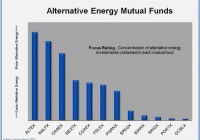
Summary There is a wide range of how focused the different green mutual funds are on alternative energy. Some stocks that a mutual fund may hold are easy to classify as alternative energy companies, others are not. Mutual Funds with the greatest alternative energy focus are ALTEX, NALFX and GAAEX. Not all alternative energy mutual funds are created equal. In a recent interview with the Wall Street Journal , a reporter asked me which alternative energy mutual funds were the most focused on renewables, noting that many mutual funds hold non-energy related companies such as Apple (NASDAQ: AAPL ), PepsiCo (NYSE: PEP ) and Google (NASDAQ: GOOG ). The answer to this question is not as straight forward as one might think. This article sorts out which mutual funds are truly invested in the dynamic and growing green energy sector, and which ones are more peripheral. Greener Than Thou-Revealing How Much a Mutual Fund is Focused on Alternative Energy Despite the desire of many investors to keep their portfolios clean of polluting investments, there is no perfectly pure alternative energy mutual fund. There is, however, a wide range of how focused the different green mutual funds are on alternative energy. Finding out which mutual funds have the highest concentration of alternative energy investments takes a multipronged approach. First, the Roen Financial Report scrutinizes the prospectus of each fund to see if its principles align with alternative energy investment goals. Second, for each company that the mutual fund holds, the annual report and financial filings are thoroughly examined to determine exactly how much of a company’s operations are related to the various green sectors that the Roen Financial Report covers – energy efficiency, environmental * , fuel alternatives, smart grid, solar and wind. Sometimes it is easy to tell whether a mutual fund holds stocks that are in one or more of the alternative energy sectors, but in other cases it is not so obvious. Clearly, pure play companies like First Solar, Inc (NASDAQ: FSLR ), Renewable Energy Group Inc (NASDAQ: REGI ) and SolarCity Corp (NASDAQ: SCTY ) are stocks that alternative energy investors are seeking. There are other companies, though, that have alternative energy products and services as part of their business model, but those operations are not the company’s bread-and-butter. For example, Johnson Controls (NYSE: JCI ) is a large industrial conglomerate that has two business units which address alternative energy themes -building efficiency and renewable power solutions. I estimate that alternative energy accounts for perhaps half of JCI’s revenues. Interestingly, shares of JCI are owned by 8 out of 12 alternative energy mutual funds, more than any other single company. Another example of a company with partial alternative energy operations is Valmont Industries (NYSE: VMI ). Valmont manufactures support towers for wind turbines, anemometers, power line transmission, mass transit poles, lighting and related structures. This company cannot be ignored-its contribution is critical to the infrastructure needed to support utility-scale solar, wind and smart grid projects that will continue to be built over the coming decades. However, my analysis attributes an estimated 15% of Valmont’s current earnings are a result of alternative energy projects. Google is another company that blurs into alternative energy, though it is obviously not its main business. Google realizes that it is basically an electricity-based service-no electricity, no Google. Because of this, Google has made a significant commitment to moving toward a more clean and sustainable electric supply. Google has moved on this in no small way, having invested in over $1.5 billion in wind and solar projects . In order to simplify the analysis of how much of a stocks business relates to alternative energy, only the stocks needed to reach at least 50% of a fund’s weighted holdings were included (or at a minimum, the fund’s top 10 holdings). Also, two mutual funds that the Roen Financial Report tracks were left out of the rating system, Allianz RCM Global Water A (MUTF: AWTAX ) and Calvert Green Bond A (MUTF: CGAFX ). AWATX invests in stocks and securities engaged in water-related activities, a sector related to green energy but with more of an environmental focus. Calvert Green Bond is another good choice for green investors, but is a different kind of animal than a stock fund, so it is hard to make an apples-to-apples comparison. Its prospectus states that investments include: …securities of companies that develop or provide products or services that address environmental solutions and/or support efforts to reduce their own environmental footprint; bonds that support environmental projects; structured securities that are collateralized by assets supporting environmental themes; and securities that, in the opinion of the Fund’s Advisor, have no more than a negligible direct environmental impact, which may include securities issued by the U.S. government or its agencies, and U.S. government-sponsored entities. The Greenest Alternative Energy Mutual Funds (click to enlarge) Three funds clearly top the list of having the greatest alternative energy focus: Firsthand Alternative Energy (MUTF: ALTEX ), New Alternatives (MUTF: NALFX ) and Guinness Atkinson Alternative Energy (MUTF: GAAEX ). These funds have a high concentration of alternative energy investments, and strongly focused investment principles. Firsthand Alternative Energy Five of Firsthand Alternative Energy’s top 10 weighted holdings are pure play companies such as First Solar , Sun Power (NASDAQ: SPWR ) and Solar City . Firsthand Alternative Energy is very specific in their prospectus, stating that they: …invest at least 80% of the Fund’s assets in alternative energy and alternative energy technology companies, both U.S. and international. Alternative energy currently includes energy generated through solar, hydrogen, wind, geothermal, hydroelectric, tidal, biofuel, and biomass. Alternative energy technologies currently include, but are not limited to, technologies that enable energies to be tapped, stored, or transported, such as fuel cells; services or technologies that conserve or enable more efficient utilization of energy; and technologies that help minimize harmful emissions from existing energy sources, such as helping reduce carbon emissions. It is important to note that ALTEX is the smallest of all alternative energy funds that the Roen Financial Report tracks, and we give this fund a low overall investment rank. New Alternatives New Alternatives Fund also has a very good concentration of alternative energy investments. The top six of its holdings are 100% pure play alternative energy companies. Additionally, the top 50% of its weighted portfolio is estimated to be over 75% involved in alternative energy. The investment objective of the fund is not the strongest of all alternative energy funds, but it is very specific: At least 25% of the Fund’s total assets will be invested in equity securities of companies in the alternative energy industry. ‘Alternative Energy’ means the production and conservation of energy in a manner that reduces pollution and harm to the environment, particularly when compared to conventional coal, oil or nuclear energy… The Advisor also considers the perceived prospects for the company and its industry, with concern for economic, political and social conditions at the time. In addition the Advisor considers its expectations for the investment based on, among other things, the company’s technological and management strength. Guinness Atkinson Alternative Energy GAAEX has a very strong concentration of alternative energy companies in its portfolio. When looking at the top two-thirds of its holdings, about 90% of those investments are involved in green energy production. Guinness Atkinson Alternative Energy also has one of the tightest investment principles guiding the fund: The Alternative Energy Fund invests at least 80% of its net assets in equity securities of alternative energy companies (both U.S. and non-U.S.). Alternative energy companies include, but are not limited to companies that generate power through solar, wind, hydroelectric, tidal wave, geothermal, biomass or biofuels and the various companies that provide the equipment and technologies that enable these sources to be tapped, used, stored or transported, including companies that create, facilitate or improve technologies that conserve or enable more efficient use of energy. Mutual Funds With a Lesser Alternative Energy Focus Funds that the Roen Financial Report rate as having the least alternative energy stocks are Gabelli SRI Green AAA (MUTF: SRIGX ), Portfolio 21 R (MUTF: PORTX ) and Green Century Balanced Fund (MUTF: GCBLX ). Gabelli SRI AAA Prior to last year, Gabelli SRI AAA had more of an alternative energy focus (its previous name was The Gabelli SRI Green Fund), but is now a social screened fund. It does, however, include some alternative energy holdings, such as JCI and VMI. Its investment objectives show that SRIGX has more of an exclusionary screen than a proactive green energy focus: Pursuant to the guidelines, the Fund will not invest in the top 50 defense/weapons contractors or in companies that derive more than 5% of their revenues from the following areas: tobacco, alcohol, gaming, defense/weapons production, and companies involved in the manufacture of abortion related products. Portfolio 21 R PORTX is an environmentally focused fund, which also has a broader social charge. Fewer than expected of its holdings, though, have an alternative energy focus. Only about one-third of its portfolio comprises companies that have a hand in alternative energy sectors. Its prospectus states that: The Advisor believes that the best long-term investments are found in companies with above-average financial characteristics and growth potential that also excel at managing environmental risks and opportunities and societal impact… The Advisor considers a company’s position on various factors such as ecological limits, environmental stewardship, environmental strategies, stance on human rights and equality, societal impact as well as its corporate governance practices. Green Century Balanced Fund Green Century Balanced is a mutual fund that invests in environmentally responsible and sustainable companies, and those not directly in the fossil fuel business. Even though its prospectus is very specific about including companies that have environmental goods and services, very few of the top weighted stocks in its portfolio work in green energy. Instead, many of its top holdings are in technology, health care and financial services. Despite this fact, GCBLX does have a detailed and relevant investment objective: The Fund invests primarily in the stocks and bonds of environmentally responsible and sustainable U.S. companies…whose primary business involves the provision of an environmentally sound good or service, such as appropriate technology for sustainable agriculture, renewable energy, energy efficiency, water treatment and conservation, air pollution control, pollution prevention, recycling technologies, or other effective remedies for existing environmental problems. The Fund also invests in companies whose primary business is not solving environmental problems but which conduct their business in an environmentally responsible manner. Such companies are evaluated on a range of criteria that includes, but is not necessarily limited to, an assessment of each company’s: Environmental performance indicators such as its consumption of natural resources, energy usage, greenhouse gas emissions, toxic emissions, use of toxic chemicals, and solid waste generation; Pollution prevention programs and supply chain environmental policies; Compliance with environmental laws and regulations and its potential environmental liabilities; Environmental management infrastructure and governance procedures; Public reporting on an annual basis of its environmental performance… The Balanced Fund does not intend to invest in companies engaged in the extraction, exploration, production, manufacturing or refining of fossil fuels… Summary My analysis clearly shows that there is a wide range in how committed an alternative energy mutual fund may be in its investments. There is a big difference in the holdings of funds like Firsthand Alternative Energy and New Alternatives compared to Green Century. This information should help guide investors interested in green energy mutual funds to help them know what these funds may or may not be holding. * Though not directly involved in alternative energy, environmental stocks include those in the business of recycling, pollution control, clean water supply and related sectors. While their business is related to the goals of alternative energy by reducing pollution and creating a cleaner planet, it is not as directly related as companies in the energy sector. So for the purposes of this analysis, the factor that environmental companies contribute to a mutual fund’s alternative energy focus was reduced. In other words, a water service company like Xylem Inc (NYSE: XYL ) rates lower than a solar panel manufacturer like Trina Solar (NYSE: TSL ).