Tag Archives: stocks

A Compilation Of The Best International Equity ETFs

Summary I’m rounding up six of my favorite international equity ETF investments. I’m temporarily bearish on two of them for exposure to H-Shares in Hong Kong. I want international diversification without China. I like VNQI despite a high expense ratio because it is a fairly unique ETF for diversification. My favorite international ETF is SCHF due to the rock-bottom expense ratio. I’ve been holding off on purchases due to correlations on international investments. If China crashes, it may drag down most international investments. That could create an excellent buying opportunity on SCHF. Investors should be seeking at least some international exposure in their portfolio for diversification. To help with that challenge, I rounded up several of the ETFs that I believe offer some of the most compelling alternatives. These options have low expense ratios relative to the sectors they are covering and each is free to trade in at least one brokerage. Given the volatility of international equity markets, I consider a lack of trading costs to be a nice bonus for investors that may want to rebalance frequently. Since I want these assets to be solid targets for rebalancing, I also want strong liquidity so the bid-ask spread will be small. Below is a short list of contenders for the best international ETFs: Vanguard Global ex-U.S. Real Estate ETF (NASDAQ: VNQI ) Schwab International Equity ETF (NYSEARCA: SCHF ) Schwab Emerging Markets ETF (NYSEARCA: SCHE ) Schwab International Small-Cap Equity ETF (NYSEARCA: SCHC ) Vanguard FTSE Emerging Markets ETF (NYSEARCA: VWO ) Vanguard Total International Stock ETF (NASDAQ: VXUS ) While I like all of these ETFs for long-term returns due to low expense ratios, I feel some are more compelling than others at the present time. Different Exposure Diversified investments in global real estate are very rare. This is a niche sector, and I like the diversification benefits of including it in a portfolio. If the expense ratio was present on another ETF (.24%), I would find that expense ratio less attractive. However, for this niche market, it is a fairly low expense ratio. Another major factor for me right now is safety. I have been vocal about my bearish assessment of China and that means I prefer international equity with less exposure to China. Comparative Rankings for Emerging Markets In this list, which does not contain a single loser, I would personally put SCHE and VWO at the bottom because I’m not big on emerging markets right now. This is a temporary placement based on my assessment of which countries I want to include in my portfolio. China is being classified as an emerging market and has a heavy weight in these ETFs. That doesn’t mean that they are specifically holding the A-shares for Chinese equities, but I’m not big on the H-shares in Hong Kong either. I expect a crash in the Chinese market to result in dramatic losses of wealth for domestic consumers, and I see that loss of consumer wealth as causing a fundamental problem for sales in the country. Declining sales may drive declining earnings and that would justify lower valuations of the companies regardless of which market is being used to create exposure to businesses in China. If I were bullish on China, I would rank these two ETFs as being extremely attractive. Given my bearish stance, the combination of large positions in China and high correlation between emerging markets during times of stress (again, not the fault of the ETFs) makes me want to underweight emerging markets and severely underweight China. I favor trading shares of SCHE for free trading in a Schwab account. Investors with free trading on VWO should make the exact opposite argument. VNQI The market exposures are concerning me for VNQI, but holdings in China are fairly slow while still offering me a very unique portfolio. Since I want diversification and don’t want China, this is a natural choice for inclusion though I may be heavier on it than I really want to be. It is running around 13% to 14% of my portfolio. International Equity This section is looking at international equity that is not specified as emerging markets. These ETFs should hold more developed markets, and I expect them to be less volatile. I like all three of these ETFs (SCHF, SCHC, and VXUS) as solid options for international exposure, but the high correlation of emerging markets does not end with the other emerging markets. The emerging markets also have a fairly strong correlation to international equities when the markets are stressed. A terrible performance by China could hurt these ETFs because of the correlation even though they have solid holdings in markets that I consider to be more fundamentally sound. I don’t want to give up international equity exposure, and these are some of the best ETFs for gaining it. They all offer expense ratios below .20 and exposure to markets that I think are less risky than the emerging markets. I picked SCHF as my ETF to hold for a couple reasons. While the free trading is nice for making small additions, the ETF also delivers rock-bottom expense ratios for international ETFs. If I decide to make any additions to my international equity exposure, SCHF is the easy choice. SCHC offers some very interesting exposure elements with small-cap equity, but I’m concerned about market stress and correlations. Therefore, I figure small-cap international equity is more risky than large-cap international equity. Conclusion I find all six of the ETFs to be legitimate contenders for best of breed in their respective category. Due to expense ratios and a desire for more developed markets and larger companies, SCHF is the easy choice for my portfolio. The thing that makes me hesitate to buy more shares is not a concern about the fundamentals of the companies being overvalued; it is concerns about correlation to China hurting international returns. To conclude that though, if China crashes and correlation drags down share prices on SCHF, I’ll be one of the investors buying the cheap shares to take advantage of the situation. Disclosure: I am/we are long VNQI SCHF. (More…) I wrote this article myself, and it expresses my own opinions. I am not receiving compensation for it (other than from Seeking Alpha). I have no business relationship with any company whose stock is mentioned in this article. Additional disclosure: Information in this article represents the opinion of the analyst. All statements are represented as opinions, rather than facts, and should not be construed as advice to buy or sell a security. Ratings of “outperform” and “underperform” reflect the analyst’s estimation of a divergence between the market value for a security and the price that would be appropriate given the potential for risks and returns relative to other securities. The analyst does not know your particular objectives for returns or constraints upon investing. All investors are encouraged to do their own research before making any investment decision. Information is regularly obtained from Yahoo Finance, Google Finance, and SEC Database. If Yahoo, Google, or the SEC database contained faulty or old information it could be incorporated into my analysis.
The Vanguard Short-Term Bond ETF Is A Great Replacement For Cash

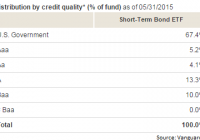
Summary The Vanguard Short-Term Bond ETF delivers excellent diversification benefits relative to the equity market without being as miserable as a savings account. The bonds in the Vanguard Short-Term Bond ETF are focused on very high credit quality but there is a small selection of lower rated bonds to enhance returns. The Vanguard Short-Term Bond ETF bond selections contain some diversification in maturity to give investors a focus on short term investments without giving up on yield. The Vanguard Short-Term Bond ETF (NYSEARCA: BSV ) is a solid bond fund for the very conservative investor that wants a place to park while earning a better return than a savings account will offer. Lately I’ve been concerned about the market being relatively highly valued. I don’t intend to retire for quite a while (measured in decades), so I’m willing to be more aggressive with my portfolio. Despite being willing to accept additional risk on my portfolio, I want to be compensated for taking risk. While I still like certain parts of the market (as shown by buying diversified REIT ETFs), I’m looking for ways to get better diversification in the portfolio. The desire for better diversification across asset classes has pushed me to make a few hard decisions. For instance, it is pushing me to slow my rate of purchases on additional equity so I can have more money on hand to buy in if we see a significant retreat in equity prices. Those expectations and desires bring to me look for some solid bond ETFs so I can at least get a little interest on the money that I would otherwise have to hold in cash. Low volatility and low correlation with the domestic stock market are major concerns, but I also want something with reasonable liquidity and low expense ratios. When the yields on bonds are terrible, and I believe that is a fair statement today, a high expense ratio would eat a substantial portion of the returns. In this case, the expense ratio is only .10%. It is in my nature to be cheap and I have to admit, that .10% sounds fair to me. It thoroughly beats many bond funds on expense ratio. How volatile is the Vanguard Short-Term Bond ETF? I started by checking for correlation with the SPDR S&P 500 Trust ETF (NYSEARCA: SPY ) by comparing the monthly changes in dividend adjusted closes over the last 8 years. The correlation was 3.34%, which is beautiful. By virtually any measure, incorporating BSV into a portfolio is going to materially reduce the risk of the portfolio. While SPY had a standard deviation of 4.6% in monthly returns, BSV only had a deviation of .777%. Low correlation and low volatility is exactly what we should expect for a fund invested in short-term high quality bonds, but it is always worth double checking. Sources of Return With the returns on short term maturities being very low, investors should consider having at least a little bit of credit risk or duration in their portfolio even if they want to focus on short term holdings. I checked both of those areas to see how the Vanguard Short-Term Bond ETF was doing on internal diversification. Credit The following chart shows the credit quality breakdown: In my opinion, this is a fairly reasonable allocation for an ETF that an investor might want to use as a substitute for cash in their portfolio if they expect to be holding that cash for a few months at a time. The ETF portfolio drops down to ratings as low as Baa but keeps the majority of their holdings in very high credit quality bonds. Maturity The next chart shows the maturity of the various bonds Again the maturity distribution looks good for short term holdings. By dividing the holdings between the different maturities rather than focusing them around a specific point there is more diversification across the short term yield curves which should produce a slight decrease in the expected level of volatility for the expected level of income. A Potential Cash Replacement Looking at the monthly returns over 8 years, I found there was only one month where the change in the dividend adjusted close was equal to 2% or greater. In that one month, it was precisely at 2%. Due to the positive returns from interest and low levels of duration and credit and risk the downside risk is fairly low. Of course, if an investor is using it as a replacement for cash they’ll need to use a brokerage that lets them buy and sell it with no commissions. Conclusion I like the portfolio for the Vanguard Short-Term Bond ETF. The yields are still weak, but that is an issue with high quality short term yields being very low rather than a problem with the underlying ETF. Given the low risk of the bond ETF, I like this fund as a source of diversification in the portfolio. It’s too bad free trading on the ETF is not more widely available, because this looks like a solid place to park cash when the market gets too rich or when investors are just looking for new options. The combination of a small amount of duration with a little credit risk makes this option more appealing to me than a fund that refused to take on any risk in those categories. Disclosure: I/we have no positions in any stocks mentioned, and no plans to initiate any positions within the next 72 hours. (More…) I wrote this article myself, and it expresses my own opinions. I am not receiving compensation for it (other than from Seeking Alpha). I have no business relationship with any company whose stock is mentioned in this article. Additional disclosure: Information in this article represents the opinion of the analyst. All statements are represented as opinions, rather than facts, and should not be construed as advice to buy or sell a security. Ratings of “outperform” and “underperform” reflect the analyst’s estimation of a divergence between the market value for a security and the price that would be appropriate given the potential for risks and returns relative to other securities. The analyst does not know your particular objectives for returns or constraints upon investing. All investors are encouraged to do their own research before making any investment decision. Information is regularly obtained from Yahoo Finance, Google Finance, and SEC Database. If Yahoo, Google, or the SEC database contained faulty or old information it could be incorporated into my analysis.

Market Lab Report – Premarket Pulse 7/20/15

Major averages rose Friday on higher volume with the NASDAQ Composite closing at new all-time highs and up the most due to favorable earnings reports from tech heavyweight Google (GOOGL) which helped other substantial NASDAQ stocks rally including Illumina (ILMN) and Priceline (PCLN). Another tech heavy, Facebook (FB), also had a gap up. Stocks such as GOOGL and FB could be considered potentially buyable gap ups as they are tech leading heavyweights, but the speed of ascent may be slower than our normal type of buyable gap up. GOOGL’s market cap stands at $478 billion and FB’s at $267 billion. Nevertheless, they could be considered actionable if either meets your risk tolerance profiles. That said, both may rise in a back-and-filling manner. Gold hit new multi-year lows even though China’s supply of gold came in lower than expected. That said, China is vying to get the IMF to include its currency as a reserve currency as it challenges the hegemony of the US dollar, so that could have far reaching implications. With all the cross current in play regarding the price of gold, it is best as always not to try to out think the markets, and focus on the technicals. Commodities in general are also heading lower once again as they approach multi-year lows. The global economy’s woes especially in China imply slackening demand for commodites, thus the lower prices. As we have had a number of strong, actionable names over the past week as the market bounced higher, do as we have advised all year by taking profits when you have them in context with the overall chart, and keep stops tight. In this market, stocks take the elevator up and the trap door down.