Tag Archives: setpageviewname

Best And Worst: Small Cap Growth ETFs, Mutual Funds And Key Holdings
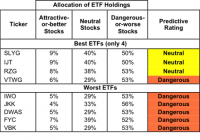
Summary Small Cap Growth style ranks 10th in 2Q15. Based on an aggregation of ratings of 11 ETFs and 498 mutual funds. SLYG is our top rated Small Cap Growth ETF and VSCRX is our top rated Small Cap Growth mutual fund. The Small Cap Growth style ranks 10th out of the 12 fund styles as detailed in our 2Q15 Style Rankings report . It gets our Dangerous rating, which is based on an aggregation of ratings of 11 ETFs and 498 mutual funds in the Small Cap Growth style. Figures 1 and 2 show the five best and worst rated ETFs and mutual funds in the style. Not all Small Cap Growth style ETFs and mutual funds are created the same. The number of holdings varies widely (from 29 to 1214). This variation creates drastically different investment implications and, therefore, ratings. Investors seeking exposure to the Small Cap Growth style should buy one of the Attractive-or-better rated ETFs or mutual funds from Figures 1 and 2. Figure 1: ETFs with the Best & Worst Ratings – Top 5 (click to enlarge) * Best ETFs exclude ETFs with TNAs less than $100 million for inadequate liquidity. PowerShares Fundamental Pure Small Growth Portfolio ETF (NYSEARCA: PXSG ) and Vanguard S&P Small Cap 600 Growth (NYSEARCA: VIOG ) are excluded from Figure 1 because their total net assets are below $100 million and do not meet our liquidity minimums. Figure 2: Mutual Funds with the Best & Worst Ratings – Top 5 (click to enlarge) * Best mutual funds exclude funds with TNAs less than $100 million for inadequate liquidity. Transparent Value Small Cap Fund ( TVSIX , TVSFX ) and Oak Associates River Oak Discovery Fund (MUTF: RIVSX ) are excluded from Figure 2 because their total net assets are below $100 million and do not meet our liquidity minimums. State Street SPDR S&P 600 Small Cap Growth (NYSEARCA: SLYG ) is our top-rated Small Cap Growth ETF and Virtus Small-Cap Core Fund (MUTF: VSCRX ) is our top-rated Small Cap Growth mutual fund. SLYG earns a Neutral rating and VSCRX earns an Attractive rating. One of our favorite stocks held by Small Cap funds is Universal Insurance Holdings (NYSE: UVE ), which earns a Very Attractive rating. Since 2009, Universal Insurance has grown after-tax profit ( NOPAT ) by 21% compounded annually. In addition to its NOPAT growth, the company has increased its return on invested capital ( ROIC ) to 39% in 2014, up from 16% in 2011. Economic earnings have also been positive since 2007. Despite the impressive profit growth achieved by Universal Insurance, the stock remains undervalued. At its current price of $24/share, UVE has a price to economic book value ( PEBV ) ratio of 0.9. This ratio implies the market expects Universal Insurance’s NOPAT to decline by 10% from current levels. However, as noted above, Universal has grown NOPAT by double digits over the past five years. If Universal Insurance Holdings can grow NOPAT by just 8% compounded annually for the next 10 years the stock is worth $38/share today – a 58% upside. Vanguard Small-Cap Growth ETF (NYSEARCA: VBK ) is our worst rated Small Cap Growth ETF and AllianzGI Ultra Micro Cap Fund (MUTF: GUCAX ) is our worst rated Small Cap Growth mutual fund. VBK earns a Dangerous rating and GUCAX earns a Very Dangerous rating. One of our worst rated stocks held by GUCAX is Cardiovascular Systems (NASDAQ: CSII ), which earns our Dangerous rating. NOPAT losses have increased every year since 2012, expanding from -$14 million to over -$33 million in 2014. ROIC has also been negative each year since 2012 and is currently -32%. This equates to Cardiovascular Systems destroying 32 cents of every dollar invested into the business. Despite all of this, CSII’s stock price does not reflect the company’s deteriorating performance. Since 2012, the stock has tripled in price. When considering the fundamental performance of the company over this period, we believe the stock to be overvalued. To justify its current price of $29/share, the company would need to achieve positive pretax margins immediately and grow revenue by 35% compounded annually for the next 18 years . This seems very optimistic given that the company has never grown revenue above 31% year over year, and has remained unprofitable while doing so. Figures 3 and 4 show the rating landscape of all Small Cap Growth ETFs and mutual funds. Figure 3: Separating the Best ETFs From the Worst ETFs (click to enlarge) Figure 4: Separating the Best Mutual Funds From the Worst Funds (click to enlarge) Sources Figures 1-4: New Constructs, LLC and company filings Disclosure: David Trainer and Allen L. Jackson receive no compensation to write about any specific stock, style, style or theme. Disclosure: I/we have no positions in any stocks mentioned, and no plans to initiate any positions within the next 72 hours. (More…) I wrote this article myself, and it expresses my own opinions. I am not receiving compensation for it. I have no business relationship with any company whose stock is mentioned in this article.

3 Healthcare Funds To Buy As Supreme Court Upholds ObamaCare

Fund holdings, ETF investing “}); $$(‘#article_top_info .info_content div’)[0].insert({bottom: $(‘mover’)}); } $(‘article_top_info’).addClassName(test_version); } SeekingAlpha.Initializer.onDOMLoad(function(){ setEvents();}); The Supreme Court has ruled 6-3 to uphold a key provision of the Affordable Care Act. The Supreme Court ruling holds that the Affordable Care Act can authorize federal tax credits for eligible Americans living not just in states with their own exchanges but also in the states that use the federal market place. This decision is not only a major win for the Obama Administration, it is also a win for healthcare companies. After the announcement, the S&P 500 healthcare index rose .85 percent and many hospital stocks enjoyed gains of 8 percent and above. These reactions from the market, show that Wall Street views the Supreme Court decision as a positive sign for the continuance of strong growth in the healthcare sector. With this Supreme Court decision and the historical steadiness of the healthcare sector, it would be wise to consider investing in this sector or increasing your investment exposure. Below we will share with you 3 buy-ranked healthcare mutual funds. Each has earned either a Zacks Mutual Fund Rank #1 (Strong Buy) or a Zacks Mutual Fund Rank #2 (Buy) as we expect these mutual funds to outperform their peers in the future. Fidelity Select Medical Delivery Portfolio (MUTF: FSHCX ) seeks long-term capital growth. FSHCX invests a major portion of its assets mainly involved in operations related to hospitals, nursing homes and other organizations engaged in providing healthcare services. FSHCX primarily focuses on acquiring common stocks of companies throughout the globe. Factors including financial strength and economic conditions are considered to invest in a company. The Fidelity Select Medical Delivery Portfolio fund is non-diversified and has returned 17.1% in the year-to-date frame. FSHCX has an expense ratio of 0.79% as compared to a category average of 1.37%. Turner Medical Sciences Long/Short C (MUTF: TMSCX ) invests a large chunk of its assets in healthcare firms. TMSCX uses a long/short growth strategy for reduction of volatility and capital preservation during market downturns. TMSCX mainly focuses on acquiring securities of companies having market capitalizations greater than $250 million. TMSCX is expected to maintain a portfolio of 15 to 75 securities long, and 15 to 75 securities short. The Turner Medical Sciences Long/Short C fund has returned 27.6% in the year-to-date frame. As of May 2015, TMSCX held 40 issues with 4.96% of its assets invested in Prothena Corp. pls (NASDAQ: PRTA ). Janus Global Life Sciences D (MUTF: JNGLX ) seeks capital appreciation over the long run. JNGLX invests the lion’s share of its assets in securities of life science oriented companies. JNGLX invests a minimum of one-fourth of its assets in firms from the “life sciences” domain. The Janus Global Life Sciences D fund has returned 21.8% in the year-to-date frame. Andrew Acker is the fund manager and has managed JNGLX since 2007. Original Post Share this article with a colleague

3 ETFs To Buy As Housing Picks Up

Though the U.S. housing market saw a rough first quarter, sales are picking up as the spring selling season gets into full swing. The season usually warms up in March and sees maximum business till the back-to-school season in September. The spring selling season generally brings in improving sales trends. Higher job numbers, a reassuring economy, moderating home price gains, affordable interest/mortgage rates, rising rentals, recent federal initiatives to increase mortgage availability and a limited supply of inventory point to an inevitable pickup in the housing market. Even though the U.S. economy faltered in the first quarter of the year, this can mostly be attributed to the strong dollar and a harsh winter. The economy is expected to improve later this year. Rising consumer confidence, a reassuring economy and improving employment trends should lead to better home sales as the year progresses. Last year saw slowing housing price gains on stabilizing demand. The trend is expected to continue in 2015 as well. Moreover, housing should remain an affordable option in 2015, as mortgage rates are still below historical levels. Even if mortgage rates rise in the latter half of the year – as is widely anticipated – housing will likely remain reasonable. Apartment rental rates have also continued to move up, making home buying more attractive than renting. To add to the positives, plans from the White House to cut premiums on mortgage insurance should increase mortgage availability and thereby encourage home buying among first-time homebuyers. With oil prices continuing their downward journey and the economy largely on the mend, the desire to own new homes should get a shot in the arm. ETFs to Tap the Sector Given the improving fundamentals, the homebuilding sector deserves a closer look. For investors willing to play the space in a less risky way, an ETF approach can be a good idea. This technique can help to spread out assets among a wide variety of companies and reduce company-specific risk at a very low cost. Below, we have highlighted three ETFs that are worth looking into. SPDR Homebuilders ETF (NYSEARCA: XHB ) XHB is one of the more popular homebuilding ETFs in the market today, with assets under management of around $1.58 billion and a trading volume of roughly 4.28 million shares a day. The fund has an expense ratio of 35 basis points. The fund holds 37 stocks in its basket, with 50% of the assets going to mid caps and 6% comprising large-cap stocks. Despite the smaller holding pattern, the fund does not appear to be concentrated in the top 10 holdings. The fund has just 33.9% in the top 10, with Aaron’s Inc. (NYSE: AAN ), A. O. Smith Corporation (NYSE: AOS ) and Tempur Sealy International Inc. (NYSE: TPX ) occupying the top 3 positions with asset allocation of 3.84%, 3.54% and 3.41%, respectively. The fund’s assets include 32.83% homebuilders, 29.27% building products and 15.59% home furnishing retail stocks. The fund carries a Zacks Rank #3 (Hold), with a high level of risk. iShares U.S. Home Construction ETF (NYSEARCA: ITB ) Another popular choice in the homebuilding sector is ITB, which tracks the Dow Jones U.S. Select Home Construction Index. It has $2.03 billion in assets, with a trading volume of roughly 4.1 million shares a day, while its expense ratio is just 45 basis points. The fund holds 37 stocks in its basket, of which only 11% are large cap securities. The fund has a concentrated approach in the top 10 holdings, with 57.7% of its asset base invested in them. Among individual holdings, the top stocks in the ETF include D. R. Horton, Inc. (NYSE: DHI ), Lennar (NYSE: LEN ) and Pulte (NYSE: PHM ), with asset allocation of 10.61%, 10.45% and 8.30%, respectively. Homebuilders accounts for around 65% of this fund. The fund carries a Zacks Rank #3 (Hold), with a high level of risk. PowerShares Dynamic Building & Construction Portfolio ETF (NYSEARCA: PKB ) This ETF comprises around 30 housing companies, and has its assets invested across all classes of the market spectrum. Engineering and construction stocks comprise 21% of the fund, followed by building materials companies that account for 17%. A look at the style pattern reveals that the fund has a preference for growth stocks. The fund manages an asset base of $56.4 million, and has an expense ratio of 63 basis points. The fund has only 15% in large cap securities and 46.3% in the top 10 holdings. The fund carries a Zacks Rank #3 (Hold), with a high level of risk. To Sum Up While the housing market slowed down in the first quarter, homebuilders are increasingly optimistic of the spring selling season. However, increasing competitive pressure and rising land and construction cost amid moderating home price increases are the headwinds in the housing market. Original Post