Tag Archives: seeking

Correction Prep With These Inverse ETFs

U.S. equities have been on a multi-year bull streak. We are now seeing some weakness in the markets. Bearish, short ETFs to hedge against potential turns. With U.S. markets showing some chinks in the armor, investors can utilize inverse or short exchange-traded funds to hedge against a bearish turn. Some market observers point out that it has been over 1,200 days since the S&P 500 experienced a 10% or greater correction, reports John Melloy for CNBC . For those who are wary of a potential pullback in the S&P 500 index, there are a number of bearish or inverse ETF options with varying levels of leveraged exposure to capitalize off a weakening S&P 500. The ProShares Short S&P 500 ETF (NYSEARCA: SH ) takes a simple inverse or -100% daily performance of the S&P 500 index. Alternatively, for the more aggressive trader, leveraged options include the ProShares UltraShort S&P 500 ETF (NYSEARCA: SDS ) , which tries to reflect the -2x or -200% daily performance of the S&P 500, the Direxion Daily S&P 500 Bear 3x Shares ETF (NYSEARCA: SPXS ) , which takes the -3x or -300% daily performance of the S&P 500, and the ProShares UltraPro Short S&P 500 ETF (NYSEARCA: SPXU ) , which also takes the -300% daily performance of the S&P 500. Market participants are growing wary after a lackluster start to 2015, with poor earnings growth and a significant rally in 2014. According to a recent Investors Intelligence survey, 34.7% of polled strategists see a correction ahead, compared to 31% a week ago. “I believe that the end of Fed QE (cannot be replaced by ECB QE in its influence) and growing possibility in my mind of a June rate hike, at the same time earnings growth is slowing, dramatically raises the risk of a stock market correction,” Peter Boockvar, strategist for The Lindsey Group, said in the article. “After six years into a bull market where valuations are very stretched, investors should be watching their back and not swinging for any fences anymore.” Furthermore, looking at the fixed-income market, Bob Walters, who oversees the capital markets business for Quicken Loans, argues than an inverting yield curve could indicate a slowdown or recession could occur this year, reports Ron Insana for CNBC . Specifically, the flattening yield curve usually occurs during a slowdown and inverts during a recession where long-term rates are lower than short-term rates. The central bank typically hikes short-term rates to cool an overheating economy. Meanwhile, long-term bonds will see greater demand and yields fall as higher short-term rates help depress inflation expectations. Alternatively, investors can also capitalize off the fall in the widely viewed Dow Jones Industrial Average through the ProShares Short Dow 30 ETF (NYSEARCA: DOG ) , which tries to reflect the -100% daily performance of the Dow Jones Industrial Average. For the more aggressive traders, the ProShares UltraShort Dow 30 ETF (NYSEARCA: DXD ) takes the -200% of the Dow Jones and the ProShares UltraPro Short Dow 30 ETF (NYSEARCA: SDOW ) reflects the -300% of the Dow. Lastly, the ProShares Short QQQ ETF (NYSEARCA: PSQ ) takes the inverse or -100% daily performance of the NASDAQ-100 Index. For the aggressive trader, the ProShares UltraShort QQQ ETF (NYSEARCA: QID ) tracks the double inverse or -200% performance of the NASDAQ-100, and the ProShares UltraPro Short QQQ ETF (NASDAQ: SQQQ ) reflects the triple inverse or -300% of the NASDAQ-100. Disclosure: The author has no positions in any stocks mentioned, and no plans to initiate any positions within the next 72 hours. (More…) The author wrote this article themselves, and it expresses their own opinions. The author is not receiving compensation for it. The author has no business relationship with any company whose stock is mentioned in this article.
Momentum Vs. Cap-Weighted Sectors: Know What You Own

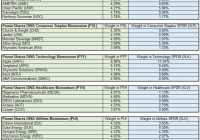
In February of 2014, we were hired to be the index provider for 9 PowerShares sector ETFs and they then became the PowerShares DWA Momentum Sector ETFs. This was an extension of the work that we were already doing with PowerShares in creating the indexes used for PDP , PIE , PIZ , and DWAS . The idea behind these Momentum sectors was to identify the top momentum names from each sector and then weight the stocks in the index by momentum. This is a clear departure from creating a sector index that is just weighted by market capitalization. To get an idea of just how different a momentum-weighted and a capitalization-weighted sector ETF can be, consider the table below. It shows the top 5 holdings and weights of those holdings in each of our momentum sectors and compares that exposure to a capitalization-weighted ETF. (click to enlarge) Source: PowerShares and State Street, As of 2/4/15 As you can see, there can be significant differences in exposure. Two key reasons for the differences: We weight the stocks by momentum and not by capitalization. Our investment universe also consists of Small, Mid, and Large Cap stocks. Weighting sector ETFs by momentum, we believe, will lead to superior results over time. The relative strength strategy is NOT a guarantee. There may be times where all investments and strategies are unfavorable and depreciate in value. See www.powershares.com for more information. Dorsey Wright is the index provider for a suite of momentum ETFs with PowerShares. Are you Bullish or Bearish on ? Bullish Bearish Neutral Results for ( ) Thanks for sharing your thoughts. Submit & View Results Skip to results » Share this article with a colleague

Apple And IBM Enter The PowerShares Buyback ETF

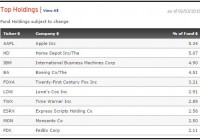
Apple and IBM are now holdings of PKW. 5% of shares outstanding was the key cutoff line. These two tech heavyweights represent more than 10% of the ETF. Additions should make this growing ETF more popular. When investors look at exchange-traded funds, there are a number of choices out there. You can buy an index ETF like the SPDR S&P 500 (NYSEARCA: SPY ), a sector ETF like the Energy Select Sector SPDR (NYSEARCA: XLE ), or even a country fund like the iShares MSCI Germany (NYSEARCA: EWG ). There are certainly ETFs for everyone, and there are even many specialty ones. One of my favorite ETFs is the PowerShares Buyback Achievers Portfolio ETF (NYSEARCA: PKW ), an exchange-traded fund that buys stock in companies that are buying back stock, and lots of it. I’ve written about this ETF a couple of times, and today I’m here to write about it again. My first article on PKW was in regards to a major shakeup that could come involving technology giant Apple (NASDAQ: AAPL ). As many investors know, Apple has an extremely large share repurchase plan in place. Well, PKW has just done its annual reconstitution, and Apple and tech giant IBM (NYSE: IBM ) are now holdings in this ETF. Today, I’ll look at what that means for both stocks, as well as PKW. For those that have not heard of this ETF, please see the above-linked article for the complete description. The main idea is to include companies that have bought back at least 5% of their outstanding shares over the past twelve months. The fund is reconstituted every January and rebalanced four times a year. Apple recently announced a tremendous quarter highlighted by nearly 75 million iPhone sales. The strength of the phone and other products has allowed Apple to spend more than $70 billion on its buyback in the past couple of years. Last year, Apple missed out on inclusion in this ETF, but in the past twelve months, the share count has come down by more than 6%. IBM has also been buying back a tremendous amount of shares, and it is the third-largest holding in the fund. In the table below, you can see the other top ten holdings, which include Home Depot (NYSE: HD ), Boeing (NYSE: BA ), Twenty-First Century Fox (NASDAQ: FOXA ), Lowe’s (NYSE: LOW ), Time Warner (NYSE: TWX ), Express Scripts (NASDAQ: ESRX ), Monsanto (NYSE: MON ), and FedEx (NYSE: FDX ). That’s an impressive list of companies, including a couple of Dow components. (See all holdings here ) The total value of the ETF is a little over $2.7 billion, meaning Apple represents about $145 million. That doesn’t sound like much when thinking about Carl Icahn’s couple of billion worth of Apple’s shares or the market cap of nearly $700 billion. However, to the average investor, it is still a lot of money. Another ETF buying up a chunk of Apple makes less shares available to the public, which Apple’s buyback is also helping with. Adding Apple and IBM to the ETF should help PKW become more popular. On the face of it, a buyback ETF seems like a great idea. When stocks are rising, those that are buying back shares should do even better. When stocks are falling, buybacks should ease the fall. Companies are spending a ton of money on buybacks currently . In the chart below, you can see how PKW has significantly outperformed SPY over the past five years. (click to enlarge) (Source: Yahoo! Finance) The ETF market just got a bit more interesting, as Apple and IBM have been added to the PowerShares Buyback Achievers Portfolio ETF. These names may only stay in the ETF for a year, but they certainly will attract attention to PKW. This has been one of my favorite ETFs over the past couple of years, and its performance has been rather spectacular. For those looking for some exposure to Apple or IBM without gambling on them individually or the tech sector as a whole, perhaps you should take a look at this name. Disclosure: The author has no positions in any stocks mentioned, and no plans to initiate any positions within the next 72 hours. (More…) The author wrote this article themselves, and it expresses their own opinions. The author is not receiving compensation for it (other than from Seeking Alpha). The author has no business relationship with any company whose stock is mentioned in this article. Additional disclosure: Investors are always reminded that before making any investment, you should do your own proper due diligence on any name directly or indirectly mentioned in this article. Investors should also consider seeking advice from a broker or financial adviser before making any investment decisions. Any material in this article should be considered general information, and not relied on as a formal investment recommendation.