Tag Archives: seeking

Leveraged Oil ETPs: How To Lose Your Shirt Waiting For A Bounce
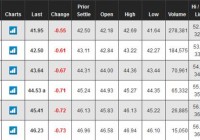
Summary Leveraged oil ETPs are for traders, not investors. There is a wealth destroyer in their rebalancing. And another one in their holdings. A reader wrote in a comment that he was long crude oil with leveraged ETPs : the VelocityShares 3x Long Crude Oil ETN ( UWTI) and the ProShares Ultra Bloomberg Crude Oil ETF ( UCO). I wrote a short answer, but I think a more detailed one to a broader audience may avoid significant wealth destruction to some Seeking Alpha members. This is also a way to give back to the investing online community. Many years ago, someone helped me understand one of the points below, resulting in closing a position with a loss that could have become much worse. This article is in no way an analysis or opinion on oil price. I have no idea if crude oil will bounce or fall lower. It aims at explaining that leveraged oil ETPs are a risky way to bet on a reversal. Indeed, they cumulate 2 wealth destroyers in their internal structure: beta-slippage and contango. 1st wealth destroyer: beta-slippage To understand what is beta-slippage, imagine a very volatile asset that goes up 25% one day and down 20% the day after. A perfect double leveraged ETP goes up 50% the first day and down 40% the second day. On the close of the second day, the underlying asset is back to its initial price: (1 + 0.25) x (1 – 0.2) = 1 And the perfect leveraged ETP? (1 + 0.5) x (1 – 0.4) = 0.9 Nothing has changed for the underlying, and 10% of your money has disappeared. Beta-slippage is not a scam. It is a mathematical property of a leveraged and rebalanced portfolio. Beta-slippage may be positive in a steady bull market, but the only sure thing is that you lose money when it is not. To learn more about beta-slippage, you can read this article . 2nd wealth destroyer: contango Contango happens when future contracts for an asset are at a higher price than the spot price. It means that buyers are ready to pay a premium for a later delivery. Just like a factory director anticipating higher raw material prices would try to buy stuff now, and rent a warehouse to store it. Contango can be assimilated to the warehousing cost. The opposite situation, called backwardation, can be interpreted as a premium for fast delivery. By extension, we also speak of contango when future contracts for a given month are more expensive than for the previous month (rolling cost is a more appropriate denomination in this case). It means that when you roll futures from one month to the next one, you get less stuff for the same money. This is what commodity ETPs do, leveraged or not. Here are crude oil futures quotes on 8/17/2015: (click to enlarge) (source: cmegroup.com) When rolling contracts from September to October, oil ETPs are losing 1.3%. It is an annualized loss of 14.6%. It is not so much if oil price surges in a near future, but it is an additional decay if it continues to the downside, or just stays in a range the next few months. Conclusion Leveraged oil ETPs are instruments for traders. They should not be held more than a few weeks unless oil enters a steady bullish trend. They are in no way designed for “buy-and-hold” and long-term investors. Holding them without an entry signal and an exit plan is a fool’s game. Leveraged oil ETPs shareholders are currently losing money to wait and see. There are better ways to bet on a bounce in oil price, like seeking undervalued and solid energy stocks with little debt. It is out of this article’s scope. Recommended reads on the cost of waiting: The Tartar Steppe by Dino Buzzati and Waiting for Godot by Samuel Beckett. Disclosure: I/we have no positions in any stocks mentioned, and no plans to initiate any positions within the next 72 hours. (More…) I wrote this article myself, and it expresses my own opinions. I am not receiving compensation for it (other than from Seeking Alpha). I have no business relationship with any company whose stock is mentioned in this article.

Best And Worst Q3’15: Large Cap Blend ETFs, Mutual Funds And Key Holdings

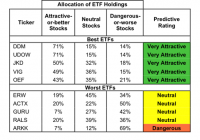
Summary Large Cap Blend style ranks second in Q3’15. Based on an aggregation of ratings of 56 ETFs and 848 mutual funds. DDM is our top-rated Large Cap Blend ETF and CMIIX is our top-rated Large Cap Blend mutual fund. The Large Cap Blend style ranks second out of the 12 fund styles as detailed in our Q3’15 Style Ratings for ETFs and Mutual Funds report. It gets our Attractive rating, which is based on an aggregation of ratings of 56 ETFs and 848 mutual funds in the Large Cap Blend style. See a recap of our Q2’15 Style Ratings here. Figures 1 and 2 show the five best and worst-rated ETFs and mutual funds in the style. Not all Large Cap Blend style ETFs and mutual funds are created the same. The number of holdings varies widely (from 18 to 1334). This variation creates drastically different investment implications and, therefore, ratings. Investors seeking exposure to the Large Cap Blend style should buy one of the Attractive-or-better rated ETFs or mutual funds from Figures 1 and 2. Figure 1: ETFs with the Best & Worst Ratings – Top 5 (click to enlarge) * Best ETFs exclude ETFs with TNAs less than $100 million for inadequate liquidity. Sources: New Constructs, LLC and company filings The Arrow QVM Equity Factor ETF (NYSEARCA: QVM ) is excluded from Figure 1 because its total net assets are below $100 million and do not meet our liquidity minimums. Figure 2: Mutual Funds with the Best & Worst Ratings – Top 5 (click to enlarge) * Best mutual funds exclude funds with TNAs less than $100 million for inadequate liquidity. Sources: New Constructs, LLC and company filings The ProShares Ultra Dow 30 ETF (NYSEARCA: DDM ) is the top-rated Large Cap Blend ETF and the Calvert Large Cap Core Portfolio (MUTF: CMIIX ) is the top-rated Large Cap Blend mutual fund. Both earn our Very Attractive rating. The Ark Innovation ETF (NYSEARCA: ARKK ) is the worst-rated Large Cap Blend ETF and the Virtus Equity Trend Fund (MUTF: VAPAX ) is the worst-rated Large Cap Blend mutual fund. ARKK earns our Dangerous rating and VAPAX earns our Very Dangerous rating. Qualcomm (NASDAQ: QCOM ), is one of our favorite stocks held by Large Cap Blend funds and earns our Very Attractive rating. Since 2010, Qualcomm has grown after-tax profit ( NOPAT ) by an impressive 29% compounded annually. Over this same time frame, Qualcomm’s already top quintile return on invested capital ( ROIC ) has improved from 31% to 54%. In addition, Qualcomm’s NOPAT margin has increased from 23% to 26%. Qualcomm is becoming more efficient and profitable but the stock does not reflect these advancements. At its current price of $62/share, Qualcomm has a price to economic book value ( PEBV ) ratio of 0.8. This ratio implies that the market expects Qualcomm’s NOPAT to permanently decline by 20% from current levels. If Qualcomm can grow NOPAT by just 4% compounded annually over the next five years , the stock is worth $87/share ­- a 40% upside. Amazon.com (NASDAQ: AMZN ) is one of our least favorite stocks held by Large Cap Blend funds and earns our Dangerous rating. Since peaking in 2010, Amazon’s NOPAT has declined by 28% compounded annually. Its ROIC has fallen from 31% to a bottom quintile 2% over the same time frame. We’ve previously written on Amazon’s free cash flow issues , which have only worsened as Amazon had -$7 billion in free cash flow in 2014. Despite the issues, bulls continue to propel AMZN higher, and it is up 47% year to date, which leaves it significantly overvalued. To justify its current price of $535, Amazon must grow NOPAT by 28% compounded annually over the next 23 years . This scenario also assumes Amazon is able to maintain its pre-tax (NOPBT) margin at 1%, a level it has not been able to maintain in recent years. We think the expectations embedded in AMZN are out of touch with reality. Figures 3 and 4 show the rating landscape of all Large Cap Blend ETFs and mutual funds. Figure 3: Separating the Best ETFs From the Worst Funds (click to enlarge) Sources: New Constructs, LLC and company filings Figure 4: Separating the Best Mutual Funds From the Worst Funds (click to enlarge) Sources: New Constructs, LLC and company filings D isclosure: David Trainer and Kyle Guske II receive no compensation to write about any specific stock, style, style or theme. Disclosure: I/we have no positions in any stocks mentioned, and no plans to initiate any positions within the next 72 hours. (More…) I wrote this article myself, and it expresses my own opinions. I am not receiving compensation for it. I have no business relationship with any company whose stock is mentioned in this article.

5 Huge Advantages You Have Over Professional Investors

Summary 5 ways you are better than the Wall Street pros. Why you should ignore what the pros are doing. How to take advantage of your advantages. “Don’t bother. The professionals are better than you and they know something you don’t.” Really? There’s some truth to that, but there’s plenty of lies mixed in that short statement too. And it’s easy to dismiss yourself or come up with excuses for why you can’t do it. Here are five to get things started. 5 Common Excuses That Investors Believe The market definitely knows more than me. I’m not smart enough to invest on my own and build wealth. I always miss out on the best opportunities. I can’t beat the computer trading that the market uses. I don’t know where or how to start. Sure there’s some validity to each excuse above. But investing is unique because anyone can be a good investor. The Uniqueness of the Stock Market Outside of the stock market, it’s a good idea to find a professional to solve a problem instead of trying to do it yourself or asking the average Joe next door. Need a kidney transplant? Find a surgeon. Not Ms. Traci, your old biology teacher. But the investment industry is one of the very few where you don’t need any qualification, practice, skill or even knowledge to be involved in the markets. The entry criteria is zero, which is why so many people lose money, throw their hands in the air and forever condemn the stock market as a rigged gambling machine. But choose your direction wisely from the get-go (value investing for you and me), build a good framework based on good guidance, quality investment books and investing resources, and it’s easy to do well. Ignore all the talking heads using jargon or the people who talk about much money they are raking in. All they want to do is make you feel dumb and gloat about how smart they are. But what if you continue to disbelieve, or you know people who continue to doubt that investing successfully on your own is possible? You don’t need to be a rocket scientist. Investing is not a game where the guy with the 160 IQ beats the guy with 130 IQ. – Warren Buffett If you have more than 120 or 130 I.Q. points, you can afford to give the rest away. You don’t need extraordinary intelligence to succeed as an investor. – Warren Buffett Here are 5 advantages small investors hold over professionals that you must take advantage of. 1. As a Small Investor You Are Able to Choose Your Expertise When you are investing as an individual, you are free to choose whatever specialty you like. You can choose whatever stock to invest in. Large. Small. Biotech. Miners. Safety. Whatever. You can even choose to focus and become an expert in a few industries that excite you or take a broader approach. On the other hand, professionals are paid to focus on certain fields or investing strategies. If you get sick of an industry, just move onto your next interest. Professionals don’t have this luxury of choosing their strengths. As a small investor, you are agile and can go to different market caps, sectors, and even buy some odd lots for a quick turnover. 2. You Can Go Against the Grain Professional investors follow the herd. It’s better to be incorrect with the herd and maintain job security instead of sticking your neck out and getting fired if the investment doesn’t work out. You don’t have a boss obsessed with profits breathing down your neck with another younger guy waiting in line to take your job. You’re free to take a contrarian approach like the good ol’ net net strategy or concentrating on Buffett type stocks. The pros will start investing in an “uncertain” stock, sector or country once it starts to rebound – when the best time to invest has already passed. 3. You Are Not Judged Monthly, Quarterly or Yearly Not being obsessed with beating the market is one of the biggest advantages you have. Because the pros have clients and upper management demanding results, the only thing they can do is chase hot stocks, hot trends and buy and sell quickly so as not to “look” left out. Ignoring short term results and focusing on the big picture will put you in a position to succeed. The once bad Golden State Warriors didn’t win the NBA championship by flipping players every time something didn’t work out. They had a long term team building strategy that paid off in the end. Being able to sacrifice short term results to compound long term wealth is a huge advantage. 4. You Can Afford to Be Patient Can’t find a company to invest in? That’s ok because you can hold cash and wait for the right opportunity. Nobody is going to say anything because you hold 30% of your portfolio in cash. You also put yourself in the best position to succeed by buying depressed securities and playing the waiting game. Professionals on the other hand are risk-averse as they can’t afford to lose their client’s money. This leads to following the herd and mediocre returns. 5. It’s Cheaper You don’t need a room full of computers, computerized trading system software or instant access to information. You don’t have to pay people for insider “tips”. With all the high frequency trading going on, the long term value investing approach saves you money on commissions, taxes and other fees. Take Advantage of Your Advantages There’s no reason to play the same game as the professionals. In Malcolm Gladwell’s book David and Goliath , it covers how the “disadvantaged” overcome the expected winners. An important observation was that if David (the small investor) tries to take on Goliath (Wall Street professionals) within the same set of rules, the winner is always Goliath. However, by not playing by the same system and expectations, David is able to defeat Goliath. In other words, as a small investor, do what the big boys can’t to beat them at their own game. In 2008, Buffett bet that a low cost index fund will outperform a fund of hedge funds. Over a ten-year period commencing on January 1, 2008, and ending on December 31, 2017, the S&P 500 will outperform a portfolio of funds of hedge funds, when performance is measured on a basis net of fees, costs and expenses. The result at the start of 2015? The S&P500 up 63.5% and the hedge fund up around 19.6%. The takeaway? It’s only in the stock market where the average Joe can have such a strong advantage over the professionals. Make the most out of your advantages. Disclosure: I/we have no positions in any stocks mentioned, and no plans to initiate any positions within the next 72 hours. (More…) I wrote this article myself, and it expresses my own opinions. I am not receiving compensation for it. I have no business relationship with any company whose stock is mentioned in this article.