Tag Archives: seeking-alpha

Comparing 2 Monthly Eaton Vance Income Closed End Funds EOS And EOI

Summary EOI has a steady monthly income ($0.0864) of 7.8%. EOS has a steady monthly income ($0.0875) of 7.6%. Total return for both funds beat the DOW average over the last 30-month test period. EOS Fund is higher than 30% in Tech companies. Moderate downside protection and income from covered call writing. This article compares the Eaton Vance Enhanced Equity Income Fund II (NYSE: EOS ) and the Eaton Vance Enhanced Equity Income Fund (NYSE: EOI ), for steady monthly income. The differences between these two funds and how each fund has its place in the investment world, will be shown by looking at total return, company allocation, the use of covered calls and the distribution break down of each fund. Both funds use covered calls on a different group of companies to smooth out some of the volatility of the market. The EOI fund and EOS fund both invest in large Cap and Mid Cap companies and would be a good addition to a portfolio needing more diversification in this category. The big difference between them is that EOS tries to model the Russell 1000 and EOI tries to model the S&P 500. Both of these funds would be good for a tax deferred account because of the large amount of long term and short term capital gain in the distribution amounts. If you need a similar fund for a taxable account please see my articles on the Eaton Vance Tax-Managed Buy-Write Opportunities Fund (NYSE: ETV ). Yearly Income percentage and Total Return Being in retirement, my goal is to have a steady monthly income, without the swings of dividends that are paid on a quarterly or yearly basis. The EOI fund distribution of 7.8% ($0.0864/Month) return in today’s low interest rate environment is fantastic. This distribution is slightly higher than the EOS yearly distribution of 7.5% ($0.0875/Month). I calculated the total return of EOS and EOI over a two-year plus six-month period starting with January 1, 2013 till July 2015 YTD, 30 months in total. I chose this time frame since it included the great year of 2013, the moderate year of 2014 and the moderate year of 2015 YTD. EOS outperformed the DOW average by over 18%. For the 30-month period, the DOW total return was 37.52% and EOS beat it at 56.13%. EOI total return was 46.18%, beating the DOW total return by 8.66%. Fund Symbol Total Return For last 30 months Yearly Distribution Difference from DOW Baseline Difference EOI 46.18% 7.8% 8.66 EOS 56.13% 7.5% 18.61 DOW Baseline 37.52% —— Company Allocation The Eaton Vance website gives a full list of the companies and percentage of each in the fund portfolios for the latest quarter. The table below gives the top ten companies for each fund and their percentage in their individual portfolios. Using price chart data, I calculated the total return of the EOI top 10 companies out of 61 that the fund owns. Seven outperformed against the DOW average in total return over the 30-month test period and three missed the total return baseline of 37.52%, Qualcomm (NASDAQ: QCOM ) at 14.82%, General Electric (NYSE: GE ) at 36.9% and Exxon (NYSE: XOM ) at 4.56%. Similarly for EOS, all ten of the companies beat the DOW baseline total return. The total percentage of the portfolio for the top ten companies of each fund is shown at the bottom of the table. EOS Company Percentage In Portfolio EOI Company Percentage In Portfolio Apple (NASDAQ: AAPL ) 6.60% Apple 4.63% Google Inc. (NASDAQ: GOOG ) 5.29% Google Inc. 4.08% Facebook (NASDAQ: FB ) 3.18% JPMorgan Chase (NYSE: JPM ) 2.69% Amazon (NASDAQ: AMZN ) 3.01% Exxon Mobil Corp 2.51% Visa (NYSE: V ) 2.74% Visa 2.36% Biogen Inc (NASDAQ: BIIB ) 2.70% General Electric Co. 2.36% Celgene (NASDAQ: CELG ) 2.69% Qualcomm Inc. 2.31% Medtronic PLC (NYSE: MDT ) 2.45% Amazon 2.27% Priceline Group Inc. (NASDAQ: PCLN ) 2.14% Walt Disney (NYSE: DIS ) 2.26% Walt Disney 2.13% Medtronic PLC 2.14% Total 32.93% Total 27.61% Source: Eaton Vance EOI pretty much follows its S&P 500 index while EOS is a bit heavy in tech compared to its Russell 1000 index at 31.77% of the portfolio Covered Calls Both funds sell covered calls for income and downside protection, but there is a difference in what they do. EOS sells covered calls against 48% of their individual company positions with an average duration of 26 days and 6.3% out if the money. EOI sells covered calls against 46% of their individual company positions with an average duration of 24 days and 5.4% out of the money. Covered calls provide both EOS and EOI fund portfolios some downside risk protection and extra income to smooth out the normal market gyrations. The management in using covered calls, has the time to use covered call exit methods, if the market price goes against them. The big difference is that EOS tries to follow the Russell 1000 and EOI tries to follow the S&P 500. For both funds selling covered calls on individual company positions provides a steady income that does well in total return in a strong up market and gives some downside protection in a moderate market. If you want to learn about covered calls, I recommend the books written by Alan Ellman on the subject. Distributions Each month, both funds issue a statement saying which part of the distribution comes from short-term capital gains, long-term capital gains, investment income and return of capital. It is best to have both funds in a tax-deferred account so that you do not have to handle the tax calculations for the different categories of the distribution and most of the income is taxable. The EOS distribution through June 2015 YTD was 7.9% investment income, 0.0% short-term capital gains, 65.0% long-term capital gains and 27.1% return of capital. The EOI distribution through June 2015 YTD was 17.1% investment income, 0.0% short-term capital gains, 60.8% long-term capital gains and 22.1% return of capital. This is typical with short-term and long-term gains being a significant part of the EOS and EOI distributions. The funds do really well in a strong up market and follows the market in an average market. The fund managers advise against drawing any performance conclusions from the distribution breakdown. They do manage the fund payouts to try and keep the monthly payment constant. For a full explanation of return of capital, please refer to the articles written by Douglas Albo (CEFs and Return Of Capital: Is It As Bad As It Sounds). Conclusion EOI does not perform (Total Return) as well as EOS so EOS gets the nod here. Both funds follow the market and provide steady income, with fund price muted both on the upside and down side swings. Both funds are a good income vehicle in a tax-deferred account. they give a high monthly distribution , which is steady and beats the DOW averages over the test period of 30 months. They also provide someone like me, who generally picks his own companies an easy means of buying a diversified portfolio of large Cap and Mid Cap tech companies, without having to research each company in detail. EOS and EOI are a good complement to individual company positions. The Good Business Portfolio has a 5.5% position in EOS because of its better total return and high technology component. This is the only fund in the Good Business Portfolio. Of course this is not a recommendation to buy or sell and you should always do your own research and talk to your financial advisor before any purchase or sale. This is how I manage my IRA retirement account and the opinions on the companies are my own. I am long on EOS, GE, DIS and ETV and do not own or intend to buy any other companies mentioned in the article. Disclosure: I am/we are long EOS, ETV, DIS, GE. (More…) I wrote this article myself, and it expresses my own opinions. I am not receiving compensation for it (other than from Seeking Alpha). I have no business relationship with any company whose stock is mentioned in this article.
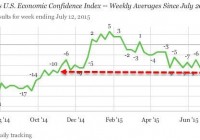
Economic Lethargy Continues To Bankroll The U.S. Stock Bull

Both wage growth and employment have shown lackluster improvement since the end of the Great Recession in mid-2009. Americans do not believe the economy is improving because they are not earning more money or securing higher-paying employment. The weaker the economic picture, the more likely the stock bull will prevail. Over the past century, the U.S. stock market typically turned down prior to the onset of a recession. You did not need to predict economic contraction; rather, you monitored the Dow and the S&P 500 because the benchmarks acted like leading indicators of bad times ahead. (Investors checked the market internals to get a sense for whether or not stocks themselves might “roll over.”) Stocks demonstrated their predictive powers as recently as October of 2007. The bear market eroded 20%-30% of value before the National Bureau of Economic Research (NBER) even acknowledged the recession’s inception date (12/07) in October of 2008. On the flip side, U.S. equities in today’s world do an atrocious job at recognizing economic sluggishness. The skepticism of chief financial officers (CFOs) at the largest corporations just hit two-year lows. Small business optimism registered its worst reading in 15 months. Meanwhile, you’d have to travel back to November of 2014 to find the sort of pessimism that exists today on the part of the American public. “Gary,” you protest. “People do not always act based upon the way that they feel.” Just the facts, then? The industrial sector – an economic segment that incorporates manufacturing, mining, and utilities – posted its weakest year-over-year (YOY) growth in more than five years. Wholesale sales (YOY) have been in steady decline since 2011, contracting 3.4% in June. Retail sales plummeted in June as well. (No snow. Was it just too hot outside?) And perhaps most importantly, both wage growth and employment (as a function of the population) have shown lackluster improvement since the end of the Great Recession in mid-2009. The take-home is twofold. First, Americans do not believe the economy is improving because they are not earning more money or securing higher-paying employment. For instance, the erosion of roughly one-and-a-half million higher-paying manufacturing jobs has been supplanted by the same number of lower-paying waiter/bartender positions. This dynamic hardly represents economic well-being. Second, the weaker the economic picture, the more likely the stock bull will prevail. In fact, the entire reason that the Federal Reserve needed to enact three rounds of electronic money creation via quantitative easing ($3.75 trillion in “QE”) on top of six-and-a-half years of zero percent overnight lending rates is because the economy has been too weak to tighten borrowing costs. Ironically, Fed chairwoman Yellen maintains that she anticipates hiking rates some time in 2015. Even though annual economic growth throughout the recovery has been stuck near the 2% level? Even as the Fed has downgraded its own expectations for economic expansion for the seventh consecutive year? Even as the the Fed has overestimated the pace of expansion in each of the last seven years? The bond market via the iShares 7-10 Year Treasury Bond ETF (NYSEARCA: IEF ) is not entirely sure if overnight lending rates will be bumped up or not. The fact that the slope of the 50-day moving average has turned lower here in 2015 suggests higher yields in the future, in much the same way that the announcement of QE tapering sent bond yields skyrocketing in 2013. However, IEF’s higher lows over the past five weeks coupled with strong resistance for the 10-year yield near 2.5% may suggest otherwise. Even more intriguing is the likelihood that the pace of any rate hikes may be more important than the timing of the first shot. September? Doubtful. December. Probably. Yet fed funds futures have only priced in a rate of 0.75% by the end of 2016. Only three rate hikes over the next 18 months? Or maybe it will be six at 0.125% so that the pace is even slower than the seemingly preordained quarter-point moves. (You heard the concept of one-eighth of a point here first!) Impressively, stocks continue to benefit from every economic downgrade as well as the lowered expectations for the rate hike timeline. If the European Central Bank (ECB) in Europe can successfully kick Greek debt woes down the pathway – if Chinese authorities can successfully decree that “thou shalt buy-n-hold Shanghai shares” – U.S. stocks may not have much too fear. Indeed, the uptrends for core holdings like the iShares S&P 100 ETF (NYSEARCA: OEF ), the Health Care Select Sect SPDR ETF (NYSEARCA: XLV ) and the Vanguard Information Technology ETF (NYSEARCA: VGT ) remain intact. At the same time, we’re holding a larger-than-usual amount in cash/cash equivalents (15%) in most portfolios. Debt-fueled excess in Greece, Puerto Rico and China gave us a peek of the challenges that central banks around the world will be facing. Global economic deceleration and sky-high U.S. valuations are another. We anticipate an opportunity in the 2nd half of 2015 to buy quality assets at significantly lower prices. Disclosure: Gary Gordon, MS, CFP is the president of Pacific Park Financial, Inc., a Registered Investment Adviser with the SEC. Gary Gordon, Pacific Park Financial, Inc, and/or its clients may hold positions in the ETFs, mutual funds, and/or any investment asset mentioned above. The commentary does not constitute individualized investment advice. The opinions offered herein are not personalized recommendations to buy, sell or hold securities. At times, issuers of exchange-traded products compensate Pacific Park Financial, Inc. or its subsidiaries for advertising at the ETF Expert web site. ETF Expert content is created independently of any advertising relationships.

Giving Utilities Credit When Tax Credit Is Due

Federal tax credits creates winners. Tax credits can boost utility earnings. Government is not using tax credits to pick losers. Tax credits can be helpful for taxpayers and consumers. Government has limited influence over utilities’ investments. It cannot force investor-owned utilities to build new wind turbines, solar farms, nuclear power or clean coal. However, it can offer incentives and hope utilities will be motivated to build new projects. One powerful incentive is the federal tax credit. For qualifying assets, the federal government allows investor-owned utilities to claim a credit on their income tax. That credit is determined by the asset’s type, condition and age. Federal tax credits come in two flavors. One is an investment tax credit (ITC). The other is a production tax credit (PTC). Normally, assets cannot qualify for both credits at the same time. Tax-exempt utilities, such as municipals and cooperatives, cannot use either. The ITC is a one-time credit offered for new capacity. The amount is a percentage of capital expended. It can only be claimed for qualified equipment after the new facility is fully constructed and only after it produces commercial power (source: 26 USC § 48 ). The federal government assumes no development risk and it assumes no construction risk. Except for initial production, the ITC is not designed to reward investors for energy production. The PTC is an annual credit offered for new energy production. The amount is based on energy produced (source: 26 USC § 45 ). To earn PTCs, utilities not only assume all development and construction risks, they also assume all production risks. If the facility’s production is anemic and underproduces, owners are penalized with reduced PTCs. In some cases, PTC payments may be reduced further if the asset earns above threshold revenues. In addition, PTC payments are limited to the first few years of the asset’s operating life. Unlike ITCs, PTCs are generally indifferent towards the utility’s capital cost. Most existing assets do not qualify for either credit. Wind power plants operating more than ten years do not qualify for tax credits. Solar power plants operating more than five years do not qualify. In addition, there are clawback provisions for assets that change ownership within prescribed periods. The government’s intent is to stimulate new investments. They use tax credits to help utilities reduce their capital expenditures, help small businesses with project financing and help owners reduce operating risks. They also use credits to help investors attract permanent financing. During the recent recession, the government used tax credits to create a temporary incentive that was intended to stimulate large, small and tax-exempt businesses. It was called 1603 and it referred to Section 1603 of American Recovery and Reinvestment Act of 2009 ( Public Law 111-5 ). For a short time, Congress allowed power plants that normally qualified for ITCs or PTCs to earn cash payments in lieu of tax credits. According to a recent US Treasury report , § 1603 performed as intended. It stimulated approximately 99,000 new energy projects with a combined capacity of 31,700 megawatts valued at approximately $84.5 billion (or $2.66 million per megawatt). Notwithstanding, special interests mischaracterize tax credits. Some claim tax credits are a federal giveaway program. Some claim the federal government uses tax credits as a means to pick winners over losers. Some also claim that tax credits intentionally hurt their businesses and help their competitors. There is a thread of truth in most of these claims. However, there are some distortions. Tax credits can be profitable for federal, state and local governments. First, the federal government allows all taxpaying businesses to deduct a number of ordinary expenses, including interest, taxes, depreciation and amortization. In addition to those deductions, qualifying assets may also earn ITCs. However, if a taxpayer earns an ITC, it must reduce their depreciable basis by one-half the value of the ITC. When the reduced depreciation is combined with the credit, the ITC’s net cost to the federal government is zero. In fact, it is less than zero. Second, the Modified Accelerated Cost Recovery System (MACRS) assigns a five-year useful life to solar, wind, geothermal and other property. For solar, wind and geothermal assets, there are no fuel costs. After five years, owners have no depreciation expenses. With no fuel costs or depreciation expense, utilities may find their asset generating revenues at the maximum federal income tax bracket for the remaining life of that asset (typically 15 to 20 more years). Consequently, the federal government can expect to receive at least some of their tax credit money returned. In some cases, as in ITC-earning utility-grade solar, they can expect to see all of it returned. Federal tax credits also produce new local, state and payroll taxes. If utilities had done nothing and not built new assets, state and local governments would earn no new taxes. With new assets appearing, state and local government have a new tax base that cost them nothing. Consequently, federal tax credits benefit state and local governments directly. When those benefits are added, the returns on federal investments become positive. There is more. Tax credits produce other economic benefits, some tangible and others intangible. Some tangible benefits include reduced energy costs, reduced taxes and increased economic development. Intangible benefits include improve system reliability, increased energy independence and improved energy security. Adding direct and indirect benefits and improving the federal, state and local tax base, tax credits appear to represent a solid investment. Another distortion is the argument that the federal government uses tax credits to pick winners over losers. It is true government is picking winners. However, their picks are not what some critics would have us believe. To illustrate the point, look at Exelon (NYSE: EXC ). Exelon owns the nation’s largest fleet of commercial nuclear power plants. When originally built, every one of those plants received government guarantees. Those guarantees amounted to tens of billions of dollars, all of which have all been previously consumed. Notwithstanding, Exelon and their Washington-based lobbying group (Nuclear Energy Institute) are upset about PTCs. They have been aggressively lobbying the US Congress to kill the PTC for wind turbines. Their argument is found on Exelon’s website , which claims: “The federal wind energy production tax credit is a prime example of the negative consequences of subsidies through which the government picks energy technology winners and losers.” It is an incredible statement. It turns out; the nuclear power industry is also granted PTCs (source: 26 U.S. Code § 45J ). In fact, nuclear-PTCs are designed to look very much like wind-PTCs. While wind-PTCs are set to expire, nuclear-PTCs are available today and tomorrow. In fact, two utilities plan to use those credits to help them finance their new nuclear construction projects. Southern Company (NYSE: SO ) expects to earn $2 billion worth of nuclear-PTCs. They, and their non-profit partners, are building a two-unit new nuclear power plant in Georgia. Their expected investment is approximately $15 billion. Their first unit is expected to enter commercial operations in 2019. Their second unit is scheduled to enter service in 2020. After each unit begins to produce power, they will be eligible to earn approximately $125 million per year in tax credits for eight years. For both units, Southern can expect to book approximately $2 billion in nuclear-PTCs. SCANA (NYSE: SCG ) also expects to earn nuclear-PTCs. Like Southern, SCANA and their non-profit partner, are building new nuclear units in South Carolina. They are using the same technology, similar contractors, similar budgets and similar schedules as Southern. They also expect to earn $2 billion in nuclear-PTCs after their units enter commercial operations. Considering the $4 billion in nuclear-PTCs allocated for Southern and SCANA, Exelon’s complaint appears confused. On the one hand, we have the nuclear industry complaining about wind-PTCs; on the other hand, we have the very same industry planning to book $4 billion in nuclear-PTCs. At the same time, the nuclear industry is complaining about the government picking winners, it appears they want the government to pick winners. The difference is Exelon wants the government to pick their assets as the winner and, conveniently, they want their competitors’ assets to be designated as the loser. While it appears the federal government likes new nuclear, new solar, new wind and new geothermal, they must hate coal. It turns out; they don’t. Like new nuclear units, the coal industry gets to play in the tax credit game. Utilities building new coal-burning power plants qualify for tax credits (source: 26 U.S. Code § 48A ). Unlike nuclear-PTCs, new coal burners earn ITCs. For example, the government offers a 20 percent ITC for coal projects using integrated gasification combined cycle technology (IGCC) and a 15 percent ITC for other advanced projects. Like all other power producers, coal-burning assets must qualify their assets in order to claim their tax credits. It appears coal-ITCs offered enough incentive for Southern and several other utilities to build new coal facilities. Southern has been building a next-generation IGCC in Kemper County, Mississippi. Unfortunately, Southern took too long to finish their project. Those delays forced Southern to disqualify Kemper for ITC purposes under current tax rules. Consequently, Southern lost $133 million in tax credits . The lesson learned from Southern’s Kemper experience is to count your chickens after they hatch, not before. Specifically, tax credits are not earned until all construction work is completed and the plant is producing power. If a utility booked a tax credit before the project is completed, they could find that tax credit recalled and siezed. There are other lessons. It is true; the government is using tax credits to pick winners. Those winners include new investments in almost everything, including coal, nuclear, wind, solar and other power technologies. The government is not using tax credits to pick losers, but they are ignoring gas turbines and depreciated assets. Those older assets consumed all manner of government incentives years ago. In fact, some of those older assets received higher levels of state government assistance than and new solar, wind or efficiency projects could ever expect. Tax credits do not work everywhere. Most of the nation’s 3,000+ utilities are municipal and cooperative utilities, which are normally tax exempt. To provide broader incentives, the federal government created other tools, which include grants, loan guarantees and public-private partnerships. And yes, it is possible for utilities to simultaneously secure federal loan guarantees, a state guarantees and federal tax credits for a single asset. The federal government offers carrots to utilities. They also keep sticks in their back pocket. The Environmental Protection Agency, the Nuclear Regulatory Commission, the Federal Energy Regulatory Commission, the Securities and Exchange Commission and the Internal Revenue Service all limit utility investments and operations. For utility investors, consumers and those relying on nation’s infrastructure, a balance favoring carrots is needed. When looking at utility financial statements, consider the impact of tax credits and related depreciation schedules. Those incentives affect earnings, balance sheets and cash flows in positive ways. As we saw with Southern’s Kemper project, premature declarations can be clawed back. For shareholders, utilities’ strategic investments in targeted areas can be profitable. It can also be profitable for states, consumers and taxpayers. Disclosure: I/we have no positions in any stocks mentioned, and no plans to initiate any positions within the next 72 hours. (More…) I wrote this article myself, and it expresses my own opinions. I am not receiving compensation for it (other than from Seeking Alpha). I have no business relationship with any company whose stock is mentioned in this article. Additional disclosure: Feel free to edit for clarity and readability. Constructive criticism is always appreciated