Tag Archives: seeking-alpha

My Rules For Portfolio Strategy

Summary The list of rules below comes from my personal investing experience. By preparing a set of rules in advance investors can be ready to make better decisions. A major change in my personal views is the inclusion of a rule to not be scared of sitting on cash. When a high quality ETF drops in price I view the drop as a sale, but when a company is trading down on good cause, I’m less attracted to it. Lately I’ve been finding more and more messages coming to my inbox. It’s great to hear what my readers are thinking, however I’ve noticed a trend in reader messages. Since I frequently cover the mREIT sector, readers want to know about how attractive the sector is as a whole and how I’m modifying my holdings and my portfolio strategy. This is a great area for research and it is an area that has been on my mind quite a bit lately. Therefore, I’ve come to a few rules for portfolio strategy that I believe will help me avoid mistakes and that I think readers will want to consider in designing their own portfolio strategy. Rule #1 Contemplate your portfolio goals before deciding how your money should be allocated. Frequently we here that all investors really care about is “total return”. I’m not saying that the source of return is a huge factor, but the volatility of the returns is a meaningful factor. In seeking risk adjusted returns I think investors often forget that the returns need to be measured on the basis of the risk involved in achieving them. Rule #2 All volatility is not created equal. I expect to see some volatility in my portfolio but the cause of the volatility matters. When my holdings fluctuate with the values on the major indexes it does not bother me as much as when individual holdings are moving dramatically. When Freeport-McMoRan (NYSE: FCX ) plummets on weak demand for commodities and commodity futures take a nose div, it bothers me more than when shares of the Schwab U.S. REIT ETF (NYSEARCA: SCHH ) drop on interest rate movements. This is a purely human response. I have a very strong level of faith in the future of equity REIT indexes, but I don’t have that same level of faith in commodity pricing. If someone asked me about the difference in these scenarios even a year ago, I might have had a different answer. I might have said that the volatility at the portfolio level was what mattered. Under “Modern Portfolio Theory” it would be precisely correct to focus only on the volatility at the portfolio level. However, the simple facts remain. When SCHH drops significantly, I see the low price precisely the same way I would view a discounted price at the grocery store. It looks like a sale and I toss more of it into my basket (portfolio). Rule #3 Focus on what you know. I discovered that the mREIT sector was a great fit for me because I enjoy math and prefer the harder sciences to the softer sciences. The construction of mREIT portfolios as leveraged option-embedded bond funds fits in precisely with how I like to do research. For many investors the mREIT sector is simply too dangerous for involvement and those investors should follow their allocation rules rather than go chasing yield. Rule #4 Index what you don’t know. There are thousands of investable equity securities in the U.S. market. It would be impossible for a single investor to know enough to be competent on every single security. Being truly competent (rather than merely arrogant) on a sector requires an intense time commitment. Only investing in that sector though would create a great deal of risk for the portfolio. Therefore, I believe the core of the portfolio should be held in funds that track a diversified portion of the equity market. For instance, I’m long the Vanguard Total Stock Market ETF (NYSEARCA: VTI ) as a major holding in my portfolio. I want to complement my indexing strategies with buying the most attractive options. This rule should not be construed as saying that if you don’t know “Chinese Solar Stocks” you should buy an index to represent them. If you don’t know that part of the market and it is not highly relevant to your investing strategy, then it should be avoided entirely. The goal with this rule is simply to fill in the desired allocations with low fee index funds to reduce the volatility. Rule #5 Don’t be scared of cash. I’ve been guilty of allocating my cash to equity rapidly on the basis that cash earns very poor returns when interest rates are very low. This becomes a situational issue. If we are talking about an employer sponsored 401k plan, it makes sense to pick the appropriate allocations (which would usually be low on cash) and to just “set it and forget it”. Since these accounts are using dollar cost averaging this can be a great strategy so long as the 401k plan has at least a couple excellent options. For instance, I’m using the Fidelity Spartan Total Market Index Fund (MUTF: FSTVX ) and the Fidelity Spartan Real Estate Index Fund (MUTF: FSRVX ) in an employer sponsored account. They have an enormous overlap with some of my other holdings, but when it comes to a passive account using dollar cost averaging I simply want a diversified U.S. market fund and a diversified U.S. REIT index fund. In both cases I care a great deal about expense ratios which were huge factors in picking the funds I did for that account. When I’m adding to my other holdings which are going to be more actively managed, I’ve revised my strategy to be more willing to hold cash. I’ll hold onto the cash until I find very attractive opportunities. One example of this scenario is being willing to pass on attractive opportunities when there may be even better opportunities right around the corner. Missing out on a good investment is an acceptable tradeoff for me if the discipline also keeps me from making bad investments. Rule #6 Define attractive opportunities. This builds upon the rule of not being scared to hold cash. If the goal in holding cash is to have some dry powder to load up on the investments that appear to be on sale, then you should know in advance what you consider to be a sale. For instance, I consider shares of SCHH at about $36.00 to be on sale. If shares of SCHH drop under $36.00 then I will happily spend my cash on buying more. I am perfectly willing to be overweight on the equity REIT sector despite the interest rate sensitivity because I have such a strong belief in the underlying fundamentals. I am also willing to buy up mREITs when I see them trading at what I consider to be a material discount to the market leaders. I generally view Annaly Capital Management (NYSE: NLY ) and American Capital Agency Corp. (NASDAQ: AGNC ) as the big players in the sector and I view other mREITs in relation to those companies. Due to the sheer size of NLY and AGNC, I believe the market will usually be more efficient in pricing them than in pricing the smaller players. Since I view mREITs on the basis of relative attractiveness, NLY and AGNC will usually be rated near hold in my view. The smaller mREITs can range from “strong buy” down to “short” based on their prices relative to the big players and their sustainable level of dividends. I may occasionally see AGNC or NLY as a very attractive company to go long or short as part of a pair trade. In those cases I’m seeing an attractive opportunity based off the other mREIT in the trade being too expensive or too cheap and I see the offsetting position in AGNC or NLY as an effective hedge to make the position market neutral so the investor is strictly seeking the alpha from correcting the pricing differences between the two mREITs. Conclusion The times when I’ve got burned the worst on a trade are precisely the times that I violated these fundamental rules. Each investor should know their own boundaries before selecting securities and they should remember that the rules they make are there to protect them. Those are the rules I attempt to follow in handling my investments. What rules do you follow in yours? Disclosure: I am/we are long VTI, SCHH, FSRVX, FSTVX, FCX. (More…) I wrote this article myself, and it expresses my own opinions. I am not receiving compensation for it (other than from Seeking Alpha). I have no business relationship with any company whose stock is mentioned in this article. Additional disclosure: Information in this article represents the opinion of the analyst. All statements are represented as opinions, rather than facts, and should not be construed as advice to buy or sell a security. Ratings of “outperform” and “underperform” reflect the analyst’s estimation of a divergence between the market value for a security and the price that would be appropriate given the potential for risks and returns relative to other securities. The analyst does not know your particular objectives for returns or constraints upon investing. All investors are encouraged to do their own research before making any investment decision. Information is regularly obtained from Yahoo Finance, Google Finance, and SEC Database. If Yahoo, Google, or the SEC database contained faulty or old information it could be incorporated into my analysis.
MTS4: Systemic Market-Timing For All Investors

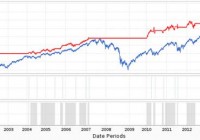
What are Multi Timing Scores. Why they are safer than the usual market-timing indicators. An actionable example. Multi Timing Scores are multi-valued market timing indicators focused on a long-term investing horizon, including the 4 main categories of market analysis: sentiment, economy, fundamentals, technicals. They count bearish signals among a set of elementary indicators based on economic data and S&P 500 companies. Indicators are chosen based on publications and consensus, they are not optimized. Multi Timing Scores gather them and makes the assumption that any of them may be wrong at any time, but not most of them at the same time. By definition, a systemic model is a model able to cope with complexity, which implies coping with uncertainty. Market timing scores take into account uncertainty about signals, and even that an indicator may be irrelevant. This makes them not only systemic, but also more robust than usual optimized indicators. Another characteristic of Multi Timing Scores is that they are multi-valued. The usual market-timing indicators are binary: they tell when you should be in or out of the market. Market conditions are more complex than risk-on / risk-off. Multi Timing Scores do not aim at making predictions, but at telling when the ecosystem is favorable to black swans. They can be considered as risk indicators, but the risk is not necessarily proportional to the score. The best way to understand Multi Timing Scores is to compare them with another score well-known by back-country skiers and mountaineers: the avalanche danger scale. When the level is maximum, it is strongly recommended to stay at home. But even when it is at its lowest value, zero risk does not exist. Fortunately the danger is less acute in investing. Mountains (a tough school of risk management) teach something else: regarding risk, expertise and experience don’t matter. Accident reports show that experts and professionals have more or less the same risk as beginners. Knowledge and routine are an advantage, except when they lead to an excess of confidence. Hence, the importance of having an objective view of risk built on facts and indicators, and always keeping in mind that zero risk does not exist. Market Timing Scores can be used in two ways: Defining an alarm level : the indicator value beyond which the benchmark average return is negative. It can be used to go in cash or take a hedge. The calculation is dependent of a backtest period. Hedging by thresholds. The hedge (for example shorting a stock index) is sized depending on the indicator value. Various tactics are possible, and backtesting may help make a better choice depending on the priority: risk reduction, drawdown duration reduction or return maximization. I will disclose now a simple and actionable version of Multi Timing Score with 4 components: MTS4. It is calculated from 4 elementary values (a,b,c,d) defined as follows: If the unemployment rate is above its value 3 months earlier, then a=1; else a=0. If S&P 500’s current-year EPS estimate is below its value 3 months earlier, then b=1; else b=0. If S&P 500’s 50-day sma is below the 200-day sma, then c=1; else c=0. If the 52-week sma of S&P 500 companies’ average short interest is above the 104-week sma, then d=1; else d=0. MTS4 is simply the sum a+b+c+d. As a consequence, it is an integer between 0 and 4. Readers willing more insights on the choice of elementary indicators can refer to this article and this other one . The charts and table hereafter report simulations of SPY when MTS4 =n+1. The period includes only 2 market cycles (01/01/2001 to 07/22/2015). Most components have been chosen from academic or professional publications studying elementary indicators on longer periods. Data and charts: portfolio123 MTS4=0: (click to enlarge) MTS4

Rounding Up The Top International Equity REIT ETFs

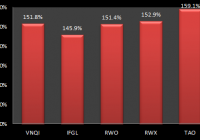
Summary TAO has delivered the strongest total returns, but when it outperformed the pack in the past it usually fell right back within a year. My favorite international equity REIT ETF is VNQI primarily due to the substantially lower expense ratio. While VNQI is offering the best expense ratio here, there are options for international equity without the REIT structure that offer much lower expense ratios. International equity REITs offer investors a compelling opportunity for portfolio diversification, but high expense ratios limit the long term potential returns. To help investors identify which funds might work for them, I’m performing a quick comparison on several of the most liquid options. The ETFs I’m comparing in this piece are: Vanguard Global ex-U.S. Real Estate ETF (NASDAQ: VNQI ) iShares International Developed Real Estate ETF (NASDAQ: IFGL ) SPDR Dow Jones Global Real Estate ETF (NYSEARCA: RWO ) SPDR Dow Jones International Real Estate ETF (NYSEARCA: RWX ) Guggenheim China Real Estate ETF (NYSEARCA: TAO ) Comparing Returns Out of the 5 ETFs, VNQI is by far the youngest. That is a little disappointing because I would love to have a longer period for measuring returns. Since I had to limit my assessment of historical performance to the period in which VNQI was a viable investment, my sample size was reduced to only about three and a half years. The chart below shows the total returns earned for each ETF using dividend adjusted closes since the start of 2012. TAO was the clear winner for the period, but it also shows less correlation with the other ETFs. The weaker correlation should be expected since TAO is investing in China and the other four are showing a great deal of international diversification. In my opinion, TAO is the most dangerous due to the very high volatility of monthly returns (about twice the volatility of the SPDR S&P 500 Trust ETF ( SPY)), but the price charts also indicate that TAO seems to be risky when it deviates from the rest of the pack. The next chart uses those dividend adjusted closes and standardizes for share prices by charting returns over time as a percentage of their starting values. (click to enlarge) The real reason to use a chart like this is to be able to do a quick eyeball check for correlation. When I run correlation statistics, sometimes the values appear to be more correlated than they do when I just eyeball the chart. At a glance we can see that TAO and RWO seem more prone to deviating from the rest of the pack. However, we have also seen that the deviations from the pack are reversed within a year or less. At the moment, TAO is still above the other options and expecting international REIT valuations to stay strongly correlated would suggest it may be moving a little too high unless it is actually breaking out of a very long term connection to the other international REIT markets. Comparing Expense Ratios Remember that over the long term a buy and hold investor will see a meaningful part of their total return determined by the expense ratio. In a period of 3 or 6 months the expense ratio won’t make a large difference in the total returns but a difference of .5% in the expense ratio becomes very meaningful if it is allowed to compound for 30 or 40 years. Even without compounding, a difference of .5% in the expense ratio would devour 20% of the portfolio value over 40 years. The next chart compares the expense ratio for each ETF. Since TAO was the only ETF with a different gross and net expense ratio, I’ve included both in the chart. As you might guess from my feelings about expense ratios, my holding for the exposure is the Vanguard Global ex-U.S. Real Estate ETF. As I’ve been digging into the returns for international equity REITs, I’m finding that I’m less than impressed with the risk to return ratio. Within my portfolio the highest expense ratio comes from VNQI and I’m contemplating if I may want to sell off from the sector all together and just use the Schwab International Equity ETF (NYSEARCA: SCHF ) for my international exposure. I love the REIT structure for investing, but I’d rather see lower levels of volatility and lower expense ratios. The expense ratio on SCHF is only .08%, which thoroughly beats even VNQI. Do I want international equity REIT exposure enough to keep holding VNQI over SCHF? I’m not sure. I want my equity holdings to be long term allocations and if I was going to buy one international equity investment and then not touch it for 40 years, I think I would lean towards SCHF. At the moment, I’m out of my position in SCHF because I liquidated the position to fund a limit-buy order on a microcap. If you’re looking for that international REIT exposure as part of the portfolio, my favorite is VNQI. I’m just starting to question whether it offers enough risk adjusted returns to be worth the allocation I’ve given to it. A Note on RWO RWO holds international REIT investments, but it is really a global REIT ETF. It was holding around 55% of the portfolio in domestic equity REIT investments. The internal diversification is great for an investor that is seeking to get their diversification with as few tickers as possible, but I see no reason to pay .50% on RWO when an investor could pay .24% on VNQI and .12% on the Vanguard REIT Index Fund (NYSEARCA: VNQ ). Conclusion There are a few options for international REIT investing through ETFs. In my opinion, VNQI offers the most compelling option but I’m starting to question whether the sector is worthy of allocation when the expense ratios and level of volatility throughout the industry are so high. If I was holding TAO, I would contemplate selling it whenever it moved meaningfully above the other international equity REIT investments. Since I’m bearish on China and prefer to make long term investments, the strategy doesn’t work very well for me. If I sell out later in the year, I would probably swap to an international ETF with a lower expense ratio. I might also put part of the cash into a short term bond fund to reduce my total exposure to international equity since I am concerned about the correlation between international equity investments. Even if I’m not holding shares in China, if my concerns come to pass I would expect most international ETFs to take a hit even if there was no direct exposure to China. Disclosure: I am/we are long VNQ, VNQI. (More…) I wrote this article myself, and it expresses my own opinions. I am not receiving compensation for it (other than from Seeking Alpha). I have no business relationship with any company whose stock is mentioned in this article. Additional disclosure: Information in this article represents the opinion of the analyst. All statements are represented as opinions, rather than facts, and should not be construed as advice to buy or sell a security. Ratings of “outperform” and “underperform” reflect the analyst’s estimation of a divergence between the market value for a security and the price that would be appropriate given the potential for risks and returns relative to other securities. The analyst does not know your particular objectives for returns or constraints upon investing. All investors are encouraged to do their own research before making any investment decision. Information is regularly obtained from Yahoo Finance, Google Finance, and SEC Database. If Yahoo, Google, or the SEC database contained faulty or old information it could be incorporated into my analysis.