Tag Archives: seeking-alpha

You Hungry? Have A Look At This Food And Beverages ETF

Summary This Food and Beverage ETF is poised to grow in the coming years. It offers a solid diversification of highly valued growth stocks in the food and beverage industry. The majority of the holdings in this ETF expect to have higher earnings in the future which offsets the current valuation. “So long you have food in your mouth, you have solved all questions for the time being” Quote by Franz Kafka Food and beverages, from sausages to drinks, there is always demand for something delicious. As the population of the world is growing, I am expecting that demand for food and beverages will continue to surge. The PowerShares Dynamic Food & Beverage Portfolio ETF (NYSEARCA: PBJ ) offers a perfect opportunity to take advantage of the ever growing food industry. This article will cover a fundamental analysis of PBJ. Dynamic Food & Beverage ETF This ETF is based on the Dynamic Food & Beverage Intellidex Index. This Intellidex index includes a variety of American food and beverage firms active in the production, manufacturing, sale and distribution of food and beverage products. Some of its holdings are well-known firms such as Starbucks (NASDAQ: SBUX ), Heinz-Kraft (NASDAQ: KHC ), Monster Beverages (NASDAQ: MNST ) and many more. In my view, these are typical expensive growth stocks and they certainly do not come cheap. As these are stocks with high P/E ratio’s I can understand that for some investors it carries too much unique investment risk . This food and beverage ETF offers the opportunity to diminish this unique risk as it’s well diversified. Therefore, it makes this ETF an interesting candidate for a retired investor who would like to invest in the fast growing food and beverage industry but not carry a large individual investment risk. Food and Beverage ETF: Profile Source: ETFDB The issuer of this ETF is Invesco , a large independent investment management company incorporated in Bermuda. The expense ratio of 0.61% is a reasonable number and should not be considered expensive. With 188 million assets under management it’s not a large ETF. The fund is rebalanced quarterly, every February, May, August and November. This ETF is currently trading 2% under its year high. Food and Beverage ETF: Return This ETF has pleased investors over the last few years as can be seen in the line chart underneath: (click to enlarge) Source: Ycharts Food and Beverage ETF: Sector Breakdown (click to enlarge) Source: ETFDB The Food and Beverage ETF has an excellent mixture between small and large cap stocks. Sector wise, holdings are mostly consumer defensive with a small part in the consumer cyclical sector and the rest in industrials . Food and Beverage ETF: Top Holdings Source: Invesco The main holdings of this ETF are Monster Beverages, Kraft-Heinz, Mondelez (NASDAQ: MDLZ ), Starbucks and General Mills (NYSE: GIS ). Together they consist of more than 26% of the entire ETF. Source: Ycharts As can be seen in the line chart above, the main holdings have yielded normal to abnormal returns in the last 2 years. Monster Beverages has done As can be seen in the line chart above, the main holdings have yielded normal to abnormal returns in the last 2 years. Monster Beverages has done especially well. Unfortunately, these large growth players do not come at a discount, as their current P/E is relatively high as shown underneath: Source: Ycharts Nevertheless, when looking at the forward P/E (the ratio of current price divided by predicted earnings), the 4 firms all have a lower P/E. This indicates that earnings are predicted to increase . That’s exactly the kind of growth you are looking for. This is an ETF with substantial expected growth in the future . That sheds a more positive light on the current valuation of this ETF. The Food and Beverage ETF: The main 3 holdings Monster Beverages is a firm that manufactures energy drinks, natural soft drinks and fruit drinks including their most known brand Monster Energy. The firm currently has a market cap of over 30 billion. It’s a firm with a high P/E, yet its expecting to grow significantly in the future as shown underneath: Monster Beverages estimates Source: 4traders The expected EPS of Monster in 2017 is $4.68, a substantial increase in comparison to today’s earnings per share. Kraft-Heinz is a firm which resulted out of the merger of Kraft Foods and Heinz, backed by 3G Capital and Berkshire Hathaway (NYSE: BRK.A ). They currently own 13 brands. It currently holds a P/E of around 50 which labels it not cheap. Mondelez is a large confectionery, food and beverage conglomerate with revenue over $30 billion. Recently, Bill Ackman bought a 5.5 billion stake in Mondelez. In his views the firm should accelerate revenue’s and cut costs or sell itself to a competitor such as Kraft-Heinz for example. This is positive news as it gives the ETF some short term boost. ETF Fund Characteristics Source: Invesco The overall P/E ratio of this ETF is around 22. This is not considerably high or low for an exchange traded fund. An earlier ETF I covered from Invesco was the PowerShares Water Resources Portfolio ETF (NYSEARCA: PHO ), which is currently valued at a P/E of over 30. Even as I laid out in that article, there were plenty of reasons for that ETF to surge in the future. I don’t consider the current P/E of 22 a red flag for this ETF and also see plenty of reasons for this ETF to continue to rise as I discussed earlier in this article. Conclusion The food and beverage industry is a sector with significant growth and relatively high valuations. Buying such stocks is an incredibly difficult endeavor as many of these firms have a high P/E and for many investors that does not sound like good value for money. However, this ETF is an excellent opportunity for a retiree which aims to take part in the growing food and beverage industry. The market cap breakdown shows a perfect mix between micro, small and large cap stocks. This diversity makes it an interesting stock for retirees as an investment in a single stock would yield too much unique risk . I consider PBJ a safe investment for a retired investor. It might not be poised to explode the coming months, but I consider it strong enough to weather any conflict that might happen due to one of its (overvalued) holdings falling over. Disclosure: I/we have no positions in any stocks mentioned, but may initiate a long position in PBJ over the next 72 hours. (More…) I wrote this article myself, and it expresses my own opinions. I am not receiving compensation for it (other than from Seeking Alpha). I have no business relationship with any company whose stock is mentioned in this article.
Best Performing Aggressive Growth Funds Of Q2 2015

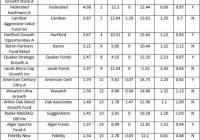
Aggressive growth funds’ second-quarter performance did not justify its characteristic of high capital gains. Except for the top 2 gainers, none of the funds could cross a 4% return in the second quarter of 2015. However, a higher number of non-aggressive growth funds posted returns over 4%. Gains for certain growth funds such as the Driehaus Micro Cap Growth Fund (MUTF: DMCRX ) and the Berkshire Focus Fund (MUTF: BFOCX ) soared as much as 10.7% and 9%. While average gains for the top growth funds performers of second quarter 2015 reached 6.8%, the average gain for top 10 aggressive growth funds was 3.2%. However, it was a tough second quarter for the broader markets. Markets had a dismal run in the second quarter, wherein the S&P 500 and Dow declined 0.2% and 0.9%; however, the NASDAQ did gain 1.8%. Just 41% of mutual funds could manage to finish in the green in the second quarter. This is less than half of the 81% gains scored by mutual funds in the first quarter. These losses, however, owed a lot to the selloff on the eve of the quarter’s end. Of the 289 funds under the study, 124 funds finished in the green while 3 funds had a breakeven return. The average gain for these 124 funds stood at 1.5%. As for the remaining 161 funds that finished in negative territory, the average loss was 1.1%. (Note: This number includes the same funds of varied classes) Aggressive Growth Funds Investors looking for the highest capital gains should look no further than investing in aggressive growth mutual funds. These funds invest in companies that show high growth prospects, but also comes with the risk of share price fluctuations. This category of funds also invests heavily in undervalued stocks, IPOs and relatively volatile securities in order to profit from them in a congenial economic climate. Securities are selected on the basis of their issuing company’s potential for growth and profitability. This category of instruments has a strong positive correlation with market movements and provides good returns during a market upswing. Such performance is achieved by investing in securities issued by companies with strong growth potential and in IPOs which are often resold quickly at a handsome profit. Many aggressive growth mutual funds may also invest in options to achieve their goal of high returns. Best Performing Below we present the top 15 aggressive growth mutual funds with best returns of Q2 2015: Note: The list excludes the same funds with different classes, and institutional funds have been excluded. Funds having minimum initial investment above $5000 have been excluded. Q2 % Rank vs. Objective* equals the percentage the fund falls among its peers. Here, 1 being the best and 99 being the worst. An interesting thing about the list of top gainers is that the 15 funds are all from different fund families. Certain major names include the Federated Kaufmann Fund A (MUTF: KAUAX ), the American Century Ultra Fund A (MUTF: TWUAX ), the Rydex NASDAQ-100 Fund Inv (MUTF: RYOCX ), the Fidelity New Millennium Fund (MUTF: FMILX ) and the Franklin Growth Opportunities Fund Adv (MUTF: FRAAX ). These are respectively from Federated , American Century , Guggenheim Investments , Fidelity and Franklin Templeton . While, KAUAX and FMILX carry a Zacks Mutual Fund Rank #4 (Sell), TWUAX, RYOCX and FRAAX hold a Zacks Mutual Fund Rank #3 (Hold). Talking of fund families, not many fund families had strong second-quarter performance. The best gain for a Franklin Templeton mutual fund lagged Fidelity’s best gain of 11.6% . Separately, Vanguard had a dismal second quarter and their best gain was just 3.8%; however, it should be noted that Vanguard has more passive funds than other fund families. Meanwhile, funds carrying a Zacks Mutual Fund Rank #1 (Strong Buy) are the Hartford Growth Opportunities Fund A (MUTF: HGOAX ), the Wasatch Ultra Growth Fund (MUTF: WAMCX ) and the White Oak Select Growth Fund (MUTF: WOGSX ). Separately, the Cambiar Aggressive Value Fund Inv (MUTF: CAMAX ), the Baron Partners Fund Adv (MUTF: BPTRX ) and the Jacob Micro Cap Growth Fund (MUTF: JMCGX ) hold a Zacks Mutual Fund Rank #2 (Buy). Original Post

ETFs To Lose Or Gain From Solid July Job Data

The U.S. labor market continued its strength with steady job gains in July, which were enough to increase the chances of the Fed pulling its trigger on the first rate hike in almost a decade as early as next month. The Fed in its last FOMC meeting stated that it is on track to increase interest rates albeit at a slower pace if the job market shows further improvement. And this is exactly what happened. The U.S. economy added 215,000 jobs in July driven by higher construction and manufacturing employment that more than offset the collapsing mining sector. Though the number was marginally below the market expectation of 225,000, unemployment remained steady at seven-year low of 5.3%. Additionally, average hourly wages rose five cents to $24.99, bringing the year-over-year increase to 2.1%. Jobless claim were the lowest level since June 2008 at 10.4% against 10.5% in June. Further, the economy appears closer to full employment given that the number of full-time U.S. jobs as a share of total employment reached to 81.7%, marking the highest level since November 2008. The decent job data suggests that the economy continued to gain momentum in July after growing 2.3% in the second quarter. To make the case for rates hike stronger, a surging service sector, increasing business activity, higher consumer spending, a recovering retail and housing market, and rising consumer confidence point to even strong economic growth that would translate into more jobs and the resultant higher rates. ETFs to Watch The news has extended the losing streak for the Dow Jones Industrial Average to the seventh day – the longest since August 2011. Additionally, the index is currently hovering at its six-month low. As a result, a few ETFs were severely impacted by the solid jobs data while a few are expected to gain in the weeks ahead. Below, we have highlighted some that are especially volatile post jobs data and increased chances of rates hike: ETFs to Lose SPDR Gold Trust ETF (NYSEARCA: GLD ) Gold will continue to remain under immense pressure as higher interest rates would diminish gold’s attractiveness since the yellow metal does not pay interest like fixed-income assets and the product tracking this bullion like GLD will lose further. The fund tracks the price of gold bullion measured in U.S. dollars, and kept in London under the custody of HSBC Bank USA. It is the ultra-popular gold ETF with AUM of $23.5 billion and average daily volume of around 5.7 million shares a day. Expense ratio came in at 0.40%. The fund is down 7.9% so far in the year and has a Zacks ETF Rank of 3 or ‘Hold’ rating. iShares MSCI Emerging Markets ETF (NYSEARCA: EEM ) As the Fed moves closer to interest rate hike, emerging markets will slump further. The most popular emerging market ETF – EEM – lost about 7% in the year-to-date timeframe and has seen huge capital outflow which has pulled its total asset base down to $24.2 billion. The fund tracks the MSCI Emerging Markets Index and charges 68 bps in annual fees from investors. Holding 847 securities, the product is widely spread out across various securities but is tilted toward the financial sector at 29.3%, followed by information technology (17%). Among the emerging countries, China takes the top spot at 23.6% while South Korea and Taiwan round off the next two spots with double-digit exposure each. The fund has a Zacks ETF Rank of 3. iShares 20+ Year Treasury Bond ETF (NYSEARCA: TLT ) The U.S. government bonds and ETFs tracking the long end of the yield curve are the most vulnerable to higher interest rates. The ultra-popular long-term Treasury ETF – TLT – tracks the Barclays Capital U.S. 20+ Year Treasury Bond Index and has AUM of $4.9 billion. Expense ratio came in at 0.15%. Holding 29 securities in its basket, the fund focuses on the top credit rating bonds with average maturity of 26.9083 years and effective duration of 17.2035 years. The fund is almost flat from a year-to-date look and has a Zacks ETF Rank of 3. ETFs to Gain PowerShares DB USD Bull ETF (NYSEARCA: UUP ) A rise in interest rates will pull in more capital into the country and lead to further appreciation of the U.S. dollar. UUP is the prime beneficiary of the rising dollar as it offers exposure against a basket of six world currencies – euro, Japanese yen, British pound, Canadian dollar, Swedish krona and Swiss franc. This is done by tracking the Deutsche Bank Long U.S. Dollar Index Futures Index Excess Return plus the interest income from the fund’s holdings of U.S. Treasury securities. In terms of holdings, UUP allocates nearly 58% in euro while 25.5% collectively in Japanese yen and British pound. The fund has so far managed an asset base of $1.3 billion while sees an average daily volume of around 2.6 million shares. It charges 80 bps in total fees and expenses and has added 6.5% in the year-to-date time frame. The fund has a Zacks ETF Rank of 2 or ‘Buy’ rating. Deutsche X-trackers MSCI EAFE Hedged Equity ETF (NYSEARCA: DBEF ) The strength in the greenback is compelling investors to recycle their portfolio into the currency hedged ETFs. For those seeking exposure to the developed market with no currency risk, DBEF could be an intriguing pick. The fund follows the MSCI EAFE U.S. Dollar Hedged Index and holds 913 securities in its basket with none accounting for more than 1.82% share. However, it is skewed toward the financial sector, which makes up for more than one-fourth of the portfolio, while consumer discretionary, industrials, health care, and consumer staples round off the top five with double-digit exposure each. Among countries, Japan takes the top spot at 21%, closely followed by United Kingdom (19%), France (10%) and Switzerland (10%). The ETF has AUM of $14.4 billion and trades in a solid volume of more than 4.7 million shares a day. It charges 35 bps in fees per year from investors and has a Zacks ETF Rank of 3. Link to the original article on Zacks.com