Tag Archives: seeking-alpha

Value And Momentum: A Beautiful Combination
Asset allocation should be a dynamic process. Value-based asset allocation can serve as a long-term investment guide. Momentum can potentially add value by allowing tactical shifts. In our most recent articles, Diversification Is Not Sufficient and Value Based Asset Allocation , we documented two simple strategies for asset allocation. The strategies are based on two seemingly opposed factors, value and momentum. We illustrated in each article the historical results of following each strategy. Empirically, each demonstrated superior results to a static allocation approach. This article illustrates the benefits of combining the two strategies. The value-based asset allocation system (Value Allocator) is a robust enough system on its own to help you navigate the uncertain markets and avoid getting caught in the next crash. The problem is that the system is most likely behaviorally impossible to apply. Using momentum to complement the strategy is an important enhancement that provides participation in further growth and protection in the down markets. The momentum strategy appears to deliver the best results historically. However, we did not examine the impact of transaction costs (most likely negligible) and taxes (significant). We have no way to estimate the tax ramifications of any system as it is obviously only successfully analyzed at the individual level. The momentum-based strategy, because of the short-term gains, is most likely the least tax efficient. Momentum strategies are also difficult to follow year in and year out. Momentum trading does not always resemble the overall stock market. In fact, these types of strategies often look much different from the traditional stock indices like the Dow Jones Industrial or the S&P 500. Since the bottom in 2009, the Barclays CTA Index (a common benchmark for trend following) has been down in every year except for 2010 and 2014. The stock market has not had a negative year since 2008. Again, momentum strategies in isolation are extremely difficult to follow over a long period. In efforts to remain pragmatic, we have combined the value based strategy and a simple momentum strategy to provide a comprehensive asset-allocation system. From this point forward, we will reference the Value Allocator as the strategic component of our asset allocation, and the momentum strategy as our tactical overlay. The combination of the two strategies keeps an investor from moving the entire policy portfolio tactically and keeps a portion in a passive, strategic posture. The strategic component is based on the assumption that markets revert to the average. The problem is that mean reversion occurs over a period of seven to ten years. Valuations tell us very little about what is going to happen over the subsequent one to three years. Our strategic asset allocation process is based on long-term value and contrarian positioning. Tactical asset allocation is the process of taking positions in various investments based on short to intermediate term opportunities. Our tactical overlay is therefore based on reacting to the trend. This is an interesting relationship as the two strategies can offer up diametrically opposed recommendations. For instance, when the US stock market is overvalued, the Value Allocator would recommend rotating to a more conservative portfolio. At the same time, if the trend was positive but the market still overvalued, the tactical overlay would recommend overweighting. You can see the conflicts that can arise, and we assure you they have surfaced in the past. The Value Allocator-as illustrated in Value Based Asset Allocation -can rotate between 30 percent stocks and 70 percent bonds and 70 percent stocks and 30 percent bonds. The tactical portfolio is either 100 percent in stocks or 100 percent in the US 10-year Treasury bonds. The following matrix embodies all possible allocations when the two strategies are combined in equal proportions: Undervalued Market Overvalued Market Positive Trend 85% stocks /15% bonds 65% stocks/35% bonds Negative Trend 35% stocks /65% bonds 15% stocks /85% bonds The investor can have as little as 15 percent in stocks and as much as 85 percent. The wide range allows the investor to adapt to all market conditions, protecting when the odds are poor and growing when the odds favor return enhancement. Instead of fixing the allocation on a static portfolio, investors are allowed the flexibility to adapt their risk tolerance to the current environment. For instance, if the current market environment is undervalued, and the trend is positive, the environment is favorable for stocks. Thus, the investor would be positioned heavily in that asset class. (click to enlarge) The combination of the Value Allocator and momentum strategy outpaced the S&P 500 and fifty-fifty (stocks-bonds) benchmarks by a large degree. The advantage of the combination of these two strategies is quite clear. The worst loss the combination strategy experienced from 1972 to 2014 was 9 percent in 1974 when the market was down almost 26 percent. The Value Allocator, when analyzed in isolation, was down almost 18 percent during that same year. The momentum system added an extra layer of protection when the Value Allocator arrived early to the party. In addition to providing an extra layer of protection, the combination strategy provided growth that would have otherwise been missed during the late 1990s and from 2003 to 2007. The market stayed overvalued from 1990 until the beginning of 2009. If you had followed the Value Allocator during this period, you would have been disappointed. The combination strategy would have minimized the underperformance to the benchmark by keeping you at a higher equity position throughout the 1990s. In the chart depicted below, you can see the market outperform the combination strategy over this period. (click to enlarge) The market outperformance was only temporary, however, as the 50 percent decline from the peak in 2000 was largely avoided. In addition, instead of keeping the allocation conservative from 2003 to 2007, tactical positioning kept investors engaged in the markets. Following the Value Allocator alone from 2003 to 2007 would have had the investors conservatively positioned in 30 percent stocks and 70 percent bonds-largely missing the rebound from the tech wreck. The tactical component of the portfolio would have allowed investors to maintain 65 percent in stocks when the trend was positive, despite the overvalued conditions of the market. Astute investors would most likely diversify their strategic asset allocation with tactical positions. Value and momentum are two of the strongest factors of market returns, and their significance remains rather stable over time. Combining both value and momentum strategies in a disciplined fashion can create desirable investment results. Disclosure: I/we have no positions in any stocks mentioned, and no plans to initiate any positions within the next 72 hours. (More…) I wrote this article myself, and it expresses my own opinions. I am not receiving compensation for it. I have no business relationship with any company whose stock is mentioned in this article. Additional disclosure: HYPOTHETICAL PERFORMANCE RESULTS HAVE MANY INHERENT LIMITATIONS. NO REPRESENTATION IS BEING MADE THAT ANY ACCOUNT WILL OR IS LIKELY TO ACHIEVE PROFITS OR LOSSES SIMILAR TO THOSE SHOWN. IN FACT, THERE ARE FREQUENTLY SHARP DIFFERENCES BETWEEN HYPOTHETICAL PERFORMANCE RESULTS AND THE ACTUAL RESULTS SUBSEQUENTLY ACHIEVED BY ANY PARTICULAR TRADING PROGRAM. PAST RESULTS DO NOT GUARANTEE FUTURE RETURNS. HYPOTHETICAL PERFORMANCE FOR ILLUSTRATION PURPOSES ONLY.
Beware The Death Cross?

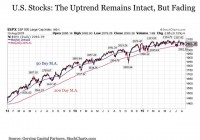
Summary A most ominous event came to pass this week. For the first time in four years, we witnessed a “death cross” in the broader U.S. stock market. It’s worthwhile to consider the death cross in historical context to determine its significance if any to investors today. A most ominous event came to pass this week. For the first time in four years, we witnessed a “death cross” in the broader U.S. stock market. The mere name alone may cause investors to think that they should be taking action. After all, if we are reading about a death cross in the business news headlines, it certainly can’t be a good thing, right? While a death cross is widely considered a bearish signal that stocks are about to break lower, this is not necessarily the case when examining these episodes from a historical perspective. This does not mean that it should be completely ignored, but at a minimum it must be taken in context. Dissecting The “Death Cross” So what exactly is the death cross? It takes place when the average closing price of the U.S. stock market over the last 50 days (a shorter term trend reading) falls below the average closing price over the last 200 days (a longer term trend reading). To many investors, the fact that the shorter-term trend in the 50-day moving average has crossed below the longer term trend in the 200-day moving average is a signal that the overall market trend may be reversing to head much lower. As a result, some investors are inclined to use the death cross as a signal that it may be time to start exiting stock positions to protect against portfolio losses. Before going any further, it’s important to make a key distinction about the recent death cross that we have been hearing about. It took place on the Dow Jones Industrial Average (NYSEARCA: DIA ). And while I appreciate the historical significance and its well-known status among the broader general public, the Dow is not a U.S. stock market index to which I pay much attention. This is due to the fact that it’s an index that’s not only limited in its number of holdings at just 30 stocks, but it also is a price weighted index instead of being market cap or equal weighted. As a result, price movements in Goldman Sachs (NYSE: GS ) trading at $200 per share has a disproportionately larger impact on the Dow on any given day than General Electric (NYSE: GE ) or Cisco (NASDAQ: CSCO ) that are trading in the $20s despite the fact that both are meaningfully larger in terms of market cap. Instead, I prefer to monitor the S&P 500 Index (NYSEARCA: SPY ), which consists of a much broader universe of 500 stocks and is market cap weighted, along with a variety of other indices. And to date, the S&P 500 Index is still trading with a 50-day moving average that’s still nearly 1% above its 200-day moving average. In other words, while we have witnessed a death cross on the Dow, it has yet to take place on the broader S&P 500. This is not to say that we won’t see a death cross in the S&P 500 Index soon, but it should be noted that we have not yet seen one to date. Moreover, the uptrend in U.S. stocks remains very much intact despite the extended period of sideways trading that has taken place since late 2014. (click to enlarge) But given the fact that the S&P 500 is as close to a death cross as it has been in years, it’s still worthwhile to consider the implications of such an event. To begin with, the death cross is a fairly uncommon occurrence for the U.S. stock market. Over the last 85 years, stocks as measured by the S&P 500 Index have experienced a Death Cross on 44 separate occasions. The last such instance took place in 2011, which is shown in the chart below. (click to enlarge) The death cross is a fairly rare experience. But do they matter? Not nearly as much as the name might suggest. First, it’s important to note that a fair amount of stock market downside has typically been absorbed by the time the death cross takes place. Historically, this supposedly bearish crossover has historically occurred 74 trading days on average following a market peak for an average decline of -10.66%. In short, investors are already down double-digits on average before the death cross alarms have been triggered. With that being said, it’s worth noting that today’s market is setting up a bit differently. Through Friday, August 14, we are now 59 trading days removed from our most recent market S&P 500 peak on May 20 (although it should be noted that we came extremely close to a new high just 18 trading days ago on July 20). And if a death cross were to take place today, it would only have stocks down less than -3% from their peaks. As a result, it could be argued that such a signal this time around might provide some protection against more meaningful downside that might follow this time around. Exploring this point in more detail, stocks have continued lower for another 77 days on average after a Death Cross before bottoming with an average decline of -12.21%. As a result, if average historical precedence held, taking action might protect an investor from absorbing a mid to high single digit portfolio decline on average. But the risk may outweigh the reward by undertaking such an approach for the stock market has shown the propensity on a meaningful number of instances to be at or near a bottom by the time a death cross has taken place. For example, in eight of the 44 past Death Crosses in the last 87 years, the stock market has bottomed immediately on the day that this bearish crossover has taken place. In other words, an investor using the death cross as an exit signal would have them selling at the exact bottom of the market 18% of the time. And a one in five chance of bottom ticking a stock market pullback is a risk that investors should take into consideration. Taking this a step further, the potential for bottom picking on a death cross signal becomes measurably worse when incrementally expanding the time horizon. For in another 12 of the 44 past death crosses, or another 27% of the time, the stock market bottomed within 10 trading days after the bearish crossover occurred. And four more, or an additional 9% of the time, stocks bottomed within 25 trading days, or roughly a month, after the death cross took place. Putting this all together, at 24 out of 44 instances, or 55% of the time, the death cross is more likely to signal that a short-term bottom is imminent for investors than that a long-term correction is underway. As a result, despite its ominous sounding name, investors should not be quick to react upon hearing that a death cross has taken place. What About The Other 45% Of The Time? None of this means, however, that the death cross should be completely ignored. For it does provide some useful leading signals that investors should consider in protecting against any future market correction or outright bear market. First, while the actual crossover of the 50-day moving average below the 200-day moving average comes too late to be useful from a trading perspective in many instances, the spread between the 50-day and 200-day moving average can serve as a useful leading indicator about the continuing strength of the stock market going forward. Over time, a spread between the 50-day and 200-day moving average between 5% and 10% is considered strong. But what we have seen since the market peak in early 2013 is that the strength of the U.S. stock market has been gradually but steadily fading in the two plus years since. What this suggests is that the third longest bull market in history is increasingly running out of gas. Could it reverse to the upside? Absolutely, but we have seen nothing to suggest a revival in stock market strength in this regard for more than two years running. (click to enlarge) Another consideration is the average amount of time between death crosses. While as suggested above that most such crossovers have often been better predictors of short-term market bottoms than long-term market reversals, nine out of 44 past instances, or 20% of the time, have been followed by extended market corrections if not full blown bear markets. And each of these nine instances has taken place following what have been far longer than normal periods of time between death crosses. For example, when U.S. stocks have gone more than 500 trading days between death crosses, the probability that it’s followed by an outright bear market including a decline greater than -20% increases to roughly half. And given the fact that we are now at 1,007 trading days and counting since the last death cross in 2011, we are operating today with risk levels considerably elevated in this regard. Bottom Line While the death cross is an ominous sounding event that we are likely to hear more about if the market continues to grind, it’s not nearly the bearish indicator that the name suggests. More often than not, it serves as a signal that a short-term bottom in stocks may be imminent. But with that being said, it’s still useful for long-term investors that are viewing the information in the right context. And while a death cross in stocks should not be viewed in isolation as anything that requires urgent portfolio action, it does hold more meaningful significance in the current environment when considered in the context of the market environment that we are operating in today. Disclosure : This article is for information purposes only. There are risks involved with investing including loss of principal. Gerring Capital Partners makes no explicit or implicit guarantee with respect to performance or the outcome of any investment or projections made. There is no guarantee that the goals of the strategies discussed by Gerring Capital Partners will be met. Disclosure: I/we have no positions in any stocks mentioned, and no plans to initiate any positions within the next 72 hours. (More…) I wrote this article myself, and it expresses my own opinions. I am not receiving compensation for it (other than from Seeking Alpha). I have no business relationship with any company whose stock is mentioned in this article.

Best And Worst Q3’15: All Cap Growth ETFs, Mutual Funds And Key Holdings

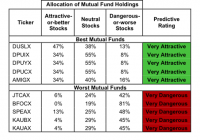
Summary The All Cap Growth style ranks sixth in Q3’15. Based on an aggregation of ratings of 0 ETFs and 494 mutual funds. DUSLX is our top-rated All Cap Growth mutual fund and KAUAX is our worst-rated All Cap Growth mutual fund. The All Cap Growth style ranks sixth out of the 12 fund styles as detailed in our Q3’15 Style Ratings for ETFs and Mutual Funds report. It gets our Neutral rating, which is based on an aggregation of ratings of 0 ETFs (no All Cap Growth ETFs are currently under coverage) and 494 mutual funds in the All Cap Growth style. See a recap of our Q2’15 Style Ratings here. Figure 1 shows the five best and worst rated All Cap Growth mutual funds. Not all All Cap Growth style mutual funds are created the same. The number of holdings varies widely (from 19 to 2177). This variation creates drastically different investment implications and, therefore, ratings. Investors seeking exposure to the All Cap Growth style should buy one of the Attractive-or-better rated mutual funds from Figure 1. Figure 1: Mutual Funds with the Best & Worst Ratings – Top 5 (click to enlarge) * Best ETFs exclude ETFs with TNAs less than $100 million for inadequate liquidity. Sources: New Constructs, LLC and company filings The AMG Renaissance Large Cap Growth Fund (MUTF: MRLIX ) is excluded from Figure 2 because its total net assets are below $100 million and do not meet our liquidity minimums. The DFA U.S. Large Cap Growth Portfolio (MUTF: DUSLX ) is the top-rated All Cap Growth mutual fund. DUSLX earns our Very Attractive rating by allocating over 47% of assets to Attractive-or-better rated stocks. The Federated Kaufmann Fund (MUTF: KAUAX ) is the worst-rated All Cap Growth mutual fund. KAUAX earns our Very Dangerous rating by allocating over 45% of assets to Dangerous-or-worse rated stocks while charging investors total annual costs of 4.45%. International Business Machines (NYSE: IBM ) is one of our favorite stocks held by DUSLX and earns our Attractive rating. Investors should view IBM as a mature cash cow in the tech sector. Over the past decade, IBM has grown after-tax profit ( NOPAT ) by 6% compounded annually. IBM still earns an impressive 13% return on invested capital ( ROIC ) and, over the past five years, has generated $57 billion in free cash flow . While the market worries about IBM’s ability to innovate, prudent investors are presented with a buying opportunity. At its current price of $155/share, IBM has a price to economic book value ( PEBV ) ratio of 0.7. This ratio implies that the market expects IBM’s NOPAT to permanently decline by 30%. However, if IBM can grow NOPAT by only 2% compounded annually over the next decade , the stock is worth $213/share today – a 37% upside. Martin Marietta Materials (NYSE: MLM ), is one of our least favorite stocks held by KAUAX. Since 2006, Martin Marietta’s NOPAT has actually declined by 2% compounded annually. In addition, its ROIC of 5% is well below the 11% achieved in 2006. However, after two years of NOPAT growth in 2013 and 2014, the market has driven MLM up 46%, a level that does not reflect the quality of its business operations. To justify its current price of $153/share, Martin Marietta Materials must grow NOPAT by 20% compounded annually for the next 18 years . Two years of NOPAT growth in 2013-2014 is a nice trend, but it still pales in comparison to the trend implied by the current market price. Investors should avoid MLM because the expectations embedded in the stock price are simply too optimistic. Figures 2 shows the rating landscape of all All Cap Growth mutual funds. Figure 2: Separating the Best Mutual Funds From the Worst Funds (click to enlarge) Sources: New Constructs, LLC and company filings D isclosure: David Trainer and Kyle Guske II receive no compensation to write about any specific stock, style, style or theme. Disclosure: I/we have no positions in any stocks mentioned, and no plans to initiate any positions within the next 72 hours. (More…) I wrote this article myself, and it expresses my own opinions. I am not receiving compensation for it. I have no business relationship with any company whose stock is mentioned in this article.