Tag Archives: request

Google Fiber Heads To San Francisco; Faster Search Service Coming

Google Fiber, the super-fast Internet-access service spearheaded by Google’s parent firm Alphabet ( GOOGL ), is about to become available in San Francisco. Google Fiber’s Internet access will soon reach “some apartments, condos and affordable housing properties” in the tech-drenched Northern California city, using existing fiber networks rather than one built from scratch, wrote Michael Slinger, Google Fiber’s director of business operations, in a blog post on Wednesday. Using San Francisco’s existing fiber network will make the startup of the service come about more quickly, but it also means the service won’t be available everywhere in the city. Still, it’s a boost for tech-innovation hub San Francisco, where homes and businesses largely don’t have Web access that’s any better than in other parts of the country. Google Fiber started six years ago in Kansas City and the company has “committed to bring Fiber to a total of ten metropolitan areas,” said Slinger in the blog post. “To date, we’ve focused mostly on building fiber-optic networks from scratch. Now, as Google Fiber grows, we’re looking for more ways to serve cities of different shapes and sizes. That’s why we’re working with Huntsville, Alabama to tap into the city’s planned municipal fiber network.” Speed Needed For Mobile Web In other news, Google is also widening use of a technology that loads Web pages more quickly while consuming less data — in an aim to make it easier for people to navigate the Internet using their mobile phones. Google said Wednesday that it will display relevant pages in the Top Stories section of search-results pages that are built with its Accelerated Mobile Pages (AMP) technology. AMP is similar to efforts underway by Alphabet-rivals Facebook ( FB ), and its Instant Articles, and Apple ( AAPL ), and its Apple News service, which also aim to speed up how quickly articles load on mobile devices. Pages built with Google’s new technology load about four times faster and use 10 times less data than typical pages, Google said. The AMP technology improves how ads are seen. Stopping ads from slowing-down readers’ access to online articles could help deflect one of the main threats that the industry says could be facing digital ad companies — the growing use of ad-blocking software. AMP works by having developers rewrite their pages in a slightly simpler and more limited language, and hosts the pages on Google’s infrastructure, according to a Bloomberg report . “No matter how many ads you put on the page the content comes first,” Bloomberg quoted David Besbris, a Google vice president of engineering for search, as saying. “If a user taps on something they will get the content immediately.” Alphabet stock closed up 0.5% in the stock market today , at 720.90. Facebook stock and Apple stock both rose more than 1%. Image provided by Shutterstock .
Salesforce.com Meets And Beats On Q4, Stock Jumps On Outlook

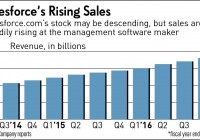
Salesforce.com ( CRM ) matched analyst forecasts on earnings and beat them on revenue with a record fourth quarter, but shares soared in late trade after the enterprise cloud pioneer raised its forecast for sales growth. Announcing earnings after the market close Wednesday, Salesforce said adjusted fourth-quarter earnings rose 36% to 19 cents per share on revenue that rose 25% to $1.81 billion. Earnings were right on the money, according to estimates from analysts polled by Thomson Reuters, but sales were better than the $1.79 billion revenue they had anticipated. The No. 1 developer of customer relationship management software, Salesforce raised full fiscal 2017 revenue guidance to a range of $8.08 billion to $8.12 billion, up from $8.0 billion to $8.1 guided after its third-quarter release. For its first fiscal quarter of 2017, which ends in April, Salesforce said it expects earnings per share of 23-24 cents, up 47% at the midpoint and ahead of analysts’ 21-cent consensus view. That’s on revenue up 25% to $1.89 billion, where analysts expected $1.86 billion, up 23%. Its results seemed to strengthen hope that Salesforce might trigger an upturn in software stocks, reversing  Tableau Software ‘s ( DATA ) profitable but softer fourth quarter and weak guidance that triggered a 49.5% collapse in Tableau stock Feb. 5. Tableau’s misfortune also precipitated a 15% plunge in the entire IBD Computer Software-Database industry group, where legacy software developer Oracle ( ORCL ) also resides. Salesforce stock also fell 13% at the time, and the IBD Computer Software-Enterprise industry group where it lives fell 8%. Neither group has recovered, the most notable exception being steady Oracle, up slightly Wednesday to 36.63, 19% off a six-month high set June 17. Days after the Tableau debacle, Salesforce set a 16-month low at 52.60 on Feb. 8, before rising 19.5% through Tuesday’s close at 63.98.  Salesforce ended the regular session down 0.6% to 62.50  in the stock market today . That was 24% off the stock’s all-time high of 82.90, hit Nov. 19, when Salesforce reported fiscal-third-quarter earnings up 50%. After Wednesday’s earnings release, Salesforce jumped more than 8% to 67.95 in after-hours trading. “By any measure, this was a spectacular finish to the year with 27% revenue growth in constant currency for the fourth quarter and for the full year,” Chief Executive Marc Benioff said in the earnings release. “We are raising our fiscal year 2017 revenue guidance to $8.12 billion at the high end of our range — unprecedented growth for a company of our size and scale.” Chief Financial Officer Mark Hawkins said its adjusted operating margin rose by 177 basis points, driving full-year operating cash flow up 37% to $1.6 billion during the fourth quarter. Said President and Chief Operating Officer Keith Block: “We hit an all-time high in large transactions in fiscal 2016,” adding that Salesforce’s cloud platform is growing sales “across every region, every cloud and every industry.” For full fiscal 2016, revenue rose 24% to $6.67 billion where analysts expected $6.65 billion. Salesforce said subscription and support revenue grew 24% to $6.21 billion and professional services and other revenue rose 28% to $462 million. The full-year adjusted earnings matched Wall Street at 75 cents. Salesforce managed to take a fourth-quarter unadjusted loss of 4 cents, better than the 6-cent loss expected by Wall Street. Beyond predicting Salesforce’s first $8 billion year in fiscal 2017, Benioff repeatedly assures that the company is “well on the path to reach $10 billion faster than any other enterprise software company.” RBC Capital Markets analyst Ross MacMillan said in a recent note to clients that the firm’s Salesforce1 platform for mobile-application development is driving fresh growth, although “there are many avenues to sustain growth, including service and marketing, the platform, and international and future initiatives.” MacMillan went on to say: “We think Salesforce can continue to drive premium growth for its size, and it remains an important strategic asset.” RBC maintains an outperform rating on Salesforce.com stock, with a price target of 80, as “one of the best positioned companies in large-cap software.” Image provided by Shutterstock .

Facebook Looks Beyond ‘Like’ With ‘Angry’ Button, A Brand Strategy

Facebook ( FB ) has unveiled a new feature that lets its users show how they really feel about posts or ads on the site. Instead of a plain vanilla “Like” in reaction to a post or ad, users of Facebook’s new Reactions feature can add faces that emote “Like,” “Love,” “Haha,” “Wow,” “Sad” or “Angry.” The move adding more expressive emojis comes as Facebook is competing against Apple ( AAPL ), Google parent Alphabet ( GOOGL ), Microsoft ( MSFT ), microblog Twitter ( TWTR ) and others to attract more advertisers. Advertisers and brands have said that extending a wider range of reactions will give advertisers a better understanding of what Facebook users think. Armed with that knowledge, brands can improve targeting and deliver better ads. “They’ll provide greater feedback,” J.R. Rigley, president and CMO at packaged-goods company J.R. Watkins, said about the expanded sentiment options last fall, according to AdWeek . “We will know more about how viewers feel about the brand, which could be helpful to us. The con is that they might not like the content. But some of that could be good, too.” The Reactions sentiment-options feature had been in testing since October in Ireland and Spain, and was made available to all Facebook’s 1.59 billion users globally on Wednesday. “We’ve been listening to people and know that there should be more ways to easily and quickly express how something you see in News Feed makes you feel. That’s why today we are launching Reactions, an extension of the Like button, to give you more ways to share your reaction to a post in a quick and easy way,” wrote Facebook product manager Sami Krug in a blog post on Wednesday. To add a reaction, users must hold down the “Like” button on their mobile device — or hover above the “Like” button on a desktop computer to see the reaction image options — then tap buttons to add one of the expanded range of emojis. Early this month, Facebook announced that it had doubled the length of video ads on Instagram to 60 seconds, and Wednesday revealed that it has over 200,000 advertisers on the photo- and video-sharing service. Facebook derives more than 96% of total revenue from advertising, with video ads deriving a premium price. Facebook has about 2.5 million advertisers overall, of which 75% are outside the U.S. Facebook stock lifted from a morning dip to close up 1.4% in the stock market today , at 106.88. Apple stock closed up 1.5%. Alphabet and Microsoft rose fractionally and Twitter stock dropped 1.6%. A top-rated big-cap tech stock, Facebook carries the highest IBD Composite Rating of 99, putting it among the top 1% of all companies across key metrics such as revenue and earnings growth and stock-price gains.