Tag Archives: management

‘Insurance’ For A Declining Market?

It isn’t only US insurers that are in a sweet spot right now. These three European insurers / financial services providers are worth a look, too! They are big and liquid, making your due diligence easier. If world markets take it on the chin in the coming weeks I would consider it an intermediate-term buying opportunity – for some sectors. If Europe, in particular, is hit hard enough to provide great opportunities, we’ll be at least selective buyers. If we can buy cheaply enough, I’m OK holding even if we didn’t get the lows. We buy in a range of value ; we aren’t trying to get the exact low! One possibility many are considering is the Global X FTSE Greece ETF (NYSEARCA: GREK ). Let them. Me? I won’t touch it. Yes, it closed cheap on Thursday and is likely to open even cheaper on Monday. And it sells at a 3% discount to its NAV. But it’s the composition of the fund that makes it uninteresting to me. Rather than being comprised of Greek consumer staples, infrastructure, shipping, food companies etc., firms that are needed by the Greek people whether they are in the EZ or not, 22% of the ETF is in one stock: Coca-Cola HBC ( OTCPK:CCHGY ) – which is a Swiss company now, no longer Greek. I can buy 22% of GREK just by buying one Swiss stock. Another 25% is in Greek banks, which may or may not remain solvent, and nearly 10% more is in a lottery and sports betting firm in Greece. Maybe if it goes to a deeper discount and the banks look like they’ll make it… Otherwise, no way. Ironically, the Greek fiasco will most likely weaken the euro yet again. A weaker Euro means European companies like Daimler ( OTCPK:DDAIF ), VW ( OTCQX:VLKAY ), Unilever (NYSE: UL ), Roche ( OTCQX:RHHBY ), Coca Cola HBC, and others that exports to other nations, will be selling at a favorable exchange rate and are likely to, at least temporarily, be able to under-cut their competition in the US, Asia and elsewhere. Which means opportunity. We already own 1000 shares of Allianz SE ( OTCQX:AZSEY ), the giant Germany-based insurance and financial services giant that is, among other things, the parent of PIMCO, which all by itself has $1.6 trillion in assets under management. Two of Allianz’s competitors look good to me today, as well. France’s AXA SA ( OTCQX:AXAHY ) was founded in 1852 and Switzerland’s Zurich Insurance ( OTCQX:ZURVY ) in 1872. They’ve both seen far bigger calamities than the current one and survived, including bank panics, the Great Depression and two world wars. This? Poof! This is nothing! Both are global insurance companies that offer just about every kind of insurance imaginable. They also offer investment advice, mutual funds and other products to extend their reach in the financial services arena. They are depressed right now because they have had exposure to Greek headlines, eurozone turmoil, Italian bonds, etc. But both have credibly marked their portfolios to market and both are writing huge amounts of business well beyond Europe. AXA is the parent, for instance, of both Equitably Life and MONY here in the US. It trades at a PE of 11, a Price/Sales ratio of 0.50, a Price/Book of 0.80, and pays a yield of 4.26%. Zurich has a typically bulletproof Swiss balance sheet, has hedged a large part of its equity exposure, and is actively delivering products and services in more than 170 countries. The stock has a 12 P/E, a Price/Sales of 0.6, a Price/Book of 1.3, and yields just over 6%. Please note that, in the European tradition, both firms pay their dividend just once per year! Editor’s Note: This article discusses one or more securities that do not trade on a major U.S. exchange. Please be aware of the risks associated with these stocks. Disclosure: I am/we are long AZSEY, ZURVY. (More…) I wrote this article myself, and it expresses my own opinions. I am not receiving compensation for it. I have no business relationship with any company whose stock is mentioned in this article.
SCHO: Who Says Cash Is King? SCHO Is My Replacement For Cash

Summary The Schwab Short-Term U.S. Treasury ETF offers investors liquidity, low expense ratios, and trading with no commissions in Schwab accounts. I would love to see better yields on treasury securities, but I’m looking for a place to park my cash while I look for more equity opportunities. Since I’m not big on paying high P/E ratios across the broad equity market, I’m looking at microcaps and waiting for better ratios. While yields are weak on treasury securities, SCHO looks like a nice place to park cash when an investor doesn’t know when new opportunities will be available. I’m planning to start using the Schwab Short-Term U.S. Treasury ETF in my portfolio. The Schwab Short-Term U.S. Treasury ETF (NYSEARCA: SCHO ) is exactly what it sounds like. The ETF is filled with short term treasury securities and pretty much nothing else. The weighted average maturity is under 2 years and the very low maturity combined with excellent credit quality results in a yield to maturity of only .63%. The low yield matches perfectly with a very low risk portfolio. Short term treasury yields have generally been terrible and with very weak expected yields it makes sense for fixed income investors to focus a great deal on the costs of their investments. Check Out Those Costs The expense ratio of .08% works great for me. Having SCHO as a Schwab fund with no commissions on trading also works great. Add in average volume of over 200,000 shares per day and the bid-ask spreads should remain tight so that investors are not getting screwed by moving in and out of the fund. Basically, this investment perfectly fills a specific niche in the investor’s portfolio. Over the rest of the year I plan to start pushing some of my new contributions to the portfolio into SCHO so I can hold them there while I wait for better prices on equity. Using The Schwab Short-Term U.S. Treasury ETF in a Portfolio As frequent readers may know, I’ve been looking for fixed income investments for my portfolio. I would like to find both a bond fund that offers reasonable yields with limited risk and a bond fund that makes a suitable replacement for having cash in my portfolio while offering a small yield. It would be interesting if I could find both of those things in one bond ETF, but I find that fairly unlikely. What I found today when I looked into the Schwab Short-Term U.S. Treasury ETF was a perfect option for replacing cash in the portfolio. The average yield to maturity of .63% isn’t going to make me rich, but the ETF will protect my cash while I look for suitable equity investments. Things I Like The portfolio doesn’t hold MBS securities. Most of the fixed income ETFs I’ve been looking at were using MBS as a meaningful part of the portfolio. Since I’m buying mREITs for less than NAV and cover them regularly, I don’t want or need MBS exposure in my bond ETF. That dramatically reduces the number of options but it works just fine with SCHO. Very low duration results in very little exposure to losses on increases in the yield curve. I don’t mind having some exposure to longer durations in exchange for higher yields, but that is more important for the longer term holdings. When it comes to a replacement for cash, the short duration is great for reducing volatility. I don’t want to see my cash equivalent portion of the portfolio taking a meaningful loss right when I’m looking to trade out to buy more equities. With an average maturity under 2 years, a substantial loss is very unlikely. I’m not worried about a fluctuation of 1% in the value of my cash holdings if it means they can earn some interest and are still able to be freed up for trading within a couple minutes. Credit risk is about as close to non-existent as it comes. The holdings indicate 99.8% of the portfolio is in treasury securities with the rest in cash. That works for me. I normally don’t mind some credit risk in exchange for higher yields, but I’m holding the cash position in anticipation of lower equity prices. If the market is turning south and providing me with better buying opportunities, I don’t want those opportunities to come at the same time as wider credit spreads driving down the value of my replacement for cash. Things I Don’t Like Treasury yields are weak. That is obviously not an issue with the ETF specifically, but it is the end of the list. I don’t see any other weakness and every investment in treasury securities is going to offer weak yields. That is just the macroeconomic environment. Conclusion The Schwab Short-Term U.S. Treasury ETF looks like my best option for holding cash in the portfolio while still getting some yield to offset some of the impacts of inflation. I could just hold cash, but I’m expecting to keep pouring money into my portfolios. If I was comfortable with making huge investments at very high P/E ratios, I would just keep allocating new investments to indexing the equity market. Since I’m growing less comfortable with that, I’m looking to hold more of my portfolio in cash so I can be ready to buy in to the market when there is a meaningful reduction in prices. I will also occasionally be looking for microcap investments. Since I don’t know when I’ll find ones that I feel are very compelling opportunities, being able to earn a small yield while being able to immediately withdraw my investment at a fair value is important. So far, I have not seen anything that can top SCHO in that category. Keep in mind I’m going to take advantage of trading SCHO without commissions and since I’m simply planning to allocate part of new investments to SCHO every month or two, keeping the trading costs low is very important. Disclosure: I/we have no positions in any stocks mentioned, but may initiate a long position in SCHO over the next 72 hours. (More…) I wrote this article myself, and it expresses my own opinions. I am not receiving compensation for it (other than from Seeking Alpha). I have no business relationship with any company whose stock is mentioned in this article. Additional disclosure: Information in this article represents the opinion of the analyst. All statements are represented as opinions, rather than facts, and should not be construed as advice to buy or sell a security. Ratings of “outperform” and “underperform” reflect the analyst’s estimation of a divergence between the market value for a security and the price that would be appropriate given the potential for risks and returns relative to other securities. The analyst does not know your particular objectives for returns or constraints upon investing. All investors are encouraged to do their own research before making any investment decision. Information is regularly obtained from Yahoo Finance, Google Finance, and SEC Database. If Yahoo, Google, or the SEC database contained faulty or old information it could be incorporated into my analysis.

NRG Energy Increases Its Solar Ambitions

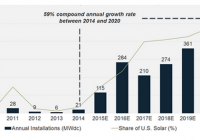
Summary NRG Energy is jumping into community solar, making it one of the first companies to enter into this promising market. NRG Energy holds many unique advantages in the community solar segment, making it highly competitive against even the likes of SolarCity. The company’s growing distributed solar operations comes with many risks, most notable in the form of long-term unknowns. The community solar concept is rapidly gaining steam, with some leading solar companies jumping into this space over the past few months. Given that community solar covers the renters’ market, which consists of 108 million individuals in the U.S. alone, its sudden emergence is not so surprising. Financing in the solar industry has finally reached a stage where community solar is not only feasible, but attractive for solar companies. While there are many more complexities involved in this solar market compared to the residential or utility-scale solar markets, it should still see explosive growth in the near term. NRG Energy (NYSE: NRG ) has been the latest company to enter into the community solar market, which is not surprising given its ambitions in distributed solar. The company recently launched a 1 MW project (connected to 200 homes), which will serve as a pilot to more community solar projects in the future. With 100 MW of shared community solar projects already in its pipeline, NRG Energy clearly has big community solar ambitions. This marks the first time that NRG Energy has been able to penetrate a major solar market so early on, which should add more upside to the company’s already undervalued stock. First Mover’s Advantage The community solar market has just recently opened up, which means that NRG Energy has a huge opportunity to cement itself early on as a dominant presence. Given the immense size of the U.S. renters’ market alone, the company should be able to experience some serious growth in this arena. While the current community solar market is nearly nonexistent, this market is expected to grow at ~60% per annum until 2020. This would mean that the community solar segment should grow approximately twice as fast as the general industry during this time period. While dominating the community solar segment will certainly not be easy for NRG Energy, the company has all the tools to do so. With the operational capabilities and expertise of its NRG Home and NRG Renew business segments, the company could even compete with the likes of SolarCity (NASDAQ: SCTY ) on this front. In fact, NRG Energy’s 100 MW community solar pipeline is equivalent to that of SolarCity’s . Given that SolarCity was the first company to make a truly impactful entrance into community solar, this shows how ambitious and forward-looking NRG Energy is. GTM Research predicts that community solar will be a half-GW market (annual) by 2020. (click to enlarge) Source: GTM Research Unique Advantages NRG Energy has some major advantages over its competitors on the community solar, and more generally, distributed solar front. First, the company already has a huge customer base off of which to leverage for its distributed/community solar business. The company also has stronger relationships with electricity companies compared to its solar pure play peers, which should allow it to expand its community solar segment more rapidly. Given that cooperation with utilities will likely prove key to dominating the community solar segment, NRG Energy definitely has an edge on this front. With NRG Energy’s enormous distributed solar ambitions, it is easy to forget that the company is one of the largest fossil fuel power companies in the world. In fact, the company has a whopping ~47 GW of operational assets, which would also give the company a financing edge over its pure play solar competitors. As such, NRG Energy will almost certainly be one of the front-runners in the highly promising community solar segment. While NRG Energy’s pure play solar competitors may be more well versed in the solar arena, NRG Energy’s own unique advantages more than make up for this. Obstacles The community solar segment is still basically unexplored, which means that first movers like NRG Energy are taking on more risk. Despite the sudden surge of competitors in this arena, the community solar business model is still new. As NRG Energy is planning to make the community solar segment a sizable portion of its business down the road, the company will likely funnel a lot of its resources into this arena. Given the unknowns associated with community solar, entering into this segment is relatively risky. More generally, there are also many long-term questions about the solar leasing model used by NRG Energy. How the long-term plays out for solar leases is incredibly important for the company as it is making a huge transition to renewables, and is planning to make distributed solar one of its focal points. Regardless of such unknowns, the potential rewards of involving itself in this solar segment far outweigh the risks. NRG Energy’s transition from a fossil fuel-centric power company to one more focused around renewables should prove to be extremely smart on balance. Conclusion NRG Energy has faced a yearlong downturn, which can largely be attributed to the instability experienced by the fossil fuels industry during this time. Although many investors still view NRG Energy as part of the fossil fuels sector, the majority of the company’s long-term prospects lie in its growing renewables sector, namely solar. Given the sheer potential of its distributed solar business alone, NRG Energy is undervalued at a market valuation of $7.2B . NRG Energy is slated to be one of SolarCity’s largest competitors, which speaks to the potential that NRG Energy’s solar segment holds. The company’s entrance into community solar just reinforces its place within the future energy landscape. Disclosure: I am/we are long SCTY. (More…) I wrote this article myself, and it expresses my own opinions. I am not receiving compensation for it (other than from Seeking Alpha). I have no business relationship with any company whose stock is mentioned in this article.