Tag Archives: management

17% Annual Return With Niska

Summary Niska trades at a substantial discount to its deal price. The buyers went into this with open eyes. The regulators know that NKA needs this deal. Deal Target Description Niska Gas Storage Partners (NYSE: NKA ) operates North American natural gas storage assets. They have storage facilities in Alberta, California, and Oklahoma. Deal Terms On June 14, 2015, Brookfield Infrastructure announced that it would buy NKA for $4.225 per unit in cash. NKA: (click to enlarge) Brookfield Infrastructure: (click to enlarge) Deal Financing The deal is not conditioned upon financing. NKA worked with both Evercore Partners (NYSE: EVR ) and Greenhill (NYSE: GHL ) on the deal. Deal Conditions The deal closing is expected to occur in the second half of 2016. Specifically, my estimates include the assumption that the deal closes in early December 2016. The deal is conditioned on standard closing conditions and regulatory approvals, including approval by the California Public Utilities Commission/PUC. Riverstone Investment Group, which owns 53% of NKA, supports the deal. No additional unit holder action is needed. The California PUC application was filed in July. That review will probably be the gating item. The HSR application was filed in July. Competition Canada was filed in July. The information statement will be filed with the SEC in early fall. Deal Price The price equaled a 222% premium to the NKA market price. It appears to be reasonable for NKA unit holders in the context of historically comparable transactions. (click to enlarge) (click to enlarge) Merger Agreement Specific Performance: Irreparable damage would occur in the event that any of the provisions of this Agreement (including each Party’s obligations under Article II or Section 6.3) were not performed in accordance with its specific terms or were otherwise breached. In the event of any breach or threatened breach by any Party of any covenant or obligation contained in this Agreement, the non-breaching Party shall be entitled (in addition to any other remedy that may be available to it, including monetary damages) to seek and obtain (on behalf of itself and the third-party beneficiaries of this Agreement) (A) an Order of specific performance to enforce the observance and performance of such covenant, agreement or obligation, and (B) an injunction restraining such breach or threatened breach. No Party or any other Person shall be required to obtain, furnish or post any bond or similar instrument in connection with or as a condition to obtaining any remedy referred to in this Section 13.14, and each Party irrevocably waives any right it may have to require the obtaining, furnishing or posting of any such bond or similar instrument. Material Adverse Effect means any change, event, circumstance, development or occurrence, individually or in the aggregate, with all other changes, events, circumstances, developments and occurrences, which has had, or would reasonably be expected to have, a material adverse effect on the financial condition, business, assets or results of operations of the Company Entities, taken as a whole; provided that with respect to this clause none of the following, and no fact, change, event, circumstance, development, occurrence or effect to the extent arising out of any of the following, shall constitute or be taken into account in determining whether a Material Adverse Effect has occurred, or may, would or could occur: changes in GAAP or changes in the regulatory or accounting requirements or in the interpretation of any of the foregoing, changes in the financial or securities markets or changes in the general economic or political conditions in the United States, Canada or abroad, changes in the price or availability of gas, oil or commodities or changes in currency exchange rates, changes (including changes of Applicable Law) or conditions generally affecting any industry in which any of the Company Entities operates, acts of war, sabotage or terrorism, any decrease in the market price of the Common Units or any delisting of the Common Units due solely to such decrease in the market price of the Common Units, any litigation initiated solely by a Person other than Swan Sponsor or any Affiliate of Swan Sponsor or a Company Entity or any Affiliate of a Company Entity (excluding suits brought in a derivative manner) arising from allegations of a breach of fiduciary duty or other violation of Applicable Law relating to this Agreement or the transactions contemplated by this Agreement (or any public disclosure relating to such litigation), the announcement, pendency or consummation of the transactions contemplated by this Agreement (including any cancellations of or delays in customer orders or other decreases in customer demand, reduction in revenues, work stoppages or loss or threatened loss of employees or other employee disruptions) (provided, that this clause (viii) shall not apply in the determination of a breach or violation of the representations and warranties contained in Section 4.8), changes or announcements of potential changes in a credit or financial rating in respect of any of the Company Entities or any indebtedness of any of the Company Entities, any failure to obtain any consent, approval, waiver or authorization from any third party in connection with the consummation of the transactions contemplated hereby (provided, that this clause (X) shall not apply in the determination of a breach or violation of the representations and warranties contained in Section 4.8, any failure of any of the Company Entities to meet any internal or published or third-party budgets, estimates, projections, forecasts or predictions of financial performance (including revenue, earnings, cash flow, cash position, liquidity or other financial measures) for any period, any action taken (or omitted to be taken) at the request of or by or on behalf of Parent, Merger Sub or any of their respective Affiliates, any action taken by Swan Sponsor, ManagementCo, the Company or any of their respective Affiliates that is required or expressly contemplated or permitted pursuant to this Agreement, or any seasonal reduction in the revenues or earnings of any of the Company Entities; provided, however , that the foregoing exclusions in (I), (II), (III), (IV) and (V)shall not apply to the extent such changes or effects have a materially disproportionate adverse effect on the Company Entities, taken as a whole, as compared to other independent natural gas storage businesses in the United States or Canada, and (Y) the underlying cause of any decrease or change referred to in clause (vi), (IX) or (xi) (if not otherwise falling within any of clauses through (XIV) above) may be taken into account in determining whether there is a “Material Adverse Effect” or the ability of Swan Sponsor, ManagementCo or the Company to perform their respective obligations under or arising out of this Agreement. Deal Alternatives No deal alternatives are expected. Event Driven Investing with Equity Options The best way to set this up is with equities; there are no derivative contracts that improve upon the equity’s risk:reward. Conclusion At today’s price, NKA units are yieldy candidates for consideration as a part of a diversified, long-term portfolio. Other master limited partnership opportunities to consider include Williams Partners (NYSE: WPZ ) and the Cushing MLP Total Return Fund (NYSE: SRV ). Disclosure: I am/we are long NKA, SRV. (More…) I wrote this article myself, and it expresses my own opinions. I am not receiving compensation for it (other than from Seeking Alpha). I have no business relationship with any company whose stock is mentioned in this article. Additional disclosure: Chris DeMuth Jr is a portfolio manager at Rangeley Capital. Rangeley invests with a margin of safety by buying securities at deep discounts to their intrinsic value and unlocking that value through corporate events. In order to maximize total returns for our investors, we reserve the right to make investment decisions regarding any security without further notification except where such notification is required by law.
U.S. Treasury ETFs Rise On Yuan Devaluation

The global investing world across asset classes was caught off guard on August 11 as Chinese policymakers devalued the country’s currency by 2% against the greenback to boost its waning export profile. The step resulted in the largest single-day decline since the historical devaluation in 1994 , after China arranged its official and market rates in a line. As a result, yuan has now plunged to a four-year low level. The Chinese central bank defended its currency intervention ‘as a free-market reform’, but global experts apprehend a currency war in the near future, especially among the Asian tigers. Most export-centric economies are likely to resort to currency devaluation to rev up their exports. However, yuan devaluation took the global markets in its grip as most asset classes were in red. In fact, the move was criticized by U.S. lawmakers and viewed as means of taking undue favor in exports. Bloodbath in global equities, commodities and currencies spurred a flight to safety for a valid reason. Several ETFs on safe haven assets including greenback-based PowerShares DB US Dollar Index Bullish Fund (NYSEARCA: UUP ) and gold bullion-based SPDR Gold Shares (NYSEARCA: GLD ) added gains on August 11. UUP gained 1.5% after hours and GLD added 0.5% in the key trading session. Here investors should note that the UUP’s strength came mainly on the back of Yuan devaluation and the looming Fed rate hike concern; a safe haven criterion played a lesser role for its ascent. On the other hand, though gold advanced for a day, we are skeptical about its momentum as the metal is due for a southward ride (presumably) in the near term due to a number of issues. In fact, this yuan devaluation will likely curb the import demand of gold from China (a key gold consuming nation) as a feebler currency will turn imports pricier. U.S. Treasury: True Safe-Haven In such a backdrop, investors started to position themselves for the imminent volatility in the risky assets and started to park their money in the safer U.S. treasuries, despite the Fed rate hike worries. Most U.S. treasury ETFs, specially the long-dated ones, added considerable gains on August 11. Yields on the U.S. benchmark 10-year notes, slipped to 2.15% on August 11 from 2.24% the day before. Below we have highlighted four Treasury ETFs that have hogged investors’ attention lately and added gains despite the looming rate hike concerns. Vanguard Extended Duration Treasury ETF (NYSEARCA: EDV ) This fund provides exposure to the long-term Treasury STRIPS market by tracking the Barclays U.S. Treasury STRIPS 20-30 Year Equal Par Bond Index. The fund holds 71 bonds in total with effective maturity of 25.2 years and average duration of 24.8 years. Expense ratio comes in at 0.12%. The product has amassed $379.2 million in its asset base. Its gains came in at 2.14% in the yesterday’s session (on August 11). Pimco 7-15 Year U.S. Treasury Index Fund (NYSEARCA: TENZ ) The fund looks to track the returns of the BofA Merrill Lynch 7-15 Year US Treasury Index. The index is unmanaged and tracks the performance of the direct Sovereign debt of the U.S. Government with at least $1 billion in outstanding face value and a remaining term to final maturity of at least 7 years and less than 15 years. The fund has amassed over $24 million in assets so far and charges 15 bps in fees. The fund holds 15 bonds in total with effective maturity of 9.03 years and average duration of 7.89 years. TENZ was up over 2.8% in the last session. iShares 20+ Year Treasury Bond ETF (NYSEARCA: TLT ) The ultra-popular long-term Treasury ETF – TLT – tracks the Barclays Capital U.S. 20+ Year Treasury Bond Index and has AUM of $4.92 billion. Expense ratio comes in at 0.15%. Holding 29 securities in its basket, the fund focuses on the top credit rating bonds with average maturity of 26.82 years and effective duration of 17.35 years. The fund was up 1.6% on August 11. SPDR Barclays Capital Long Term Treasury ETF (NYSEARCA: TLO ) The fund considers U.S. treasuries that have a remaining maturity of 10 or more years. The $201 million-fund holds 45 securities with average maturity of 24.98 years and effective duration of 17.23 years. The fund charges 10 bps in fess and was up about 1.5% on August 11. Bottom Line Having said this, we would like to note that the bond market is in a volatile mood. Especially the U.S. fixed income space is in a tug of war between safe haven demand and the imminent Fed rate hike. Though U.S. benchmark yields fell lately, any hint at Fed policy normalization will once again push up interest rates. So, edgy investors need to be hawk-eyed before playing the safe-haven fixed-income securities in this choppy market. Original Post

Is More Information Making Us Worse Investors?

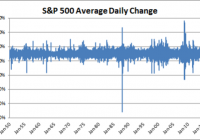
Study after study has shown that retail investors and professional money managers just aren’t very good at investing. And the primary cause of this poor performance is being overly active and incurring lots of unnecessary taxes and fees. The pros can’t control themselves because they have to impress their clients by trying to look active and “beat the market.” And the retail investor is prone to be short term because they know their financial lives are a series of short-term financial events in a long-term life. But an interesting thing appears to be occurring over the course of the last 65 years. Despite a preponderance of information and market access, we seem to be getting no better at investing AND the markets seem to be getting more volatile. If we look at the average daily change in the S&P 500, we can see a slight shift in the variance of the data over time: That’s not very clear, though. If we rearrange that chart, we can construct the average annualized standard deviation of the daily returns: This chart clearly shows that stock market volatility has increased over the last 65 years. There is almost certainly a multitude of causes here, but I don’t think it’s a coincidence that the 1980s and the era of new technology and market access has coincided with the explosion in higher volatility since then. This makes me wonder about two things: What does this say about information theory, economic theory and financial theory? What does this tell us about the current era of investing? What does this say about information theory, economic theory and financial theory? One would think that more information would make the markets behave more “efficiently.” And while we know that professional investors don’t beat the market consistently, we also know that the average holding time on stocks has cratered over the last 70 years, which means that investors, in the aggregate, are paying more in taxes and fees than they previously did. In fact, the average holding period is now consistent with a short-term capital gains rate which means the business of active investing has become a lucrative business for Uncle Sam! This means, by definition, that the post-fee and post-tax return on the aggregate of publicly-held stocks has to be lower than it was in 1940. This would seem to imply that easier access to markets and information has actually made us worse at investing. More information isn’t making us more rational or more efficient. It’s fueling our behavioral biases and short-term tendencies. Access to trading accounts combined with the 24-hour news cycle has become a behavioral nightmare for investors. And yet the vast majority of investors think that all of this information is making them smarter when the data shows that they’re not nearly as financially competent as they think. Contributing to this is all the new technologies. This includes discount brokerage firms, high-frequency trading, leveraged index funds, robo advisors, free trading applications, etc. All of these businesses feed off of our “get rich quick” mentality and/or give us access to markets in an unprecedented manner which fuels our behavioral biases in any number of ways. Further, investors haven’t been compensated for this added volatility. The average 3-year return on the S&P 500 is only marginally higher in the last 25 years than it is over the last 65 years. This shows how futile the idea of “risk” as “standard deviation” really is. In other words, the textbook model of the financial markets hasn’t at all reflected what one might have expected where more information makes markets more efficient, and more volatility compensates investors for what is considered more risk. Basically, modern financial theory doesn’t tell us much about modern financial reality. What Does This Tell us About the Modern Era of Investing? Nothing good. I’ve talked about the difficulty of managing time in one’s portfolio . This intertemporal conundrum is, by a wide margin, the most difficult concept to master in portfolio management. This is the problem of time in an investor’s portfolio. While we know we should be long term, we are inclined to be short term for any number of reasons. Threading that needle and finding the timeframe that makes the most sense for you is incredibly difficult. I’d venture to guess that investors in the 40s probably weren’t far off with their 7-year period. Sadly, what I seem to be finding is that more and more investors are veering in the direction of being ultra short term, hoping to make the quick risk-free buck. And in doing so, they’re falling victim to all of the behavioral biases that are driving this extremely short-term view which necessarily leads to poor performance.