Tag Archives: lists

Lipper Fund Flows: Money Markets Gain While China Surprises

Lipper’s fund macro-groups (including both mutual funds and exchange-traded funds) had aggregate net inflows of $4.9 billion for the fund-flows week ended Wednesday, August 12. This marked the second consecutive week of overall positive net flows and the fourth week in the past six. Every group except taxable bond funds (-$2.0 billion) took in net new money. Money market funds (+$6.0 billion) paced the groups in net inflows and were followed by equity funds (+$936 million) and municipal bond funds (+$11 million). In market activity, the Dow Jones Industrial Average closed down 0.79% (-137.96 points), while the S&P 500 Index retreated 0.66% (-13.79 points) on the week. It was a volatile week of trading, with the Dow experiencing three days of triple-digit moves (two down and one up) and another day that saw it recoup almost all of its more-than-270-point intraday loss to close the day down less than one point. A good deal of the market’s uncertainty was triggered by China’s surprise move to devalue its currency on two consecutive days (August 11 and 12). China made these moves in response to a string of recent economic data that indicated the world’s second largest economy is slowing. The first devaluation shook the U.S. equity markets, with the Dow and S&P 500 closing down 1.2% and 1.0%, respectively, in direct response to the news. After the second currency devaluation, the Dow and the S&P continued their descent from the previous day, but both bounced back to finish virtually unchanged. The market rebounded on speculation the Federal Reserve might push back its highly anticipated September interest rate hike in response to fears that China might devalue its currency further as well as on buying of some recently oversold issues (Apple, energy stocks). The $6.0 billion of net positive flows into money market funds represented their second consecutive week and the seventh of the last nine weeks of taking in net new money. This streak reduced the group’s net outflows for the year to date to $55.0 billion. Institutional money market funds were responsible for $11.2 billion of the group’s net inflows for the week. For equity funds, ETFs accounted for the bulk of the net inflows (+$646 million) for the week, while mutual funds benefited from $290 million of the positive flows. The two largest individual net inflows for ETFs belonged to Deutsche X-trackers MSCI EAFE Hedged Equity ETF ((NYSEARCA: DBEF ), +$562 million) and Utilities Select Sector SPDR Fund ((NYSEARCA: XLU ) , +$382 million ) . Following the trend we’ve seen for most of 2015 among mutual funds, nondomestic equity funds (+$1.1 billion) took in net new money for the week, while domestic equity funds (-$466 million) saw money leave their coffers. ETFs were responsible for the majority of the net outflows (-$1.3 billion) for taxable bond funds, while mutual funds saw $759 million leave. The data indicated investors were running away from high yield in both mutual funds and ETFs. iShares iBoxx $ High Yield Corporate Bond ETF ((NYSEARCA: HYG ), -$524 million) and SPDR Barclays High Yield Bond ETF ((NYSEARCA: JNK ) , -$305 million) saw the most money leave among ETFs, while Lipper’s Loan Participation Funds (-$567million) and High Yield Funds (-$254 million) classifications had the largest negative flows on the mutual fund side. Municipal bond mutual funds had net inflows of just over $11 million for the week. Funds in the national muni debt classifications (+$28 million) were the beneficiaries of the largest positive flows. Share this article with a colleague
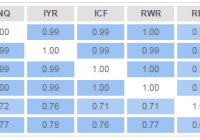
U.S. REIT ETFs: Correlations

REIT ETFs appear to offer an improvement to the overall portfolio performance. Correlations to the S&P 500 were in the low to mid 0.50s in the last 12 months. The largest U.S. REIT ETFs are fairly homogeneous with correlation coefficients of 0.98-1.00 between themselves. Real estate is often mentioned as a stand-alone asset class next to equities, fixed income and commodities. This notion prompts investors to allocate a portion of their portfolios to the real estate investment trusts (“REITs”) in pursuit of diversification benefits. In this article, I review how the U.S. REIT ETFs fit into the overall portfolio and whether they help to improve the performance. The analysis focuses on the five largest U.S. REIT ETFs that have been around for at least 5 years and manage over $1 billion of assets each (in descending order by size): Vanguard REIT Index ETF (NYSEARCA: VNQ ), iShares U.S. Real Estate ETF (NYSEARCA: IYR ), iShares Cohen & Steers REIT ETF (NYSEARCA: ICF ), SPDR DJ Wilshire Global REIT ETF (NYSEARCA: RWR ), and iShares Mortgage Real Estate Capped ETF (NYSEARCA: REM ). All the calculations were carried out on the freely available investor resource InvestSpy. To start with, let’s look at the correlation matrix of these ETFs plus the SPDR S&P 500 Trust ETF (NYSEARCA: SPY ), utilizing 5 years of historical data: The table above presents us with two important insights. Firstly, all REIT ETFs had a correlation coefficient with the broad equity market no higher than 0.78. Although such a reading indicates a relatively close co-movement, it is low enough to offer diversification benefits. Secondly, the four largest REIT ETFs (VNQ, IYR, ICF, and RWR) had almost perfect correlation of 0.99-1.00 between themselves. This means that from an investor’s standpoint, these are pretty much identical securities, thus it is worthwhile paying more attention to expense ratios and bid-ask spread when making a selection. The only standout is REM, which demonstrates a lower correlation both with SPY and with the remaining REIT ETFs. This is due to the fact that REM is a mortgage REIT, thus it behaves somewhat differently from equity REITs. Five years is fairly long period of time and it is useful to investigate correlations in the more recent past. Below is the same correlation matrix, utilizing daily data for the last 12 months only: It appears that the close co-movement between the four equity REIT ETFs persisted to the same degree whilst REM deviated even further from the traditional REIT class with its correlation coefficients no higher than 0.70. Interestingly, correlations with the broad U.S. equity market dropped across the board to as low as 0.49 in the case of ICF. As all of these ETFs except for REM posted positive total returns similar to the S&P 500 over the last year, it is clear that investors that had allocation to REITs in this period achieved an improved risk/reward performance. Just to illustrate the difference a 20% allocation to REIT ETFs would have made, consider a standard 60% equities/40% bonds portfolio where 20% of equity allocation is replaced with a REIT ETF. A portfolio with 60% invested in the Vanguard Total Stock Market ETF (NYSEARCA: VTI ) and 40% in the iShares Core Total U.S. Bond Market ETF (NYSEARCA: AGG ) would have brought the following results in the last year: (click to enlarge) Meanwhile, with 20% allocated to VNQ, the dynamics change a little bit: (click to enlarge) The key metric I am looking at here is the annualized volatility. Note that even though we have replaced VTI with a riskier VNQI (12.1% vs. 14.4% volatility), the overall portfolio volatility has decreased from 7.0% to 6.8%. This is the diversification benefit in its purest sense. In addition to that, the total return and maximum drawdown figures are the same for both portfolios whilst the second one is substantially less dependent on the broad equity market with a beta below 0.50. It is also clear that risk contributions are largely skewed away from fixed income, but this a classical case in most of traditional portfolios as I have covered here , and this topic requires a separate discussion. Summing up, U.S. REIT ETFs appear to offer an improvement to the overall portfolio performance. The largest ETFs in this space are extremely highly correlated, thus an investor needs to look more closely at ETF features such as expense ratio and bid-ask spread to identify the most efficient option. Finally, correlations change over time and so does the diversification benefit. Therefore, one has to monitor periodically if their asset class allocation is delivering performance as anticipated. Please share your thoughts and feedback on the insights above. In the next article later this week, I will present a similar analysis for international REITs. Disclosure: I/we have no positions in any stocks mentioned, and no plans to initiate any positions within the next 72 hours. (More…) I wrote this article myself, and it expresses my own opinions. I am not receiving compensation for it (other than from Seeking Alpha). I have no business relationship with any company whose stock is mentioned in this article.

Gold Demand Drops 12%, Hurts SPDR Gold Trust ETF

The SPDR Gold Trust ETF (NYSEARCA: GLD ) had a nice bump yesterday after the index closed with gains of 1.40% at $107.75. The gains contrast sharply with weak global demand for gold in the second quarter and it is unlikely that the ETF will keep yesterday’s gain in today’s session. CNBC reports that the global demand for gold has dropped to a 6-year low as buyers in China and India reduce their bullion purchases. A report released by the World Gold Council (WGC) this morning provided insight into the demand for the yellow metal. It was reported that the overall demand for bullion in the second quarter came in at 915 tons to mark a 12% year-over-year decrease. The low global demand for gold in Asia echoes earlier fears that the devaluation of the Chinese Yuan might be bad for Gold and Direxion Shares Exchange Traded Fund Trust. Demand for gold is weak in Asia Asians ( especially in India and China ) are buying less gold as the demand drops from 1,038 tons last year to 915 tons this year. The price of the yellow metal has plummeted more than 40% in the last four years from $1,920.94 a troy ounce in September 2011 to a narrow $1,200 to $1,230-per-ounce range during the April to June period. In fact, prices are already down 3% this quarter. Alistair Hewitt, head of market intelligence at the WGC says, “It’s been a challenging market for gold this quarter, particularly in Asia, on the back of falls in India and China.” The drop in the demand reflects the 14% decline in demand for gold jewelry from 594.5 tons in Q2 2014 to 513.5 ton in Q2 2015. It might interest you to know that gold jewelry holds 60% of the global gold consumption. A rough road ahead for gold ETFs GLD might start feeling the pinch of the poor demand for gold. For instance, Direxion Shares Exchange Traded Fund Trust was down 4.43% in pre-market trading to $4.53 and yesterday’s gains might be lost when the market opens and gold investors read that the demand for gold has slumped . However, the weak demand for the yellow metal and falling bullion prices might send the ETF up if the market believes that demand will increase in the second half of the year. If there’s a prospect for increased demand for gold in the second half of 2015, the yellow metal will find support , bargain-hunters will start buying and bullion-backed ETFs, like GLD, might not need to worry much about the drop in demand. Hewitt at WGC believes that the low demand coupled with the devaluation of the Yuan might support the bullish thesis for the yellow metal. In his words, “we often see people turning towards gold when threatened by weak currencies and I think that’s clearly the situation we’ve seen in China over the past few days”. Link to the original post on Learn Bonds Share this article with a colleague