Tag Archives: lists

Volatility Brings Buy-Write ETFs Into Focus

Summary Buy-write ETFs hold long equity positions while simultaneously writing covered call options hoping that the calls expire worthless so they can bank the options premiums. These funds tend to outperform in volatile or bear markets while underperforming in rising markets. Market volatility as measured by the CBOE’s Volatility Index has been on the rise since the 4th quarter of 2014. Market volatility as measured by the CBOE’s Volatility Index (VIX) has been on the rise thus far in 2015. Over the past couple of years, volatility has remained relatively tame as the market was marching upward in almost a straight line. In the 4th quarter of 2014, up until now, volatility has increased with much more movement on a regular basis. This comes right around the time of falling oil prices, weakness in several Eurozone countries, and high political tensions. Investors looking to maintain exposure to the equity markets, but also looking to protect themselves on the downside, might find solace in buy-write ETFs. These are the products that buy equity shares while at the same time write covered calls on those positions in an attempt to boost income and total return. These funds tend to underperform in rising markets as calls tend to get exercised limiting the overall upside potential. But they tend to do better in sideways or down markets as managers can let out-of-the-money calls expire and collect the premiums. One of the benefits of these products is that they tend to produce oversized yields. The Recon Capital NASDAQ 100 Covered Call ETF (NASDAQ: QYLD ) – an ETF that has been executing the buy-write strategy for over a year – has a current yield of 11.6%. It’s precisely that type of yield that helps cushion investors on the downside should the market turn bearish or become overly volatile. As expected, however, the ETF has underperformed the SPDR S&P 500 Trust ETF (NYSEARCA: SPY ) and the PowerShares QQQ Trust ETF (NASDAQ: QQQ ) by a wide margin in 2014. The Covered Call ETF lost about 5% on the year compared to the NASDAQ 100’s 18% total return as the option premium income wasn’t able to overcome the upside limitation resulting from the exercised options. In a volatile or bear market though (which this ETF hasn’t experienced yet), we should reasonably expect that this fund could outperform the S&P 500 and NASDAQ as many call options would instead expire worthless. The Recon Capital ETF is just one such option in this space. Horizons S&P 500 Covered Call ETF (NYSEARCA: HSPX ) Whereas the Recon Capital ETF targets NASDAQ 100 stocks, this one focuses on the S&P 500 stocks. This fund, which launched in June of 2013, was able to grind to a 4% gain in 2014, and currently yields a little over 5%. Madison Covered Call & Equity Strategy Fund (NYSE: MCN ) This is actually a closed-end fund and targets mid- and large-cap companies across all exchanges and indices. It carries a current yield of 8.6% and has carried the same $0.18/share quarterly distribution since 2009. One thing to consider with this closed-end fund is that the distribution is in most cases not a pure dividend yield. Distributions on these funds are often times a combination of dividends, capital gains and return of capital. Taking a look at the fund’s most recent annual report , we can see that 22% of the 2013 distribution was a return of capital. In 2012, it was almost 98%. In other words, do your research to see what those yields are actually comprised of. Conclusion There are other buy-write funds out there, but these three cover some of the most popular strategies and products. These types of funds can be an important part of a larger portfolio so long as investors know the structure of these types of products. At roughly 60 basis points, the expense ratio on these funds is not excessive. Investors hoping for a market return in addition to an income boost will likely be disappointed though. We’ve already seen in the examples above that these funds will lag in up markets. In down markets, the funds could outperform, but that yield boost could come in a straight return of shareholder capital. These funds could be appropriate for a short-term play on a down market, but it’s unlikely you’ll want to hold them for the long term. But given the recent volatility the markets have already experienced lately, coupled with an uncertain global economic environment, these funds could find themselves outperforming in the near future. Disclosure: The author has no positions in any stocks mentioned, and no plans to initiate any positions within the next 72 hours. (More…) The author wrote this article themselves, and it expresses their own opinions. The author is not receiving compensation for it (other than from Seeking Alpha). The author has no business relationship with any company whose stock is mentioned in this article.
Coca Cola, PepsiCo Earnings Stir Up Consumer Staples ETFs

The beverage space closed out 2014 on a sizzling note as two cola and food bellwethers – Coca Cola Co. (NYSE: KO ) and PepsiCo (NYSE: PEP ) – quenched investors’ thirst with better-than-expected earnings for Q4 ’14. In fact, 2014 will remain especially memorable for PepsiCo as the company beat the Zacks Consensus Estimate for both earnings and revenues in all four quarters. On the other hand, Coca Cola managed to beat on both lines in Q4 after posting mixed results in Q3. Let’s delve a little deeper. Impressive PEP Earnings & Dividend Hike On February 11, PepsiCo beat the Zacks Consensus Estimate for both earnings and revenues. Not only this, the food and beverage behemoth announced a 7.3% increase in annual dividend along with an authorization of a new $12 billion share buyback program. Pepsi’s fourth-quarter core earnings per share of $1.12 easily surpassed the Zacks Consensus Estimate of $1.08 by 3.7% and year-ago earnings by 6% helped by higher organic revenues, improved margins and lower taxes. Total sales of $19.95 billion – down 1% year over year – beat the Zacks Consensus Estimate of $19.78 billion. A stronger snacks performance and improved beverage volumes in Europe and Americas were probably the reasons for the beat. However, it was adverse currency translation which weighed on total revenue growth as currency concerns ate away 6% revenue growth. Pepsi now expects core constant currency earnings per share to increase 7% in 2015, in tune with the long-term management goal of high single-digit core constant currency earnings growth. Notably, currency is expected to mar both earnings per share and revenues by 7% in 2015. Thanks to upbeat earnings, the PepsiCo stock was up about 2.5% in the key trading session of February 11. Coca-Cola Too Posts Decent Earnings On February 10, Coca-Cola reported adjusted earnings of $0.44 per share in Q4 which beat the Zacks Consensus Estimate by around 5%. Earnings declined 5% year over year thanks to a stronger dollar, which was up 5% on a constant currency basis, driven by improved organic revenues and cost-cutting efforts. Net revenue slipped 2% year over year to $10.87 billion due to headwinds from currency and structural changes. Excluding these effects, constant currency revenues grew 4% in the quarter. The best part is that revenues beat the Zacks Consensus Estimate of $10.77 billion by 1%. An extra selling day, better sparkling beverage performance, strong price/mix gains and volume growth in North America helped the company to hold gains. Management remains hopeful about its 2015 operations and sees this as a transition year. However, foreign exchange is expected to hurt 2015 revenues by 5% and profit before tax by 7-8%. While an overall beat offered the KO stock about 2.8% gains in the key trading session of February 10, its shares retreated about 0.1% on February 11. ETF Impact The beverage earnings also put in focus several consumer staples ETFs having notable exposure to Coca Cola and PepsiCo. Funds like Consumer Staples Select Sector SPDR ETF (NYSEARCA: XLP ) , Vanguard Consumer Staples ETF (NYSEARCA: VDC ) and iShares Dow Jones U.S. Consumer Goods Sector ETF (NYSEARCA: IYK ) have large allocations in KO and PEP. Below, we have highlighted these funds in detail: XLP in Focus The most popular consumer ETF in the market, XLP follows the S&P Consumer Staples Select Sector Index. The fund invests about $10.2 billion of assets in 41 holdings. Of these firms, the in-focus Coca-Cola takes the second spot, making up roughly 9.21% of the assets while PepsiCo accounts for about 4.63% of XLP taking up the seventh position. The fund charges 15 bps in fees per year from investors. The fund has added about 1.6% (as of February 11, 2015) post KO earnings. XLP currently has a Zacks ETF Rank #3 (Hold) with a ‘Medium’ risk outlook. VDC in Focus This fund manages a $2.61 billion asset base and provides exposure to a basket of 100 consumer stocks by tracking the MSCI U.S. Investable Market Consumer Staples 25/50 Index. The product charges a low fee of 12 bps per year from investors. Again here, Coca-Cola is the second firm with 8.0% allocation and PepsiCo is the third firm holding 6.7%. The product is widely spread across various sectors out of which soft drinks have a 17.1% allocation. VDC added about 1.6% (as of February 11) within the last two days. VDC currently has a Zacks ETF Rank #3 with a ‘Medium’ risk outlook. IYK in Focus This ETF tracks the Dow Jones U.S. Consumer Goods Index, giving investors exposure to the broad consumer staples space. The fund holds about 115 stocks in its basket with AUM of $516 million, while charging a slightly higher fee of 43 bps per year from investors. Coca-Cola and PepsiCo occupy the second and third positions respectively in the basket with 7.87% and 6.91% of assets. The fund was up 1.63% (As of February 11) post the duo’s earnings. The product has a Zacks ETF Rank #3 with a ‘Medium’ risk outlook. Bottom Line Though the beverage giants ended 2014 with an overall beat and started off 2015 on a refreshing note, currency concerns might surface this year. Plus, the industry fundamentals are also not great as it falls in the bottom 29% section of Zacks Industry Ranks. So, investors having high hopes on the duo might bet on these beverage giants through a basket approach as it partly shields the risk of single-stock investing.

The U.S. Economy Recovers – GLD Comes Down

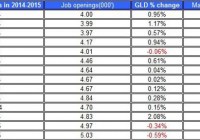
The non-farm payroll brought down GLD. Rising long-term treasury yields are keeping down GLD. It’s still uncertain where the demand for gold in China and India is heading. The recovery of the SPDR Gold Trust (NYSEARCA: GLD ) came to a halt in recent weeks as the recent economic indicators, mainly in the U.S. labor market, were better than anticipated. Let’s review the latest from the U.S. economy and its relation to the progress of GLD. The two major labor reports are the non-farm payroll and JOLTS. The non-farm payroll presented better-than-expected results. The JOLTS report was in line with market expectations. These reports suggest the U.S. economy is progressing with higher number of jobs, more job openings, and improved wages. The recent JOLTS report presented another positive gain in the number of job openings as it passed 5 million. Quit rate hasn’t changed at 1.9%, but the number of quits continues to slowly pick up, which is another positive indication for the progress in the U.S. labor force. In the past, the price of GLD tended to react strongly to the non-farm payroll report and to a lesser degree to the JOLTS report, as presented in the table below. (click to enlarge) Source of data taken from Google Finance and U.S. Bureau of Labor Statistics But the recovery in the labor market is likely to enable the FOMC, down the line, to raise rates. Higher rates in the coming months aren’t likely to do well for the price of GLD. One important issue related to the non-farm payroll report was the gain in wages – which also implies higher core inflation. After all, wages have risen by 2.2% year over year and by 0.5% compared to the previous month. (click to enlarge) Source of chart: FRED Is the current rate of gain in wages good enough for the FOMC? The chart above presents the year-over-year percent changes in U.S. wages over the past few years. The FOMC aims to reach a core inflation target of 2%, which isn’t far off the current gain in wages. Nonetheless, the growth in wages is still well below the levels recorded before the 2008 recession. So even though wages have gone up, they still have a long way to go before reaching their high levels of 2007. The other side of equation related to the labor market is the unemployment rate, which is currently at 5.7%. Back in 2007, the rate of unemployment was around 4.5%, but the FOMC’s long-term rate is around 5.3%. So the current level isn’t far off the FOMC’s long-term target, and thus, shouldn’t be among the factors holding back the FOMC from raising rates, right? (click to enlarge) Source of chart: FRED It depends on who you ask. According to a recent article by Krugman , the natural rate of unemployment is actually below 5%. Even if the rate of unemployment and wages are still off the “healthy levels”, for now, it seems a bit of stretch to consider they will be enough to impede the FOMC from raising rates in the middle of the year. One factor that has changed course in recent weeks is the rise in interest rates: The 10-year U.S. treasury yields have gone up and reached 2%. Source of data taken from U.S. Treasury and Google Finance The relation between the changes in yields and the price of GLD remains mid-strong and robust – it currently stands at -0.365. This negative relation suggests that if U.S. treasury were to keep picking up, this trend could also coincide with the drop in shares of GLD. Despite the recent fall in the price of GLD, the demand for the ETF has picked up – the ETF’s gold holdings continue to rise, as indicated in the chart below. Source of data taken from GLD’s website Keep in mind that the recent developments in Europe, including the ECB’s QE program and the higher chances (the market gives) of a Greek exit from the EU weigh on the euro. The higher uncertainty is likely to do well for the U.S. dollar, which isn’t something good for the price of GLD, but could also raise the demand for gold as an investment. Besides the changes in the demand for gold as an investment, the physical demand for gold is another, albeit secondary, factor to consider for the progress of gold prices. On this front, the leading country in consuming gold is China – the country has taken the reign from India as the leading importer of gold. In 2014, however, China’s gold consumption dropped by 25% compared to 2013. But since the beginning of the year , the demand for gold in China has started to pick up. Bear in mind, however, that China’s economy is expected to grow at a slower pace than in previous years, which may also translate to slower growth in demand for gold. India may also see a rise in gold imports if government officials were to follow through and reduce the import tax on the yellow metal. It’s still unclear where the chips will fall for gold consumption in China and India, but if these countries do surprise and show higher consumption, this could play a secondary role in raising gold prices. The rise in U.S. treasury yields and the improved U.S. labor market don’t vote well for the price of GLD. But there are also other factors to consider that could curb down the descent of gold. The uncertainty around Europe’s future and the demand for gold in China and India are question marks that could play in favor of gold. For more see: Gold and Inflation – Is there a relation? Disclosure: The author has no positions in any stocks mentioned, and no plans to initiate any positions within the next 72 hours. (More…) The author wrote this article themselves, and it expresses their own opinions. The author is not receiving compensation for it (other than from Seeking Alpha). The author has no business relationship with any company whose stock is mentioned in this article.