Tag Archives: investment

The Phases Of An Investment Idea

Investing ideas come in many forms: Factors like Valuation, Sentiment, Momentum, Size, Neglect… New technologies New financing methods and security types Changes in government policies will have effects, cultural change, or other top-down macro ideas New countries to invest in Events where value might be discovered, like recapitalizations, mergers, acquisitions, spinoffs, etc. New asset classes or subclasses Durable competitive advantage of marketing, technology, cultural, or other corporate practices Now, before an idea is discovered, the economics behind the idea still exist, but the returns happen in a way that no one yet perceives. When an idea is discovered, the discovery might be made public early, or the discoverer might keep it to himself until it slowly leaks out. For an example, think of Ben Graham in the early days. He taught openly at Columbia, but few followed his ideas within the investing public because everyone was still shell-shocked from the trauma of the Great Depression. As a result, there was a large amount of companies trading for less than the value of their current assets minus their total liabilities. As Graham gained disciples, both known and unknown, they chipped away at the companies that were so priced, until by the late ’60s there were few opportunities of that sort left. Graham had long since retired; Buffett winds up his partnerships, and manages the textile firm he took over as a means of creating a nascent conglomerate. The returns generated during its era were phenomenal, but for the most part, they were never to be repeated. Toward the end of the era, many of the practitioners made their own mistakes as they violated “margin of safety” principles. It was a hard way of learning that the vein of financial ore they were mining was finite, and trying to expand to mine a type of “fool’s gold” was not a winning idea. Value investing principles, rather than dying there, broadened out to consider other ways that securities could be undervalued, and the analysis process began again. My main point this evening is this: when a valid new investing idea is discovered, a lot of returns are generated in the initial phase. For the most part they will never be repeated because there will likely never be another time when that investment idea is totally forgotten. Now think of the technologies that led to the dot-com bubble. The idealism, and the “follow the leader” price momentum that it created lasted until enough cash was sucked into unproductive enterprises, where the value was destroyed. The current economic value of investment ideas can overshoot or undershoot the fundamental value of the idea, seen in hindsight. My second point is that often the price performance of an investment idea overshoots. Then the cash flows of the assets can’t justify the prices, and the prices fall dramatically, sometimes undershooting. It might happen because of expected demand that does not occur, or too much short-term leverage applied to long-term assets. Later, when the returns for the investment idea are calculated, how do you characterize the value of the investment idea? A new investment factor is discovered: it earns great returns on a small amount of assets applied to it. More assets get applied, and more people use the factor. The factor develops its own price momentum, but few think about it that way The factor exceeds the “carrying capacity” that it should have in the market, overshoots, and burns out or crashes. It may be downplayed, but it lives on to some degree as an aspect of investing. On a time-weighted rate of return basis, the factor will show that it had great performance, but a lot of the excess returns will be in the early era where very little money was applied to the factor. By the time a lot of money was applied to the factor, the future excess returns were either small or even negative. On a dollar-weighted basis, the verdict on the factor might not be so hot. So, how useful is the time-weighted rate of return series for the factor/idea in question for making judgments about the future? Not very useful. Dollar weighted? Better, but still of limited use, because the discovery era will likely never be repeated. What should we do then to make decisions about any factor/idea for purposes of future decisions? We have to look at the degree to which the factor or idea is presently neglected, and estimate future potential returns if the neglect is eliminated. That’s not easy to do, but it will give us a better sense of future potential than looking at historical statistics that bear the marks of an unusual period that is little like the present. It leaves us with a mess, and few firm statistics to work from, but it is better to be approximately right and somewhat uncertain, than to be precisely wrong with tidy statistical anomalies bearing the overglorified title “facts.” That’s all for now. As always, be careful with your statistics, and use sound business judgment to analyze their validity in the present situation. Disclosure: None
Adoption Of VXUP As A Hedging Instrument Could Transform Investment Management

VXUP is revolutionary. VXUP could become a key hedge for non-correlated portfolios. VXUP deserves to become a billion-dollar ETF. Spot CBOE VIX Up Class Shares (NASDAQ: VXUP ) could transform investment management. While I am very empathetic to the notion put forth in yesterday’s article that the daily movement of the ETF currently lags the responsiveness of the raw VIX index, the recognition, appreciation, and acceptance of VXUP’s benefits should dramatically increase its trading volume. In turn, the increase in VXUP’s trading volume should make it much more responsive to changes in the raw VIX index. And this increased responsiveness to the raw VIX index will further increase the ETF’s value as a hedging tool, in a virtuous cycle. The general acceptance and adoption of VXUP as a hedging instrument should transform investment management in a variety of ways which I will specifically illustrate. Indeed, I believe that the investment community will quickly realize the immense profitability of promoting a very healthy level of liquidity and AUM in VXUP. Yesterday’s article did an excellent job of explaining VXUP’s mechanics, along with that of its inverse ETF VXDN (NASDAQ: VXDN ). I will not recreate the wheel here. However, I will point out numerous examples of strategies which could be vastly improved by the use of VXUP as a hedging component. Indeed, as a hedging instrument, it is totally irrelevant whether VXUP is perfect. What matters to the investor is whether or not VXUP is a drastic improvement over every other ETP hedging alternative currently available. I will argue forcefully that VXUP is vastly superior. The ZOMMA Index Master Sheet is an exhaustive list of ETP strategy indices and their variations that we have published on seekingalpha and sometimes in books. I forcefully argue that for any of the strategies which use iPath S&P 500 VIX Mid-Term Futures ETN (NYSEARCA: VXZ ), iPath S&P 500 VIX Short-Term Futures ETN (NYSEARCA: VXX ), or ProShares Ultra VIX Short-Term Futures ETF (NYSEARCA: UVXY ) as a hedging component, that the performance of those strategies could be vastly improved over multi-year periods by replacing the use of VXZ, VXX, and UVXY with VXUP. Theoretically, there are very short, discrete time periods where backwardation could benefit the use of VXZ, VXX, or UVXY. However, it has been definitively illustrated by dozens of studies that over longer times frames, persistent contango tends to cause an uncomfortable amount of performance drag when using these instruments as hedges. On one hand, I have argued that all of the strategies illustrated in the master sheet should no longer be used due to their correlation to long bonds. On the other hand, reducing the size of TMF, and making VXZ, VXX, or UVXY larger percentage allocations in an effort to reduce the strategies’ long bond correlation and diversify hedging sources kills upside performance due to contango lag–equally unacceptable. VXUP would solve this problem elegantly, allowing larger volatility-related hedges, which could reduce the correlation of the strategy indices to both stocks and to bonds, while eliminating contango lag. I have argued forcefully that the nightmare scenario for the financial markets is for both stocks and bonds to crash simultaneously. On 3/11/2015 , I wrote: The sad joke of financial markets is that they are driven by long term interest rates, which set the discount rate for all other asset classes. And indeed, dropping interest rates have made speculators of every stripe look brilliant. Imagine a high jumper who is constantly buoyed by a dropping force of gravity. His athletic prowess appears to be improving, but instead, the force of gravity is becoming weaker. And conversely, rising gravity, or interest rates, cause moving objects to drop to earth more quickly. Moving objects like stock prices, bonds, real estate, and even gold. Every asset class will be affected by rising rates. Since then, the TLT ETF has dropped from $127 to a touch below $117. Imagine a nightmare scenario is which both stocks and long bonds dropped by 50%, due to a spike in interest rates. In such a scenario, it is almost facile and axiomatic to point out that volatility would skyrocket. A hedge like VXUP would be absolutely essential to reduce a portfolio’s correlation to both stocks and to bonds during such a nightmare. Moreover, if stocks and bonds do not simultaneously collapse, a lower correlation to both asset classes will not hurt the investor seeking an authentically non-correlated return stream during more normal regimes. So returning to the issue at hand, the use of VXUP as a hedging tool potentially allows the serious investor to reduce a portfolio’s correlation to both stocks and to bonds without the continuous contango that a VXZ, VXX, or UVXY position would entail. And without contango, the new VXUP volatility hedge could be comparatively larger without the associated drag of pre-existing alternatives. So it is largely irrelevant to the serious investor whether or not VXUP perfectly mirrors the raw VIX index. No hedge is perfect. There are merely hedges which are far better than any available ETP alternative! And VXUP is that far better hedge. As the investment community realizes it and volume in the VXUP increases, ironically, the VXUP should better mirror the raw VIX and even further outpace the competition as the most serious tool in the hedger’s toolbox. The portfolio manager’s dream has always been a continuously traded put option of sorts, which can serve as a shock absorber to a portfolio, without the drawbacks of a put option’s time decay or a volatility future-based instrument’s contango (which some would call synthetic time decay). The VXUP should become that continuously traded put option. Nothing else which has been introduced in the ETF world comes close to the VXUP in achieving that goal. I am not an expert in ETF design, but the goal that VXUP seeks to achieve is exceedingly shrewd. I would argue that increased volume, AUM, and acceptance will make the instrument more robust, useful, and demanded. Disclosure: I am/we are long VXUP. (More…) I wrote this article myself, and it expresses my own opinions. I am not receiving compensation for it (other than from Seeking Alpha). I have no business relationship with any company whose stock is mentioned in this article.

Today’s Most Competitive Wealth-Builder ETF Investment

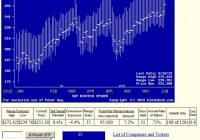
Summary From a population of some 350 actively-traded, substantial, and growing ETFs this is a currently attractive addition to a portfolio whose principal objective is wealth accumulation by active investing. We daily evaluate future near-term price gain prospects for quality, market-seasoned ETFs, based on the expectations of market-makers [MMs], drawing on their insights from client order-flows. The analysis of our subject ETF’s price prospects is reinforced by parallel MM forecasts for each of the ETF’s ten largest holdings. Qualitative appraisals of the forecasts are derived from how well the MMs have foreseen subsequent price behaviors following prior forecasts similar to today’s. Size of prospective gains, odds of winning transactions, worst-case price drawdowns, and marketability measures are all taken into account. Today’s most attractive ETF Is the SPDR Biotech ETF (NYSEARCA: XBI ): The investment seeks to provide investment results that, before fees and expenses, correspond generally to the total return performance of an index derived from the biotechnology segment of a U.S. total market composite index. In seeking to track the performance of the S&P Biotechnology Select Industry Index (the “index”), the fund employs a sampling strategy. It generally invests substantially all, but at least 80%, of its total assets in the securities comprising the index. The index represents the biotechnology industry group of the S&P Total Market Index (“S&P TMI”). The fund is non-diversified. The fund currently holds assets of $2.28 billion and has had a YTD price return of +27.87%. Its average daily trading volume of 1,069,010 produces a complete asset turnover calculation in 8.5 days at its current price of $250.86. Behavioral analysis of market-maker hedging actions while providing market liquidity for volume block trades in the ETF by interested major investment funds has produced the recent past (6 month) daily history of implied price range forecasts pictured in Figure 1. Figure 1 (used with permission) The vertical lines of Figure 1 are a visual history of forward-looking expectations of coming prices for the subject ETF. They are NOT a backward-in-time look at actual daily price ranges, but the heavy dot in each range is the ending market quote of the day the forecast was made. What is important in the picture is the balance of upside prospects in comparison to downside concerns. That ratio is expressed in the Range Index [RI], whose number tells what percentage of the whole range lies below the then current price. Today’s Range Index is used to evaluate how well prior forecasts of similar RIs for this ETF have previously worked out. The size of that historic sample is given near the right-hand end of the data line below the picture. The current RI’s size in relation to all available RIs of the past 5 years is indicated in the small blue thumbnail distribution at the bottom of Figure 1. The first items in the data line are current information: The current high and low of the forecast range, and the percent change from the market quote to the top of the range, as a sell target. The Range Index is of the current forecast. Other items of data are all derived from the history of prior forecasts. They stem from applying a T ime- E fficient R isk M anagement D iscipline to hypothetical holdings initiated by the MM forecasts. That discipline requires a next-day closing price cost position be held no longer than 63 market days (3 months) unless first encountered by a market close equal to or above the sell target. The net payoffs are the cumulative average simple percent gains of all such forecast positions, including losses. Days held are average market rather than calendar days held in the sample positions. Drawdown exposure indicates the typical worst-case price experience during those holding periods. Win odds tells what percentage proportion of the sample recovered from the drawdowns to produce a gain. The cred(ibility) ratio compares the sell target prospect with the historic net payoff experiences. Figure 2 provides a longer-time perspective by drawing a once-a week look from the Figure 1 source forecasts, back over two years. Figure 2 (used with permission) What does this ETF hold, causing such price expectations? Figure 3 is a table of securities held by the subject ETF, indicating its concentration in the top ten largest holdings, and their percentage of the ETF’s total value. Figure 3 source: Yahoo Finance XBI apparently takes a low-concentration approach to holdings, with an average of 1 ½% of its assets in each of its top ten commitments. This provides a wide dispersion of holdings among competitive contestants in an industry where success rewards can be huge, while failures tend to be complete. If the remaining 85% of assets are distributed on a 1% basis 95 separate bets may being made, offering great diversification, as well as dilution of encountered bonanzas. Where ultimate payoffs are less dependent on initial capital commitment size, this may be an advantaged strategy. Figure 4 is a table of data lines similar to that contained in Figure 1, for each of the top ten holdings of XBI. Figure 4 (click to enlarge) In an industry as unpredictably dynamic as this, wide variations in market experience seem to be the rule. Column (5) contains the upside price change forecasts between current market prices and the upper limit of prices regarded by MMs as being worth paying for price change protection. The average of +16.3% of the top ten XBI holdings is well above the population average of all 2600+ equities MM forecasts of +12.9%. It is about double the upside forecast for SPY price change prospects. The other side of the coin is column (6), which shows what actual worst-case price drawdowns have been typical in the 3 months following each time there has been a forecast like those of the present day. Those risk exposures have been nearly -10% in the holdings top ten, less than -9 by equities at large, and only -3.5% on the SPY ETF. But these holdings are attractive reward tradeoffs between returns and risks, with the top ten (column 14) at a ratio of 1.7, compared to equities overall at 1.5 times. Still, the market average of SPY provides a best ratio of 2.5 times risk avoidance. Another qualitative consideration is the credibility of the ten XBI big holdings after previous forecasts like today’s. The net average price change (column 13) of the ten has been 1.1 times the size of the upside forecast average, +17.4% compared to +16.3%. The equity population’s actual price gain achievement, net of losses has been a pitiful +3.7% compared to promises of 12.9%. The ability of XBI holdings to recover from those worst-case drawdowns and achieve profits occurred in 84% of experiences. The equity population only recovered less than two thirds of the time, and while the SPY experiences were more consistent like the ten XBI holdings, the achieved gains were much smaller. SPY has had only +3.3% gains previously from like forecasts of +8.6%. Conclusion XBI provides attractive forecast price gains, supported by equally appealing largest holdings. Both the ETF and many of its major holdings offer very attractive prospects in near-term price behaviors, demonstrated by previous experiences following prior similar forecasts by market makers. Disclosure: I/we have no positions in any stocks mentioned, and no plans to initiate any positions within the next 72 hours. (More…) I wrote this article myself, and it expresses my own opinions. I am not receiving compensation for it (other than from Seeking Alpha). I have no business relationship with any company whose stock is mentioned in this article.