Tag Archives: investing ideas

5 Impressive Large-Cap Blend Mutual Funds To Beat Peers

Blend funds are a type of equity mutual funds which holds in its portfolio a mix of value and growth stocks. Blend funds are also known as “hybrid funds”. Blend funds aim for value appreciation by capital gains. It owes its origin to a graphical representation of a fund’s equity style box. In addition to diversification, blend funds are great picks for investors looking for a mix of growth and value investment. Meanwhile, large-cap funds usually provide a safer option for risk-averse investors, when compared to small-cap and mid-cap funds. These funds have exposure to large-cap stocks, providing long-term performance history and assuring more stability than what mid-caps or small-caps offer. Below we will share with you 5 large-cap growth mutual funds . Each has either earned a Zacks #1 Rank (Strong Buy) or a Zacks #2 Rank (Buy) as we expect these mutual funds to outperform their peers in the future. To view the Zacks Rank and past performance of all large-cap blend funds, investors can click here to see the complete list of funds. Principal Capital Appreciation A (MUTF: CMNWX ) seeks long-term capital appreciation. Though CMNWX generally invests in large-cap companies, it may also invest a small portion of its assets in small- and mid-cap firms. CMNWX uses a “blend” strategy to invest in equity securities of companies. The Principal Capital Appreciation A fund has a three-year annualized return of 19.5%. As of April 2015, CMNWX held 154 issues with 3.34% of its assets invested in Apple Inc. Steward Large Cap Enhanced Index Individual (MUTF: SEEKX ) invests a lion’s share of its assets in securities listed in the benchmark index. SEEKX changes relative weighting of value and growth stocks by following style of the benchmark. SEEKX also uses quantitative analysis of factors such as valuation, growth and dividend yield for investing in securities other than those included in the index in order to maintain its social responsible investment policies. The Steward Large Cap Enhanced Index Individual fund has a three-year annualized return of 20.7%. SEEKX has an expense ratio of 0.90% as compared to category average of 1.04%. Fidelity Disciplined Equity (MUTF: FDEQX ) seeks capital appreciation over the long run. FDEQX invests a major portion of its assets in common stocks of companies. FDEQX follows the companies’ weighting in the S&P 500 Index before investing in securities of firms across a wide range of sectors. FDEQX invests in companies throughout the globe by using quantitative analysis of factors such as growth potential, valuation and financial strength. The Fidelity Disciplined Equity fund has a three-year annualized return of 21.8%. Alex Devereaux is the fund manager and has managed FDEQX since 2013. Vantagepoint Growth & Income Investor (MUTF: VPGIX ) invests a large chunk of its assets in common stocks of domestic companies that are believed to be undervalued and have an impressive earnings growth potential. VPGIX focuses on acquiring stocks of companies that are expected to pay dividends. The Vantagepoint Growth & Income Investor fund has a three-year annualized return of 20%. As of April 2015, VPGIX held 208 issues with 2.22% of its assets invested in Microsoft Corp. Dreyfus Disciplined Stock (MUTF: DDSTX ) seeks capital growth over the long-term. DDSTX invests s majority of its assets in large-cap companies having market capitalizations above $5 billion. DDSTX is expected to follow the weighting of the S&P 500 Index to invest in both value and growth stocks. The Dreyfus Disciplined Stock fund has a three-year annualized return of 17.5%. DDSTX has an expense ratio of 1.00% as compared to category average of 1.04%. Original Post
Does UNG Have A Silver Lining?

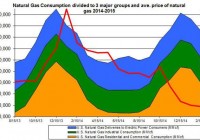
The weather is expected to remain hotter than normal and drive up the demand for natural gas in the power sector. The natural gas storage buildup is still expected to reach higher-than-normal level by the end of the injection season. The injections to storage are still expected to be higher than normal in the coming weeks. The natural gas market started to heat up again as shares of United States Natural Gas ETF (NYSEARCA: UNG ) climbed back up to the $13 mark. It’s still too early to portray the recent bump in the price of natural gas as a recovery, but UNG still has a silver lining in the short term – the ongoing rise in demand for natural gas in the power sector. The weather is expected to heat up. This suggests the consumption of natural gas, at least in the power sector, could keep ramping up. Despite the expected rise in demand for natural gas in the power sector, which accounts for around a third of total U.S. consumption during the year but close to 45% of total demand between April and October, it may not be enough to drive up the price of UNG much higher than its current levels. (click to enlarge) Source of data taken from EIA For one, the injections to storage are still projected to remain higher than normal in the coming weeks. And the storage, which is currently nearly 2% higher than the 5-year average, is expected to reach 3,900 by the end of the October, as you can see in the chart below: (click to enlarge) Source of data taken from EIA Last week, the injection to storage was 111 Bcf – only 2 Bcf lower than market expectations. Looking forward, the market estimates were slightly revised down; even though they still project higher-than-normal injections in the coming weeks, these injections are slightly lower than previous estimates. The higher pace of injection is still driven by the stable production , which, despite the low price of natural gas, remained around 6% higher than last year. The number of operating natural gas rigs has stabilized at 221, as of last week based on the estimates of Baker Hughes (NYSE: BHI ). This number hasn’t changed a whole lot since April. Nonetheless, the warmer weather could bring down the injections to storage in the coming weeks – this could lead to a downward revision of the storage outlook in the coming weeks. In the next couple of weeks, the current weather projections suggest another heat-wave mainly in the West Coast and Southeast. This forecast is also supported by the expected higher-than-normal U.S. average cooling degree days for the week. Last week, total consumption grew by 3.1%; the power sector’s demand rose by 13.3% week over week. The rise in demand was offset by lower consumption in the residential/commercial sectors, which during the injection season accounts for only 20% of total demand – during the year, these sectors account for over a third of total demand. The higher temperatures in the coastal regions are likely to keep driving up the demand for natural gas in the power sector, which could also, in turn, allow short-term rallies for UNG. Despite the expected higher demand in the power sector, the storage is still projected to reach a high level, relative to the 5-year average, by the end of the injection season. For more see: On the Contango in Natural Gas Market Disclosure: The author has no positions in any stocks mentioned, and no plans to initiate any positions within the next 72 hours. (More…) The author wrote this article themselves, and it expresses their own opinions. The author is not receiving compensation for it (other than from Seeking Alpha). The author has no business relationship with any company whose stock is mentioned in this article.

E.ON – Strategically Positioning Itself For A Green Future

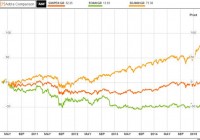
Positioning themselves strategically; inflection point in stock price. Geographical exposure to accelerating green energy trends. Preferred pick amongst large-cap European utilities. E.ON ( OTCQX:EONGY ) reported a record annual loss for 2014 as it took impairment charges associated with writing off its Italian and Spanish businesses as discontinued assets in its FY14 results on 11th March. These divestments are part of a refocusing its core businesses and portfolio optimization. E.ON’s announced in Dec 2014 that it will divest carbon interests and look to refocus business on renewables, smart grids and energy efficiency in a bold move to reposition itself in an industry strongly influenced by green energy trends. The European Union has set a target of 20% for the share of energy consumption to come from renewable energy sources by 2020, with each member state agreeing to a national target outlined in the 2009 EU Renewables Directive. Initial doubters of the credibility of the commitment have been proved wrong with the steady progress made by member nations. By 2012 the EU achieved 11.0% share of energy consumption generated from renewables . E.ON is particularly exposed to these trends as its home market is Germany which has undergone a transformation since the 2011 Fukushima crisis. It has set itself a target of generating 80% of electricity from clean sources by 2050 . Furthermore, technological advances in renewables have seen the costs of generating renewable energy falling, particularly for solar energy. This the shift towards renewable energies looks set to continue and we believe E.ON’s recently announced new strategic positioning will bring long term benefits to the company and its shares. Within Europe, E.ON has exposure to the regions that appear to be most affected by trends towards green energy. The company’s earnings are mainly generated from Germany with the UK and Sweden the other largest sources of earnings within the EU. Germany and Sweden generated ~24% and 60% of their electricity consumption from renewables in 2012. Furthermore, the UK government has been supportive of new green energy projects approving a number of projects in recent years as it tries to meet EU targets for 2020. In 2014, E.ON grew EBITDA by 20% in wind and solar and overall 18% of EON s EBITDA came from renewables . This looks set to continue as they stated they would pursue disciplined capex with > 70% of 2015 capex in Wind, Solar, Distribution Networks & Customer Solutions. The recent new refocused strategy and its exposure to countries in Europe that provide more favorable conditions for renewable energy growth should benefit the company in the medium to long term. E.ON has stated its preference towards wind and solar energy. Positioning towards renewables not only aligns it to wider energy regulation but also to technological trends. UBS stated in a report published in 2014 it believes solar and smart grid technologies will be at the forefront of wider change in power generation . It emphasizes “Solar is at the edge of being a competitive power generation technology” and that “power is no longer something that is exclusively produce by huge, centralized units owned by large utilities”. The falling cost of renewables technologies has coincided with the expected rise of the electric car and improvements in battery technologies. UBS predict a 50% reduction in the cost of batteries by 2020. This will allow homeowners to own battery packs to store energy and power their electric vehicles. Michael Liebrich of Bloomberg New Energy Finance stated that renewable energies have become “fully competitive with fossil fuels in the right circumstances” and their competitiveness looks set to strengthen in coming years as technological advances continue. Therefore, the positioning of the business towards renewables looks smart and it should help E.ON trade on higher valuation multiples, such as P/E. Renewables trade on higher multiples compared to traditional energy business due to stagnation in these traditional businesses and the potential for growth in renewable energy along with higher profit margins. Risks during the strategic overhaul should be taken into account as there is degree of uncertainty over divestments and the valuation of the new company that will be spun-off in 2016. Divestments have continued into 2015 with the sale of its Italian coal and gas power plants and reports suggesting it is looking to sell its North Sea exploration and production assets for around $2bn. Other business risks include its exposure to Russia which generated 7.4% of EBITDA in 2013. Furthermore, gas prices which continue to stay low or trend downwards will affect company earnings as E.ON repositions its business model. Analysts appear divided on whether EON’s transformation is too radical and whether the strategy will be successful. The stock has underperformed the wider European market and Stoxx 600 Utilities index over the last 5 years due to its poor performance, see graph below. It is valued attractively given this underperformance and current poor ROA at 0.96x P/B (cf sector 3.2x) with EV/EBITDA of 4.2x . Its dividend yield is 3.9%, slightly higher than the sector with a pay-out ratio of 60% which is easily defendable given a reasonable net debt to EBITDA ratio of 2.4x. It has also announced it will keep a fixed dividend to bridge the transition to its spin-off. (click to enlarge) The big question is can a traditional utility reinvent itself as a green energy services power house. We believe they can and implementing the strategy earlier than its competitors will allow E.ON to position itself competitively within a transforming industry. Its aims to decarbonise its services at a faster rate should be attractive to investors and raise it from current low stock valuation multiples. Furthermore, the less capital intensive its business becomes the greater the cash flows it will generate and the more it will be able to boost investment and shareholder returns in the future. Renewable energy is shaping the utilities sector and we believe E.ON’s recent strategic overhaul positions it perfectly to benefit. Editor’s Note: This article discusses one or more securities that do not trade on a major U.S. exchange. Please be aware of the risks associated with these stocks. Disclosure: The author has no positions in any stocks mentioned, and no plans to initiate any positions within the next 72 hours. (More…) The author wrote this article themselves, and it expresses their own opinions. The author is not receiving compensation for it (other than from Seeking Alpha). The author has no business relationship with any company whose stock is mentioned in this article.