Tag Archives: income

Buffett Explains Bubbles

Back when the financial crisis was in full blown collapse mode, the government stepped in to shore up the problem areas and infused a huge amount of reassurance in the financial system. It was like a giant hug for the markets, for the people, and anyone else that needed one, that said, “things will be okay.” Then the government did what all governments do best. Congress formed a committee to investigate why it happened. They needed a villain. So the FCIC, Financial Crisis Inquiry Committee, was created to find who or what was to blame. In the end, we all know what happened. The banks took the heat while a lot of the co-conspirators walked away clean. In reality, it was a fairly solid team effort between lenders, borrowers, Congress, rating agencies, regulators, Fannie Mae ( OTCQB:FNMA ), Freddie Mac ( OTCQB:FMCC ), mortgage brokers, real estate speculators, derivatives, media, etc. that led to the largest bubble and crisis in history. This past weekend, the FCIC made available some transcripts and notes from that investigation. One of those transcripts was a two-hour interview with Warren Buffett. I won’t cover the entire interview though it was an interesting read (at least I thought so). Buffett offered an enlightening take on bubbles, which I thought I’d share. It didn’t cause it, but there were a vast number of things that contributed to it. The basic cause, you know, embedded in psychology – partly in psychology and party in reality in a growing and finally pervasive belief that house prices couldn’t go down and everyone succumbed – virtually everybody succumbed to that. But that’s – the only way you get a bubble is when basically a very high percentage of the population buys into the same originally sound premise and – it’s quite interesting how that develops – originally sound that becomes distorted as time passes and people forget the original sound premise and start focusing solely on the price action. So every – the media, investor, the mortgage bankers, the American public, me, my neighbor, rating agencies, Congress, you name it, people overwhelmingly came to believe that house prices could not fall significantly. And since it was the biggest asset class in the country and it was the easiest class to borrow against, it created probably the biggest bubble in our history. … I think every aspect of society contributed to it virtually, but they fell prey to the same delusion that existed throughout the country eventually and it meant that the models that they had were no good. They didn’t contemplate – but neither did the models in the minds of 300 million Americans contemplate – what was going to happen. … Well, there’s a very interesting aspect of this, which will take a minute or two to explain, but what my former boss, Ben Graham, made an observation, 50 or so years ago to me that it really stuck in my mind and now I’ve seen evidence of it. He said, “You can get in a whole lot more trouble in investing with a sound premise than with a false premise.” … It’s a totally sound premise that houses will become worth more over time because the dollar becomes worth less. It isn’t because – you know, construction costs go up. So it isn’t because houses are so wonderful, it’s because the dollar becomes worth less, and that a house that was bought 40 years ago is worth more today than it was then. And since 66 or 67 percent of the people want to own their own home and because you can borrow money on it and you’re dreaming of buying a home, if you really believe that houses are going to go up in value, you buy one as soon as you can. And that’s a very sound premise. It’s related, of course, though, to houses selling at something like replacement price and not far outstripping inflation. So this sound premise that it’s a good idea to buy a house this year because it’s probably going to cost more next year and you’re going to want a home, and the fact that you can finance it gets distorted over time if housing prices are going up 10 percent a year and inflation is a couple percent a year. Soon the price action – or at some point the price action takes over, and you want to buy three houses and five houses and you want to buy it with nothing down and you want to agree to payments that you can’t make and all of that sort of thing, because it doesn’t make any difference: It’s going to be worth more next year. … And the price action becomes so important to people that it takes over the – it takes over their minds, and because housing was the largest single asset, around $22 trillion or something like that…Such a huge asset. So understandable to the public – they might not understand stocks, they might not understand tulip bulbs, but they understood houses and they wanted to buy one anyway and the financing, and you could leverage up to the sky, it created a bubble like we’ve never seen. … It wasn’t like somebody was thinking, “This is going to end in a paralysis of the American economy.” You know, they just – they started believing what other people believed. It’s very tough to fight that. Of course, a similar sound premise was behind the ’29 bubble and internet boom. Buffett explained both cases started with a sound premise – stocks outperform bonds over time and the internet will change our lives – which was a solid argument for owning stocks. But at some point, the sound premise became “you should own stocks because prices are going up,” then momentum and FOMO (Fear Of Missing Out) kicked in. Eventually, people gradually wake up to the reality that it’s not true and the bubble pops. Source: Buffett FCIC Interview Transcript
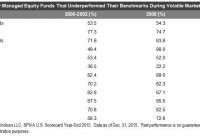
Does Market Volatility Favor Active Management?

By Aye Soe Twice a year, S&P Dow Jones Indices releases the SPIVA U.S. Scorecard. The scorecard measures the performance of actively managed equity and fixed income funds across various categories. Since the initiation of the report in 2002, the results have consistently shown that managers across most categories overwhelmingly underperform on a relative basis against their corresponding benchmarks over a medium-to-long-term investment horizon. The Year-End 2015 SPIVA U.S. Scorecard reveals little surprise. The second half of 2015 was marked by significant market volatility, which was brought forth by plunging commodity prices, a strengthening U.S. dollar, growing global concerns over Chinese economic growth, and the subsequent devaluation of the Chinese renminbi. Market volatility, in theory, favors active investing, because managers can tactically move out of their positions at their discretion and park themselves in cash. Passive investing, on the other hand, has to remain fully invested in the market. Investors in actively managed strategies should therefore realize fewer losses during periods of heightened volatility, all else being equal. Given this theoretical background, recent volatility in the market has supporters of active investing proclaiming that active management is back in favor. However, over a decade of experience in publishing the SPIVA Scorecard has painfully taught us that active funds don’t always perform better than their passive counterparts during those precise periods in which active management skills seem to be called for. Exhibit 1 compares the performance of actively managed equity funds across the nine style boxes during the 2000-2002 bear market, the financial crisis of 2008, and 2015. As the data clearly show, there is no consistent pattern across most of the categories. Large-cap value managers appear to be the only exception to the losing trend, outperforming their benchmark in both bear markets. Again in 2015, mid-cap value is the only winning equity category, with the majority (67.65%) of them outperforming the S&P MidCap 400® Value . Disclosure: © S&P Dow Jones Indices LLC 2015. Indexology® is a trademark of S&P Dow Jones Indices LLC (SPDJI). S&P® is a trademark of Standard & Poor’s Financial Services LLC and Dow Jones® is a trademark of Dow Jones Trademark Holdings LLC, and those marks have been licensed to S&P DJI. This material is reproduced with the prior written consent of S&P DJI. For more information on S&P DJI and to see our full disclaimer, visit www.spdji.com/terms-of-use .

Your Strategy Will Sometimes Lag, And That’s OK

By Roger Nusbaum, AdvisorShares ETF Strategist Barron’s featured an ETF Roundtable that focused on smart beta funds . The actual discussion wasn’t all that interesting, but there was an important general point made about investment strategies. Gray: Value investing is driven in part by behavioral biases-otherwise, why wouldn’t everyone just be Warren Buffett and buy cheap stocks and hold them? They don’t because if you hold concentrated, cheap-stock portfolios, there will be multiple years when you’ll get your face ripped off. You need clients that understand how true active strategies work over the long term. Indeed, the cheapest U.S. stocks have trailed more expensive growth stocks for nine years now. Whistler: The challenge with strategic beta, or any factor-based investment, is that they can underperform a traditional cap-weighted index for quite a long period-two, three, even five years. For purposes of this blog post, value investing is merely an example. There are plenty of valid strategies that could replace value in the excerpt. The passage is important, because it accepts as an inevitability that any given strategy will have periods where it lags. Value has lagged for the entire bull market until this year, according to another Barron’s article from this weekend, but there is no sentiment that somehow value is not a valid investment strategy. Value or growth, buy and hold no matter what, indexing or passive and so on and on are all capable of getting the job done. Underperformance for a couple of years, although completely normal, potentially breeds impatience, which can lead to chasing the performance of what just did well in the expectation that it will continue to do well. In simplistic terms, something that just outperformed last year has a good chance of underperforming this year. The person who perpetually chases last year’s winner has a high likelihood of always lagging, which does not have to be ruinous, but does make things harder over the long term in terms of keeping pace with the projection of “the number.” My preference is to maintain exposure to various market segments: small cap/large cap, growth/value, foreign/domestic, high dividend/no or low dividend and so on. And like any approach out there, there are times where my preference outperforms and times where it lags. More important than returns are savings rates and the avoidance of self-destructive investment behaviors. At a high level, everyone knows they need to save money, but doing it is the hard part. People who save 10%, 15% or more are making things easier for their future selves and are acting on the thing they have far more control over – saving money, versus the whims of the capital markets. Chasing previous top performers is just one of countless behavioral things that people do to themselves. My hope in revisiting these building blocks, especially when others in the field say essentially the same thing, is that hopefully, more market participants will come to realize that how they are doing in 2016 simply won’t matter in the long run. As I often mention in this context, “Without looking, how’d you do in the first quarter of 2012?” The only way someone is likely to know is if something catastrophic happened to their portfolio. Disclosure: I/we have no positions in any stocks mentioned, and no plans to initiate any positions within the next 72 hours. I wrote this article myself, and it expresses my own opinions. I am not receiving compensation for it. I have no business relationship with any company whose stock is mentioned in this article. Additional disclosure: To the extent that this content includes references to securities, those references do not constitute an offer or solicitation to buy, sell or hold such securities. AdvisorShares is a sponsor of actively managed exchange-traded funds (ETFs) and holds positions in all of its ETFs. This document should not be considered investment advice, and the information contain within should not be relied upon in assessing whether or not to invest in any products mentioned. Investment in securities carries a high degree of risk, which may result in investors losing all of their invested capital. Please keep in mind that a company’s past financial performance, including the performance of its share price, does not guarantee future results. To learn more about the risks with actively managed ETFs, visit our website AdvisorShares.com .