Tag Archives: ideas

A Well Designed High Yield Bond Fund: HYG
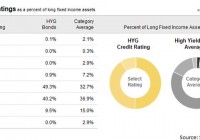
Summary The IShares iBoxx $ High Yield Corporate Bond ETF has the expected credit risk for a high yield fund, but the yield is worth it. The holdings show reasonable diversification in the debt securities in the portfolio. Maturities are scattered from 1 year through 10 years with the heaviest levels in the 5 to 7 year range. The correlation to SPY which causes the ETF to dip with the S&P 500 is a concern of investing in junk bond funds. The correlation issues should be less pronounced if investors include other (not junk, lower yield) bond funds in their portfolio. The iShares iBoxx $ High Yield Corporate Bond ETF (NYSEARCA: HYG ) is a solid bond fund for exposure to securities rated BB or B. As I’ve been searching for appealing bond funds, finding great ETFs for bonds of mediocre quality and higher yields has been difficult. After looking through the portfolio, I think the holdings are fairly reasonable for an investor wanting to regularly keep part of their portfolio in a bond fund. The holdings clearly don’t have impeccable credit ratings but they do offer investors a decent yield. The distribution yield is about 5.5% which means investors are actually getting some respectable income out a bond fund. Credit Quality When the name says “High Yield Corporate Bond”, investors should know that is going to mean that credit ratings won’t be very high. The allocation here seems within reason even if it is a little heavier on the specific ratings it targets than the category average. See the chart below: (click to enlarge) The concentration doesn’t bother me. If I’m going to invest in a credit sensitive bond portfolio I want the holdings to be diversified when considering the issuer of the debt, however having a heavy focus on the specific credit ratings is nice when an investor wants to build an entire portfolio and use multiple bond funds. Holdings I prepared the following chart showing the largest debt holdings of HYG. There were a couple equity holdings showing up but they were inconsequential to the overall portfolio as their combined value was significantly less than 1% of the portfolio. (click to enlarge) Maturities I grabbed another chart to show the maturity ranges across the portfolio: (click to enlarge) The maturity profile for the iShares iBoxx $ High Yield Corporate Bond ETF is fairly reasonable for an investor trying to get a solid diversification across the yield curve with a preference for shorter to medium length securities which should reduce the volatility of the portfolio. Of course, the credit risk on the portfolio could be an issue for some investors and may influence volatility in its own way. Regardless, the portfolio is showing almost no exposure beyond 10 years while having a solid yield. When it comes to maturities, I think this breakdown looks fairly solid. Risk HYG has been around since early 2007 which is wonderful for seeing how the fund did during that challenging period that followed. The shares did drop hard along with the market, which is not surprising given that they are investing in high yield (and thus higher risk) securities, however it did not fall even remotely as hard as the S&P 500. The biggest risk factor from a portfolio standpoint that came up for me was a 73.8% correlation in monthly returns with the S&P 500. Since one purpose of the bond portion of the portfolio is to provide diversification, it is a strike against junk bond funds that they tend to move with the market. That is a problem that should be impacting most junk bonds though, not a risk unique to HYG. Expense Ratio The one thing I really don’t care for is the expense ratio at .50%. I’m not going to say that this is terrible for a bond fund, but my expectations for low expense ratios are not met. Conclusion HYG is a fairly solid option for junk bond exposure. The portfolio appears to be designed well, the distribution of maturities works to help avoid excessive exposure to a single part of the yield curve and the portfolio produces a respectable amount of income. I could go for a lower expense ratio to really make this fund stand out, but that is the only weakness I see that is specific to the fund. If an investor is looking at the role of the bond fund in their portfolio, it would be wise to consider having multiple bond funds if the first one is going to be investing in junk bonds. This kind of fund can offer some diversification benefits to investors but it would be most productive in a portfolio that combines it with a few other bond funds with different duration exposures and higher credit ratings to enhance the diversification benefits that bonds bring to the investor’s portfolio. Disclosure: I/we have no positions in any stocks mentioned, and no plans to initiate any positions within the next 72 hours. (More…) I wrote this article myself, and it expresses my own opinions. I am not receiving compensation for it (other than from Seeking Alpha). I have no business relationship with any company whose stock is mentioned in this article. Additional disclosure: Information in this article represents the opinion of the analyst. All statements are represented as opinions, rather than facts, and should not be construed as advice to buy or sell a security. Ratings of “outperform” and “underperform” reflect the analyst’s estimation of a divergence between the market value for a security and the price that would be appropriate given the potential for risks and returns relative to other securities. The analyst does not know your particular objectives for returns or constraints upon investing. All investors are encouraged to do their own research before making any investment decision. Information is regularly obtained from Yahoo Finance, Google Finance, and SEC Database. If Yahoo, Google, or the SEC database contained faulty or old information it could be incorporated into my analysis.

Merger Arbitrage Interview Series: Chris DeMuth Jr. Of M&A Daily

Merger Arbitrage Interview Series continues. Global mergers on record pace in 2015. Chris DeMuth, writer of the new M&A Daily. Global mergers and acquisitions are on pace this year to hit the highest level on record. That may be why interest in deal stocks is running pretty high on Seeking Alpha. The merger arbitrage blog on the site is one of the most popular with more than 1000 comments so far this year. I recently started a Merger Arbitrage Interview Series on Seeking Alpha. Earlier this week, we heard from MergerBrief founder Carl Barnick . In this installment, we hear from Chris DeMuth Jr., author of the new M&A Daily. Special Situations and Arbs: You run the most popular premium service on Seeking Alpha, Sifting The World, and you recently started a daily merger arbitrage product called M&A Daily. Can you explain what you hope to accomplish with this? Chris DeMuth Jr.: I started the new M&A Daily to offer top news on deal activity as well as my $0.02 on investment opportunities surrounding those deals. The great idea to start this came from Eli Hoffmann , Seeking Alpha’s new CEO. This is Seeking Alpha’s first contributor-generated newsletter. It will feature the option for readers to have it sent straight to their inboxes when it is published. I started researching M&A transactions in 1999 and have been doing so ever since, so I hope that this will be a great new outlet for using some of my experience and enthusiasm that I have in regard to this topic. Thank you, Eli, for the chance to launch this product and roll it out to a much wider audience starting next week. SSA: Is M&A Daily geared to readers that trade M&A stocks or the general SA reader? CDM : It is geared to anyone interested in M&A – corporate insiders, financial and legal advisors, as well as merger arbitrageurs and other investors. SSA: What attracted you to merger arbitrage initially? CDM: My first job involved public policy research in DC. I conducted regulatory and antitrust analysis and tracked litigation and legislation for well-known hedge funds and banks. A lot of the work revolved around policy-sensitive issues such as asbestos and tobacco. About half of the job was analytical and about half was investigative. I read a lot of SEC filings, but I also would know who checked into what hotels and where their planes landed. What attracted me to initially focus on merger arbitrage were some of the people involved at the top hedge funds and prop desks at the time. I wanted to learn from them while I worked for them. SSA: How do you think a merger arbitrage strategy will perform in the upcoming downturn, whenever that is? CDM: The market is precariously expensive and a collapse would be unsurprising. Merger arbitrage should do fine, as long as exposures are sized appropriately. SSA: How do years of experience make a merger arbitrage trader better? CDM: A lot of this business is highly practical. After years of experience, one gets to know the relevant personnel much better. SSA: Do you invest in the deals you write about on SA? CDM: Yes, without exception. The only reason why I have the time and energy to discuss ideas on SA is because it is so highly redundant with what I am doing anyway – seeking mispriced securities for Rangeley Capital, sharing edgy and actionable ideas with StW , and then disseminating more general ideas to the mass market on SA. SSA: Do you prefer cash or stock deals? CDM: I have no preference. I like cash; I like stock. The only thing that I need is a substantial discount to the probability-weighted outcomes. As Warren Buffett says, Take the probability of loss times the amount of possible loss from the probability of gain times the amount of possible gain. That is what we’re trying to do. It’s imperfect, but that’s what it’s all about. SSA: Do you attempt to hedge cash deals? If so how? CDM: No. Instead, I am extremely picky about which deals I get involved in. In terms of playing defense, I use selectivity, cash, and disciplined sizing. SSA: Do you use leverage? CDM: Rarely and sparingly. The last time that I was substantially leveraged was March 2009. As of today, I have a substantial cash position. SSA: Do you utilize the options market in respect to M&A? If so how? CDM: Yes, the options market is quite useful for M&A-related positions. We frequently have information or judgment that leads us to a high level of confidence on a deal likelihood or its price or its date, without confidence in other aspects of a potential deal. Options allow us to more precisely isolate the aspects of a given investment where we have an advantage. When I write up deal targets such as here , I typically include a section that I call Event Driven Investing with Equity Options. The idea is to find opportunities where typical options pricing models fail to take into account salient aspects of corporate events. SSA: Do you invest in pre-deal rumors? If so, how do you decide which ones to invest in and which ones to pass on? CDM: I have never invested in a situation that could be accurately characterized as a rumor. We do, however, invest in non-definitive deals. I look for targets that are trading beneath to only slightly above their intrinsic value as standalone companies. That way, we own any upside from deal announcements. I am less interested in paying anything for deal speculation once it is in the price. This year, two investments of mine that turned into definitive deals included Informatica (NASDAQ: INFA ) and Magnetek (NASDAQ: MAG ). SSA: What are your thoughts on holding a handful of concentrated positions vs. investing in several deals? CDM: It is fine as long as one knows what they are doing. I am fine with concentrated positions as long as there is a substantial and unambiguous asymmetry. It happens, but does not happen all the time. SSA: Both the Shire/AbbVie and Time Warner Cable/Comcast deals fell apart not that long ago. How does an arbitrageur avoid these kinds of deals? Is the regulatory process getting tougher? CDM: Both Shire (NASDAQ: SHPG ) and Time Warner Cable (NYSE: TWC ) are trading above their prices before their earlier deals were discounted by the market, so these are cautionary stories regarding fortitude, not avoidance. I bought about $7.5 million of TWC at the beginning of last year which grew to over $10 million this year, wrote about it here and here and think that it is still an opportunity. TWC data by YCharts Good things happen to cheap stocks and we ended up with a better deal after the first one failed. SSA : What do you think of the role of the activist in merger deals? CDM: It is largely positive. However, I do not see any need for a clear distinction between activists and other holders. We are all owners and should all act like it. That means we do whatever we can to maximize shareholder value. Sometimes that involves cheering on our managers in their job as stewards of our companies. Other times that means simply staying out of their way. Yet other times, it involves standing up for ourselves and fighting. The tactic should simply fit the circumstances. SSA: Can you share one or two recent merger arbitrage trades and discuss why you put the trade on? CDM: I own both Pinnacle (NYSE: PNK ) and Depomed (NASDAQ: DEPO ). Through constant and productive communication with the relevant decision makers, we concluded that the bidders were committed and their commitment would result in definitive deals. Pinnacle did. Depomed will. SSA: Is there a current deal you won’t invest in? CDM: At the right price, I would invest in any deal. Of the current deals, I think that it is reasonable to expect the Rexam (OTCQX: REXMY ) deal with Ball (NYSE: BLL ) to be blocked on antitrust grounds and it is reasonable to interpret the management-led buyout of SFX Entertainment (NASDAQ: SFXE ) as a dubious to fraudulent effort to buy a company that is worth somewhere in the neighborhood of $0.00. So those are two examples of securities that would have to be quite a bit cheaper and more analyzable to attract me. SSA: How do you decide whether to add to a position that had declined or to close the trade? CDM: Any position that moves a material amount is re-analyzed from scratch. The route that a stock took to a given price is not an input in my analysis. I look only at its upside, downside, and embedded probabilities of each possible outcome. I add to positions that are increasingly variant and close positions when the market price has converged upon a security’s intrinsic value whether it converged upwards, downwards, or sideways. SSA: May was a record for M&A activity. Domestic take-overs totaled $243B last month, besting the two previous month highs, May 2007 and January 2000. Does reading that sentence scare you? CDM: I thought that both January 2000 and May 2007 were delightful, so no. Deal activity is strong. Markets are expensive. Volatility is low. One can probably do well through a combination of cash, sizing discipline, and one of the best sets of short opportunities that I have ever seen. SSA: Is there anything else you would like to add about M&A Daily, your hedge fund or merger arbitrage in general? CDM: Seeking Alpha’s computer geniuses are hard at work setting up the M&A Daily update so that it can go out as part of a daily e-mail as soon as next week. Thank you, Daniel Hochman, for the great work behind the scenes as we get this product to our readers. I hope that the M&A community will find it useful and make it part of their routine. At Rangeley Capital, we are busily building out a new seeding platform that is going to bring on a number of talented new portfolio managers starting in the months ahead. Some of them are even people who are already well known to the Seeking Alpha readership. As far as merger arbitrage, it is just a part of what I do, but every once in a while it can get interesting and lucrative. To date, it has not been a big emphasis on Sifting the World , but it may be a bigger part of STW’s future. With bond prices at extremely high prices, it is easier to justify merger arbitrage spreads as an attractive bond substitute. If anyone wants to learn more, they should check out your terrific Merger Arbitrage Blog . Finally, thank you, Special Situations and Arbs, for taking the time to discuss merger arbitrage. I love thinking about investment ideas, so I am glad that you asked. Disclosure: I/we have no positions in any stocks mentioned, and no plans to initiate any positions within the next 72 hours. (More…) I wrote this article myself, and it expresses my own opinions. I am not receiving compensation for it (other than from Seeking Alpha). I have no business relationship with any company whose stock is mentioned in this article. Additional disclosure: Special Situations and Arbs has no positions in any stocks mentioned above.

5 Top-Ranked Global Mutual Fund Picks

Over the years, studies have consistently shown that investing in both domestic equities and foreign stocks reduces portfolio risk while enhancing returns. In addition, the primacy of the US equity markets has greatly diminished with its share of the global stock market capitalization declining steadily. This is why investors can no longer limit themselves to domestic investments. By holding widely diversified portfolios, selected after careful research, global mutual funds offer a secure and attractive opportunity for investors. Below we will share with you 5 top-rated global mutual funds. Each has earned a Zacks Mutual Fund Rank #1 (Strong Buy) as we expect these mutual funds to outperform their peers in the future. Oppenheimer Global Y (MUTF: OGLYX ) invests in US and non-US companies. There are no limitations on the investing in foreign securities, be it from developing or emerging economies. Nonetheless, OGLYX is now focusing on developed markets including the US, Western Europe and Japan. Though OGLYX mostly invests in mid-to-large-cap firms, but it is not limited to particular capitalization range. The global mutual fund returned 14.3% over the last one-year period. As of June 2015, OGLYX held 89 issues with 2.53% of its assets invested in McGraw Hill Financial Inc. Fidelity Worldwide (MUTF: FWWFX ) seeks capital appreciation. The fund purchases securities issued from any nation across the world. It focuses on acquiring common stocks and diversifies investments across various countries and regions. FWWFX returned 10.5% over the last one-year period. The fund has an expense ratio of 0.97% as compared to category average of 1.30%. Janus Global Select T (MUTF: JORNX ) seeks long-term growth of capital. JORNX’s objective is to invest primarily in common stocks selected for their growth potential. JORNX may invest in companies across the globe of any size, from larger, well-established companies to smaller, emerging growth companies. The Fund normally concentrates its investments in a core group of 40-70 US and non-US common stocks. The global mutual fund returned 19.5% over the last one-year period. George P. Maris is the fund manager and has managed JORNX since 2012. Thornburg Global Opportunities R5 (MUTF: THOFX ) invests in varied equities and debt securities across the globe, including firms with market capitalization lower than $500 million. THOFX may invest in common stocks, preferred stocks, real estate investment trusts, and other equity trusts, which fund adviser believes help in achieving investment goals. THOFX returned 20.4% over the last one-year period. The fund has an expense ratio of 0.99% as compared to category average of 1.30%. Fidelity Value Strategies (MUTF: FSLSX ) seeks capital growth. FSLSX focuses on acquiring common stocks. FSLSX invests primarily in common stocks of companies considered to be undervalued in relation to factors such as assets, sales, earnings or growth potential. FSLSX returned 7.7% over the last one-year period. As of June 2015, this fund held 83 issues with 5.59% of its assets invested in LyondellBasell Industries N.V. Original Post