Tag Archives: history

Today’s Strongly Competitive Wealth-Builder Sector ETF Investment

Summary From a population of some 350 actively-traded, substantial, and growing ETFs, this is a currently attractive addition to a portfolio whose principal objective is wealth accumulation by active investing. We daily evaluate future near-term price gain prospects for quality, market-seasoned ETFs, based on the expectations of market-makers [MMs], drawing on their insights from client order-flows. The analysis of our subject ETFs’ price prospects is reinforced by parallel MM forecasts for each of the ETF’s ten largest holdings. Qualitative appraisals of the forecasts are derived from how well the MMs have foreseen subsequent price behaviors following prior forecasts similar to today’s. Size of prospective gains, odds of winning transactions, worst-case price drawdowns, and marketability measures are all taken into account. Today’s most attractive ETF Today’s most attractive ETF is the SPDR S&P Retail ETF (NYSEARCA: XRT ). The investment seeks to provide investment results that, before fees and expenses, correspond generally to the total return performance of an index derived from the retail segment of a U.S. total market composite index. In seeking to track the performance of the S&P Retail Select Industry Index (the “index”), the fund employs a sampling strategy. It generally invests substantially all, but at least 80%, of its total assets in the securities comprising the index. The index represents the retail industry group of the S&P Total Market Index (“S&P TMI”). The fund is non-diversified (Description from Yahoo Finance) Figure 1 (used with permission) The vertical lines of Figure 1 are a visual history of forward-looking expectations of coming prices for the subject ETF. They are not a backward-in-time look at actual daily price ranges, but the heavy dot in each range is the ending market quote of the day the forecast was made. What is important in the picture is the balance of upside prospects in comparison to downside concerns. That ratio is expressed in the Range Index [RI], whose number tells what percentage of the whole range lies below the then current price. Today’s Range Index is used to evaluate how well prior forecasts of similar RIs for this ETF have previously worked out. The size of that historic sample is given near the right-hand end of the data line below the picture. The current RI’s size in relation to all available RIs of the past 5 years is indicated in the small blue thumbnail distribution at the bottom of Figure 1. The first items in the data line are current information: The current high and low of the forecast range, and the percent change from the market quote to the top of the range, as a sell target. The Range Index is of the current forecast. Other items of data are all derived from the history of prior forecasts. They stem from applying a T ime- E fficient R isk M anagement D iscipline to hypothetical holdings initiated by the MM forecasts. That discipline requires a next-day closing price cost position be held no longer than 63 market days (3 months) unless first encountered by a market close equal to or above the sell target. The net payoffs are the cumulative average simple percent gains of all such forecast positions, including losses. Days held are average market rather than calendar days held in the sample positions. Drawdown exposure indicates the typical worst-case price experience during those holding periods. Win odds tells what percentage proportion of the sample recovered from the drawdowns to produce a gain. The cred(ibility) ratio compares the sell target prospect with the historic net payoff experiences. Figure 2 provides a longer-time perspective by drawing a once-a week look from the Figure 1 source forecasts, back over two years. Figure 2 (used with permission) What does this ETF hold, causing such price expectations? Figure 3 is a table of securities held by the subject ETF, indicating its concentration in the top ten largest holdings, and their percentage of the ETF’s total value. Figure 3 source: Yahoo Finance XRT apparently takes a low-concentration approach to holdings, with an average of 1¼% of its assets in each of its top ten commitments. This provides a wide dispersion of holdings among competitive investment contestants in an industry where success rewards can be huge, while failures may be complete. If the remaining 88% of assets are distributed on a comparable basis 99 separate bets may be being made, offering great diversification, as well as dilution of encountered bonanzas. Where ultimate payoffs are less dependent on initial capital commitment size, this may be an advantaged strategy. Figure 4 is a table of data lines similar to that contained in Figure 1, for each of the top ten holdings of XRT. Figure 4 (click to enlarge) In an industry as unpredictably dynamic as this, wide variations in market experience seem to be the rule. Column (5) contains the upside price change forecasts between current market prices and the upper limit of prices regarded by MMs as being worth paying for price change protection. The average of +10.2% of the top ten XRT holdings is near the population average of all 2600+ equities MM forecasts of +13.4%. It is about double the upside forecast for SPY price change prospects. The other side of the coin is column (6), which shows what actual worst-case price drawdowns have been typical in the 3 months following each time there has been a forecast like those of the present day. Those risk exposures have been about -7% in the holdings top ten, less than -9 by equities at large, and only -3.2% on the SPY ETF. But these holdings are attractive reward tradeoffs between returns and risks, with the top ten (column 14) at a ratio of 1.4, compared to equities overall at 1.6 times. The market average of SPY provides a ratio of 1.6 times risk avoidance. Another qualitative consideration is the credibility of the ten XRT big holdings after previous forecasts like today’s. The net average price change (column 13) of the ten has been only 0.5 times the size of the upside forecast average, +4.8% compared to +10.2%. The equity population’s actual price gain achievement, net of losses has been a pitiful +3.3% compared to promises of 13.4%. The ability of XRT holdings to recover from those worst-case drawdowns and achieve profits occurred in 75% of experiences. The equity population only recovered less than two thirds of the time, and while the SPY experiences were more consistent like the ten XRT holdings, the achieved gains were much smaller. SPY has had only +3.2% gains previously from like forecasts of +5.2%. The 20 top prospective equities from our overall equity population have superior credentials historically, given the past performance of present MM price range outlooks. Their reward-risk score of 1.8 is the highest of the four blue row averages. Their price recovery ability at 89% contributes mightily to their upside price forecast credibility and their % payoff achievement. Moving to targets more quickly than others has generated annual rates of gain (11) three times the XRT holdings and five times the rate of the population and market average. Conclusion XRT provides competitive forecast price gains in comparison to many other sector ETFs, supported by the outlooks for their largest holdings. Both the ETF and many of its major holdings offer strong prospects in near-term price behaviors, demonstrated by previous experiences following prior similar forecasts by market makers. In a market environment many consider to be at risk they present a reasonable defensive alternative. Disclosure: I/we have no positions in any stocks mentioned, and no plans to initiate any positions within the next 72 hours. (More…) I wrote this article myself, and it expresses my own opinions. I am not receiving compensation for it (other than from Seeking Alpha). I have no business relationship with any company whose stock is mentioned in this article.
Dividend Growth Stock Overview: California Water Service Group

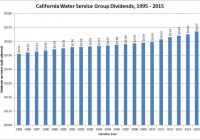
About California Water Service Group California Water Service Group (NYSE: CWT ) is a holding company with six operating subsidiaries that provide regulated and non-regulated water utility service to nearly 500,000 customers in four states. The regulated subsidiaries are California Water Service Company (Cal Water), New Mexico Water Service Company, Washington Water Service Company, and Hawaii Water Service Company. Non-regulated services – like billing and meter reading services, and leasing antenna sites to telecommunications companies, are provided by the CWS Utility Services and HWS Utility Services subsidiaries. The company dates back to the formation of Cal Water in 1926. California Water Service Group organizes all of its business into a single segment. Nearly all (94%) of the company’s customers and revenues come from business conducted in California. More than half of the California customers are in the greater San Francisco Bay area; the rest of the customers are in locations throughout the rest of the state. The Hawaii Water Services and HWS Utility Services subsidiaries serve 4,300 customers on the islands of Maui and Hawaii. The Washington Water Services subsidiary serves 16,300 customers in the Tacoma and Olympia areas, and the New Mexico Water Services subsidiary serves 7,600 customers in three communities between Albuquerque and Las Cruces, NM. In 2014, California Water Service Group earned $56.7 million on revenues of $597.5 million. These figures were up 20.0% and 2.3%, respectively from 2013. The increase in net income was due to the approval of a 9.2% rate increase by the California Public Utilities Commission (CPUC). The CPUC has approved future rate increases of 1.9% in 2015 and 1.8% in 2016. Earnings per share were up in 2014 as well, by 16.7% to $1.19. With the current annualized dividend rate of 67 cents per share, the company’s payout ratio is 56.3%. The company has stated that it targets a payout ratio of 60%, giving the company a bit more room to grow the dividend. The company is a member of the Russell 2000 index and trades under the ticker symbol CWT. California Water Service Group’s Dividend and Stock Split History (click to enlarge) California Water Service Group has grown its dividends slowly, compounding them at a rate of less than 2% over the last quarter century. California Water has paid dividends since 1945 and increased them since 1968. The company regularly announces increases at the end of January, with the stock going ex-dividend towards the middle of February. In January 2015, California Water announced a 3.08% increase in its dividend to an annualized rate of 68 cents per share. California Water should announce its 49th annual dividend increase in January 2016. Like many public utilities, California Water has grown its dividend very slowly over its history. Since 2001, the largest increase in the quarterly dividend has been half a cent, resulting in a 5-year dividend growth rate of 2.40%. Longer term, the dividend growth rates are even slower, with the company posting a 25-year dividend growth rate of 1.74%. The company has split its stock six times. The first split, 4-for-1, occurred in 1940. The next split occurred in March 1959 and was 2-for-1. It would be another 25 years until the stock split again – in May 1984, the company split the stock 2-for-1 again. The remaining three splits were also 2-for-1 and occurred in October 1987, January 1998 and, most recently, in June 2011. Over the 5 years ending on December 31, 2014, California Water Service stock appreciated at an annualized rate of 9.21%, from a split-adjusted $15.62 to $24.27. This underperformed the 13.0% compounded return of the S&P 500 and the 14.0% compounded return of the Russell 2000 Small Cap indices over the same period. California Water Service Group’s Direct Purchase and Dividend Reinvestment Plans California Water Service has both direct purchase and dividend reinvestment plans. You do not need to be a current investor in California Water Service to participate in the plans. The minimum investment amount is $250 for new investors and $25 for existing shareholders. The dividend reinvestment plan does allow for partial reinvestment of dividends. The plans’ fee structures are favorable to investors, with the company picking up all costs on stock purchases, both directly and through dividend reinvestment. When you go to sell your shares, you’ll pay a transaction fee of $15 plus a commission of 10 cents per share. All fees will be deducted from the sales proceeds. Helpful Links California Water Service Group’s Investor Relations Website Current quote and financial summary for California Water Service Group (finviz.com) Information on the direct purchase and dividend reinvestment plans for California Water Service Group Disclosure: I do not currently have, nor do I plan to take positions in CWT.

HIX: Smaller Distributions And History Suggest A Long Life Ahead

The Western Asset High Income Fund II has been trimming its distributions for years. That’s a problem for income-hungry investors. But distribution cuts and a historically stable NAV suggest HIX will live to fight another day. If you are after a reliable stream of income that can you use to live, don’t buy the Western Asset High Income Fund II (NYSE: HIX ). If you are looking for a decent high-yield fund, however, take a look. Those two statements may seem at odds with each other, but they aren’t. Here’s why… A little more than generic At its core, HIX is a high-yield bond fund. As its name implies, Western Asset Management is calling the shots and, over the long haul, its done a solid job. For example, the fund’s trailing annualized 15-year total return through June based on net asset value, or NAV, is roughly 9.5%. That includes the reinvestment of distributions. Compare that to the Vanguard High Yield Corporate Fund’s (MUTF: VWEHX ) annualized 6.3% over that span and HIX looks like a solid high yield option. To be fair, HIX’s standard deviation over that span was 14 compared to Vanguard’s 8. So HIX achieved the higher return by taking on more risk. So for risk averse investors, a more conservative high-yield fund might be a better choice. But if you can stomach the risk, HIX’s performance has been good over the long term. Part of the reason for the added volatility is that HIX makes use of leverage to enhance returns. Recently leverage stood at around 25% of assets. This works great when rates are low because the fund can easily create a carry trade, borrowing for less than it earns and passing the difference on to shareholders. However, leverage also increases the impact of price movements. That’s a great thing in up markets because it enhances returns, but a bad thing in down markets because losses get exacerbated. The other issue to note at HIX on the risk front is that it has a “strategic” allocation to emerging market debt. It’s only around 8% or so of assets, but emerging market debt can be more volatile than other bonds. On the one hand it provides diversification, on the other it can be a drag when emerging markets are struggling. But, at less than 10% of assets recently, it won’t be the driving force at the fund right now. It’s just something to keep in mind, especially since management has the leeway to increase that exposure to as much as 35% of assets. So, on the whole, HIX is a solid long-term performer for those willing to take on a little more risk. That said, the last year has been pretty rough. For comparison, over the trailing 12 months through June, HIX is down 4.5% or so and Vanguard High Yield Corporate is up around 1.5%. Like so many high-yield funds, energy was a big issue in HIX’s poor showing. Leverage, of course, didn’t help either. The impact of this rough spell is worth noting, however. Between April of 2014 and April of 2015, the fund’s fiscal year ends in April, HIX’s net asset value fell from $9.47 a share to $8.57. More recently it’s stood at around $8.25. That’s clearly the wrong direction. But HIX has been here before. For example, in fiscal 2012 the fund’s NAV declined from $9.57 a share $8.86 only to almost completely recover in fiscal 2013. Based on the fund’s long-term performance, the current downdraft is something that it will likely eventually recover from. The income issue Which brings us to the income issue. The fund’s distribution has been shrinking steadily since 2010 when it was $0.09 a month. Today the distribution rounds to $0.07 a month. Not a huge decline on an absolute basis, but a notable one when looked at percentage wise. I would expect the downward trend to continue, so income focused investors looking to replace a paycheck might want to look elsewhere. But I don’t think the distribution cuts are inherently a bad thing. Rates are at historic lows, so older debt that’s matured (or sold) is replaced with the lower-yielding fare in the current market. Thus, the income the portfolio generates is naturally declining. The distribution cuts are simply a part of that. More importantly, the cuts show that management is willing to take the lumps that come along with larger market shifts to keep the portfolio from self liquidating over time. A lot of closed end funds try to delay cuts until there is no choice but to cut, which often leads to more drastic distribution declines. And if income isn’t your focus, the willingness to slowly trim distributions to protect capital is probably the more preferable option. It’s the income thing So, for investors, I think the biggest issue right now is the income question. If you want a steady distribution, HIX isn’t likely to provide it right now. If you are looking to buy a high-yield fund because you want some exposure to the asset class, however, HIX is worth a look. Management is dealing with a rough patch right now, but it’s done so before successfully and it is willing to trim distributions to ensure that it lives to fight another day. That said, the fund isn’t cheap to own, with an expense ratio of around 1.5%. That’s not outlandishly high, but it is clearly more than you’d pay for an exchange traded fund or an open-end mutual fund. Leverage costs are a part of that. But you’re not likely to find an around 11% yield from a high-yield ETF or open-end fund (noting, of course, that HIX’s distributions are likely to shrink further). And HIX is trading at a discount to NAV of around 8%, which is fairly steep for this fund. In fact, the average was a premium of around 1% over the trailing three years. So, for those looking to trade around premiums and discounts, HIX could be worth a deep dive right now. Just don’t expect the current distribution level to hold. Disclosure: I/we have no positions in any stocks mentioned, and no plans to initiate any positions within the next 72 hours. (More…) I wrote this article myself, and it expresses my own opinions. I am not receiving compensation for it (other than from Seeking Alpha). I have no business relationship with any company whose stock is mentioned in this article.