Tag Archives: history

Ideas For An Ultra-Low Volatility Index Part VII

Here are the Ultra-Low Volatility Index strategy’s rules. Buy the PowerShares S&P 500 Low Volatility Portfolio ETF (NYSEARCA: SPLV ) with 80% of the dollar value of the portfolio. Buy the Direxion Daily 30-Year Treasury Bull 3x Shares ETF (NYSEARCA: TMF ) with 20% of the dollar value of the portfolio. Rebalance annually to maintain the 80%/20% dollar value split between the positions. The index is very Zen in its elegance. We are combining the S&P 500 Low Volatility ETF with a 3x leveraged exposure to long duration government bonds, which acts as an imperfect hedge. Because of the leverage inherent in TMF, we can allocate more capital to SPLV. In addition, it is not necessary to have margin exposure. Personally, I think most investors want a portfolio that will tread water, hold its own, and only drop slightly when markets are going crazy. Low drawdowns and ultra-low volatility enable an investor to hang on and to actually enjoy the possibilities of the long term. For too long, people have had the pain theory of investing pounded into their head . Or as I like to call, it “The Bill Ackman School For Kids Who Can’t Read Financial Statements Good And Wanna Learn To Do Other Stuff Good Too.” Many of these “special people” (and let me be clear, by “special” I mean reckless and dumb) believe that in order to enjoy a decent return, that they first must endure the pain of having positions move against them, in order to eventually triumph in a grand quest for the truth of their own genius, against all odds. The pain theory of investing sounds very heroic and glamorous, but in reality, a smooth ride allows investors to hold on to their positions in order to enjoy the benefits of the long term. Why get shaken out, when you can have a smoother ride? And the smoother ride, in this case, has a higher return across a full bull/bear market cycle. Here are the index’s results: (click to enlarge) Click to enlarge (click to enlarge) Click to enlarge I will be the first to admit that this strategy is not brilliant or original. It’s just solid blocking and tackling. The current trend towards complexity in the investment world is not just disturbing – it’s also not profitable. Recent blowups like Pershing Square ( OTCPK:PSHZF ) highlight the importance of protecting investor capital. Unfortunately, many managers have the misguided urge to prove their genius, rather than to make money and to protect investor capital. Remember, it’s not about pretending that you’re always right. It’s about making money. A good investor resists the urge to make it all about his own ego. He makes it about safeguarding investor capital. Like a good doctor, the first directive must be to “first, do no harm.” In future posts, we will examine ways to apply conservative risk control to portfolios in order to hedge or to move to cash during a simultaneous collapse in stocks and bonds. Thanks for reading. We feature even more impressive strategy indices in our subscription service. If this post was useful to you, consider giving it a try. Hypothetical performance results have many inherent limitations, some of which are described below. No representation is being made that any account will or is likely to achieve profits or losses similar to those shown; in fact, there are frequently sharp differences between hypothetical performance results and the actual results subsequently achieved by any particular trading program. One of the limitations of hypothetical performance results is that they are generally prepared with the benefit of hindsight. In addition, hypothetical trading does not involve financial risk, and no hypothetical trading record can completely account for the impact of financial risk of actual trading. For example, the ability to withstand losses or to adhere to a particular trading program in spite of trading losses are material points, which can also adversely affect actual trading results. There are numerous other factors related to the markets in general or to the implementation of any specific trading program, which cannot be fully accounted for in the preparation of hypothetical performance results and all which can adversely affect trading results. Disclosure: I/we have no positions in any stocks mentioned, and no plans to initiate any positions within the next 72 hours. I wrote this article myself, and it expresses my own opinions. I am not receiving compensation for it. I have no business relationship with any company whose stock is mentioned in this article.
Does Market Volatility Favor Active Management?

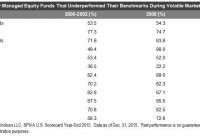
By Aye Soe Twice a year, S&P Dow Jones Indices releases the SPIVA U.S. Scorecard. The scorecard measures the performance of actively managed equity and fixed income funds across various categories. Since the initiation of the report in 2002, the results have consistently shown that managers across most categories overwhelmingly underperform on a relative basis against their corresponding benchmarks over a medium-to-long-term investment horizon. The Year-End 2015 SPIVA U.S. Scorecard reveals little surprise. The second half of 2015 was marked by significant market volatility, which was brought forth by plunging commodity prices, a strengthening U.S. dollar, growing global concerns over Chinese economic growth, and the subsequent devaluation of the Chinese renminbi. Market volatility, in theory, favors active investing, because managers can tactically move out of their positions at their discretion and park themselves in cash. Passive investing, on the other hand, has to remain fully invested in the market. Investors in actively managed strategies should therefore realize fewer losses during periods of heightened volatility, all else being equal. Given this theoretical background, recent volatility in the market has supporters of active investing proclaiming that active management is back in favor. However, over a decade of experience in publishing the SPIVA Scorecard has painfully taught us that active funds don’t always perform better than their passive counterparts during those precise periods in which active management skills seem to be called for. Exhibit 1 compares the performance of actively managed equity funds across the nine style boxes during the 2000-2002 bear market, the financial crisis of 2008, and 2015. As the data clearly show, there is no consistent pattern across most of the categories. Large-cap value managers appear to be the only exception to the losing trend, outperforming their benchmark in both bear markets. Again in 2015, mid-cap value is the only winning equity category, with the majority (67.65%) of them outperforming the S&P MidCap 400® Value . Disclosure: © S&P Dow Jones Indices LLC 2015. Indexology® is a trademark of S&P Dow Jones Indices LLC (SPDJI). S&P® is a trademark of Standard & Poor’s Financial Services LLC and Dow Jones® is a trademark of Dow Jones Trademark Holdings LLC, and those marks have been licensed to S&P DJI. This material is reproduced with the prior written consent of S&P DJI. For more information on S&P DJI and to see our full disclaimer, visit www.spdji.com/terms-of-use .

BlackRock Seeks To Ride The Gold ETF Rally

Sluggish growth in China since the beginning of the year, the oil market turbulence and concerns over global growth slowdown have lifted the demand for safe-haven assets like gold. The weakness in the global financial markets has helped the precious metal to recover its sheen in 2016. Gold has gained more than 16% year to date. The jump in gold prices was also supported by plunging interest rates on a global scale. With the Fed not expected to raise interest rates in the near term, the rally is expected to continue. Given the tailwinds, it’s not surprising that BlackRock (NYSE: BLK ) has chosen to increase its stake in gold. But what’s surprising is that to do so, it has opted for a competitor’s ETF, the SPDR Gold Trust ETF (NYSEARCA: GLD ), instead of its own product, the iShares Gold Trust ETF (NYSEARCA: IAU ). As per the SEC filing , BlackRock has increased its holding in GLD to 13%, worth almost $4 billion. This is a massive increase from a 5% stake disclosed in a regulatory filing last month. GLD is the largest and most popular ETF in the gold space, with AUM of $31.3 billion and average daily volume of about 8.1 million shares. The fund reflects the performance of the price of gold bullion. Its expense ratio comes in at 0.40%. The fund currently has a Zacks ETF Rank #3 (Hold) with a Medium risk outlook. In comparison, IAU has AUM of $7.7 billion and trades in solid volume of more than 7.5 million shares a day, on average. The ETF charges 25 bps in annual fees. Like GLD, this ETF offers exposure to the day-to-day movement of the price of gold bullion and carries a Zacks ETF Rank #3 (Hold) with a Medium risk outlook. BlackRock’s gold ETF made headlines earlier this month when it had to temporarily suspend creations. As per a Reuters report, it sold $296 million in shares of the exchange-traded fund without properly registering them with the SEC. After recognizing the slip, BlackRock stopped selling new shares of the fund. Though this is not the first time an asset manager has invested in a competitor’s product and included it in the portfolio, BlackRock’s choice of increasing its holding in GLD emphasizes the craze for gold in the market. While IAU has a lower expense ratio as compared to GLD, GLD trades in much higher volumes, keeping the bid/ask spread low, and has a much larger asset base. Original Post