Tag Archives: georgia

Dual ETF Momentum April Update

Scott’s Investments provides a free “Dual ETF Momentum” spreadsheet, which was originally created in February 2013. The strategy was inspired by a paper written by Gary Antonacci and available on Optimal Momentum . Antonacci’s book , Dual Momentum Investing: An Innovative Strategy for Higher Returns with Lower Risk, also details Dual Momentum as a total portfolio strategy. My Dual ETF Momentum spreadsheet is available here and the objective is to track four pairs of ETFs and provide an “Invested” signal for the ETF in each pair with the highest relative momentum. Invested signals also require positive absolute momentum, hence the term “Dual Momentum.” Relative momentum is gauged by the 12-month total returns of each ETF. The 12-month total returns of each ETF is also compared to a short-term Treasury ETF (a “cash” filter) in the form of the iShares Barclays 1-3 Treasury Bond ETF (NYSEARCA: SHY ). In order to have an “Invested” signal, the ETF with the highest relative strength must also have 12-month total return greater than the 12-month total returns of SHY. This is the absolute momentum filter, which is detailed in depth by Antonacci, and has historically helped increase risk-adjusted returns. An “average” return signal for each ETF is also available on the spreadsheet. The concept is the same as the 12-month relative momentum. However, the “average” return signal uses the average of the past 3, 6, and 12-month (“3/6/12″) total returns for each ETF. The “invested” signal is based on the ETF with the highest relative momentum for the past 3, 6 and 12 months. The ETF with the highest average relative strength must also have an average 3/6/12 total returns greater than the 3/6/12 total returns of the cash ETF. Portfolio123 was used to test a similar strategy using the same portfolios and combined momentum score (“3/6/12″). The test results were posted in the 2013 Year in Review and the January 2015 Update . Below are the four portfolios along with current signals: Return Data Provided by Finviz Click to enlarge As an added bonus, the spreadsheet also has four additional sheets using a dual momentum strategy with broker specific commission-free ETFs for TD Ameritrade, Charles Schwab, Fidelity, and Vanguard. It is important to note that each broker may have additional trade restrictions and the terms of their commission-free ETFs could change in the future. Disclosure: None
The V20 Portfolio #27: When To Rebalance

The V20 portfolio is an actively managed portfolio that seeks to achieve an annualized return of 20% over the long term. If you are a long-term investor, then this portfolio may be for you. You can read more about how the portfolio works and the associated risks here . Always do your own research before making an investment. Read the last update here . Note: Current allocation and planned transactions are only available to premium subscribers . After a volatile week, the V20 Portfolio declined by 3.2% while the SPDR S&P 500 ETF (NYSEARCA: SPY ) declined by 1.2%. The underperformance can once again be attributed to the largest holding, Conn’s (NASDAQ: CONN ). When To “Average Down” Recently our cash balance has grown as a percentage of the overall portfolio, which can be primarily attributed to the decline in portfolio value as opposed to strategic shifts in allocation. As mentioned earlier, the biggest laggard is Conn’s. You may recall that the V20 Portfolio will continue to purchase shares of a company if fundamentals have not deteriorated, even if price has dropped. In 2016, we did exactly that. Conn’s position would have been 42% smaller had we not made any purchases in 2016. But as share price has continued to drop since the last transaction, I have not yet made any additional purchases for Conn’s, which is a part of the reason why cash allocation has swelled to one of the highest levels since the portfolio’s inception. Why did I make that decision? The truth is that I’ve been looking for the opportunity to “pull the trigger” so to speak. This relates to my rebalancing philosophy. There are many ways to rebalance, but I break them down to systematic and discretionary. The former style follows a predetermined method (e.g. once every quarter according to some specification). As you probably guessed already, the V20 Portfolio’s rebalancing method is discretionary. I believe that too many factors are shifting to warrant a systematic method. However, discretion does not imply randomness. The V20 Portfolio seeks to allocate more capital to stocks with the highest expected rate of return while accounting for the possibility of permanent capital loss . I believe that the smallest position in the portfolio right now, Dex Media, actually has the highest expected return; but due to the high risk of shareholders being wiped out in the restructuring deal, it is not prudent to allocate a significant amount of capital to the stock, no matter the expected return. Bringing the discussion back to the topic of rebalancing; a position essentially shifts between “no exposure” to “too much exposure” at any given time. However, there is no specific number associated with these two groups. Let’s suppose that the ideal allocation is 10% for a certain stock. Should you rebalance when it falls to 9.99%? Or what if it rises to 11%? There is no good answer. However, if we examine the extremes, the answer can become clearer. Using the same example, I don’t think anyone will disagree that rebalancing would be appropriate if the allocation falls to 1%, assuming no changes in fundamentals. There are also short-term considerations. While the focus should be long-term, short-term fluctuations are very real. Each time you place a trade, you are implying that prices shouldn’t go lower, or else you would have waited. This implication exists even if your investment horizon is long-term . There are numerous factors that could lead to sustained mispricing. For Conn’s, the general macro picture for retail has been soft and the credit division’s results may not improve for a while. Both of these factors could put more pressure on the stock, providing better opportunities to accumulate shares. In conclusion, there is no “perfect” time to rebalance. I believe that Conn’s current allocation remains large enough to capture the stock’s significant upside. The allocation could be larger, it could be smaller. However, one thing is certain: if shares continue to fall in the future, there is no doubt that more capital would be allocated to the position. Performance Since Inception Click to enlarge Disclosure: I am/we are long CONN. I wrote this article myself, and it expresses my own opinions. I am not receiving compensation for it. I have no business relationship with any company whose stock is mentioned in this article.

Growth And Surging Popularity Of Unconstrained Bond Funds

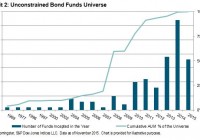
By Hong Xie In the aftermath of the global financial crisis of 2007-2008, one noticeable trend in fixed income investment is the growth and popularity of unconstrained bond funds. They have generated strong interest in the investment industry due to the flexibility they offer in duration management and the broader investment universe. Because they are not managed against a specific benchmark, unconstrained bond funds may also pose challenges for investors in understanding and measuring their performance. The global financial crisis of 2007-2008 and the economic recession that followed prompted unprecedented quantitative easing monetary policies across many countries. Not only were short-term interest rates lowered to either zero or close to zero, but quantitative easing was also adopted in places such as the U.S., the U.K., the eurozone, and Japan to flatten the yield curve and keep long-term interest rates low. As the U.S. economy continues to recover and the Fed starts to increase interest rates, many investors have concerns about holding core fixed income products with high interest-rate risk in a rising-rate environment. It is this widespread market sentiment that has driven the surging popularity of unconstrained bond funds, which offer wide latitude to fund managers on duration management and investment selection. We use fund data from Morningstar to gauge the size and growth of unconstrained bond funds. In particular, we screen for funds categorized as “U.S. OE Nontraditional Bonds” by Morningstar, while excluding those with mandates in specific sectors or with duration constraints. As of November 2015, there were 122 open-ended mutual funds with total assets under management (AUM) of USD 140 billion in our data set, in comparison with 19 funds with AUM of USD 9 billion at the end of 2008 (see Exhibit 1). Even though the first fund started in 1969, it wasn’t until after the global financial crisis of 2007-2008 that unconstrained bond funds started gaining traction among investors. Exhibits 1 and 2 show the rapid growth of unconstrained bond funds since 2008 in terms of both AUM and number of funds. Disclosure: © S&P Dow Jones Indices LLC 2015. Indexology® is a trademark of S&P Dow Jones Indices LLC (SPDJI). S&P® is a trademark of Standard & Poor’s Financial Services LLC and Dow Jones® is a trademark of Dow Jones Trademark Holdings LLC, and those marks have been licensed to S&P DJI. This material is reproduced with the prior written consent of S&P DJI. For more information on S&P DJI and to see our full disclaimer, visit www.spdji.com/terms-of-use .