Tag Archives: etfs

Investing Lessons From Baseball’s Active Managers

By James T. Tierney Jr., Chief Investment Officer – Concentrated US Growth As the popularity of passive investing continues to gain momentum, take pause to think about a lesson from baseball. The question is: what kind of equity lineup creates a winning team? Nobody can deny the increasing shift of equity investors toward index strategies. Net flows to passive US equity funds have reached $21.7 billion this year through June, while investors have pulled $83.7 billion out of actively managed portfolios, according to Morningstar. In this environment, active managers are increasingly challenged to prove their worth and justify their fees. Building a Winning Lineup Baseball provides an interesting analogy for the active equity manager. Across all players in Major League Baseball, the batting average this season is .253 , as of August 6. Yet even in today’s statistics driven environment, you won’t find a single team manager who would choose to put together a lineup of nine players who all bat .253-even if it were possible. The reason is clear and intuitive. For a baseball team to be successful, you need to have at least a few hitters who are likely to get hits more often than their peers. And to create a really robust lineup, a manager wants a couple of power hitters who pose a more potent threat. Of course, some hitters will trend toward the average and slumping players will hit well below the pack. That’s why you need a diverse bunch. A team comprised solely of .253 hitters is unlikely to have the energy or the momentum needed to win those crucial games and make the playoffs. False Security in Average Performance So what does this have to do with investing? When an investor allocates funds exclusively to passive portfolios, it’s like putting together an equity lineup that is uniformly composed of .253 hitters. This lineup might provide a sense of security because returns will always be in synch with the benchmark. But it’s little consolation if the benchmark slumps. A passive equity lineup won’t be able to rely on any higher-octane performers to pull it through challenging periods of lower, or negative, returns. Still, many investors fear getting stuck with a lineup of .200 hitting active managers. We believe the best strategy to combat that risk is to focus on investing with high conviction managers, who have a strong track record of beating the market, according to our research . Passive and Active: The Best of Both Worlds Passive investing has its merits. Investors have legitimate concerns about fees as well as the ability of active managers to deliver consistent outperformance. The appeal of passive is understandable. Yet we believe that putting an entire equity allocation in passive vehicles is flawed. It leaves investors exposed to potential concentration risks and bubbles that often infect the broader equity market. And with equity returns likely to be subdued in the coming years, beating the benchmark by even a percentage point or two will be increasingly important for investors seeking to benefit from compounding returns and meet their long-term goals. There is another way. By combining passive strategies with high-conviction equity portfolios, investors can enjoy the benefits of an index along with the diversity of performance from an active approach, in our view. Baseball managers don’t settle for average performance. Why should you? The views expressed herein do not constitute research, investment advice or trade recommendations and do not necessarily represent the views of all AB portfolio management teams.
Dual Momentum August Update

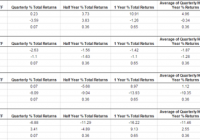
Scott’s Investments provides a free “Dual ETF Momentum” spreadsheet, which was originally created in February 2013. The strategy was inspired by a paper written by Gary Antonacci and available on Optimal Momentum . Antonacci’s book, ” Dual Momentum Investing: An Innovative Strategy for Higher Returns with Lower Risk “, also details Dual Momentum as a total portfolio strategy. My Dual ETF Momentum spreadsheet is available here , and the objective is to track four pairs of ETFs and provide an “Invested” signal for the ETF in each pair with the highest relative momentum. Invested signals also require positive absolute momentum, hence the term “Dual Momentum”. Relative momentum is gauged by the 12-month total returns of each ETF. The 12-month total returns of each ETF is also compared to a short-term Treasury ETF (a “cash” filter) in the form of the iShares Barclays 1-3 Year Treasury Bond ETF (NYSEARCA: SHY ). In order to have an “Invested” signal, the ETF with the highest relative strength must also have 12-month total returns greater than the 12-month total returns of SHY. This is the absolute momentum filter, which is detailed in depth by Antonacci, and has historically helped increase risk-adjusted returns. An “average” return signal for each ETF is also available on the spreadsheet. The concept is the same as the 12-month relative momentum. However, the “average” return signal uses the average of the past 3-, 6-, and 12- (“3/6/12”) month total returns for each ETF. The “invested” signal is based on the ETF with the highest relative momentum for the past 3, 6 and 12 months. The ETF with the highest average relative strength must also have an average 3/6/12 total returns greater than the 3/6/12 total returns of the cash ETF. Portfolio123 was used to test a similar strategy using the same portfolios and combined momentum score (“3/6/12”). The test results were posted in the 2013 Year in Review and the January 2015 Update. Below are the four portfolios, along with current signals: (click to enlarge) As an added bonus, the spreadsheet also has four additional sheets using a dual momentum strategy with broker-specific, commission-free ETFs for TD Ameritrade, Charles Schwab, Fidelity, and Vanguard. It is important to note that each broker may have additional trade restrictions, and the terms of their commission-free ETFs could change in the future. Disclosures: None. Share this article with a colleague

Top 5 Smart Beta FAQs

In the first half of 2015 we’ve seen many of our smart beta predictions fulfilled. In particular I’m glad to see that there is more consensus around the definition of smart beta, with investors growing more comfortable with the investment strategy that captures aspects of both traditional passive and active investing. However, we are far from the Smart Beta Promised Land. In the meantime, here are a handful of questions I get most often from investors-so I thought I’d share my answers with you. Why is smart beta the topic du jour? Given the prolific attention on smart beta (in the United States alone, the term “smart beta” was searched an average of 7,500 times per month in the past year on Google), you’d think that smart beta is the shiny new bike on the block. We’re the first to admit that many of the concepts behind smart beta are not new – the idea of seeking inexpensive companies (Value investing) or high quality balance sheets (Quality investing) have been part of the active management toolkit for ages. What’s getting everyone’s attention is the ability to capture these potential sources of return in a low cost and transparent form – and we all like the potential to get more for less. How should I choose a smart beta strategy? There are lots of types of smart beta available these days, so the strategy you choose should be driven by the outcome you are trying to achieve. The best forms of smart beta are deliberate and transparent in the exposures they deliver, making it easy for investors to determine what’s under the hood. However not all smart beta strategies deliver “pure” exposure, so being mindful of any unintended risks lurking in the portfolio is always a good idea. Skilled implementation is also critically important. Most smart beta strategies have a higher level of turnover than traditional market cap-weighted indexes, and a slightly less advantageous liquidity profile. Without a skilled portfolio management team in place, transaction costs and tracking error may quickly begin to erode the potential benefits of a smart beta strategy. Smart beta providers talk a lot about transparency. Why is that important? Transparency is a defining attribute of smart beta strategies. Like traditional index strategies, smart beta strategies follow pre-set rules to determine the process for security selection, portfolio construction and rebalancing. Often those rules are published by a third-party benchmark provider. That means investors should have full knowledge of construction rules and portfolio characteristics, enhancing their ability to make deliberate allocations and build more diversified portfolios. Smart beta ETFs have yet another layer of transparency in that daily holdings are publicly available. One thing to note: Those pre-set rules stay set. Those rules have no knowledge of and make no adjustments for changing market conditions. Where would I implement smart beta into my existing portfolio? Many investors struggle to think about how to add smart beta strategies to their existing portfolios. Conceptually it is really no different than blending traditional passive and active strategies. Many smart beta strategies are designed to seek incremental returns. Others provide the potential for less risk (some do both, but let’s start with the simple case). A return-seeking strategy like the iShares® FactorSelectTM MSCI USA ETF (NYSEARCA: LRGF ) can complement traditional active and passive investments as a potential source of incremental return. In contrast, a risk-mitigating strategy like the iShares MSCI USA Minimum Volitility ETF (NYSEARCA: USMV ) can complement your traditional investments as a way to seek potential downside risk protection. Quantifying your desired outcome, such as an after fee incremental return goal, or a certain decrease in max drawdown, can further refine the asset allocation decision. Is smart beta just equities? There are many forms of equity smart beta, but we can apply this way of thinking to any asset class. One of the things I’m most excited about is the work we are doing in fixed income smart beta. As I wrote in my previous post discussing the iShares U.S. Fixed Income Balanced Risk ETF (BATS: INC ), there are many opportunities for smart beta to re-write the rules of fixed income investing. Original Post