Tag Archives: etfs

Berkshire Hathaway And The Importance Of Deferred Taxes

Summary As Charlie Munger says, a deferred tax liability is like an interest-free “loan” from the government. The magic of compounding is best illustrated with a high return investment held over a large number of years. Examples help illustrate the importance of the timing of tax payments. Introduction Tax laws in the U.S. are setup such that patient investors can be rewarded. Warren Buffett of Berkshire Hathaway (NYSE: BRK.A ) illustrates this in an example in his 1989 letter to shareholders. We’ve added a few more examples that show what happens when the number of years and the rate of return are different. Examples Warren Buffett uses an extreme example in the 1989 letter to shareholders to show how tax laws favor investors who hold for the long term as opposed to switching investments yearly: Imagine that Berkshire had only $1, which we put in a security that doubled by year-end and was then sold. Imagine further that we used the after-tax proceeds to repeat this process in each of the next 19 years, scoring a double each time. At the end of the 20 years, the 34% capital gains tax that we would have paid on the profits from each sale would have delivered about $13,000 to the government and we would be left with about $25,250. Not bad. If, however, we made a single fantastic investment that itself doubled 20 times during the 20 years, our dollar would grow to $1,048,576. Were we then to cash out, we would pay a 34% tax of roughly $356,500 and be left with about $692,000. Summing up, we have the following: Starting Investment: $1 Length: 20 years Return: 100% Tax Rate: 34% Yearly Switch Total: $25,250 No Switch Total: $692,000 This is a powerful example but it may not fully register with everyone. For one thing, most of us won’t find an investment that doubles every year for 20 years straight. If we do then we’ll put more than $1 into it. We’ll use this first example as a template for more examples where these 2 variables are more realistic. As for the 34% tax rate, we’ll leave that alone. It is fine for companies. When it comes to individuals, folks in some states pay less and folks in others pay a little more. Living in California, my cumulative tax rate is actually higher than 34% because it’s about 23.8% federal plus about 13.3% state. Long-term capital gains apply to assets held over a year so in these examples the “Yearly Switch” investor might actually have to switch after a year and 1 day. Like the first example above, we’ll ignore transaction costs. Over the years Berkshire let the timing of tax payments work to its advantage with big investments like American Express (NYSE: AXP ), Coca-Cola (NYSE: KO ) and Wells Fargo (NYSE: WFC ). However, showing the specifics here could get a bit messy. Looking at Coca-Cola for instance, the letters to shareholders show different share amounts in 1988, 1989 and 1994. The 1989 letter shows most of the position was in place by the end of that year (373.6 million out of today’s 400 million shares adjusted for splits) but showing the yearly switch and no switch differences isn’t as straightforward as other examples. Suppose an investor decided to buy 1 share of Berkshire Hathaway on June 30, 2005, and hold it for 10 years until June 30, 2015. It went from $83,500 to $204,850 per share during that time: Starting Investment: $83,500 Length: 10 years Return: 9.3893% Tax Rate: 34% Yearly Switch Total: $152,337 No Switch Total: $163,591 (204,850 – .34*(204,850-83,500)) Our investor made over $10,000 more after taxes with the patient No Switch strategy as opposed to the more frenzied Yearly Switch strategy. Let’s look at another example with a higher rate of return and a greater number of years than the last one. Suppose an investor decided to buy 1 share of Berkshire Hathaway on June 30, 1985, (technically just before the closing bell on June 28) and hold it for 30 years until June 30, 2015. It went from $2,150 to $204,850 per share during that time. Starting Investment: $2,150 Length: 30 years Return: 16.4036% Tax Rate: 34% Yearly Switch Total: $46,960 No Switch Total: $135,930 (204,850 – .34*(204,850-2,150)) This time the patient No Switch approach made a huge difference as it ends up with almost 3 times as much money after taxes as the more frenzied Yearly Switch approach. Closing Thoughts We see that being patient and not jumping from investment to investment has great rewards when the rate of return is high and the number of years is large. Those that bash Warren should note that the government makes more money as well in the long run when Berkshire defers taxes. Sources Berkshire Hathaway Letters to Shareholders MarketWatch Historical Stock Prices Yahoo Finance Historical Stock Prices Disclosure: I am/we are long BRK.A, BRK.B, KO, WFC. (More…) I wrote this article myself, and it expresses my own opinions. I am not receiving compensation for it (other than from Seeking Alpha). I have no business relationship with any company whose stock is mentioned in this article.
Is More Information Making Us Worse Investors?

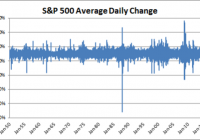
Study after study has shown that retail investors and professional money managers just aren’t very good at investing. And the primary cause of this poor performance is being overly active and incurring lots of unnecessary taxes and fees. The pros can’t control themselves because they have to impress their clients by trying to look active and “beat the market.” And the retail investor is prone to be short term because they know their financial lives are a series of short-term financial events in a long-term life. But an interesting thing appears to be occurring over the course of the last 65 years. Despite a preponderance of information and market access, we seem to be getting no better at investing AND the markets seem to be getting more volatile. If we look at the average daily change in the S&P 500, we can see a slight shift in the variance of the data over time: That’s not very clear, though. If we rearrange that chart, we can construct the average annualized standard deviation of the daily returns: This chart clearly shows that stock market volatility has increased over the last 65 years. There is almost certainly a multitude of causes here, but I don’t think it’s a coincidence that the 1980s and the era of new technology and market access has coincided with the explosion in higher volatility since then. This makes me wonder about two things: What does this say about information theory, economic theory and financial theory? What does this tell us about the current era of investing? What does this say about information theory, economic theory and financial theory? One would think that more information would make the markets behave more “efficiently.” And while we know that professional investors don’t beat the market consistently, we also know that the average holding time on stocks has cratered over the last 70 years, which means that investors, in the aggregate, are paying more in taxes and fees than they previously did. In fact, the average holding period is now consistent with a short-term capital gains rate which means the business of active investing has become a lucrative business for Uncle Sam! This means, by definition, that the post-fee and post-tax return on the aggregate of publicly-held stocks has to be lower than it was in 1940. This would seem to imply that easier access to markets and information has actually made us worse at investing. More information isn’t making us more rational or more efficient. It’s fueling our behavioral biases and short-term tendencies. Access to trading accounts combined with the 24-hour news cycle has become a behavioral nightmare for investors. And yet the vast majority of investors think that all of this information is making them smarter when the data shows that they’re not nearly as financially competent as they think. Contributing to this is all the new technologies. This includes discount brokerage firms, high-frequency trading, leveraged index funds, robo advisors, free trading applications, etc. All of these businesses feed off of our “get rich quick” mentality and/or give us access to markets in an unprecedented manner which fuels our behavioral biases in any number of ways. Further, investors haven’t been compensated for this added volatility. The average 3-year return on the S&P 500 is only marginally higher in the last 25 years than it is over the last 65 years. This shows how futile the idea of “risk” as “standard deviation” really is. In other words, the textbook model of the financial markets hasn’t at all reflected what one might have expected where more information makes markets more efficient, and more volatility compensates investors for what is considered more risk. Basically, modern financial theory doesn’t tell us much about modern financial reality. What Does This Tell us About the Modern Era of Investing? Nothing good. I’ve talked about the difficulty of managing time in one’s portfolio . This intertemporal conundrum is, by a wide margin, the most difficult concept to master in portfolio management. This is the problem of time in an investor’s portfolio. While we know we should be long term, we are inclined to be short term for any number of reasons. Threading that needle and finding the timeframe that makes the most sense for you is incredibly difficult. I’d venture to guess that investors in the 40s probably weren’t far off with their 7-year period. Sadly, what I seem to be finding is that more and more investors are veering in the direction of being ultra short term, hoping to make the quick risk-free buck. And in doing so, they’re falling victim to all of the behavioral biases that are driving this extremely short-term view which necessarily leads to poor performance.

How Smart Should Smart Beta Be?

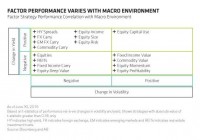
By Vadim Zlotnikov Smart beta strategies are growing in popularity, and investors have a lot of forms to choose from. One key question to ask is: How proactive should smart beta be in avoiding unintended risks? At its core, smart beta is a portfolio that’s built differently from capitalization-weighted market indices. Smart beta creates exposure by allocating to certain risk premiums, including value, momentum and defensive. Value, for example, means owning cheap securities that should generate strong returns. Smart beta has been around for a long time, but interest has grown since 2008, because the demand for transparency and lower cost has increased – so has the desire for exposures with low correlation to broad markets. Interest in smart beta has also extended beyond equities into fixed income. There are a number of approaches to smart beta, ranging from simple rules-based index construction using an index provider (used for most passive smart beta) to fully customized, actively managed combinations of risk premiums that complement a core portfolio. Be Aware of Unintended Risks Ideally, investors would choose an approach that balances their considerations of cost, liquidity, transparency, unintended risks and effectiveness. But it’s not easy to answer some of these questions. How would you choose a version of smart beta without knowing whether it could magnify existing exposures and increase portfolio risk? How much impact do these trade-offs have? Let’s compare three types of equity smart beta drawn from the MSCI World stock universe – each built to exploit value and momentum premiums. A basic smart beta version simply takes the most attractive stocks based on value and momentum measures. A second version, MSCI style indices, uses a proprietary approach to tilt to value and momentum. And a pure factor smart beta portfolio uses risk modeling to minimize risk exposure to sectors, styles, market betas and other characteristics. Since 2008, the three smart beta versions had relatively high correlation but produced different outcomes – mainly because of sector biases in their design. In terms of value, the simple and index versions have been overweight financials and underweight technology – exposures that currently account for more than two-thirds of their underperformance versus the pure smart beta portfolio. If technology underperforms while financials rebound, the pure portfolio would probably underperform the index version. So, the pure smart beta portfolio sacrifices some intensity in value exposure in order to reduce unintended risks. Index-based funds that pursued momentum can be underexposed to value and have very large sector and/or country biases. Smart-beta biases evolve, and it takes careful management to keep common risk exposures from building up. Make Smart Beta Work Smarter One way to keep common risk exposures from building up, and to protect against drawdowns, is to be aware of how the performance of different factors changes as the macro environment evolves ( Display ). Take an environment with falling yields and rising volatility. This situation would be consistent with a flight-to-safety scenario with economic turmoil. We’d expect strategies linked to duration (like value in fixed income), defense (such as equity profitability) or rapid adaptability to changing market leadership (equity momentum factor) to perform well. Because the effectiveness of risk premiums changes with the macro environment, tactically allocating among them has the potential to enhance smart beta results. Because risk premiums have somewhat similar risk-adjusted returns over time but behave differently, it’s possible to build a portfolio that allocates risk equally to each factor. Then risk can be actively tilted toward more attractive factors as valuations and the business cycle evolve. Putting It All Together: Assessing Opportunities In our view, a holistic assessment is the best approach to identifying which factors are attractive and which aren’t. This analysis should include a quantitative assessment of potential upside, an evaluation of the macro environment and, finally, judgment. Using this lens, one opportunity we see is in European distress, which has driven the valuation spread for deep-value stocks wider ( Display ). Of course, valuation spreads have been widening since 2009, so investors need to agree with a certain investment thesis: quantitative easing and a willingness to promote credit creation will drive investors toward value stocks, given the greater opportunity. Smart beta strategies offer low cost, improved transparency and access to return sources that complement the rest of a portfolio. But there are trade-offs to consider in choosing an approach, and the ability to avoid unintended risk exposures is a key consideration. In other words, investors need to decide how smart they want their smart beta to be. MSCI makes no express or implied warranties or representations, and shall have no liability whatsoever with respect to any MSCI data contained herein. The views expressed herein do not constitute research, investment advice or trade recommendations and do not necessarily represent the views of all AB portfolio-management teams.