Tag Archives: earnings-center

Trade Ideas To Make Money From The Strong U.S. Dollar – Idea 1
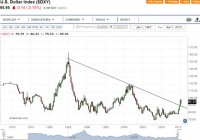
Summary A stronger U.S. Dollar will make USD denominated emerging market debt to become more expensive. As higher default risks get priced into sovereign bonds especially post the Greek debt default saga, a significant price decline could ensue. The slowing emerging market growths are not positive for emerging market debts. The U.S. Dollar has been on a tear since July 2014 and the knock-on effects of a significantly stronger U.S. Dollar have already been felt amongst the whole spectrum of commodities. With the U.S. Dollar having convincingly broken out a multi-year downward trendline (see chart below), it is quite apparent that we are only in the early stages of the USD bull market. The two main reasons which underpin my view are as follows: Divergence in monetary policy – As the U.S. intends to raise rates while the rest of the major economies are still easing, this will incentivise investors to hold more USD denominated assets. The global Carry Trade which is in the trillions of USD is likely to see a reversal as U.S. interest rates rise. This will cause the USD to get bid. Since the USD is still the world’s reserve currency and most transactions are denominated in USD, it goes without saying that this USD bull market will not only radically change the dynamics worldwide but this will undoubtedly also create exciting trading opportunities in a panoply of areas. This series will look at ideas in the following areas: Emerging Market Debt (Idea 1) Emerging Market Equity (Idea 2) – we’ll shortlist a few opportunities at the Emerging Markets Indices level and at the Individual Stocks level. The U.S. Equity Market (Idea 3) – we’ll shortlist a few opportunities at the Individual Stock level. Opportunities in the currency space (Idea 4) – we’ll shortlist a few currencies which still offer good risk/reward. (click to enlarge) The knock-on effects of the nascent USD bull market are many. Today, I’ll talk about one of the ways I intend to play the stronger USD. Before giving away my trade idea, let’s go back a few years in history. Ultra-low interest rates in the U.S. have allowed several countries mainly emerging economies to borrow cheaply in USD to invest in their local economies with the idea that local investments are going to yield much higher interest rates. Logic has it that if you borrow in USD, you need to pay back your loans in USD as well. With the USD significantly higher nowadays than when the loans were taken, the latter are undoubtedly getting more expensive to service. We can even go further and look at the slowing pace of GDP growth in emerging economies including China to deduce that the local investments are no longer yielding as high returns as they used to. TRADE IDEA Shorting emerging market government bonds denominated in USD is my way of playing out the dynamics I have outlined earlier. The iShares J.P. Morgan USD Emerging Markets Bond ETF (NYSEARCA: EMB ) provides a great way to structure this trade idea especially for retail traders and the non-professionals who might not have access to express their views on emerging market bonds. EMB is an ETF holding various Emerging Market bonds which are denominated in USD. EMB is therefore negatively-correlated to the U.S. Dollar as shown below: (click to enlarge) The top 10 holdings of EMB are as follows: Name Weight (%) Market Value Duration Notional Value RUSSIAN (FEDERATION OF) RegS 1.92 $105,401,168 4.25 105,401,167.71 ARGENTINA REPUBLIC OF 1.11 $60,941,923 7.93 60,941,923.07 PERU (REPUBLIC OF) 1.02 $56,204,117 10.64 56,204,116.84 POLAND (REPUBLIC OF) 1.02 $55,977,705 3.54 55,977,705.36 URUGUAY (ORIENTAL REPUBLIC OF) 1.02 $55,887,349 15.02 55,887,348.87 POLAND (REPUBLIC OF) 0.98 $53,632,120 5.71 53,632,120.47 PETRONAS CAPITAL LTD. RegS 0.92 $50,412,611 3.68 50,412,611.24 ROMANIA (REPUBLIC OF) MTN RegS 0.89 $48,771,815 5.34 48,771,814.69 HUNGARY (REPUBLIC OF) 0.81 $44,693,103 4.83 44,693,103.00 LITHUANIA (REPUBLIC OF) RegS 0.81 $44,657,864 5.36 44,657,863.89 The complete Holdings data of EMB is available here . I believe we are still in the early stages of the trade and we have a long way to go as the U.S. starts tightening and Emerging Markets start getting squeezed. The Fed has indicated that rates will not rise too quickly but I believe that once rates come up and people start anticipating the changes in dynamics worldwide, emerging market bond prices could accelerate downwards owing to the catalysts discussed below. The time horizon for this trade to play out would be around 1 year starting from the date the U.S. starts raising rates. From the graph above, we can see that the risks associated with the increasing U.S. Dollar have not yet been priced into EMB (see the divergence). CATALYSTS A strengthening U.S. Dollar will raise the probability of defaults. Although if none of the emerging countries defaults, when the increased risks get priced into the bonds this will likely create downward pressure on bond prices. The odds of higher default risks getting priced in are quite high post the Greek debt default saga. The slowing economic growths in multiple emerging markets could act as a tailwind to EMB’s collapse. One salient example is Russia which is the world’s largest exporter of energy. It is technically in a recession since the collapse of the oil price. In addition, inflationary pressures could provide further impetus to raise rates to stoke inflation. The effective duration of the portfolio is 7.53 years. When risk gets priced in, a long-duration portfolio is likely to face significant downward pressure. (Theoretically, for every 1% rise in yield of the portfolio, we expect the portfolio to go down in value by 7.53%). The imminent rise in the U.S. interest rates could also pose a danger to emerging market bonds as ultimately, the U.S. starts exporting its tightening monetary policy overseas. Technically, EMB looks poised for breaking the near-term resistance level around the 107.50-108 area. Once this happens, we’ll be looking at testing the 105 level and if this goes, EMB could quickly accelerate towards 100 break down further. (click to enlarge) As always, we can’t have 100% certainty when putting on a trade but as traders, our job is to put all the odds in our favor. We have an unfavorable macro environment for emerging market debt and in addition to that, slowing economic growths in emerging countries are likely to put pressure on sovereign debt financing. Furthermore, we’ve seen that the EMB portfolio has a long duration and any spikes in bind price volatility due to increased risks being priced in have the potential to accelerate the decline of the EMB. Disclosure: I am/we are short EMB. (More…) I wrote this article myself, and it expresses my own opinions. I am not receiving compensation for it (other than from Seeking Alpha). I have no business relationship with any company whose stock is mentioned in this article.
UNG Remains Range-Bound

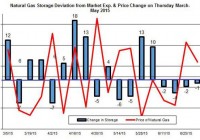
Summary The injection to storage was 69 Bcf – close to market expectations. The price of UNG bounced back. The demand for natural gas in the power sector could climb back up on account of warmer weather. The oil and natural gas market remained range-bound in recent weeks. The price of United States Natural Gas (NYSEARCA: UNG ) bounced back last week, even though the injection to storage was close to market expectations and the weather — while it keeps heating up in many parts in the U.S. — hasn’t driven up the demand for natural gas in the power sector. Moreover, the price of UNG remained range-bound for recent weeks. Will the warmer weather start to heart up the natural gas market? According to the latest EIA report , the injection to storage was 69 Bcf, which wasn’t far off market estimates. Over the next few weeks the market estimates the injections to storage will be higher than normal — on average over 85 Bcf per week, while the five-year average is around 65 Bcf. The higher injection could be driven by higher production and even more so by softer demand. But is the demand expected to cool down? As of last week, the natural gas market has cooled down. The demand for natural gas changed course and slipped by 3.2% week over week. Most of this fall came from softer demand in the power sector. Even though other sectors — including industrial and residential/commercial — also saw a decline in consumption. As of last week, total consumption is up by 4.6% year on year. That’s not far off of the current annual outlook growth in consumption. Despite the drop in demand for natural gas in the power sector, in the coming weeks the weather is projected to be much warmer than normal — mainly in the West and parts of the South Atlantic. Also, the cooling degree days (CDD) are estimated to be higher than normal by 9 degrees, and by 8 degrees compared to last year. The higher temperatures and CDD could suggest a rise in consumption in the power sector. How Will the Price of UNG React to the Storage Report? During the winter time, the price of natural gas tends to react to the news about the changes in storage. But during the summer the correlation tends to be weaker and has a smaller impact on the price of UNG. So far this injection season the price of natural gas seems partly correlated to the deviation from market expectations. (click to enlarge) Source: Data taken from the EIA. The natural gas output inched down by 0.2% last week, but it’s still up for the year by nearly 5%. Baker Hughes reported a decline of nine gas rigs to 219. Conversely, oil rigs have gone up by 12 during the previous week. But oil rigs are also down for the year. Finally, the movement in the oil market, which shouldn’t have an impact on natural gas prices, still seems to coincide to a certain extent, as presented in the chart below. The correlation between the two data sets is 0.24. (click to enlarge) Source: Data taken from the EIA. In both cases, energy prices have been range-bound as the market continues to figure out what’s next for the energy market, and if and when we will see a drop in the production of U.S. oil companies. So far, oil and gas companies have reduced the number operating rigs and slashed capex for 2015. But these measures have yet to cool down the U.S. oil and gas yield. The injection season still has a few more months to go, in which the injections to storage are still expected to be higher than normal. Nonetheless, the hotter-than-normal weather in the coming weeks could start again driving up the demand for natural gas in the power sector, which could bring the price of UNG back up. Or, at the very least, it could keep prices range-bound. (For more, please see ” Natural Gas Is Still Floating … Barely .”) Disclosure: I/we have no positions in any stocks mentioned, and no plans to initiate any positions within the next 72 hours. (More…) I wrote this article myself, and it expresses my own opinions. I am not receiving compensation for it (other than from Seeking Alpha). I have no business relationship with any company whose stock is mentioned in this article.

Hull Launches Its First ETF Product For U.S. Market

Hull Tactical Asset Allocation, in partnership with Exchange Traded Concepts, a white label exchange traded fund (ETF) service provider, has recently launched a new fund that employs a long-short strategy with the potential to profit from both rising and falling market conditions. The fund trades under the name Hull Tactical U.S. ETF (NYSEARCA: HTUS ). Below, we have highlighted some of the details about this newly launched product for investors keen to include this type of fund as part of their portfolio. Hull Tactical U.S. ETF The newly launched actively managed ETF seeks long-term capital appreciation by investing in U.S. equities and Treasuries markets. The fund uses proprietary, patent-pending, quantitative trading model, to take long and short positions in ETFs, leveraged ETFs or other securities that seek to track the performance of the S&P 500. The model is designed to forecast the returns of the S&P 500 for the next six months. Also, the fund is constructed to perform under all market conditions. The ETF currently holds 69.7% in the SPDR S&P 500 Trust ETF (NYSEARCA: SPY ). However, the active strategy renders the fund pretty expensive with 99 basis points as annual fees How Does it Fit in the Portfolio? The fund is a good option for investors seeking to stay invested in the market under all conditions. “A wide range of investors – from sophisticated retail investors, to independent advisors to endowments and pension funds in the institutional space – should find our product advantageous,” says Steve McCarten, Chief Operating Officer of Hull Tactical Asset Allocation. Given the current equity market condition, investors can expect to reduce volatility exposure to the equity market through this fund. This is especially true as the long-short positions taken by the fund help to withstand volatility. Moreover, the fund is expected to provide higher diversification benefits as the long strategy is believed to be highly uncorrelated to the traditional asset classes. “Investing in the S&P 500 can be an uncertain game, but a disciplined and systematic approach can help you to outperform on a risk-adjusted basis,” says Blair Hull, Founder of Hull Tactical Asset Allocation. Competition Though the long-short space is not much crowded, it is gaining popularity every passing day and seeing a buildup in assets. The ProShares RAFI Long/Short ETF (NYSEARCA: RALS ) is expected to be the biggest competitor for the newly launched fund in the long-short space. This passively managed fund has an asset base of $46.7 million and charges 95 basis points as expenses. Apart from this, the First Trust Long/Short Equity ETF (NYSEARCA: FTLS ) is also likely to pose some competition for the fund. The actively managed product manages a relatively small asset base of $16.1 million and charges 95 basis points. Thus, it needs to be seen whether the newly launched ETF, which is slightly expensive to both the existing products, is successful in garnering a sizable asset base. Given its high expense ratio in the space, the success is expected to be a huge factor of the net returns the fund manages to deliver. Link to the original post on Zacks.com