Tag Archives: earnings-center

The Bruce Fund: A Great Long-Term Investment

Summary Fund management is very frugal and the expense ratio is only 0.70%. The fund has earned 16% a year over the last 15 years. The fund tends to be relatively uncorrelated with other equity investments. Bruce Fund: Overall Objective and Strategy The primary objective of the Bruce Fund (MUTF: BRUFX ) is to achieve long term capital appreciation by investing primarily in domestic common stocks and bonds, including convertible bonds and “zero coupon” Treasury bonds. Income is a secondary consideration. The fund has built an outstanding long term performance record using a “barbell” type strategy. They often accumulate long-dated zero coupon Treasuries to seek capital appreciation when they feel there is an absence of viable common stock opportunities. But they will also buy higher risk debt securities and own some defaulted bonds selling at a small fraction of their par value. Their strategy is to use primarily bonds which have a very high yield to maturity, or to use convertible bonds which fluctuate with the common stock. Most of these higher risk bonds carry no credit rating. The Bruce Fund invests in domestic common stocks of any market capitalization, although they seem to focus mainly on smaller companies, as well as micro-cap securities. Both growth and value criteria are used to select these stocks. They actively pursue unseasoned companies, out-of-favor, turnaround and distressed situations. The Fund may invest in foreign securities, either directly or through ADRs or GDRs. At times, they hold a large cash position for a transitional period of time and the Fund tends to have a low “beta”. Fund Expenses The expense ratio for BRUFX is 0.70% which is very low for a fund that uses “hedge fund” style strategies. The Bruce Fund management is very frugal. One reason for the low BRUFX expense ratio is that they do not market their fund through discount brokers like Fidelity or Schwab. These brokers generally charge a mutual fund 40 basis points a year for the “privilege” of being on their platforms. Most mutual funds on these platforms offer “special” share classes with higher expense ratios to cover this platform fee. The Bruce Fund refuses to do this, and the fund can only be purchased directly. A mutual fund has to pay a yearly “Blue Sky” fee to every state where they sell the fund. Some small startup mutual funds only register in states where they have enough investors to make it worthwhile. The Bruce Fund started the same way, and until a few years ago, it was not available to Texas or Nebraska residents. But now it is available in every state. Minimum Investment BRUFX has a minimum initial investment of $1,000. Past Performance BRUFX is classified by Morningstar in the “Moderate Allocation” or MA category. BRUFX has blown away the competition and often ranks as the #1 fund in their category. Over the last 15 years, BRUFX has earned 16.37% a year, which trounces the category average of 5.19%. Here are the annual performance figures computed by Morningstar since 2006. 2006 2007 2008 2009 2010 2011 2012 2013 2014 YTD BRUFX 17.72% -5.13% -27.27% 32.26% 23.96% 7.24% 7.86% 18.95% 13.68% 2.56% Category (MA) 11.29% 5.99% -28.00% 24.13% 11.83% -0.11% 11.72% 16.48% 6.21% 2.58% Percentile Rank 4% 99% 41% 8% 1% 2% 76% 1% 1% Source: Morningstar Mutual Fund Ratings -Forbes Honor roll BRUFX is a member of the Forbes Mutual Fund Honor Roll. Forbes Up Market Grade: A+ Forbes Down Market Grade: A -Morningstar Rating : 5 Stars Fund Management The fund is managed by a father and son team, Robert and Jeffrey Bruce. They rarely speak to the press and spend none of their time marketing the fund, although they are glad to speak with shareholders who call. Instead of marketing the fund, they prefer to increase the assets via fund performance. Robert Bruce is 83 years old and previously helped to establish a great performance record at the Mathers Fund (MUTF: MATRX ) over forty years ago. In 1973, he left the Mathers Fund to manage his own money and eventually formed the Bruce fund in 1983 with his son. Bruce Fund Portfolio Analysis (as of December 31, 2014) Common Stock 48.5% Convertible Pfd. 1.8% Corporate Bonds 4.2% Convertible Bonds 5.4% U.S. Treasuries 16.9% Money Market 23.0% Other 0.2% Top 8 Equity Holdings (as of March 31, 2015) Amerco Inc (NASDAQ: UHAL ) 12.01% Allstate Corp (NYSE: ALL ) 3.23% IBM (NYSE: IBM ) 2.92% Airboss of America ( OTC:ABSSF ) 2.63% Pfizer (NYSE: PFE ) 2.21% Merck (NYSE: MRK ) 2.09% NextEra Energy (NYSE: NEE ) 1.89% Flotek Industries (NYSE: FTK ) 1.85% Source: Morningstar Comments It is common on Wall Street to hear fund managers talk about creating shareholder value. But when push comes to shove, the vast majority of mutual fund managers seem more concerned with growing assets under management (and maximizing their own fees) than with maximizing returns for shareholders. That explains the widespread popularity of mutual funds with 12b-1 fees. I give the Bruce Fund a lot of credit for refusing to use 12b-1 fees. They could probably attract a lot more assets if it was available on the discount broker platforms, even with a higher expense ratio. This would benefit the Bruce Fund managers, but would be detrimental to long term shareholders, would have to pay the higher fees every year. I have had a Roth IRA at the Bruce Fund for over ten years. They charge an annual IRA maintenance fee of $15. At first, I found this fee a little annoying, but on second thought I think it is very fair. It costs the fund a little more to administer IRA accounts, but rather than hike the expense ratio for everyone, they just charge this fee to those with IRA accounts. They also allow you to pay this fee with money outside your IRA, so the fee is tax deductible. The Bruce Fund managers are very frugal, but in a good way. The largest equity holding in the Bruce fund is Amerco, which currently trades for $325 a share. There is an interesting story behind this stock. Amerco is the parent company of U-Haul which was experiencing major problems back in 2003 including lawsuits and accounting irregularities. But the Bruce Fund managers liked the underlying business of renting trailers and the company owned a lot of undervalued real estate. Amerco filed for Chapter 11 in June 2003, but their management intended to leave the common equity intact and restructure the debt. Most institutional investors dumped their Amerco shares during this time period when the stock dropped as low as $2 a share. But the Bruce Fund managers stuck with the company and continued to buy more shares through the bankruptcy process. The stock has appreciated about 150 times since then. Another thing I like about the Bruce Fund is its low beta and relative lack of correlation with other equity investments. It has many hedge fund like attributes in the good sense without having to pay 2%/20% management fees. There is also a low turnover ratio, so BRUFX can also be a good investment in taxable accounts. If you want to purchase this fund, you cannot use a broker, and must buy direct. The fund web site is here . Disclosure: I am/we are long BRUFX. (More…) I wrote this article myself, and it expresses my own opinions. I am not receiving compensation for it (other than from Seeking Alpha). I have no business relationship with any company whose stock is mentioned in this article.

Frontier Markets As A Part Of Portfolio

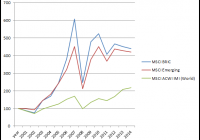
Most investors would benefit from exposure in frontier markets, despite their risks. In the next decade or two, frontier markets could (some probably will) make the same leap as EM and BRIC markets did. Investors should not miss that. Investing through the more popular ETFs might not be as viable in the case of frontier markets as it usually is. Active managers are also a great option in this space. Frontier market countries are loosely defined as countries between the emerging economies and the least developed economies. They are still economic dwarfs compared to emerging or developed nations by metrics such as GDP, or equity market capitalization. For example, countries such as Romania and Bulgaria in Europe, Vietnam or Pakistan in Asia and Nigeria or Morocco in Africa, or Kuwait in the Middle East are defined to be frontier markets. Growth in these countries should be faster in the future compared to developed or emerging economies based on favorable demographics and simply catching up to the rest of the world (the economic convergence effect). According to forecasts of the World Bank, Sub-Saharan Africa and South Asia regions should achieve real GDP growth between 4% and 8% depending on the country. Also in Emerging Europe, countries like Kazakhstan, Turkey and Romania are expected to achieve solid growth. There is significant potential in the frontier markets, and for once the small guys could actually get a head start. Frontier markets are still often too small for bigger institutional investors to get a meaningful exposure. (The MSCI Frontier Markets market cap is about $93 billion. For comparison Johnson & Johnson’s (NYSE: JNJ ) Mcap = $272 billion and China Mobile’s (NYSE: CHL ) market cap = $269 billion) Once the institutional funds start flowing, there could be a lot of upside. The leap that emerging markets and especially BRICs made before the financial crisis gives some perspective. The BRIC term was popularized in 2003 Goldman Sachs report. (In 2003 MSCI BRIC index returned 91%) I think it is certain that at least some of the current countries defined as frontier markets will make similar leap at some point in time. Valuations are also quite low in the frontier space. iShares MSCI Frontier 100 (NYSEARCA: FM ) P/E ratio is about 10, Price/Cash flow is 4.4 and dividend yield is also over 4%. (Source: Morningstar ) Picture data: MSCI Indices Countries and Indices One of the problems in investing in the frontier market space is the fact that the term is very loosely defined and is not really tied to any particular geographic area, so getting broad exposure is not easy. Many ETFs and funds also combine smaller emerging markets and frontier markets, so you do not necessarily know if you are investing in emerging or frontier markets, although this line is sometimes very blurred. The biggest weights in frontier market indices are often in a few single countries such as Kuwait (22%) in MSCI Frontier Markets 100 index, Argentina (19%) and Qatar (28%) in FTSE Frontier 50 Index and Argentina (30%) and Pakistan (19%) in S&P Select Frontier Index. Also because frontier markets are really small, few countries with bigger equity markets and just a few firms in those countries easily dominate the indices. From example MSCI Frontier 100 index has over 20% exposure to Kuwait. And over 12% of that exposure consists of just two financial firms. (National Bank of Kuwait and Kuwait Finance House) So an investor would actually have large tail risk regarding the banking sector in Kuwait. I doubt that many investing in the index are aware of this and that risk sounds like something I would rather not take. Also according to Morningstar report correlations between different frontier markets are very low. So there is fair amount of idiosyncratic risk in the indices, because there could easily be a shock (for example some political risk) that would affect only one country. It is in essence the same as having over 20% of a stock portfolio in a single stock. Just for comparison the biggest firm in the S&P 500, which is Apple (NASDAQ: AAPL ), is 4% of the index. And S&P 500 represents just US equity markets, not a whole asset class as FM indices are supposed to do. The same problem is in pretty much all of the mcap weighted frontier indices. Also one aspect of this is that the weight of the countries with smaller equity markets is nonexistent. But if one looks at the GDP of Kuwait vs. Romania, for example, Romania is actually the bigger economy (Data: Romania , Kuwait ). But Romania gets under 5% weighting as Kuwait gets 22% in MSCI index. I am not arguing that GDP weighting would necessarily be better, but the disparity seems very large. So although with ETFs following the main indices it is usually hard to go wrong, I doubt that it is the best way in the case of frontier markets. With only one ETF, investor would not get a good exposure. It might be better to buy a basket of different ETFs (FM, EMFM , FRN ) and maybe country specific ETFs when available. There are direct products at least to Vietnam , Pakistan and apparently even Kazakhstan and to many other countries too if one takes the time to search. Creating a basket is costly and time consuming, but this way one would get more broad exposure, which would not be so concentrated in a few big financial firms and certain countries. Those countries might not even be the growth stories of the decades to come. And actually those much denounced active managers could really earn their paycheck when investing in often illiquid and information scarce frontier markets. Active vs. Passive In the case of frontier markets, active managers could actually be a very decent choice. First of all the costs of the ETF-products are not really small either. The iShares FM charges 0.79% which is a high number compared to developed or even emerging (iShares Emerging Markets ETF IMI: 0.25%) fees. The average annual fees of a mutual fund investing in the space is about 2%, smaller for larger investors and bigger for individuals. Here I have calculated returns, volatility and Sharpe ratios for two frontier market funds, which had a track record of 3 years. Funds are Harding Loevner Frontier Emerging Markets (MUTF: HLFMX ) and Morgan Stanley Frontier EM markets A (MUTF: MFMPX ). The index option is represented by the popular iShares MSCI 100 Frontier. Annual return Volatility Sharpe HLFMX 7.78 % 10.10 % 0.77 MFMPX 13.87 % 11.03 % 1.26 FM 9.04 % 12.42 % 0.73 As can be seen both funds have performed better risk adjusted than the index. Also in addition to lower volatility it seems likely that the risks are better managed in the active funds because of the large single country (and firm) exposure of MSCI frontier 100 index. At least the active options definitely seem to be an interesting option. Summary and Risks In my opinion having some kind of an allocation in Frontier markets is a great idea and it could be worthwhile even to overweight them relative to developed and emerging markets. Arbitrarily I would say that 10% allocation would be decent from a risk/reward perspective. There is a lot of potential in terms of upside when markets and economies mature and capital starts flowing in the next 10+ years. Also correlations between developed economies is low, which provides great diversification for an investor in developed countries. MSCI Frontier 10 year correlation to US equity markets is just 0.58. (Source: Morningstar report ) Active management seems to be a solid choice too and there are funds with great track record and lower risk than the ETFs. Also the cost of trading and information is higher, which should give more edge to great active managers. Just one ETF is not enough exposure in my opinion, because of the problems of underlying FM indices. Investors should look closely what the underlying index includes and maybe use a basket approach of many products if possible. However, there are some downsides too. Because Frontier markets are illiquid the drawdowns can be large. In 2008 frontier markets was the asset class that came down the most ( -66% ). (Source: Morningstar report ) Also the Fed tapering in 2013 caused a bit of a panic in emerging markets and as the rate hike looms, we could well see another one. The tapering affected most to the countries that have been dependent on US Capital flows (such as Turkey). Actually many frontier markets are not dependent from these flows because of their small size, but it could still cause a lot of turbulence in all of the emerging and frontier market space. Disclosure: I/we have no positions in any stocks mentioned, and no plans to initiate any positions within the next 72 hours. (More…) I wrote this article myself, and it expresses my own opinions. I am not receiving compensation for it (other than from Seeking Alpha). I have no business relationship with any company whose stock is mentioned in this article.

NRG Energy Is Ready For A Turnaround

Summary Despite NRG Energy’s current troubles in the fossil fuels arena, the company’s decentralized generation segment is booming. NRG Energy’s heavy footprint in the distributed generation market ensures that it a place in the future energy landscape. NRG Energy’s enormous fossil fuels business will help pave the way for the company’s future. Although NRG Energy has a bright long-term future, near-term volatility in the fossil fuels arena represents a significant risk to the company. NRG Energy (NYSE: NRG ) has been on a steady decline over the past year, with its stock price dropping from a high of $37 to its current levels of around $25. Much of this drop has been associated with the company’s increasingly volatile fossil fuels business, in which recent fluctuations and margin compressions have taken a toll on the company’s financials. With the majority of NRG Energy’s business being based in fossil fuels, the company’s recent underperformance is not so surprising. Given the heavy oil price volatility, plummeting natural gas prices, and unfavorable coal rulings, it is no wonder that NRG Energy has been experiencing pressure on the margins front. While the company’s total revenues is on an upward trend, its net income is facing much more uncertainty. Given that nearly one-third of the company’s energy generation comes from coal, which is facing an unprecedented amount of industry headwinds, NRG Energy may face some difficulties in the near-term. Regardless of NRG Energy’s underperformance in its fossil fuels business, the company’s heavy presence in residential solar should provide it with a massive long-term boost. Whereas the benefits of the company’s early residential solar involvement are not yet apparent, they should be soon enough as NRG Energy ramps up its involvement. Given the comparatively small size of residential solar, it is only natural that investors are overlooking this crucial energy market. NRG Energy Is Hedging Its Bets As one of the first major power companies to enter the residential solar market, NRG Energy still has upside even in spite of the obstacles facing its fossil fuels business. If predictions of the global rooftop solar market being worth $2.7 trillion by 2040 are anywhere near accurate, NRG Energy is on the cusp of explosive growth. Given the growth trend of solar PV and the theoretical advantages of decentralized generation, this prediction may even underestimate rooftop solar’s impact in the long-run. As NRG Energy is one of the few large companies fully on board with rooftop solar, it is well-positioned to reap the benefits of such growth. Despite the fact that NRG Energy’s residential solar segment still only accounts for a tiny fraction the company business, with just over 16K customers as of Q1, NRG Energy is paying particularly close attention on the segment. Such enthusiasm about an extremely small but promising aspect of its business shows how dedicated NRG Energy is to distributed solar. Such a forward thinking mindset is exactly what will push NRG Energy to the forefront of the energy industry. Given residential solar’s potential, NRG Energy is definitely on the right path. In fact, NRG Energy CEO David Crane is so convinced of the distributed energy paradigm that he is even starting to throw jabs at the electric utility industry. David Crane has recently implied in an interview that utilities are too near-sighted to full embrace new energy concepts(e.g. distributed solar), stating that “There are no thirty-year-old C.E.O.s of electric utilities, no Zuckerbergs,” and that “You have to pay your dues, come up through the ranks. You become C.E.O. when you have five years, max, left. Some of them are just not worrying about ten, fifteen years in the future.” Clearly, NRG Energy is fully committed to the distributed generation paradigm in a way that most other energy companies are not. The company’s residential solar wing NRG Home Solar is growing in prominence, and is set to even compete with residential solar powerhouses SolarCity (NASDAQ: SCTY ) and Vivint Solar (NYSE: VSLR ) in the coming quarters. It would not be surprising to see its residential solar segment double or even triple in customer count over the next few quarters, which would place it squarely among the leading residential solar companies. Despite the uncertainty of NRG Energy’s fossil fuels business, the company’s residential solar business remains a bright spot. (click to enlarge) Source: NRG Catalyzing Residential Solar Growth Using Fossil Fuels With tens of billions in revenue from its fossil fuels business, NRG Energy is one of the largest power companies in the world. The company’s enormous fossil fuels business will allow the company to more easily dominate the distributed solar business. Rather than reinvesting its future profits into its fossil fuels business, the company will likely funnel more and more of its money into its solar operations. Given the hundreds of millions of dollars in annual net income that NRG Energy will likely see moving forward, the company is in a better position than most of its distributed generation competition from a financial standpoint. Rather than having to borrow enormous amounts of cash at relatively high rates, NRG Energy should have a wealth of capital from its fossil fuels business. While hundreds of millions of dollars is a negligible amount in the fossil fuel industry, such a quantity of money will undoubtedly make a huge impact in the comparatively miniscule solar industry. NRG Energy’s cheaper access to capital is likely a big reason why the company has been able to make such a large impact on the decentralized generation scene so quickly. While NRG Energy will have an extremely hard time outcompeting SolarCity in the long-run due to various other factors, the company definitely has the potential to eventually beat out second place residential solar company Vivint Solar. With $15.35B in revenues for 2014, NRG Energy should be able to produce net incomes of around the half-billion dollar range moving forward. Access to such large finances should allow NRG Energy to accelerate it distributed solar business. Obstacles NRG Energy still faces many obstacles in its transition to solar. Given that the vast majority of its business is still based on fossil fuels, the company’s near-term prospects are more uncertain due to the fossil fuel industry’s current volatility. Even if NRG Energy can stabilize its fossil fuels business, there are still many questions regarding the long-term viability of its residential solar business. Despite the enormous promise associated with the solar leasing model, this business model is still relatively young and untested. There is almost a complete absence of data regarding long-term default rates, module performance, etc. As such, the present value of the long-term solar lease contracts are still heavily debated. Conclusion Despite the uncertainty facing NRG Energy in the near-term, the company’s amazing progress in the residential solar sector is undeniable. The potential rewards associated with the residential solar business model far outweigh the risks, which puts NRG Energy in a great position moving forward. After dropping nearly one-third of its value over the course of a year, NRG Energy should experience significant upside moving forward. NRG Energy is at the forefront of the distributed generation movement, and has the financial resources to truly make a long-term impact. At a valuation of $8.12B , NRG Energy still has much more room to grow. Disclosure: I am/we are long SCTY. (More…) I wrote this article myself, and it expresses my own opinions. I am not receiving compensation for it (other than from Seeking Alpha). I have no business relationship with any company whose stock is mentioned in this article.