Tag Archives: consumer

Coca Cola, PepsiCo Earnings Stir Up Consumer Staples ETFs

The beverage space closed out 2014 on a sizzling note as two cola and food bellwethers – Coca Cola Co. (NYSE: KO ) and PepsiCo (NYSE: PEP ) – quenched investors’ thirst with better-than-expected earnings for Q4 ’14. In fact, 2014 will remain especially memorable for PepsiCo as the company beat the Zacks Consensus Estimate for both earnings and revenues in all four quarters. On the other hand, Coca Cola managed to beat on both lines in Q4 after posting mixed results in Q3. Let’s delve a little deeper. Impressive PEP Earnings & Dividend Hike On February 11, PepsiCo beat the Zacks Consensus Estimate for both earnings and revenues. Not only this, the food and beverage behemoth announced a 7.3% increase in annual dividend along with an authorization of a new $12 billion share buyback program. Pepsi’s fourth-quarter core earnings per share of $1.12 easily surpassed the Zacks Consensus Estimate of $1.08 by 3.7% and year-ago earnings by 6% helped by higher organic revenues, improved margins and lower taxes. Total sales of $19.95 billion – down 1% year over year – beat the Zacks Consensus Estimate of $19.78 billion. A stronger snacks performance and improved beverage volumes in Europe and Americas were probably the reasons for the beat. However, it was adverse currency translation which weighed on total revenue growth as currency concerns ate away 6% revenue growth. Pepsi now expects core constant currency earnings per share to increase 7% in 2015, in tune with the long-term management goal of high single-digit core constant currency earnings growth. Notably, currency is expected to mar both earnings per share and revenues by 7% in 2015. Thanks to upbeat earnings, the PepsiCo stock was up about 2.5% in the key trading session of February 11. Coca-Cola Too Posts Decent Earnings On February 10, Coca-Cola reported adjusted earnings of $0.44 per share in Q4 which beat the Zacks Consensus Estimate by around 5%. Earnings declined 5% year over year thanks to a stronger dollar, which was up 5% on a constant currency basis, driven by improved organic revenues and cost-cutting efforts. Net revenue slipped 2% year over year to $10.87 billion due to headwinds from currency and structural changes. Excluding these effects, constant currency revenues grew 4% in the quarter. The best part is that revenues beat the Zacks Consensus Estimate of $10.77 billion by 1%. An extra selling day, better sparkling beverage performance, strong price/mix gains and volume growth in North America helped the company to hold gains. Management remains hopeful about its 2015 operations and sees this as a transition year. However, foreign exchange is expected to hurt 2015 revenues by 5% and profit before tax by 7-8%. While an overall beat offered the KO stock about 2.8% gains in the key trading session of February 10, its shares retreated about 0.1% on February 11. ETF Impact The beverage earnings also put in focus several consumer staples ETFs having notable exposure to Coca Cola and PepsiCo. Funds like Consumer Staples Select Sector SPDR ETF (NYSEARCA: XLP ) , Vanguard Consumer Staples ETF (NYSEARCA: VDC ) and iShares Dow Jones U.S. Consumer Goods Sector ETF (NYSEARCA: IYK ) have large allocations in KO and PEP. Below, we have highlighted these funds in detail: XLP in Focus The most popular consumer ETF in the market, XLP follows the S&P Consumer Staples Select Sector Index. The fund invests about $10.2 billion of assets in 41 holdings. Of these firms, the in-focus Coca-Cola takes the second spot, making up roughly 9.21% of the assets while PepsiCo accounts for about 4.63% of XLP taking up the seventh position. The fund charges 15 bps in fees per year from investors. The fund has added about 1.6% (as of February 11, 2015) post KO earnings. XLP currently has a Zacks ETF Rank #3 (Hold) with a ‘Medium’ risk outlook. VDC in Focus This fund manages a $2.61 billion asset base and provides exposure to a basket of 100 consumer stocks by tracking the MSCI U.S. Investable Market Consumer Staples 25/50 Index. The product charges a low fee of 12 bps per year from investors. Again here, Coca-Cola is the second firm with 8.0% allocation and PepsiCo is the third firm holding 6.7%. The product is widely spread across various sectors out of which soft drinks have a 17.1% allocation. VDC added about 1.6% (as of February 11) within the last two days. VDC currently has a Zacks ETF Rank #3 with a ‘Medium’ risk outlook. IYK in Focus This ETF tracks the Dow Jones U.S. Consumer Goods Index, giving investors exposure to the broad consumer staples space. The fund holds about 115 stocks in its basket with AUM of $516 million, while charging a slightly higher fee of 43 bps per year from investors. Coca-Cola and PepsiCo occupy the second and third positions respectively in the basket with 7.87% and 6.91% of assets. The fund was up 1.63% (As of February 11) post the duo’s earnings. The product has a Zacks ETF Rank #3 with a ‘Medium’ risk outlook. Bottom Line Though the beverage giants ended 2014 with an overall beat and started off 2015 on a refreshing note, currency concerns might surface this year. Plus, the industry fundamentals are also not great as it falls in the bottom 29% section of Zacks Industry Ranks. So, investors having high hopes on the duo might bet on these beverage giants through a basket approach as it partly shields the risk of single-stock investing.
ETB Vs. ETV: What’s The Difference?

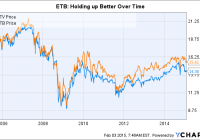
Summary At a quick glance, ETV and ETB look like almost mirror images of one another. ETV’s longer-term performance hasn’t been as good as ETB’s, based on market price. But based on total return, ETV has done a little better over time. If I had to choose, ETB would be my call. A pet peeve of mine is when a fund sponsor has two similar funds available that, on the surface, appear to be clones of one another. That’s exactly the case with the Eaton Vance Tax-Managed Buy-Write Opportunities Fund (NYSE: ETV ) and Eaton Vance Tax-Managed Buy-Write Income Fund (NYSE: ETB ). But when you look just a little closer, the differences are there – they’re just subtle. The same… One of the first things I look at when examining a fund is its objective. In the case of ETV : “The Fund’s primary investment objective is to provide current income and gains, with a secondary objective of capital appreciation.” ETB’s objective is, word for word, the same. And the managers are the same, too. With Walter A. Row and Thomas Seto heading things up since each of the funds’ initial public offerings. Which brings us to one relatively minor distinction between the two funds. ETV IPO-ed on June 30, 2005. ETB IPO-ed on April 29, 2005. This is a virtually irrelevant fact at this point, but it is a difference. Even the standard deviation, a measure of share price volatility, of the two funds is roughly the same. According to Morningstar, both funds have five-year standard deviations of about 9.5 versus a standard deviation for the S&P 500 of around 13. So they aren’t as volatile as the overall market, which can be good and bad. For example, over the trailing five-year period, they each captured around 60% of the market’s advance and 60% of the market’s decline. ETV is a touch better on both sides, gaining a little more and losing a little less. But the variance is tiny. … But different So, in a number of ways, ETV and ETB are virtual clones of each other. For example, over the trailing five-year period through the end of January (neither has 10-year numbers just yet), ETV’s annualized return is 11.4% based on its net asset value, or NAV, and 12.7% based on its share price. ETB’s annualized returns are 11% and 11.2%, respectively, over the same time span. Morningstar’s numbers are total return, which includes distributions, but it’s worth noting that the returns are fairly similar based on NAV. Furthermore, total return since the inception of each fund is only nine basis (0.09) points different based on NAV, according to Eaton Vance, bringing the pair’s performance even closer together. Yield, however, is a noteworthy differences. ETV’s yield is around 9.5%, according to the Closed-End Fund Association, and ETB’s yield is about 8.2%. Right now, ETV’s monthly distribution is $0.1108 and ETB’s distribution is $0.108. ETB’s NAV is a little over a dollar higher than that of its sibling. The biggest difference, however, is probably in the portfolios. At the end of last year, ETV’s largest sector weighting was in technology, at nearly 36% of the portfolio. That was more than double the second- and third-largest sectors combined (consumer discretionary at 14.6% and healthcare at 14%). Technology was materially overweighted relative to the S&P 500, where tech stood at roughly 20% of the index. Technology was ETB’s largest sector weighting, too. But it came in at roughly 18%, a couple of percentage points lower than the index. The financial sector, meanwhile, was the fund’s number two sector, at just a touch under 18%. The consumer discretionary sector came in third, with a weighting of about 14%. The weighting of both the consumer discretionary and financial segments were just slightly above the index. In fact, when looking at the broader portfolios based on sectors, ETB looks far more like the index than its sibling. It isn’t an index clone, but the differences are at the margins. ETV, on the other hand, is clearly making a big bet on technology – that must be where the managers see “opportunity.” The weighting given to each fund’s largest holdings is also worth a comment. ETV, for example, had over 20% of its assets in its top four holdings – all of which were tech names. And eight of the top 10 holdings were tech, with a ninth that could arguably be technology, too. ETB’s top four holdings were closer to 10% of its portfolio. In fact, you’d have to reach out to the top 10 holdings at ETB to get to 20% or so of assets. And the mix in that top 10 was comparatively diverse. “Opportunity” is the key Clearly, the use of the word “opportunity” in the name of ETV is about the fund’s ability to stray quite far from its benchmark. That’s neither good nor bad, but is something investors should keep in mind. Over the longer term (since inception) it doesn’t appear to have done too much to help performance, though over the past five years it looks like it has been a slight benefit. That said, looking at each fund’s distributions, return of capital has been a big component. The use of options strategies virtually guarantees this. However, between 2010 and year-end 2013, ETV’s NAV went from roughly $14.50 to $14.80. The NAV is currently around $14.50 again. So, over last four years, the NAV has gone virtually nowhere. ETV data by YCharts ETB, meanwhile, watched its NAV go from $15.60 at the start of 2010 to $16.25 at the end of 2013. Its current NAV is about $15.85. ETB has been better able to build value for its shareholders than ETV, if only by a little bit. That is likely attributable to the lower distribution and yield – even though ETB’s name includes the word “income.” For my money, I’d recommend ETB over ETV, leaving the upside potential of seeking out “opportunities” to someone else. Slow and steady is more my speed, because the relatively large bets that ETV is taking may pan out, but there’s the chance that they don’t. For example, if you look at NAV back to the start of 2009, ETV actually looks like a better option because of a 39% NAV advance that year, compared to ETB’s 30% increase. That said, go back one more year to 2008, and you see that ETV fell 25% more than ETB in what was a brutal year for the stock markets (ETV fell 28.5%, compared to ETB’s more modest decline of 22.8%). There are always trade-offs in investing and ETV and ETB are no exception. The differences are somewhat minor, and even where they do show up, performance hasn’t been disproportionately impacted over the long term. That leads me to err on the side of caution – the more diversified portfolio and lower distribution of ETB. Disclosure: The author has no positions in any stocks mentioned, and no plans to initiate any positions within the next 72 hours. (More…) The author wrote this article themselves, and it expresses their own opinions. The author is not receiving compensation for it (other than from Seeking Alpha). The author has no business relationship with any company whose stock is mentioned in this article.