Tag Archives: china

4 ETFs You Can Hold Forever

Summary The trend of money flowing towards robo-advisers and passive asset allocators is one that is likely to continue in the current market environment. ETFs offer real diversification, low cost, and a global reach for those that want to buy and hold for the long-term. Several funds on this list offer a compelling value proposition when composing your asset allocation strategy. The trend of money flowing towards robo-advisers and passive asset allocators is one that is likely to continue in the current market environment. Amid the more recent back drop of low volatility capital appreciation in stocks and bonds, it seems that the natural evolution is to put your portfolio on auto-pilot or give it to someone who is just going to rebalance it quarterly. That’s not necessarily my philosophy on investing , but I understand that some people want to stay fully invested at all times or use continual dollar cost averaging to their advantage. In order to do so, you may find yourself searching for the “perfect investment” or asset allocation to hold for the long-term. Instead of paying someone to do that for you, I recommend taking a simpler approach that incorporates multiple asset classes through a flexible investment vehicle. A favorite individual stock such as Apple Inc (NASDAQ: AAPL ) might be suitable for some investors. However, if you want real diversification, low cost, and a global reach, I would consider using an exchange-traded fund instead. The following funds represent excellent opportunities for long-term investors. Vanguard Total Stock Market ETF (NYSEARCA: VTI ) You can’t go wrong with VTI for complete coverage of the U.S. stock market across multiple styles and market caps. This ETF charges a rock bottom expense ratio of just 0.05% for access to 3,800 U.S.-based publicly traded companies that include large, mid, and small-cap segments. While that level of diversification may seem overly broad to some investors, it is perfect for those who are looking for a core position in a small account or to simplify many overlapping funds down to a single entity. VTI has over $50 billion in total assets and a current 30-day SEC yield of 1.88%. The best thing I can say about this ETF is that it is low cost, extremely liquid, and will provide a passive vehicle for tracking the entire U.S. stock market. In addition, it has very little turnover to minimize tax implications for investors that wish to hold this fund in a long-term taxable account. Vanguard Total International Stock ETF (NASDAQ: VXUS ) Often times I see investors trying to get cute with their international exposure to overweighting certain areas of the globe in order to try and capture the best performers. However, if I was to pick just one ETF to bet on the entire market outside of the U.S., it would be VXUS. This ETF contains over 5,800 securities of both developed and emerging market nations around the world. That includes everything from Canada to China and everywhere in between. VXUS also follows a passive index approach similar to VTI with a minimal expense ratio of just 0.14%. Pairing an international fund such as VXUS with VTI can provide you with full coverage of global stocks in just two positions that are easy to track over time. If you wanted to pair that down to just one vehicle you could always select the Vanguard Total World Stock ETF (NYSEARCA: VT ) as well. PIMCO Total Return ETF (NYSEARCA: BOND ) Picking a single bond fund to pair with my stock exposure is not an easy task considering the challenges facing fixed-income over the next several years. Ultra low yields around the globe have made the way forward a potentially treacherous one given the expectation of interest rate cycles changing over time. Despite the turmoil associated with its portfolio manager leaving last year, I would be inclined to incorporate BOND in my portfolio as a solid long-term holding. The reason I selected BOND has to do with a number of complex factors that include the fact it is one of the only truly global broad-market offerings in the ETF space with sufficient size and history. The newly established Fidelity Total Bond ETF (NYSEARCA: FBND ) may be a suitable alternative. However, I don’t believe that Fidelity has the same level of sophistication when it comes to fixed-income research and security selection as compared to PIMCO. In addition, I like the active style of the BOND portfolio that gives the manager flexibility to target specific duration, credit quality, country, and sector exposure. I truly believe that these factors are important when competing with passive “total bond market” indexes from the approach of managing risk to enhance returns . Cambria Global Asset Allocation ETF (NYSEARCA: GAA ) If you are looking for the structure of a global multi-asset index that takes care of rebalancing your asset allocation, GAA should certainly be on your radar. This “fund of funds” is the first ETF of its kind to offer exposure to stocks, bonds, real estate, and commodities with zero expense ratio. While there are still minimal “acquired fund expenses” to own the 28 underlying ETFs, GAA is focused on low-cost indexes to achieve its goals. The current asset allocation of GAA is 51% bonds, 43% stocks, and 7% commodities. The majority of the underlying holdings are Vanguard, iShares, State Street, and Market Vectors products. The benefit to GAA is that their model is created using not just a market cap weighted methodology, but also incorporating value and momentum as well. The ultra-low fees to own this fund combined with the added bonus of automatic rebalancing make this an attractive position for moderate or conservative investors looking for a long-term core holding. Disclosure: The author has no positions in any stocks mentioned, and no plans to initiate any positions within the next 72 hours. (More…) The author wrote this article themselves, and it expresses their own opinions. The author is not receiving compensation for it. The author has no business relationship with any company whose stock is mentioned in this article. Additional disclosure: David Fabian, FMD Capital Management, and/or clients may hold positions in the ETFs and mutual funds mentioned above. The commentary does not constitute individualized investment advice. The opinions offered herein are not personalized recommendations to buy, sell, or hold securities.
Sell The State, Buy The People

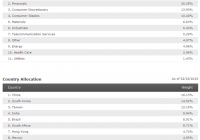
Summary State-owned companies dominate many emerging-market ETFs. State-owned companies generate lower return on assets than privately-managed firms. Avoiding the slower-growing state firms by going with small caps, or a fund such as XSOE. Investors can slice and dice the investment world into all manner of categories. One of the most common is to separate its investments into domestic and international, developed and emerging markets, then into regions or individual countries. A different way to slice the market is to break it down into state-owned and private companies. This is not a critical distinction for investors in the developed world, where deep capital markets offer exposure to many private firms, but many emerging markets are still developing their capital markets. A passive investment approach in emerging markets results in a state-owned heavy portfolio, but there are ways to avoid this exposure. State Interference Doesn’t Pay At least since Ludwig Von Mises published Economic Calculation in the Socialist Commonwealth , the case against socialist economic planning has been there for those who choose to look. Without information, an enterprise cannot make good decisions, and one of the first casualties of central planning is the informational content in prices. Prices exist in centrally-planned economies, but they do not reflect the supply and demand in the economy. The unfolding disaster in Venezuela, a country that suffered toilet paper shortages and is now occupying supermarkets with the army in its never-ending war against the laws of economics, is only the latest example of this basic truth. Clearly, one does not want to invest in a basket case such as Venezuela. At the other end, one cannot avoid some intervention in the economy, as nearly every nation on Earth has a central bank working to manipulate interest rates. In between are the mixed economies such as in China, where the transition to market capitalism is still incomplete. These countries have varying degrees of market forces, but one common trait in many is that state-owned enterprises (SOEs) compete alongside private firms. In many of those countries, the state-owned giants dominate the stock market and make up the bulk of market capitalization. The extreme case is China, where most of the listed companies on the mainland stock exchange are SOEs. In Brazil, semi-private Petrobras (NYSE: PBR ) has accounted for 20 percent of stock market capitalization alone. As oil prices have tumbled and PBR sees corruption charges swirl around the firm , investors in funds such as iShares MSCI Brazil (NYSEARCA: EWZ ) have paid the price. Investors who passively plunk money into market capitalization index funds are often unknowingly choosing to invest with the state and even where the firms are increasingly competitive, they still often lag behind fully-privatized competitors. Recent figures show that Chinese SOEs earn about 5 percent on assets , versus roughly 9 percent for private firms. SOEs in China achieve this low return despite access to cheap credit and regulatory favoritism, in part because the largest shareowner, the state, cares about many things besides profit. Additionally, the government officials in charge of these firms have their own private agendas, and those often stray into the realm of corruption. Some recent examples are the lackluster performance of Russian energy firms even when oil prices were high, Chinese banks that have run up a mountain of bad debt due to politically-motivated lending, and as mentioned above, Brazil’s largest company is racked with scandal. Aside from the aforementioned issues, there’s the issue of sector exposure. Many state-owned companies are banks, energy producers, utilities and telecom firms. While these companies can experience rapid growth in a rapidly-growing economy, they aren’t growing as fast as technology start-ups and new consumer companies catering to an emerging and increasingly wealthy middle class. Investment Options There are some ways around this, the easiest of which is to go with small caps, though that involves taking on more volatility. Broad small-cap ETFs, such as WisdomTree Emerging Markets SmallCap Dividend (NYSEARCA: DGS ), reduce exposure to SOEs. Guggenheim China Small Cap (NYSEARCA: HAO ) and Market Vectors Brazil Small Cap (NYSEARCA: BRF ) both offer a different mix of sector exposure along with avoiding the giant SOEs that populate many emerging-market ETFs. Some sector ETFs, such as KraneShares CSI China Internet (NASDAQ: KWEB ) achieve the same result. WisdomTree Emerging Markets ex-State-Owned Enterprises (NYSEARCA: XSOE ) WisdomTree launched XOSE in December to help investors maintain emerging market exposure while avoiding state-owned companies. The case for the fund is straightforward: the growth of emerging markets is the story of a rising middle class. The sectors most poised to benefit are those that serve these customers: consumer staples, consumer discretionary and healthcare firms. Technology is also an emerging sector in many of these countries that is growing far faster than the overall economy. To really profit from the growth of emerging markets, investors want to be positioned in the sectors pulling GDP forward, not the moribund state-owned enterprises that lag behind or at best, are indirect plays on the commodity cycle. From WisdomTree’s website : (click to enlarge) Technology is the largest sector exposure at nearly 23 percent of assets. Healthcare is underweight, consumer discretionary and consumer staples are the third and fourth largest sectors. Financials are a large portion of assets at about 20 percent, but that is less than many emerging market funds. One reason why the fund isn’t better positioned with respect to sectors is because the fund’s main goal is the removal of SOEs, not a shift in sector exposure. From WisdomTree, the index criteria (emphasis mine): ” State owned enterprises are defined as government ownership of more than 20% of outstanding shares of companies. The index employs a modified float-adjusted market capitalization weighting process to target the weights of countries in the universe prior to the removal of state owned enterprises while also limiting sector deviations to 3% of the starting universe. ” For investors who want to remove SOE exposure while still getting similar sector and country exposure as the run-of-the-mill emerging-market fund, XSOE is a great choice. Assuming the state-owned companies aren’t reformed and unlock hidden value from their assets, over time XSOE should beat the market capitalization weighted competition such as iShares MSCI Emerging Markets (NYSEARCA: EEM ). The case for owning XSOE over other funds is stronger today because the sectors dominated by SOEs are at the center of the slowdown in emerging markets, from China’s debt-laded banks to Brazil and Russia’s energy-heavy stock markets. The fund might lag for long periods when plain vanilla emerging market funds benefit from the sector exposure that SOEs bring, but over the long run, XSOE is likely to come out ahead thanks to holding shares in more efficient firms. Disclosure: The author has no positions in any stocks mentioned, and no plans to initiate any positions within the next 72 hours. (More…) The author wrote this article themselves, and it expresses their own opinions. The author is not receiving compensation for it (other than from Seeking Alpha). The author has no business relationship with any company whose stock is mentioned in this article.