Tag Archives: cash

The 7 Deadliest Words Of Investing And Why You Are Not Smarter Than The Average Bear

Summary Stay away from these 7 deadly words that we tell ourselves. See how investors can be classified into three types of lemmings. Discover a simple concept of what valuation really is to an investor. I’m a valuation nut. The methods I choose are not perfect because valuation involves art and science. But then again, what is the perfect valuation method? There’s no such thing. And that’s difficult for many people to grasp because we are taught to do things the “right” way, a “certain” way. One of the most difficult things with investing and any form of valuation is that there is no step by step guide. In any other industry there’s a clear process that you can follow from start to finish to accomplish a task Ikea furniture assembly instructions Photography tutorials How to tie a tie Learning to hang glide and so on But investing is like a choose your own adventure book that I loved to read growing up. A choose your own adventure book is one where you come to a section of the book and then get to choose which adventure you want to take. Depending on your choices, the ending is different. When it comes to investing, there is no clear single method of doing things and it can overwhelm, and frankly, freaks out some people. Instead of a straight path from A to B, the waves of decisions and new information you have to take in requires lots of work. And it’s too much for many people. That’s why you always see people asking strangers what their thoughts are on a stock they hold. But the truth is that people can invest successfully. People can value stocks properly. You’re just led to believe you can’t. It’s just that there are a ton of blogs, news and articles that discuss complex ideas, causing people to simply walk by obvious low risk ideas. I call these low hanging fruits. Bloggers, news reporters, financial analysts all want to write about the hard stuff to get recognized. The complex deals. Who wants to write about how a small, well run, industrial niche company in Nashville, with a 70 year long heritage that continues to gain business and generate cash when less than 400 people on the Internet will read it? Instead they could be writing about how Tesla (NASDAQ: TSLA ) is reinventing the auto industry and revolutionizing a new energy era, poring over PHD words and speculating about what the future could bring. It could go viral and look good on their writing stats. But… You’re led to believe that they must know something that you don’t. The 7 Most Deadly Words in Investing This is a video that I refer to now and then when I need to clear my head or when I start second guessing myself. I’ve marked the video to start from 1:57. Watch the next 2 minutes to around the 3:50 mark. Did you catch those 7 deadly words? They must know something that you don’t. If seasoned professionals fall into this trap, how much easier is it for regular investors to tell themselves the same thing? Especially when they read or hear people they regard as more intelligent as themselves disagreeing with their analysis and valuations. If you didn’t or can’t watch the video above, Prof Aswath Damodaran lays out a simple example that I certainly relate to. You value a company. Say you come up with a value of $50 per share. Let’s say the company is Amazon. Stock is trading at $278. One of the great stocks of the last decade. Your rational side is saying, “don’t buy that stock, it’s expensive”. But then you hear a voice at the back of your head. “They must know something that you don’t”. And when you hear that voice, magical things happen to your valuation. Your cash flows increase, your growth rates go up, your discount rates go down, $50 becomes $100, $100 becomes $150, and before you know it, guess what? You’re at $275, $300, justifying your need to buy. 3 Types of Lemmings Damodaran continues on to group investors into 3 groups of lemmings. After all, we are all lemmings to some degree. There is no such thing as a pure contrarian, because that just means you are a contrarian just for the sake of being a contrarian. Lemming #1: The Proud Lemming These are just momentum investors who are proud of following what’s hot. They don’t care what the company is or does. They look for a crowd and buy and sell whatever is being bought or sold. Lemming #2: The Yogi Bear Lemming Yogi Bear’s tagline is “smarter than the average bear” and it refers to the investors who like to think that they are able to pull out of a stock just before it crashes. The problem is that most people claim they are smarter than the average bear, but rarely are they able to jump ship of a momentum train before it crashes. If Isaac Newton, the father of advanced mathematics and mechanics couldn’t handle the charts, market and lemming fever, I have serious doubts about most of us. Isaac Newton Became a Lemming ( Photo Credit: Safal Niveshak ) Lemming #3: The Lemming with a Life Vest Valuation is simply a life vest. A compass. It’s something for you to hang onto when everyone else is doing something else. Buffett knew that dot com stocks were at stupid valuations in 2000 and held onto his life vest when Barron’s basically called him “old”. After more than 30 years of unrivaled investment success, Warren Buffett may be losing his magic touch. … To be blunt, Buffett, who turns 70 in 2000, is viewed by an increasing number of investors as too conservative, even passe. Buffett, Berkshire’s chairman and chief executive, may be the world’s greatest investor, but he hasn’t anticipated or capitalized on the boom in technology stocks in the past few years. Indeed, Buffett has even started taking flak on Internet message boards. One contributor called Berkshire a “middlebrow insurance company studded with a bizarre melange of assets, including candy stores, hamburger stands, jewelry shops, a shoemaker and a third-rate encyclopedia company [the World Book].” – Barrons I just love how Damodaran puts it because it’s exactly how I process it. Valuation slows the process down, gives your rational side a chance to mount an argument. Valuation is Simple. Don’t Complicate It. When you value stocks, you miss out on hundreds of opportunities. Most growth stocks go out the window. Forget about Tesla. Most investors don’t want to hear about valuation because it challenges their desire to hear what they want. But I love valuation and it’s the reason why the OSV Analyzer came to life in the first place. I love it and over 800 members have made great use of it because when facts and numbers over the past 5 years or 10 years are smack in front on your face, it’s difficult to trick yourself. Unless I can find a reason for why I have to increase my valuation from $50 to $300 without solid evidence, it’s easy to recognize I’m fooling myself. I could go into 101 reasons why everyone should use the analysis tool, but the more important thing is to start building a habit of valuing stocks. Investing is a game where you don’t win by making all the right calls. You can be right only 40% of the time. But if your conviction and position sizing is good, you can easily beat anyone out there. When I start chasing complicated stories, structures, deals, industries that I know nothing about, I’ve lost money every time. When I focus on valuation and follow it up with patiently waiting until the stock hits my margin of safety price, I’ve been rewarded more times than I’ve been wrong. You Can Win the Fight As a freebie, I have free valuation spreadsheets you can start with. It’s combined with an easy to digest mini valuation courses over email if you are a new subscriber. Just easy guides on how to value and analyze stocks using several different methods. Charlie Munger said that if he knew where he was going to die, he’d never go there. Well, you’ve just found the 7 deadliest words in investing. They must know something that you don’t. Let’s not go there. Disclosure: The author has no positions in any stocks mentioned, and no plans to initiate any positions within the next 72 hours. (More…) The author wrote this article themselves, and it expresses their own opinions. The author is not receiving compensation for it. The author has no business relationship with any company whose stock is mentioned in this article.
Dual Momentum Portfolio Update

Scott’s Investments provides a free “Dual ETF Momentum” spreadsheet which was originally created in February 2013. The strategy was inspired by a paper written by Gary Antonacci and available on Optimal Momentum. Antonacci has a new book out, Dual Momentum Investing: An Innovative Strategy for Higher Returns with Lower Risk . If you want to see how he applies Dual Momentum to a portfolio strategy I encourage you to read the book. My Dual ETF Momentum spreadsheet is available here and the objective is to track four pairs of ETFs and provide an “Invested” signal for the ETF in each pair with the highest relative momentum. Invested signals also require positive absolute momentum, hence the term “Dual Momentum.” Relative momentum is gauged by the 12 month total returns of each ETF. The 12 month total returns of each ETF is also compared to a short-term Treasury ETF (a “cash” filter) in the form of iShares Barclays 1-3 Year Treasury Bond ETF (NYSEARCA: SHY ). In order to have an “Invested” signal the ETF with the highest relative strength must also have 12-month total returns greater than the 12-month total returns of SHY. This is the absolute momentum filter which is detailed in depth by Antonacci, and has historically helped increase risk-adjusted returns. An “average” return signal for each ETF is also available on the spreadsheet. The concept is the same as the 12-month relative momentum. However, the “average” return signal uses the average of the past 3, 6, and 12 (“3/6/12″) month total returns for each ETF. The “invested” signal is based on the ETF with the highest relative momentum for the past 3, 6 and 12 months. The ETF with the highest average relative strength must also have an average 3/6/12 total returns greater than the 3/6/12 total returns of the cash ETF. Portfolio123 was used to test a similar strategy using the same portfolios and combined momentum score (“3/6/12″). The test results were posted in the 2013 Year in Review and the January 2015 Update. Below are the four portfolios along with current signals: Return data courtesy of Finviz Equity Representative ETF Signal based on 1 year returns Signal based on average returns U.S. Equities VTI Invested Invested International Equities VEU Cash SHY Credit Risk Representative ETF Signal based on 1 year returns Signal based on average returns High Yield Bond HYG Invested Interm Credit Bond CIU Invested Cash SHY Real-Estate Risk Representative ETF Signal based on 1 year returns Signal based on average returns Equity REIT VNQ Invested Invested Mortgage REIT REM Cash SHY Economic Stress Representative ETF Signal based on 1 year returns Signal based on average returns Gold GLD Long-term Treasuries TLT Invested Invested Cash SHY As an added bonus, the spreadsheet also has four additional sheets using a dual momentum strategy with broker specific commission-free ETFs for TD Ameritrade, Charles Schwab, Fidelity, and Vanguard. It is important to note that each broker may have additional trade restrictions and the terms of their commission-free ETFs could change in the future. Disclosures: None Are you Bullish or Bearish on ? Bullish Bearish Neutral Results for ( ) Thanks for sharing your thoughts. Submit & View Results Skip to results » Share this article with a colleague

Are Some Decisions To Allocate To U.S. Equities Due To Survivorship Bias?

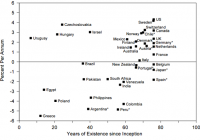
By David Foulke The CFA Institute Magazine recently published an interview (a copy is here ) with C. Thomas Howard, CEO of Athena Investment Services. Howard has some pretty explicit views on why investors should allocate all of their assets to U.S. stocks: The primary driver of long-horizon wealth is expected returns. Why would you invest in anything but stocks? Why isn’t your portfolio 100% stocks? Do you believe stocks are going to have the highest return? By the way, stocks have averaged 10% a year for a long period of time. Bonds have averaged about 6%. The difference between a portfolio that’s 100% stocks and one that is a mixture of stocks and one that is a mixture of stocks and bonds over long periods of time is huge, possibly millions of dollars. Why would I want to buy anything but the highest expected return, asset-wise? U.S. stocks have offered the best returns for a long time, and therefore the U.S. stock market is where you want to be invested. This is an interesting argument. Certainly, Howard is right that the U.S. stock market has been the best place to be invested. For instance, Mehra and Prescott in their 1985 paper, “The Equity Premium Puzzle” (a copy can be found here ), demonstrated how the risk premium on U.S. Equities from 1889-1978 averaged roughly 6%. The paper was notable in that it suggested that existing general equilibrium models were unable to explain the size of this premium, which was dramatically higher than for other economies. Academics struggled to explain the persistently strong U.S. stock market. This is the “puzzle” to which the paper’s title refers. In 1998, Reitz proposed that investors in U.S. markets might be more risk averse due to the potential occurrence of large drawdowns, or “crashes.” In a risky market that could crash dramatically, risk averse investors might expect high equity returns as compensation for bearing the risk of such crashes. Perhaps this explained high returns in the U.S. As academics pondered the effect of possible crashes on risk premia, they increasingly questioned that it was risk aversion to crashes that was driving returns. Some thought these unexplainable returns might have something to do with whether a market simply survived, which by definition meant that it consistently recovered from periodic drawdowns over long time frames. Was their some bias introduced to a market’s returns that was associated with the mere fact of its survival? In their paper, “Global Stock Markets in the Twentieth Century” (a copy can be found here ), the authors Jorion and Goetzmann explored this question. They examined 39 global stock markets from 1921 through 1996 and, as before, saw evidence of the outperformance of the U.S. stock market, which provided a real return of 4.32% over the period, the highest of all countries. During this period, however, several of these 39 markets experienced interruptions to their functioning, caused by forces such as war, political instability, hyperinflation, and so forth. The authors compared what happened when they considered both “loser” markets, and how long they were viable, in addition to the survivors, like the U.S. and others, who were “winners” over long periods. The figure below plots annual returns against the length of the history of each market: (click to enlarge) There appears to be a clear relationship between returns and longevity of markets, with longer-lived markets generating higher returns. Over the period, the median return for all 39 countries was 0.75%, representing the return earned by holding a globally diversified portfolio since 1921. Notably, there were 11 “winner” countries, which had continuous returns going back to 1921. For this group, the median return was dramatically higher, at 2.35%. Also, note that the U.S. appears at the upper right of the figure. These results suggest that returns for the U.S. 1) are uncommon at 4.3% versus 0.8% for all other countries, and 2) could be explained by survival, as could higher returns for the other survivors. If you happened to invest in a country that survived, you would have earned higher returns. The paper also examined Reitz’s hypothesis. Recall that Reitz had suggested that investors demanded a higher return as compensation for the risk of a crash. If this were true, then you would expect to see the “losers” exhibit higher equity premia. As the figure above illustrates, the opposite appears to be the case. A regression of these points would slope upward to the right. The returns of the winners may thus be conditional on their survival. If you think about investing in a particular country as like drawing a ball from an urn, then how meaningful is it to say that we can expect future returns to resemble past returns in that country, if those past returns are a result of survivor bias? Survivor bias refers to how we can focus on survivors in a data set, and ignore failures, which provide additional information about risk. Hindsight may be 20/20, but predicting the future is not, and if we condition on only the surviving winners, we ignore the possibility that we may be investing in a previous winner that may turn into a loser in the future. In a PBS interview (a copy is here ) Jack Bogle stated the following: Good markets turn to bad markets, bad markets turn to good markets. So the system is almost rigged against human psychology that says if something has done well in the past, it will do well in the future. That is not true. And it’s categorically false. And the high likelihood is when you get to somebody at his peak, he’s about to go down to the valley. The last shall be first and the first shall be last. Indeed, why should it be easy to predict which markets will survive? As Bogle points out, it may be precisely the past winners who are about to fail. Or as Jeremy Siegel stated in his paper, “The Equity Premium: Stock and Bond Returns since 1802”: Certainly investors in…1872…did not universally expect the United States to become the greatest economic power in the next century. This was not the case in many other countries. What if one had owned stock in Japanese or German firms before World War II? Or consider Argentina, which, at the turn of the century, was one of the great economic powers. It’s probably likely that Argentinian investors predicted continued economic dominance at the turn of the century. They were wrong. The outcome of World War II, which today looks obvious, could have played out in many different ways, and the U.S. might very well have turned into a loser. The Japanese certainly thought they would emerge as the dominant power after the war, or they wouldn’t have fought the war. Same for Germany. If the outcome of WW II had been different, we might today be studying the stock markets of Japan, Germany or other European countries, instead of the U.S. Who is to say the U.S. will not enter a hyperinflationary period or a sustained major war? Such an outcome for the U.S. is obviously not without precedent elsewhere. When we look at past U.S. returns, we are looking at a market that did not fail, but does it follow that it cannot fail in the future? Conditioning on past survival can subject investors to risks, which they are not accounting for. Even with strong past returns, we need to consider survivor bias, and that we are necessarily betting on a winner. Interestingly enough, Warren Buffett and Jack Bogle offer investors puzzling investment advice in the face of the results presented by Jorion and Goetzmann and a simple knowledge of survivor bias. First, Warren’s advice: Put 10% of the cash in short-term government bonds and 90% in a very low-cost S&P 500 index fund. (I suggest Vanguard’s.) Next, Jack Bogle’s advice : I wouldn’t invest outside the U.S. If someone wants to invest 20 percent or less of their portfolio outside the U.S., that’s fine. I wouldn’t do it, but if you want to, that’s fine. We have to question whether the advice from Buffett/Bogle considers the reality of survivor bias or their own personal bias. Original Post