Tag Archives: cash

Schwab Intelligent Portfolios: Intelligent Investing Or Marketing Hype?
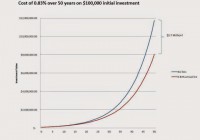
Summary Schwab has joined the rapidly growing robo-adviser market with its “Schwab Intelligent Portfolios.” Cash drag can dramatically diminish investor returns. Smart beta does not live up to its hype of superior returns. “No adviser fee” is just a marketing hype that can cost an investor millions of dollars when cash drag and ETF expenses are taken into account. Schwab Intelligent Portfolios won’t be a game changer for many reasons. Due to the increasing popularity of robo adviser investing, Charles Schwab (NYSE: SCHW ) has entered this market with its introduction of Schwab Intelligent Portfolios . For a minimum of $5,000 initial investment, Schwab sets an asset allocation using ETFs and rebalances the portfolio periodically. For a minimum of $50,000, a client may elect tax loss harvesting by the program. No adviser fees are charged on top of the fees charged by the ETFs. Is this a game changer? Should you enroll? How much will it cost? One major implicit cost is cash drag. Schwab Intelligent Portfolios hold 6-30% of assets in cash, allowing Schwab to earn the spread between the interest it pays on the cash deposits (currently around 0.12%) and investment income from such deposits. Assuming average stock market return of around 10%, a 6-30% cash allocation costs 0.6-3% annually ! That is at least twice as much as the 0.3% annual adviser fees charged by other similar robo adviser programs, as stated in Schwab’s disclosure . For comparison, neither Wealthfront nor Betterment mandate cash allocations. After all, if I want to hold cash, why do I need to give it to a robo adviser? While Schwab pays only 0.12% on cash deposits, you can earn over 8 times as much with a high yield savings account , which also allows you to withdraw money anytime. This implicit 0.6-3% annual fee from cash drag belies Schwab’s claim as a no-fee robo adviser. But that is not all. The ETFs selected have fees of their own. The asset allocation recommended is based on risk tolerance and investment horizon. The lowest cost asset allocation possible, recommended with the highest risk and return potential, and minimum 6% cash allocation, is shown below: Stocks 94% Probable ETF Expense U.S. Large Company Stocks 11% SCHX 0.04% U.S. Large Company Stocks – Fundamental 17% FNDX 0.32% U.S. Small Company Stocks 7% SCHA 0.08% U.S. Small Company Stocks – Fundamental 11% FNDA 0.32% International Developed Large Company Stocks 9% SCHF 0.08% International Developed Large Company Stocks – Fundamental 13% FNDF 0.32% International Developed Small Company Stocks 4% SCHC 0.18% International Developed Small Company Stocks – Fundamental 6% FNDC 0.48% International Emerging Market Stocks 4% SCHE 0.14% International Emerging Market Stocks – Fundamental 6% FNDE 0.47% U.S. Exchange-Traded REITs 4% SCHH 0.07% International Exchange-Traded REITs 2% VNQI 0.24% Cash 6% 0.00% Total 100% 0.23% Schwab will likely use its own funds whenever possible, but may switch to other funds under its program as part of tax loss harvesting. While the fees of traditional Schwab cap-weighted index funds are among the lowest in the mutual fund industry, the fees of fundamental index ETFs are much higher, as seen above. The net result is an additional 0.23% annual fee for the overall portfolio. In sum, Schwab Intelligent Portfolios cost at least 0.83% of assets annually . That does not account for costs associated with capital gains tax and bid-ask spread for periodic rebalancing. What is the effect of a 0.83% annual expense? Due to the effect of compounding, an investor will lose 14% of their assets in 20 years, 20% in 30 years, 26% in 40 years, and 32%, or almost a third of their potential wealth, in 50 years. As shown by the following graph, $100,000 invested over 50 years earning 10% return will grow to $11.7 million, but the investor paying 0.83% fee would end up with only $8.0 million, losing $3.7 million to fees over the years. (click to enlarge) Do fundamental index funds offer higher returns, thereby justifying their higher fees? The research suggests no. The table below shows that such so-called smart beta funds actually underperform the market: Smart beta funds vs. S&P 500 Name 3-year annualized total return 5-year annualized total return 10-year annualized total return Net expense ratio Strategic beta ETFs* 13.33% 12.5% 7.9% 0.48% Strategic beta mutual funds** 18.17% 13.69% 6.98% 1.17% S&P 500 index 20.42% 15.45% 7.67% Source: Morningstar. Returns are through Dec. 31, 2014. *Results from 394 strategic beta exchange-traded funds covered by Morningstar. **Results from 43 strategic beta open-end mutual funds covered by Morningstar. Fundamentally weighted indices have outperformed traditional capitalization-weighted indices by greater allocation to value stocks and small size stocks. ETFs and mutual funds constructed from fundamental indices, however, fail to live up to their promise of superior returns, mainly due to higher expense ratios and turnover costs. As John Bogle famously said about investing: You get what you don’t pay for. Impact on the Robo Advisor Industry Adam Nash, CEO of Wealthfront, wasted no time to attack Schwab’s new robo advisor program as a marketing gimmick by presenting something as no fee that was in fact high cost. Schwab was equally quick to issue a response , arguing that cash is actually an investment and the interest rate will eventually rise, that fundamentally weighted indices have historically delivered excess returns, and that the 0.25% advisor fee charged by Wealthfront is a real sunk cost. Betterment also wrote an article to attack Schwab’s program as costly due to cash drag . It is revealing that both Wealthfront and Betterment, the two leaders in the robo advisor industry, each with over one billion dollars in assets under management (AUM), felt compelled to respond with such rapidity. They clearly felt threatened. And rightly so. Most investors too lazy to manage their own investment portfolio and willing to pay 0.15-0.25% advisor fee that Betterment and Wealthfront charge will probably not look too closely at the real cost of cash drag, but rather be attracted by the superficial charm of Schwab posing as a “no fee” advisor. Robo advisor services, which are new technologies, mainly appeal to younger investors, who tend to like free things and new, fashionable things, such as smart beta, one of the latest financial innovations. It is probably inevitable that Schwab will take away some market share in the robo advisor industry. Nonetheless, the products offered by the three robo advisors are differentiated enough to have their own moats. Below are the highest risk and return portfolios from Wealthfront and Betterment: Wealthfront: Asset ETF Allocation Expense ratio U.S. Stocks VTI 35% 0.05% Foreign Stocks VEA 22% 0.09% Emerging Markets VWO 28% 0.15% Dividend Stocks VIG 5% 0.10% Natural Resources DJP 5% 0.75% Municipal Bonds MUB 5% 0.25% Total 100% 0.13% Betterment: Asset ETF Allocation Expense ratio U.S. Total Stock Market VTI 16.2% 0.05% U.S. Large-Cap Value VTV 16.2% 0.09% U.S. Mid-Cap Value VOE 5.2% 0.09% U.S. Small-Cap Value VBR 4.5% 0.09% Developed Markets VEA 37.5% 0.09% Emerging Markets VWO 10.5% 0.15% Municipal Bonds MUB 5.5% 0.25% U.S. Corporate Bonds LQD 0.6% 0.15% International Bonds BNDX 2.4% 0.19% Emerging Market Bonds VWOB 1.6% 0.34% Total 100.2% 0.11% For some reason, probably due to rounding error, the Betterment allocations don’t exactly add up to 100%. The table below summarizes the differences between the three portfolios. Schwab Wealthfront Betterment Stocks 92% 89% 89% Bonds 0% 5% 10% Cash 6% 1% 1% Alternatives 2% 5% 0% U.S. Stocks 52% 40% 41% Foreign Developed Market 33% 26% 38% Emerging Market 7% 23% 10% Value 58% 59% 58% Growth 42% 41% 42% Large Cap 59% 81% 76% Mid/Small Cap 41% 19% 24% Price/earnings 17.5 16.14 16.26 Price/book 1.81 1.94 1.79 Return on equity 14.61 18.21 16.61 Average Market Cap 16.0B 29.3B 29.0B Expense ratio 0.24% 0.13% 0.11% Number of Holdings 13 6 10 Overall stock allocation is similar, with Wealthfront and Betterment both at 89%, while Schwab is slightly higher at 93%. The rest is mostly in cash for Schwab, partly in bonds and partly in alternatives for Wealthfront, and mostly in bonds for Betterment. In terms of allocation to world regions, Schwab is U.S. centric. Wealthfront has a significantly higher allocation to emerging markets at 23%. All three are similar in value versus growth allocation. Schwab has significantly higher allocation to small cap stocks. The price ratios are similar for all three. Schwab has a significantly higher expense ratio, twice as much as its competitors; it also has the higher number of holdings in its portfolio. Wealthfront would appeal to investors who prefer simplicity (the portfolio has only 6 holdings), emerging markets, and alternative investments. Betterment would appeal to cost conscious investors. Schwab would appeal to investors who prefer complexity, small cap, smart beta, and tax loss harvesting (more holdings create more opportunities for tax loss harvesting). But the $64,000 question is, will this be a game changer? I doubt it, for several reasons. First, the robo advisor market is relatively small within the entire asset management business. Even if Schwab could reach $1 billion AUM, at 0.83% fee, that would still generate only a tenth of one percent of Schwab’s 2014 revenue of $6.157 billion, too small to move the needle. Second, Schwab Intelligent Porfolios might even eat into Schwab’s high margin core business, as it could cause Schwab clients using traditional advisor services and expensive actively managed mutual funds to switch over to Schwab’s robo advisor service, causing loss of revenue. Third, robo advisor service may not be a sustainable business model, as it has never been tested under bear market conditions. Young investors confident in a bull market may not feel so confident when the next bear market comes, especially without the hand-holding and long-term relationship of a personal investment advisor, causing funds to go out as fast as they had come into the robo advisor industry. Fourth, investors will probably come to the realization that cash drag is a significant hidden cost, and Schwab Intelligent Portfolios may end up being a total flop. Finally, even if Schwab does succeed in gaining market share and the industry continues to grow, the success itself will attract fierce competition from yet bigger firms, such as Merrill Lynch, ultimately driving profits down. Even though Schwab’s new robo advisor service would not alter Schwab’s fundamentals, robo advisor service is a Wall Street fad worth paying attention to for the enterprising investor. If Schwab succeeds in penetrating the market, it could generate undue optimism, creating good selling opportunities. Watch for its growth in AUM relative to the competitors, new market entrants, and how it handles a bear market. If the new robo advisor service fails, on the other hand, it could generate undue pessimism, leading to a selloff in Schwab’s stock, creating good buying opportunities. Conclusion Don’t fall prey for the marketing hype of Schwab’s “no fee” robo investing. One should hold enough cash as an emergency fund for 6 months worth of living expenses, but not in an investment portfolio meant to last 20 years or more. Put the cash in a high yield savings account, where you can earn over 8 times as much interest, and be able to withdraw anytime you want, rather than be forced to hold at least 6% cash at all times. Forget about smart beta. For higher returns, allocate more to value and small cap, and minimize costs. Schwab Intelligent Porfolios is good marketing, but it won’t be a game changer. Whether or not it succeeds, the potential market is too small to move the needle for Schwab; nonetheless, its success or failure may create price discrepancies for the enterprising investor to exploit. Disclosure: The author has no positions in any stocks mentioned, and no plans to initiate any positions within the next 72 hours. (More…) The author wrote this article themselves, and it expresses their own opinions. The author is not receiving compensation for it (other than from Seeking Alpha). The author has no business relationship with any company whose stock is mentioned in this article.

E.ON Should Continue To Outperform

FY 2014 numbers were in line with low expectations. Earnings are still declining, but at a slowing speed. Cash generation is strong enough to support leverage and to allow for new growth capex. The corporate split is well under way. Relative out-performance vs RWE should continue. E.ON’s (OTCQX: EONGY ) FY 2014 results were in line. Ebitda was in line with guidance, at Eur 8.3bn (USD 8.8bn), vs. consensus of Eur 8.4bn (USD 8.9bn). Net income came in at Eur -3.3bn (USD -3.5bn), broadly in line with consensus of Eur -3.2bn (USD -3.4bn). The Eur 5.4bn (USD 5.7bn) write-offs, most of which on the power plant, were well flagged. They now allow for a clean slate ahead of the corporate split. Adjusted net income was in line at Eur 1.6bn (USD 1.7bn). Management’s guidance for 2015 Ebitda of Eur 7-7.6bn (USD 7.4-8bn) is 5% short of the Eur 7.7bn (USD 8.1bn) consensus at the mid point. The outlook is weak, but largely reflected. The power price impact is smoother than for RWE ( OTCPK:RWEOY ). Achieved hedged prices are still coming into line with market forwards over the next two years. Nevertheless, among the two Germans, E.ON stacks up much better than RWE. The generation business accounts for ~21% of Ebitda, vs. ~36% for RWE. E.ON’s generation portfolio has a stronger cash flow base due to its better fuel mix. It is cash positive. Even when excluding the one off effects of the nuclear tax and provisions release, I estimate cash flow generation would have been flat y/y. Going forward, there will be a small positive impact from capacity payments in the UK. Leverage is still high at 4.1x Ebitda, but it is slightly less of a concern: Higher cash flows leave a greater degree of financial flexibility. And, there will be further cash inflows from the various announced disposals. There will be movement on gearing as the split will entail different balance sheet structures from today. Capex is twice the amount of RWE’s capex, with a correspondingly higher level of growth capex. I estimate that at least Eur 2.5bn will go into growth capex, most of which into renewables. That will build a stronger foundation for growth post 2015. In a sector that is returning to growth mode, E.ON has a good foundation in place: Renewables, one of the most important growth drivers, account for ~15% of Ebit, vs. ~8% for RWE. The split is well under way and both new companies are viable propositions. There will be intense scrutiny on the company’s ability to meet its nuclear liabilities post split. The government has commissioned legal studies, but not found any factors that were conducive to stopping the deal at this stage. So far, there will likely be a very public debate, but outright government intervention seems less likely. While the outlook is challenging for E.ON, I expect it to outperform on a relative basis. The shares are trading on a 16x 2015E P/E which is in line with the broader sector peer group. Editor’s Note: This article discusses one or more securities that do not trade on a major U.S. exchange. Please be aware of the risks associated with these stocks. Disclosure: The author has no positions in any stocks mentioned, and no plans to initiate any positions within the next 72 hours. (More…) The author wrote this article themselves, and it expresses their own opinions. The author is not receiving compensation for it (other than from Seeking Alpha). The author has no business relationship with any company whose stock is mentioned in this article.

ETF Stats For February 2015 – Actively Managed Assets Jump 10%

The ETF industry roared back in February after beginning the year with a negative start in January . Twenty-two new products came to market during the month and seven shuttered operations. Assets jumped 5.3% to $2.1 trillion, which by our calculations allowed month-end assets to close above the $2 trillion mark for the first time. Readers should note that we exclude fund-of-fund assets in our calculations to avoid double counting. As such, our year-end 2014 data put assets just a sliver short of that threshold. February’s net addition of 15 active listings brought the year-to-date count back into positive territory at plus five. The month’s launches were heavily skewed with 21 ETFs and just one ETN coming to market. Additionally, six of the seven closures were ETNs, putting month-end listings at 1,667 consisting of 1,462 ETFs and 205 ETNs. Actively managed ETFs saw four additions and one closure. Their count now stands at 123, which is a decline of two for the year. However, actively managed assets surged 10.6% for the month, are up 13.0% year-to date, and now total $19.5 billion. ETFs with more than $10 billion of assets increased by two and now number 49. Although they represent less than 3% of products, they hold more than 58% of industry assets. Products with $1 billion or more in assets increased by nine to 259 and have a better than 89% market share. The smallest 830 products (nearly half) account for just 1% of assets. Trading activity plunged more than 28% with just $1.3 trillion worth of ETFs and ETNs changing hands. There were only 19 trading days in the month, which only partially accounts for the decline. The quantity of products averaging more than $1 billion a day in trading activity dropped from twelve to eight, yet they still accounted for 48.7% of industry dollar volume. February 2015 Month End ETFs ETNs Total Currently Listed U.S. 1,462 205 1,667 Listed as of 12/31/2014 1,451 211 1,662 New Introductions for Month 21 1 22 Delistings/Closures for Month 1 6 7 Net Change for Month +20 -5 +15 New Introductions 6 Months 98 6 104 New Introductions YTD 34 1 35 Delistings/Closures YTD 23 7 30 Net Change YTD +11 -6 +5 Assets Under Mgmt ($ billion) $2,058 $27.6 $2,085 % Change in Assets for Month +5.3% +5.4% +5.3% % Change in Assets YTD +4.3% +2.7% +4.3% Qty AUM > $10 Billion 49 0 49 Qty AUM > $1 Billion 254 5 259 Qty AUM > $100 Million 765 39 804 % with AUM > $100 Million 52.4% 19.5% 48.2% Monthly $ Volume ($ billion) $1,282 $50.2 $1,333 % Change in Monthly $ Volume -28.6% -28.2% -28.6% Avg Daily $ Volume > $1 Billion 7 1 8 Avg Daily $ Volume > $100 Million 80 3 83 Avg Daily $ Volume > $10 Million 296 12 308 Actively Managed ETF Count (w/ change) 123 +3 mth -2 ytd Actively Managed AUM ($ billion) $19.5 +10.6% mth +13.0% ytd Data sources: Daily prices and volume of individual ETPs from Norgate Premium Data. Fund counts and all other information compiled by Invest With An Edge. New products launched in February (sorted by launch date): RevenueShares Global Growth Fund (NYSEARCA: RGRO ) , launched 2/2/15, holds about 100 securities based on two main selection criteria. First, 5 developed and 5 emerging countries will be chosen by selecting those with the highest percentage growth of their year over year GDP from the prior 2 quarters, with each country getting a 10% weighting. Second, the top 10 revenue-producing companies in each country are weighted by revenue, but they are limited to a 5% portfolio allocation. The expense ratio will be capped at 0.70% until 11/25/15 ( RGRO overview ). ETRACS Monthly Pay 2xLeveraged US Small Cap High Dividend ETN (NYSEARCA: SMHD ) , launched 2/4/15, is an exchange-traded note that provides 2x (200%) leveraged exposure (reset monthly) to an index of small-cap stocks having dividend yields that are relatively high compared to other small-cap stocks in the U.S. market. The ETN pays a variable monthly coupon linked to two times the cash distributions paid by index constituents. SMHD has an estimated yield of 16.8% and sports an expense ratio of 0.85% ( SMHD overview ). Fidelity MSCI Real Estate Index ETF (NYSEARCA: FREL ) , launched 2/5/15, is designed to represent the performance of the real estate sector in the U.S. equity market. The fund will not hold all of the positions in the underlying index, MSCI USA IMI Real Estate Index, but will instead select a representative sample of securities that collectively has an investment profile similar to the index. Investors will pay 0.12% annually to own this fund ( FREL overview ). ProShares Russell 2000 Dividend Growers ETF (NYSEARCA: SMDV ) , launched 2/5/15, invests in the companies of the Russell 2000 Index with at least 10 consecutive years of dividend growth. The fund will hold a minimum of 40 stocks equally weighted, and right now it holds 55. The top sectors represented in the fund are Financials and Utilities, each at about 23%. SMDV has an estimated yield of 2.4% and expects to pay dividends quarterly. The fund’s expense ratio will be capped at 0.40% until 9/30/16 ( SMDV overview ). ProShares S&P MidCap 400 Dividend Aristocrats ETF (NYSEARCA: REGL ) , launched 2/5/15, will invest in the companies of the S&P 400 MidCap Index that have at least 15 consecutive years of dividend growth. The fund will hold a minimum of 40 stocks equally weighted, and right now it holds 47. Financials leads the sector lineup at nearly 30%, and the next closest is Materials at 17%. The estimated yield for REGL is 1.8%. The fund’s expense ratio will be capped at 0.40% until 9/30/16 ( REGL overview ). SPDR S&P 500 Buyback ETF (NYSEARCA: SPYB ) , launched 2/5/15, provides exposure to companies in the S&P 500 that have high buyback ratios compared to other stocks. The fund may either hold all of the positions in the underlying index, S&P 500 Buyback Index, or it could instead select a representative sample of securities that collectively has the same risk and return characteristics of the Index. The Index provides exposure to the 100 companies in the S&P 500 that have the highest buyback ratio in the last 12 months, and currently the fund holds 101 positions. The fund sports a 0.35% expense ratio ( SPYB overview ). Guggenheim S&P High Income Infrastructure ETF (NYSEARCA: GHII ) , launched 2/11/15, invests in 50 high-yielding securities of companies in developed markets that engage in various infrastructure-related industries. Sector representations in the fund include Utilities 50.2%, Industrials 33.2%, and Energy 16.7%. Investors will pay 0.45% annually to own this fund ( GHII overview ). KraneShares FTSE Emerging Markets Plus ETF (BATS: KEMP ) , launched 2/13/15, invests in large- and mid-cap companies in emerging market countries and weights the country allocations by gross domestic product. As of the end of 2014, the largest markets represented were China (43.5%), India (17.7%), Brazil (5.2%), Mexico (4.5%), and Russia (3.9%). The fund’s largest holding at 17.5% is KraneShares Bosera MSCI China A ETF (NYSEARCA: KBA ), and it has a 0.68% expense ratio ( KEMP overview ). ProShares Ultra Gold Miners (NYSEARCA: GDXX ) , launched 2/13/15, seeks a daily return that is 2x (200%) the daily performance of an index made up of publicly traded companies involved in gold and silver mining. Companies whose revenues lean toward silver mining are limited to 20% of the holdings. Canada has the largest geographic allocation at 60%. The expense ratio will be capped at 1.11% until 9/30/16 ( GDXX overview ). ProShares Ultra Junior Miners (NYSEARCA: GDJJ ) , launched 2/13/15, seeks a return that is 2x (200%) the daily performance of an index made up of micro- and small-cap companies involved in gold and silver mining that generate at least 50% of their revenues from those activities. Companies whose revenues lean toward silver mining are limited to 20% of the holdings. Canada takes top billing in the geographic allocation at 64%. The expense ratio will be capped at 1.12% until 9/30/16 ( GDJJ overview ). ProShares UltraShort Gold Miners (NYSEARCA: GDXS ) , launched 2/13/15, seeks a daily return that is 2x inverse (-200%) the daily performance of the same index underlying GDXX. The expense ratio will be capped at 0.95% until 9/30/16 ( GDXS overview ). ProShares UltraShort Junior Miners (NYSEARCA: GDJS ) , launched 2/13/15, seeks a daily return that is 2x inverse (-200%) the daily performance of the same index underlying GDJJ. The expense ratio will be capped at 0.95% until 9/30/16 ( GDJS overview ). AdvisorShares Pacific Asset Enhanced Floating Rate ETF (NYSEARCA: FLTR ) , launched 2/19/15, is an actively managed ETF designed to produce a high level of current income. The ETF invests in senior secured and unsecured floating rate loans, secured second lien floating rate loans, and other floating rate debt securities of domestic and foreign issuers. The portfolio manager can choose to invest as little as 80% of the fund or can leverage the portfolio up to 130%. Although the fund is focused on income, an estimated yield is not currently provided on the fund’s website. The expense ratio will be capped at 1.10% until at least 2/13/16 ( FLTR overview ). Sit Rising Rate ETF (NYSEARCA: RISE ) , launched 2/19/15, has an objective to profit from rising interest rates by using futures contracts and options on futures on 2-, 5-, and 10-year U.S. Treasury securities. The underlying index targets a negative 10 year duration, making it an inverse bond fund. The weighting of the instruments are expected to be from 30% to 70% for the shorter duration securities and 5% to 25% for those with 10 year maturities. RISE will issue K-1 tax reports instead of the easier to use 1099. It has an expense ratio of 1.64% based on the breakeven analysis in the prospectus ( RISE overview ). Greenhaven Coal Fund (NYSEARCA: TONS ) , launched 2/20/15, is designed to track the daily price movements of coal futures. The fund will hold an equal number of futures contracts in each of the three months making up the closest calendar quarter. The positions will be rolled over to the next calendar quarter four times a year. TONS will issue K-1 tax reports instead of the more investor friendly 1099. Based on the breakeven analysis in the prospectus, the expense ratio will be 1.23% ( TONS overview ). SPDR DoubleLine Total Return Tactical ETF (NYSEARCA: TOTL ) , launched 2/24/15, is an actively managed income fund designed to provide investors with maximum total return. The fund’s manager, Jeffrey Gundlach, invests in fixed income securities of any credit quality and may include mortgage-backed securities, high yield securities, foreign-denominated instruments, and securities tied to emerging market countries. TOTL characteristics include a current yield of 4.8% and a duration of 3.1 years. The fund’s expense ratio will be capped at 0.55% until 10/31/16 ( TOTL overview ). Tuttle Tactical Management U.S. Core ETF (NASDAQ: TUTT ) , launched 2/25/15, is an actively managed fund-of-funds seeking to deliver relative returns during market uptrends and capital preservation during market downtrends. The fund will combine multiple, uncorrelated tactical strategies. The top two holdings are iShares 7-10 Year Treasury Bond (NYSEARCA: IEF ) at 26.6% and Pimco Enhanced Short Maturity (NYSEARCA: MINT ) at 20.0%. TUTT sports a 1.34% expense ratio ( TUTT overview ). iShares U.S. Fixed Income Balanced Risk ETF (BATS: INC ) , launched 2/26/15, is an actively managed ETF investing in U.S. dollar denominated investment-grade and high-yield fixed-income securities. The portfolio will be designed so that, in the aggregate, the fund’s exposure to credit spread risk and interest rate risk should be equal. In order to achieve the balanced goal, the fund may take short or long positions in U.S. Treasury futures. The fund is currently leveraged with a 25% short position in cash and/or derivatives. The expense ratio will be capped at 0.25% until 2/29/16 ( INC overview ). Lattice Developed Markets (ex-US) Strategy ETF (NYSEARCA: RODM ) , launched 2/26/15, invests in a broad range of companies showing favorable valuation, momentum, and quality characteristics that are located in major developed markets of Europe, Canada, and the Pacific Region. There are currently about 340 holdings. Japan leads the country allocation at 18.6%, and the U.K. follows with 13.7%. Investors will pay 0.50% annually to own this fund ( RODM overview ). Lattice Emerging Markets Strategy ETF (NYSEARCA: ROAM ) , launched 2/26/15, strives to balance risk across emerging market countries, currencies, and companies. It will provide increased exposure to smaller, more locally driven emerging economies and enterprises that have encouraging valuation, momentum, and quality characteristics. ROAM sports a 0.65% expense ratio ( ROAM overview ). Lattice U.S. Equity Strategy ETF (NYSEARCA: ROUS ) , launched 2/26/15, will invest in large-cap U.S. equities that have solid valuation, momentum, and quality characteristics. Financials leads the sector allocation at 19.2%, and Information Technology comes in second at 16.1%. ROUS has an expense ratio of 0.35% ( ROUS overview ). Arrow QVM Equity Factor ETF (NYSEARCA: QVM ) , launched 2/27/15, consists of 50 equally weighted domestic equities selected based on a combined ranking score of their quality, value, and momentum characteristics. To be considered, stocks must have daily dollar volume above $1 million for the last three months and at least a $5 share price. The portfolio is constructed at the end of January and July and is rebalanced quarterly to maintain equal weighting. The expense ratio will be capped at 0.65% until 5/31/16 ( QVM overview ). Product closures/delistings in February : WisdomTree Euro Debt (NYSEARCA: EU ) PowerShares DB 3x Italian T-Bond Futures ETN (NYSEARCA: ITLT ) PowerShares DB 3x Long USD Index Futures ETN (NYSEARCA: UUPT ) PowerShares DB 3x Short USD Index Futures ETN (NYSEARCA: UDNT ) PowerShares DB Italian T-Bond Futures ETN (NYSEARCA: ITLY ) PowerShares DB US Deflation ETN (NYSEARCA: DEFL ) PowerShares DB US Inflation ETN (NYSEARCA: INFL ) iShares moved its four allocation ETFs to its Core lineup effective February 2. Deutsche Bank and Invesco ended their agreement to market DB issued ETNs under the PowerShares brand. The 26 ETNs were renamed effective 2/24/15. The role of “managing owner” for 11 PowerShares DB ETFs transferred from Deutsche Bank to Invesco effective 2/25/15 resulting in the temporary suspension of creation units on the affected funds. Creations were resumed by the following day. The only disruption we noted was PowerShares DB Oil Fund (NYSEARCA: DBO ) traded with about a 3.5% premium for a few hours the morning of 2/25/15. Previous monthly ETF statistics reports are available here . Disclosure covering writer, editor, publisher, and affiliates: No positions in any of the securities mentioned. No positions in any of the companies or ETF sponsors mentioned. No income, revenue, or other compensation (either directly or indirectly) received from, or on behalf of, any of the companies or ETF sponsors mentioned.