Tag Archives: author

Time To Worry About Utility ETFs?

Utilities – one of the best performing sectors of 2014 – started the year on a good note with smart gains logged for January. An uncertain global economic outlook, interest rate cuts in developed to emerging markets, sliding commodity prices, political instability in Greece and a surprise move by the Swiss central bank to abandon its currency cap against the euro created panic among investors driving treasury yields lower at the start of the year. However, the sector has lately given up almost all of its gains and in fact is trading in the red in the year-to-date frame. The most popular product in the space – Utilities Select Sector SPDR (NYSEARCA: XLU ) – has lost 7.4% in the past one month as against a 4% return by SPDR S&P 500 (NYSEARCA: SPY ) over the same time frame. An improved U.S. economy and a strong U.S. jobs report have sent government bond yields sharply higher in the past few weeks, making the utility sector less attractive. The U.S. economy has added more jobs than expected in January, fuelling optimism about the strength of the job market. Moreover, the U.S. average hourly earnings rose at a better-than-expected pace of 0.5% in January. The upbeat labor market data has raised optimism about the pace of economic growth, leading many to believe that a rate hike by the Fed is surely on the cards this year. Expectations of a rate hike this year has caused the 10-year Treasury bond yield to spike to a four-week high of nearly 2%, a sharp and sudden increase from levels which were in the 1.65% range earlier in the month (read: Rising Interest Rates Are Great News for These Bond ETFs ). Utilities are quite sensitive to interest rates though they offer steady and strong yields. Thus, rising Treasury yields, an improving U.S. economy and strength in the jobs market have reduced the appeal of utilities as investors are shunning defensive bets to move to sectors more closely tied to growth. Moreover, utility companies rely on a large amount of debt for conducting operational activities. Hence, any rise in interest rates would push up their borrowing costs (see 3 Sector ETFs to Profit from Rising Rates ). Given the rising yields and concerns over a hike in short-term rates this year, below we have highlighted some of the large-cap funds in this space which have been among the hardest hit by the move towards cyclical securities and away from safety. Investors who believe that this is just the beginning of the slide in the space should clearly stay away from this space. XLU is the largest and the most popular ETF in its space with an asset base of $7.8 billion and average daily trading volume of 14.7 million shares. The fund is also one of the cheapest in its space with 15 basis points as expense fees. The fund tracks the Utilities Select Sector Index, holding a basket of 30 stocks. Duke Energy (NYSE: DUK ) occupies the top spot with 9.3% allocation, followed by NextEra Energy (NYSE: NEE ) and Southern Co. (NYSE: SO ), each with a little more than 7.5% exposure. XLU has lost 4.4% in the year-to-date frame after having gained 16% in the past one year. The fund has a solid dividend yield of 3.31%. iShares Dow Jones US Utilities Sector Index Fund (NYSEARCA: IDU ) The fund too gives investors an exposure to U.S. utility stocks and manages an asset base of $1.9 billion. IDU is home to 60 stocks and is also heavily concentrated in its top 10 holdings. Duke Energy Corp. (8.3%), NextEra Energy Inc. (6.65%) and Dominion Resources Inc. (NYSE: D ) (6.3%) are the top three holdings of the fund. Sector-wise, the fund invests more than half of its assets in electric utilities, while the rest go towards multi-utilities, gas and water (see all Utilities/Infrastructure ETFs here ). The fund charges 43 basis points as fees and has a 30-day SEC yield of 2.62%. IDU has lost 7% in the year-to-date frame but up 16% in the past one year. Vanguard Utilities ETF (NYSEARCA: VPU ) VPU tracks the MSCI US Investable Market Utilities 25/50 Index to provide exposure to a basket of 78 stocks. Sector-wise, electric utilities dominate here as well, followed by a 34% allocation to multi-utilities. The fund is also quite popular in its space with an asset base of $2.1 billion and an average expense fee of 12 basis points. The fund has a 30-day SEC yield of 3.08% and has lost 7.2% in the past month.
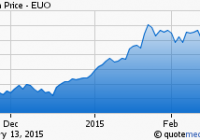
Up 20% In 3 Months Since My Recommendation, Sell EUO Stakes Now

The ProShares UltraShort Euro (EUO) ETF is up 20% over the three months since I recommended it, but I’m suggesting investors close their stakes here. The factors that came against the euro are about to reverse, and I see the euro gaining strength against the dollar near-term. A favorable Greece resolution is imminent in my opinion, and the European economy is steadying. The dollar is overextended versus the euro and against other currencies and should give way now, and thus the EUO ETF’s success should end here. In mid-November, I suggested investors buy the ProShares UltraShort Euro (NYSE: EUO ). Today I’m suggesting investors close the position and take the 20% profit earned over the 3 month period. I see the factors that have worked against the euro about to reverse, so sell the EUO ETF and take your gain. Holding Period Chart of EUO +20% at Seeking Alpha If you agreed with my investment thesis on the EUO ETF shared on November 19, 2014 when I suggested investors buy the ProShares UltraShort Euro , well then you have generated a 20% paper profit in the three month holding period through the February 13 close. It’s now time to close the stake, as I am anticipating the euro will strengthen against the dollar from here. My main thesis in the aforementioned report was keyed on a potential Russian rebuttal to Europe’s hand in sanctions against it. However, the curiously timed and perhaps not coincidental drop in oil prices that occurred this winter handcuffed Russia, in my opinion. It seems to have effectively kept the cash-strapped, energy based Russian Federation from acting in the manner I anticipated it might. I speculated Russia could cut off the flow of energy into Europe in the middle of winter and harm the euro’s value against the dollar. While this is still possible, the also curiously timed recently stepped up effort by European leaders to drive a peace initiative between Ukraine and the Russian backed rebels in the East of the country is serving the same purpose, again keeping Russia from acting against Europe. Importantly, in my November report, I also said that a weakening European economy and the potential for European Central Bank (ECB) extraordinary action had been serving the dollar versus the euro and should continue to add support to the dollar. This proved to be a continuing driver against the euro, assisted by the critical political developments in Greece that later followed. In essence, the Greek issue took the place of my Russian factor and drove the euro down versus the dollar, and led the ProShares UltraShort Euro up 20% over the three month period. Intensifying fear of a Greek exit from the euro-zone has been the booster of the dollar against the euro year-to-date, and affected a great deal more than just the currencies in my opinion. In the uncertainty, demand for U.S. treasuries drove U.S. interest rates down, and thus major U.S. financial sector issues in Bank of America (NYSE: BAC ), J.P. Morgan Chase (NYSE: JPM ) and others. The stronger dollar has played an important role in the fall of oil prices along with supply issues in my view. And the uncertainty around Europe and how it might affect the United States economy worked against U.S. equities this year in my view. But all this is about to change. I anticipate a favorable resolution between Greece and its European partners is imminent. The removal of the palpable fear that has gathered around this issue should serve a U.S. market rally in my opinion. Improving expectations have already begun to drive U.S. interest rates higher, and the dollar recently gave way a bit to the euro. European economic expectations are also improving in my opinion and Japan just exited recession . As the euro gains its strength back against the overextended dollar, the EUO ETF, which is a bet against the euro, should give way. Thus, while still ahead of the announcement of a Greek deal, you have time momentarily to close the investment I suggested in November. If you need a place to invest your gains from the EUO play, on the same thesis, I have recently suggested investors look to: the UDN ETF contra-dollar investment; or a short of the UUP ETF ; and a short of the iPath S&P VIX (NYSE: VXX ); or long investments in financial sector beneficiary Bank of America , which should rise on higher U.S. interest rates. Also, I’ve suggested Greek issues including the National Bank of Greece (NYSE: NBG ) and the Global X FTSE Greece 20 ETF (NYSE: GREK ). Readers may review my column for more. Disclosure: The author is long GREK, NBG, BAC. (More…) The author wrote this article themselves, and it expresses their own opinions. The author is not receiving compensation for it (other than from Seeking Alpha). The author has no business relationship with any company whose stock is mentioned in this article. Additional disclosure: I’m short VXX and UUP.

Loan Fund Primer

Sweden is now the latest country to make headlines about extreme central bank policy to stimulate growth which creates a dilemma for Swedish people trying to save money. This highlights the need to learn about different sectors of the fixed income market and taking a multi-sector approach in your fixed income portfolio. One sector that has attracted attention and assets has been the loan market. By Roger Nusbaum, AdvisorShares Strategist Last week the Riksbank (the Swedish central bank) dropped its benchmark interest rate to -0.10 and as of earlier this week Sweden’s ten year sovereign debt was yielding 0.50%. So Sweden is now the latest country to make headlines about extreme central bank policy to stimulate growth. We will see whether this turns out to be effective policy but it creates a dilemma for Swedish people trying to save money. This is the same or similar dilemma for people in many other countries including the US and while our rates are not as low as many other countries they are low enough to be problematic; two basis points for a money market and 2% for ten year treasuries. We’ve been looking at this issue for years, making the point about the need to learn about different sectors of the fixed income market and taking a multi-sector approach in your fixed income portfolio. We’ve talked about combining sectors with higher yields and so potentially more risk with sectors with lower yields and likely less risk to get an overall yield that hopefully approaches a useful level even if not a normal level; normal based on historical interest rates. One sector that has attracted attention and assets has been the loan market. There have been traditional mutual funds offering access for a fair bit of time and in the last couple of years ETFs have been rolled out that target the sector and the asset flows have been huge, more than $5 billion for the largest fund in the group. The attraction is simple enough; yields can be in the four percent range and because of their reset feature they don’t take interest rate risk. ‘Reset feature’ means that the interest rate paid on the loans adjusts based on prevailing rates on a regular interval, usually every three months. If you look on the info page for a loan fund you’ll see a maturity of several years but you’ll also see something like average days until reset which is when the rate on a given loan will update. From quarter to quarter there may not be much change but occasionally there will. This entire mechanism reduces interest rate risk to being essentially a non-issue. The credit quality of course tends to be lower which accounts for the yields being relatively attractive. Credit risk is generally mitigated, but not completely mitigated, by accessing the space via a fund similar to high yield. I would note that accessing an individual loan is not really a possibility for individuals. The other risk to mention is liquidity risk. Loans don’t trade on a secondary market so during some sort of event that strains liquidity the funds and their holders could have a problem with short term volatility. Most of the funds have the flexibility to hold some bonds that do trade on a secondary market to help in the face of a liquidity event. Anyone interested in the space, and with the yields available it is worth learning about, should take the time to understand what their given fund will do to address this potential issue. Disclosure: The author has no positions in any stocks mentioned, and no plans to initiate any positions within the next 72 hours. (More…) The author wrote this article themselves, and it expresses their own opinions. The author is not receiving compensation for it. The author has no business relationship with any company whose stock is mentioned in this article. Additional disclosure: To the extent that this content includes references to securities, those references do not constitute an offer or solicitation to buy, sell or hold such security. AdvisorShares is a sponsor of actively managed exchange-traded funds (ETFs) and holds positions in all of its ETFs. This document should not be considered investment advice and the information contain within should not be relied upon in assessing whether or not to invest in any products mentioned. Investment in securities carries a high degree of risk which may result in investors losing all of their invested capital. Please keep in mind that a company’s past financial performance, including the performance of its share price, does not guarantee future results. To learn more about the risks with actively managed ETFs visit our website AdvisorShares.com .AdvisorShares is an SEC registered RIA, which advises to actively managed exchange traded funds (Active ETFs). The article has been written by Roger Nusbaum, AdvisorShares ETF Strategist. We are not receiving compensation for this article, and have no business relationship with any company whose stock is mentioned in this article.