Tag Archives: author

Q3 2015 Investment Style Ratings For ETFs And Mutual Funds
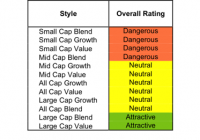
Summary Our style ratings are based on the aggregation of our fund ratings for every ETF and mutual fund in each style. The primary driver behind an Attractive fund rating is good portfolio management (stock picking) combined with low total annual costs. Cheap funds can dupe investors and investors should invest only in funds with good stocks and low fees. At the beginning of the third quarter of 2015, only the Large Cap Value and Large Cap Blend styles earn an Attractive-or-better rating. Our style ratings are based on the aggregation of our fund ratings for every ETF and mutual fund in each style. Investors looking for style funds that hold quality stocks should look no further than the Large Cap Value and Large Cap Blend styles. These styles house the most Attractive-or-better rated funds. Figures 4 through 7 provide more details. The primary driver behind an Attractive fund rating is good portfolio management , or good stock picking, with low total annual costs . Attractive-or-better ratings do not always correlate with Attractive-or-better total annual costs. This fact underscores that (1) cheap funds can dupe investors and (2) investors should invest only in funds with good stocks and low fees. See Figures 4 through 13 for a detailed breakdown of ratings distributions by investment style. All of our reports on the best & worst ETFs and mutual funds in every investment style are available here . You can see our investment style ratings for Q2’15 here . Figure 1: Ratings For All Investment Styles (click to enlarge) Source: New Constructs, LLC and company filings To earn an Attractive-or-better Predictive Rating, an ETF or mutual fund must have high-quality holdings and low costs. Only the top 30% of all ETFs and mutual funds earn our Attractive or better rating. The Schwab U.S. Dividend Equity ETF (NYSEARCA: SCHD ) is the top rated Large Cap Value fund and overall top rated style ETF. It gets our Very Attractive rating by allocating over 61% of its value to Attractive-or-better-rated stocks. Microsoft Corporation (NASDAQ: MSFT ), is one of our favorite stocks held by SCHD. Over the last decade, Microsoft’s after-tax profit ( NOPAT ) has grown by 13% compounded annually. The company currently earns a top-quintile return on invested capital ( ROIC ) of 48% and has generated positive free cash flow every year since 2002. Investors have failed to recognize Microsoft’s position as a cash-generating machine and the stock remains undervalued. At the current price of ~$47/share, Microsoft has a price to economic book value ( PEBV ) ratio of 1.1. This ratio implies that the market expects the company’s profits to only grow by 10%. However, if Microsoft can grow NOPAT by just 5% compounded annually for the next decade , the stock is worth $69/share – a 47% upside. Despite the slowing PC market, Microsoft should be able to surpass such low market expectations as they focus on monetizing their cloud services and software offerings. The Chartwell Small Cap Value Fund (MUTF: CWSVX ) is the worst rated Small Cap Blend fund. It gets our Very Dangerous rating by allocating over 62% of its value to Dangerous-or-worse-rated stocks. Making matters worse, it charges investors total annual costs of 5.22%. ESCO Technologies (NYSE: ESE ) is one of our least favorite stocks held by CWSVX. ESCO’s NOPAT has fallen by 8% compounded annually since 2011. The company earns a ROIC of only 6%, which is well below the 10% achieved in the mid 2000’s. While ESE is down 3% year to date, the stock price is still overvalued. To justify its current price of ~$38/share, ESCO must grow NOPAT by 14% compounded annually for the next 17 years . This expectation is very optimistic considering the business has not grown profits at all the past four years. Investors would be better off looking at quality stocks, such as Microsoft, and avoiding ESE. Figure 2 shows the distribution of our Predictive Ratings for all investment style ETFs and mutual funds. Figure 2: Distribution of ETFs & Mutual Funds (Assets and Count) by Predictive Rating (click to enlarge) Source: New Constructs, LLC and company filings Figure 3 offers additional details on the quality of the investment style funds. Note that the average total annual cost of Very Dangerous funds is more than three times that of Very Attractive funds. Figure 3: Predictive Rating Distribution Stats (click to enlarge) * Avg TAC = Weighted Average Total Annual Costs Source: New Constructs, LLC and company filings This table shows that only the best of the best funds get our Very Attractive Rating: they must hold good stocks AND have low costs. Investors deserve to have the best of both and we are here to give it to them. Ratings by Investment Style Figure 4 presents a mapping of Very Attractive funds by investment style. The chart shows the number of Very Attractive funds in each investment style and the percentage of assets in each style allocated to funds that are rated Very Attractive. Figure 4: Very Attractive ETFs & Mutual Funds by Investment Style (click to enlarge) Source: New Constructs, LLC and company filings Figure 5 presents the data charted in Figure 4. Figure 5: Very Attractive ETFs & Mutual Funds by Investment Style (click to enlarge) Source: New Constructs, LLC and company filings Figure 6 presents a mapping of Attractive funds by investment style. The chart shows the number of Attractive funds in each style and the percentage of assets allocated to Attractive-rated funds in each style. Figure 6: Attractive ETFs & Mutual Funds by Investment Style (click to enlarge) Source: New Constructs, LLC and company filings Figure 7 presents the data charted in Figure 6. Figure 7: Attractive ETFs & Mutual Funds by Investment Style (click to enlarge) Source: New Constructs, LLC and company filings Figure 8 presents a mapping of Neutral funds by investment style. The chart shows the number of Neutral funds in each investment style and the percentage of assets allocated to Neutral-rated funds in each style. Figure 8: Neutral ETFs & Mutual Funds by Investment Style (click to enlarge) Source: New Constructs, LLC and company filings Figure 9 presents the data charted in Figure 8. Figure 9: Neutral ETFs & Mutual Funds by Investment Style (click to enlarge) Source: New Constructs, LLC and company filings Figure 10 presents a mapping of Dangerous funds by fund style. The chart shows the number of Dangerous funds in each investment style and the percentage of assets allocated to Dangerous-rated funds in each style. The landscape of style ETFs and mutual funds is littered with Dangerous funds. Investors in Small Cap Blend have put over 73% of their assets in Dangerous-rated funds. Figure 10: Dangerous ETFs & Mutual Funds by Investment Style (click to enlarge) Source: New Constructs, LLC and company filings Figure 11 presents the data charted in Figure 10. Figure 11: Dangerous ETFs & Mutual Funds by Investment Style (click to enlarge) Source: New Constructs, LLC and company filings Figure 12 presents a mapping of Very Dangerous funds by fund style. The chart shows the number of Very Dangerous funds in each investment style and the percentage of assets in each style allocated to funds that are rated Very Dangerous. Figure 12: Very Dangerous ETFs & Mutual Funds by Investment Style (click to enlarge) Source: New Constructs, LLC and company filings Figure 13 presents the data charted in Figure 12. Figure 13: Very Dangerous ETFs & Mutual Funds by Investment Style (click to enlarge) Source: New Constructs, LLC and company filings D isclosure: David Trainer and Max Lee receive no compensation to write about any specific stock, sector or theme. Disclosure: I/we have no positions in any stocks mentioned, and no plans to initiate any positions within the next 72 hours. (More…) I wrote this article myself, and it expresses my own opinions. I am not receiving compensation for it. I have no business relationship with any company whose stock is mentioned in this article.
There’s Still Time To Lower Your Exposure To Riskier ETFs

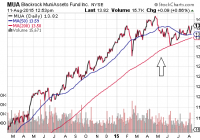
By itself, a “death cross” may not be particularly meaningful. However, when both the Dow Jones Industrials and the Dow Jones Transportation Average are flashing warning signs, stock valuations as well as risk preferences become increasingly important. As I have written previously, a tactical approach to asset allocation does not require that you abandon participation altogether. These tactical shifts will weather a hurricane, as well as permit me to raise risks at more attractive prices. A fair number of commenters, callers and perma-bulls were relatively tough on me in May when I suggested a strategic decision to raise cash levels . They were even tougher on me when I mentioned the possibility of picking up safer havens like intermediate treasuries via the i Shares 7-10 Year Treasury Bond ETF (NYSEARCA: IEF ) and intermediate-to-long duration municipal bonds via the BlackRock MuniAssets Fund (NYSE: MUA ). There’s no doubt about it… I was early on the call. Yet the idea behind raising cash as well as bolstering one’s allocation to investment grade securities (e.g., treasuries, munis, etc.) emanated from a well-reasoned interpretation of the data. At the corporate level, earnings growth had been waning, revenue had been contracting and non-financial companies had more leverage (37%) than they had back in 2007 (34%). At the macro-economic tier, wage increases had been flatlining, manufacturing had been crumbling and transporters in the iShares Transportation Average ETF (NYSEARCA: IYT ) had been dying a death by a thousand small cuts. Keep in mind, many had been dismissing the struggles of shippers, truckers, railways and airlines as irrelevant. After all, the big industrials were not tanking in the same manner as the big transporters. Until now. Industrial corporations – both in the Dow Jones Industrials average as well as the Industrial Select Sector SPDR ETF (NYSEARCA: XLI ) – have succumbed to the same technical pattern of weakness. Specifically, the shorter-term 50-day moving average has crossed over and below the longer-term 200-day trendline (a.k.a. “the death cross”). By itself, a “death cross” may not be particularly meaningful. However, when both the Dow Jones Industrials and the Dow Jones Transportation Average are flashing warning signs, stock valuations as well as risk preferences become increasingly important. Back in May and in June, valuations across nearly every metric of respectability had already reached the 2nd priciest in history (2nd only to the year 2000). Consider Buffett’s favorite indicator, market cap to GDP. As of this moment, the Wilshire Total Market Index market cap is roughly $21850 billion. That’s 123% of GDP. By this metric, the US stock market is only expected to annualize at about 0.3% with returns from dividends over the next decade. (See Market Cap To GDP chart below.) As I warned back in early June , investors would, at that time, need to monitor the market internals to gain perspective on risk-averse behavior. Risk-off behavior had not yet materialized completely. Here on August 11, the NYSE A/D Line’s 50-day trendline has not yet crossed over and below its 200-day moving average. It appears poised to make that transition. Yet equally concerning is the reality that the A/D Line itself had fallen below its 200-day for the first time since July of 2011 . Meanwhile, there have been a series of lower lows for the A/D Line since I first began highlighting market internals in May. Risk preferences – risk-taking versus risk-aversion – can be witnessed across a variety of measures and a variety of asset types. Indubitably, risk-aversion has the momentum, whether one is looking at recent relative performance of large-cap over small-cap, domestic over foreign, or investment grade credit over higher-yielding credit. Over the last two months, IEF has gained 3.1% whereas the iShares iBoxx $ High Yield Corporate Bond ETF (NYSEARCA: HYG ) has lost 1.7%. The demand for safety is trumping the risk of “junk.” One final sign that serves as a huge “yellow” caution: the S&P 500’s Advancing-Declining Volume Line (AD Volume Line). In essence, if the AD Volume Line is rising, there is significant strength behind advancing stocks. If it is falling, however, you have significant selling pressure behind the decliners. Right now, the S&P 500’s AD Volume Line isn’t just falling. Its 50-day moving average has fallen below its 200-day moving average for the first time since… yes, you guessed it… July 2011. By way of review, extreme valuations for equities have existed for the better part of a year. (Note: This can viewed a dozen ways at my “Don’t Party Like It’s 1999″ commentary.) Macro-economic weakness has been getting weaker, whether it is the lack of consumer spending, the breakdown in business spending, manufacturing woes, wholesale inventory buildups, export deceleration, slumping commodities, wage flatness and/or labor force participation. Micro-economic concerns may be summed up with earnings stagnation and the “revenue recession.” (Note: I discussed the “macro” and “micro” at great length at the end of July in “5 Reasons To Lower Your Allocation To Riskier Assets.” ) And market internals? Nearly every conceivable way that I’ve looked at them – from lack of breadth in equities, to missteps by leaders like Apple (NASDAQ: AAPL ) and Disney (NYSE: DIS ) to widening credit spreads to treasury demand – “risk-off” is garnering the limelight. As I have written previously, a tactical approach to asset allocation does not require that you abandon participation altogether. I have moved the bulk of my client base (over the last three months) from a 65% equity stake (e.g., domestic, foreign, large, small, etc.) and 35% income position (e.g., short, long, investment grade, higher yielding, etc.) to something that might resemble 55% stock (mostly large-cap domestic), 25% income (mostly investment grade) and 20% cash/cash equivalents. Cash today will reduce the adverse impact of significant price depreciation. The same can be said for larger domestic companies faring better in the storm than foreign companies or smaller corporations; similarly, investment grade should provide relief where higher-yield debt is likely to struggle alongside other riskier assets. In other words, these tactical shifts will weather a hurricane, as well as permit me to raise risks at more attractive prices. Additional evidence of market internals “rolling over” completely might encourage the use of other “risk-off” measures. For instance, 55% stock might be lowered to 40%, bolstering the overall cash stash to 35% (or one-third). Another possibility? Multi-asset stock hedging. My colleague and I created the FTSE Multi-Asset Stock Hedge Index (MASH) for those who wish to neutralize stock crises and stock bears without using leverage, options or shorting. Components of the index include ETFs like the PIMCO 25+ Year Zero Coupon U.S. Treasury Index ETF (NYSEARCA: ZROZ ), the PowerShares DB USD Bull ETF (NYSEARCA: UUP ), the CurrencyShares Swiss Franc Trust ETF (NYSEARCA: FXF ) and the iShares National AMT-Free Muni Bond ETF (NYSEARCA: MUB ). Click here for Gary’s latest podcast. Disclosure: Gary Gordon, MS, CFP is the president of Pacific Park Financial, Inc., a Registered Investment Adviser with the SEC. Gary Gordon, Pacific Park Financial, Inc, and/or its clients may hold positions in the ETFs, mutual funds, and/or any investment asset mentioned above. The commentary does not constitute individualized investment advice. The opinions offered herein are not personalized recommendations to buy, sell or hold securities. At times, issuers of exchange-traded products compensate Pacific Park Financial, Inc. or its subsidiaries for advertising at the ETF Expert web site. ETF Expert content is created independently of any advertising relationships.

Dividend Growth Stock Overview: American States Water Company

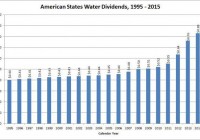
About American States Water Company American States Water Company (NYSE: AWR ) has subsidiaries that provide utility services to portions of 10 counties in southern California, and to military bases in certain parts of the United States. The company has its headquarters in San Dimas, California, and employs over 700 people. Through its Golden State Water Company (GSWC) subsidiary, American States provide water and wastewater services to 75 communities in California, and electric services to the city of Big Bear Lake and portions of San Bernardino County in southern California. GSWC was incorporated in California in 1929, and at the end of 2014, served over 250,000 water utility customers and 23,000 electric customers. The American States Utility Services subsidiary provides water and wastewater services to various military installations through its subsidiaries. The subsidiaries are on 50-year firm, fixed-price contracts with the government; the contract prices are subject to redetermination every 3 years. The military installations include Fort Bliss, TX; Andrews AFB, MD; Fort Lee, Fort Eustis, Fort Story, VA; Fort Jackson, SC; and Fort Bragg, Pope Army Airfield and Camp Mackall, NC. American States Water has three reportable segments: water utilities, electric utilities and contracted services. In 2014, 74% of the company’s EPS came from the water utilities segment, 4% came from the electric utilities segment and 20% came from the contracted services segment. (The remaining 2% came from other earnings, like earned interest.) In 2014, American States Water earned $61.1 million of income on $466 million. These numbers were each down less than 3% from 2013’s figures, but income was up more than 12% from 2012. EPS in 2014 was $1.57, down 2.5% from 2013. Given the current annualized dividend rate of 89.6 cents a share, the company’s current payout ratio is 57.1%. In addition to the annual dividend, American States Water also has an active share repurchase program. In March 2014, the company authorized the repurchase of 1.25 million shares, to be completed by June 30, 2016. By the end of 2014, there were 705,000 shares remaining to be repurchased. The company is a member of the S&P Small Cap 600 and Russell 2000 Small Cap indices, and trades under the ticker symbol AWR. American States Water Company’s Dividend and Stock Split History (click to enlarge) American States Water has accelerated its dividend growth recently, compounding its dividend at a rate of nearly 11% over the last 5 years. American States Water Company has paid dividends every year since 1931, and has increased them since 1955. Until 2012, the company would increase dividends on an irregular schedule, sometimes going up to 8 quarters without an increase. (Because the dividend increases occurred in the middle of the year, they still increased year-over-year.) In 2012, American States began to increase the dividend in the 3rd quarter of the calendar year, with the stock going ex-dividend in mid-August. Most recently, the company increased its dividend by 5.41% to an annualized rate of 89.6 cents. I expect American States to increase its dividend for the 62nd consecutive year in mid-August 2016. Since introducing the regular pattern of increasing dividends annually in the 3rd quarter, the company has grown dividends very nicely for a utility. Dividend growth from 2011 to 2012 and 2012 to 2013 exceeded 15% each year. Prior to 2012, the dividend growth was very sluggish and usually in the low-single digits. Over the 5 years ending in 2014, American States compounded its dividend at a rate of 10.92%. For the 10 and 20 years ending in 2014, the company compounded its dividends at 6.85% and 3.96%, respectively. In the last 25 years, the company has split its stock 3 times, most recently 2-for-1 in September 2013. American States Water also split its stock in October 1992 (2-for-4) and June 2002 (3-for-2). For each share of American States Water stock purchased prior to October 1993, you would now have 6 shares. Over the 5 years ending on December 31, 2014, the stock appreciated at an annualized rate of 19.79%, from a split-adjusted $15.10 to $37.25. This greatly outperformed the 13.0% annualized return of the S&P 500 index, the 15.9% annualized return of the S&P Small Cap 600 index and the 14.0% compounded return of the Russell 2000 Small Cap index over the same period. American States Water Company’s Direct Purchase and Dividend Reinvestment Plans American States has both direct purchase and dividend reinvestment plans. You do not need to be a current investor to participate in the plans. New investors can join by purchasing a minimum of $500 of American States Water stock upon enrollment. Note that you’ll be charged an enrollment fee of $10 to join. Also, the dividend reinvestment plan can be used only if you agree to reinvest dividend on at least 15 shares of the stock. If you own less than 15 shares, your dividends will be paid to you by check. If you already participate in the dividend reinvestment plan, you can purchase additional shares with a minimum investment of $100. The plans’ fee structures are favorable for investors, with the company picking up all costs on stock purchases. When you sell your shares, you’ll pay a transaction fee of $15, plus a sales commission of 12 cents per share. All fees are deducted from the sales proceeds. Helpful Links American States Water Company’s Investor Relations Website Current quote and financial summary for American States Water Company (finviz.com) Information on the direct purchase and dividend reinvestment plans for American States Water Company Disclosure: I do not currently have, nor do I plan to take positions in AWR.