Tag Archives: author

Is More Information Making Us Worse Investors?
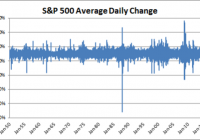
Study after study has shown that retail investors and professional money managers just aren’t very good at investing. And the primary cause of this poor performance is being overly active and incurring lots of unnecessary taxes and fees. The pros can’t control themselves because they have to impress their clients by trying to look active and “beat the market.” And the retail investor is prone to be short term because they know their financial lives are a series of short-term financial events in a long-term life. But an interesting thing appears to be occurring over the course of the last 65 years. Despite a preponderance of information and market access, we seem to be getting no better at investing AND the markets seem to be getting more volatile. If we look at the average daily change in the S&P 500, we can see a slight shift in the variance of the data over time: That’s not very clear, though. If we rearrange that chart, we can construct the average annualized standard deviation of the daily returns: This chart clearly shows that stock market volatility has increased over the last 65 years. There is almost certainly a multitude of causes here, but I don’t think it’s a coincidence that the 1980s and the era of new technology and market access has coincided with the explosion in higher volatility since then. This makes me wonder about two things: What does this say about information theory, economic theory and financial theory? What does this tell us about the current era of investing? What does this say about information theory, economic theory and financial theory? One would think that more information would make the markets behave more “efficiently.” And while we know that professional investors don’t beat the market consistently, we also know that the average holding time on stocks has cratered over the last 70 years, which means that investors, in the aggregate, are paying more in taxes and fees than they previously did. In fact, the average holding period is now consistent with a short-term capital gains rate which means the business of active investing has become a lucrative business for Uncle Sam! This means, by definition, that the post-fee and post-tax return on the aggregate of publicly-held stocks has to be lower than it was in 1940. This would seem to imply that easier access to markets and information has actually made us worse at investing. More information isn’t making us more rational or more efficient. It’s fueling our behavioral biases and short-term tendencies. Access to trading accounts combined with the 24-hour news cycle has become a behavioral nightmare for investors. And yet the vast majority of investors think that all of this information is making them smarter when the data shows that they’re not nearly as financially competent as they think. Contributing to this is all the new technologies. This includes discount brokerage firms, high-frequency trading, leveraged index funds, robo advisors, free trading applications, etc. All of these businesses feed off of our “get rich quick” mentality and/or give us access to markets in an unprecedented manner which fuels our behavioral biases in any number of ways. Further, investors haven’t been compensated for this added volatility. The average 3-year return on the S&P 500 is only marginally higher in the last 25 years than it is over the last 65 years. This shows how futile the idea of “risk” as “standard deviation” really is. In other words, the textbook model of the financial markets hasn’t at all reflected what one might have expected where more information makes markets more efficient, and more volatility compensates investors for what is considered more risk. Basically, modern financial theory doesn’t tell us much about modern financial reality. What Does This Tell us About the Modern Era of Investing? Nothing good. I’ve talked about the difficulty of managing time in one’s portfolio . This intertemporal conundrum is, by a wide margin, the most difficult concept to master in portfolio management. This is the problem of time in an investor’s portfolio. While we know we should be long term, we are inclined to be short term for any number of reasons. Threading that needle and finding the timeframe that makes the most sense for you is incredibly difficult. I’d venture to guess that investors in the 40s probably weren’t far off with their 7-year period. Sadly, what I seem to be finding is that more and more investors are veering in the direction of being ultra short term, hoping to make the quick risk-free buck. And in doing so, they’re falling victim to all of the behavioral biases that are driving this extremely short-term view which necessarily leads to poor performance.
Contrarians Buying Up XLE

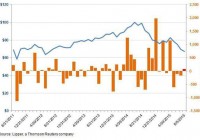
By Jeff Tjornehoj From the start of 2015 to roughly the beginning of May, crude oil prices bounced between $50 and $60 per barrel. But with mounting concerns over China’s slowdown as well as the potential for Iranian crude to hit the market post-sanctions, prices have been in freefall and by August 6 they pierced the $45/bbl support level. But a funny thing has been seen in fund flows data for the oil industry proxy, the Energy Select Sector SPDR ETF (NYSEARCA: XLE ) : flows have picked up. Way up. (click to enlarge) With a year-to-date return of negative 23.4% through August 6, one might have thought investors would flee the equity energy sector’s largest ($11.4 billion) exchange-traded fund, but instead it’s become a contrarian’s playground. Consider this: the 35 months before XLE’s peak price in June 2014 saw cumulative net inflows of just $69 million – barely anything for a fund of this size. But since June 2014, when the price of XLE hit its all-time high of just over $101/share, net inflows have totaled nearly $3.1 billion. For the recent flows week ended August 5, another $74 million was added (red column in chart), despite XLE touching its lowest price in three years. Share this article with a colleague

On Reflection – What Would Happen If A Market Gave Investors More Time To Pause For Thought?

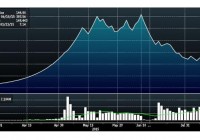
By Kevin Murphy The extreme price volatility experienced of late by the Chinese market has led to the introduction of a variety of measures, including the suspension of trading in numerous companies that we highlighted in Crash course and Key take-away . Almost everything we have read on the subject has painted this kind of market manipulation as an unequivocally bad thing but might there not be a contrarian view? Of course there might and, as instinctive contrarians, here on The Value Perspective, we are happy to offer it. So, would a market where investors are not being quoted stock prices every millisecond really be such a bad thing? To test that idea, let’s imagine a parallel universe where stock quotes happen, say, once a week and see if there are any investment lessons we might take from that. Much of the extraordinary rise seen in China’s markets was driven by what is known in some quarters as ‘momentum’ and in others, less politely, as ‘greater fool theory’ – the idea that, no matter how high a price you pay for a stock, there will always be someone out there with one or two fewer IQ points, who will be prepared to take it off your hands. This does not, of course, always prove to be so. For a very recent example, take a look at the following chart, which shows the trading volumes and price journey of shares in the audio and video entertainment business Baofeng Beijing Technology – the Chinese YouTube, so to speak – after it floated in March. You can see that trading volumes only really picked up after the share price had risen exponentially. (click to enlarge) Source: Bloomberg August 2015 What that suggests – aside from that plenty of people will be out of the money after Baofeng’s recent falls – is that investors can often focus on a stock more because of its price journey than anything that underpins it fundamentally. As such, those investors who thought it a good idea to buy Baofeng at 380x its prospective earnings would have needed to find themselves a particularly sizable fool. So the first investment lesson we might take from our parallel universe and its markedly less frenetic stock market is that, once the constant opportunity to sell on shares is removed, investors have to think a little harder about business fundamentals. Their ability – or, perhaps more accurately, their belief that they will be able – to find a greater fool will have been significantly reduced. A second investment lesson relates to time horizons, which, as regular visitors to will know, we think about a lot on The Value Perspective. Warren Buffett once observed: “I never attempt to make money on the stock market. I buy on the assumption that they could close the market the next day and not reopen it for five years.” As it happens, five years is also the average length of time we own a share. Our focus on business valuation and the margin of safety that it offers means that, here on The Value Perspective, we would not to be too concerned about having to operate in a market that did not quote prices every second of every day – though we of course acknowledge our investors always feel happier knowing they can access their money when they wish. So does this all mean we yearn to operate in that parallel universe and its more considered stock market, where one might expect to see a much greater focus from investors on business fundamentals and longer time horizons? Absolutely not. That would see a lot more people encroaching on our investment turf. As contrarians, we are – this time – perfectly happy with the status quo.