Tag Archives: author

It’s Better With Beta

The title of Larry Swedroe’s latest book, The Incredible Shrinking Alpha, raises a question: what happened to the idea that skilled managers can consistently beat the market? In a recent interview with Swedroe, we discussed the idea that this ability hasn’t really disappeared: it’s just that “alpha has become beta.” What exactly does that mean? In investing jargon, alpha is the name given to the excess return a fund manager achieves through skill. Beta , on the other hand, refers to the returns available to anyone who is willing to accept a known risk. When Swedroe says “alpha has become beta,” he simply means that anyone who understands how to structure a portfolio can increase their expected returns by simply changing their exposure to specific types of risk, known as “factors.” A factor is a characteristic of a stock that affects its expected return and risk. Factor investing (sometimes marketed as “smart beta”) means identifying which of these characteristics might predict higher returns in the future-even if it also brings more risk-and then building a diversified portfolio that captures those returns in a systematic way, without resorting to picking individual stocks. And then there were three As I’ve written about before , the so-called Fama-French Three Factor Model was a revolution in investing. In a landmark 1993 paper , Eugene Fama and Kenneth French argued that the vast majority of a stock portfolio’s returns could be explained not by the manager’s genius, but by its exposure to beta (market risk), small-cap stocks (which are expected to outperform large caps over time) and value stocks (companies with low prices relative to fundamentals such as book value, dividends and earnings, which tend to outperform growth stocks). But it didn’t end there. Later in the 1990s, a fourth factor was identified: momentum , or the tendency for stocks that have recently performed well (or poorly) to continue in the same direction. In the last few years, researchers have identified several more. First was the profitability factor : companies with a high ratio of gross profits to assets tend to outperform, even though these are generally growth stocks, not value stocks. That was followed by the investment factor , which is based on the counterintuitive idea that capital expenditures on new acquisitions and ventures usually fail, and therefore lead to lower stock returns in the future. The factor zoo If you this all sounds overly complicated, you’re not alone in that opinion. One finance professor famously described the “zoo of new factors” now in the academic literature. “Something like 300 factors have been identified,” Swedroe says. “Because there is a big premium on being published, you want to be the professor who finds a factor: then you can go and get a job on Wall Street.” One commentator reported that “some quant shops now use an 81-factor model to build equity portfolios.” The good news, says Swedroe, is that no one needs anything close to an 81-factor portfolio. “The thing to understand is that some of these factors are really just manifestations of some other factor,” Swedroe says. In a new paper , Fama and French acknowledge that once you consider beta, size, value, profitability and investment, none of the other factors have any meaningful explanatory power. (This idea is discussed in the final appendix to The Incredible Shrinking Alpha .) Five is enough In our interview, Swedroe used an analogy to explain why simple portfolios get you most of the way there. “Say you’re taking a drive across Canada, and it’s 3,000 miles. And let’s say that during each leg of your journey you drive halfway. So the first leg you drive 1,500 miles, and the next leg you drive 750 miles, and so on.” You make progress every day, but each successive leg of the journey has less of an impact. “It’s the same thing with a portfolio: if you add bonds to a stock portfolio, that’s a big move. Then you add international stocks, and that’s a pretty big move too, though not as big as adding bonds. Then you start adding small-cap and value. Once you’re at that eighth or ninth asset class, yes, you will pick up something, but you’re already most of the way there. So we want to focus on the factors that really matter the most: the ones with the big premiums, as well as the ones that help diversify. And I think the literature is pretty clear now that we’ve got these five.” Swedroe also points out that more factors may mean fewer stocks. “If you keep adding screens, what happens is you get a less and less diversified portfolio. You could start out with a small-cap portfolio that is 2,500 stocks, and then you make it small-value and you’re down to 1,500. Add another screen and you’re down to 700. At some point you don’t have enough of a diversified portfolio. So you have to make decisions about how to do this.” One decision might just be to stick to a plain-vanilla Couch Potato strategy. In fact, if you’re a DIY investor you probably should . Factor investing may be able to increase your returns slightly over the long term, but only if you have the expertise to manage a more complicated portfolio. Consider it the icing, not the cake itself .
Consider MLPX For Distribution Growth And Total Return

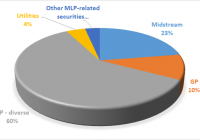
Summary GPs generally exhibit lower yields than MLPs, but can provide higher distribution growth and total return rates. The Global X MLP & Energy Infrastructure ETF is a fund that contains a high proportion of GP or GP-holding companies. This article analyzes the composition and distribution growth profile for this ETF. Introduction The general partners (GP) vs. master limited partnerships (MLPs) question has been addressed recently on Seeking Alpha. In an Oct. 2014 article entitled ” Look At The MLP GP Companies For An Alternate Path To High Total Returns “, author Tim Plaehn explains: The pure-play MLP general partner companies offer a different way to participate in the results of the partnerships they sponsor and manage. The GP companies leverage the growth rates of the LP distributions, providing more of a total return investment potential based on high distribution or dividend growth rates. A similar conclusion was reached by Seeking Alpha author Harry Domash ” General Partners Outperform Their MLPs ” (Aug. 2014). Investors who are uncomfortable with picking individual stocks may prefer owning a basket of funds. Are there any exchange-traded products that own only GPs? The answer is no, but there is a fund that comes close: the Global X MLP & Energy Infrastructure ETF (NYSEARCA: MLPX ). Fund details MLPX appears to be a little-known fund, with only 161 followers on Seeking Alpha. Pertinent fund details are shown in the table below (data from Morningstar ): MLPX Yield (ttm) 3.17% Expense ratio 0.45% Inception Aug. 2013 Assets $106M Avg Vol. 103K No. holdings 40 Avg. Cap $15.2B Annual turnover 29% Morningstar rating NR Composition The 40 constituents of MLPX are given in the table below. Also shown is the % assets, ttm yield, market cap and type of each constituent . The % assets are obtained from the fund’s website while the ttm yield and market cap are obtained from Morningstar. In categorizing the type of company, I have used the classification types in the CBRE Clarion Securities MLP Master List website, which considers these following MLP or MLP-related classes: [i] traditionally structured midstream MLPs, [ii] upstream MLPs, [iii] traditionally structured other MLPs (“other”), [iv] variable distribution MLPs (“variable”), [v] MLP GP holding companies (“GP”), [vi] other publicly-traded companies that own GP interest in an MLP, but the GP stake is not their only asset (“GP – diverse”), and [vii] other MLP-related securities. Name Ticker Assets / % Yield / % Cap / B Type MARATHON PETROLEUM CORP (NYSE: MPC ) 10.17 1.79 30.2 GP – diverse WILLIAMS COS INC (NYSE: WMB ) 9.97 4.50 38.3 GP – diverse ENBRIDGE INC (NYSE: ENB ) 8.83 3.29 36.7 GP – diverse TRANSCANADA CORP (NYSE: TRP ) 8.68 4.43 26.3 GP – diverse CHENIERE ENERGY INC (NYSEMKT: LNG ) 6.95 0.00 16.0 GP – diverse SPECTRA ENERGY CORP (NYSE: SE ) 6.76 4.81 20.7 GP – diverse EQT CORP (NYSE: EQT ) 4.44 0.15 12.0 GP – diverse ONE GAS INC (NYSE: OGS ) 4.34 2.66 2.3 Utilities ENTERPRISE PRODUCTS PARTN (NYSE: EPD ) 4.30 5.23 57.1 Midstream ONEOK INC (NYSE: OKE ) 4.18 6.37 7.9 GP TARGA RESOURCES CORP (NYSE: TRGP ) 4.05 4.12 4.4 GP SEMGROUP CORP-CLASS A (NYSE: SEMG ) 3.78 2.21 2.6 GP – diverse ENBRIDGE ENERGY MANAGEMENT (NYSE: EEQ ) 3.37 0.00 2.0 Other MLP-related securities MAGELLAN MIDSTREAM PARTNERS (NYSE: MMP ) 2.34 4.02 16.0 Midstream PLAINS ALL AMER PIPELINE (NYSE: PAA ) 2.12 7.38 14.6 Midstream ENLINK MIDSTREAM LLC (NYSE: ENLC ) 2.00 3.73 4.2 GP ENERGY TRANSFER PARTNERS (NYSE: ETP ) 1.94 2.10 25.3 Midstream WILLIAMS PARTNERS LP (NYSE: WPZ ) 1.53 7.44 25.3 Midstream MARKWEST ENERGY PARTNERS (NYSE: MWE ) 1.52 6.57 11.0 Midstream BUCKEYE PARTNERS LP (NYSE: BPL ) 1.33 4.47 9.1 Midstream TARGA RESOURCES PARTNERS (NYSE: NGLS ) 0.80 9.96 6.0 Midstream ONEOK PARTNERS LP (NYSE: OKS ) 0.78 9.96 8.6 Midstream WESTERN GAS PARTNERS LP (NYSE: WES ) 0.67 4.80 8.3 Midstream EQT MIDSTREAM PARTNERS LP (NYSE: EQM ) 0.57 2.99 5.6 Midstream NUSTAR ENERGY LP (NYSE: NS ) 0.56 8.38 4.1 Midstream GENESIS ENERGY L.P. (NYSE: GEL ) 0.52 5.53 4.8 Midstream DCP MIDSTREAM PARTNERS LP (NYSE: DPM ) 0.40 10.34 3.5 Midstream SPECTRA ENERGY PARTNERS L (NYSE: SEP ) 0.40 4.65 15.3 Midstream TESORO LOGISTICS LP (NYSE: TLLP ) 0.39 5.17 4.6 Midstream TC PIPELINES LP (NYSE: TCP ) 0.37 5.93 3.7 Midstream SHELL MIDSTREAM PARTNERS (NYSE: SHLX ) 0.31 1.19 5.3 Midstream ENLINK MIDSTREAM PARTNERS (NYSE: ENLK ) 0.29 7.86 6.3 Midstream BOARDWALK PIPELINE PARTNERS (NYSE: BWP ) 0.25 2.84 3.5 Midstream TALLGRASS ENERGY PARTNERS (NYSE: TEP ) 0.22 4.25 2.8 Midstream CRESTWOOD MIDSTREAM PARTNERS (NYSE: CMLP ) 0.20 16.99 1.8 Midstream PHILLIPS 66 PARTNERS LP (NYSE: PSXP ) 0.18 2.50 4.6 Midstream MPLX LP (NYSE: MPLX ) 0.16 3.21 3.8 Midstream HOLLY ENERGY PARTNERS LP (NYSE: HEP ) 0.15 7.33 1.7 Midstream ANTERO MIDSTREAM PARTNERS (NYSE: AM ) 0.15 2.02 3.5 Midstream ENABLE MIDSTREAM PARTNERS (NYSE: ENBL ) 0.06 7.63 6.8 Midstream The allocations of MLPX are depicted in the chart below: As can be seen in the chart above, the majority (60%) of the assets of MLPX are in “GP – diverse” companies, which according to CBRE Clarion Securities are “other publicly-traded companies that own GP interest in an MLP, but the GP stake is not their only asset”. The top 7 holdings of MLPX, namely MPC, WMB, ENB, TRP, LNG, SE and EQT are all classified as “GP – diverse” companies. MLPX also holds a number (10%) of “pure” GP companies such as OKE, TRGP and ENLC, which are classified by CBRE as “companies whose primary assets are G.P. and L.P. interests in their subsidiary MLP.” Consequently, MLPX can be considered to consist of 70% of companies whose GP/LP stake in their subsidiary MLP is either their primary asset or part of their assets. Distribution growth In the past twelve months, MLPX has distributed a total of 51.9 cents. In the twelve months before that, MLPX distributed 38.9 cents. This represents a whopping 33.5% year-on-year distribution growth, on a current 3.17% yield. There is no further dividend history as MLPX has only existed for two years. However, as MLPX is an ETF, it has the ability to control the amount of distributions that it makes, including the capability of providing return-of-capital distributions. Thus, the year-on-year distribution growth of the constituents of MLPX were analyzed in order to determine whether this 33.5% dividend growth was reflective of the distribution growth of the underlying holdings. To calculate this, the recent 24-month dividend history for the 40 constituents of MLPX were extracted from Nasdaq.com , and their year-on-year distribution growth was calculated. The following chart shows the year-on-year distribution growth for the constituents of MLPX. Note that some companies are missing because they either (i) do not pay a dividend (e.g. LNG) or (ii) have less than 2 years of operating history (e.g. SHLX, OGS). As can be seen from the chart above, the year-on-year distribution growth for most of the companies in MLPX is quite robust (with the notable exception of BWP). However, each constituent of MLPX has a different weighting in the index, and therefore a different contribution of distribution growth. I therefore calculated the weighted average of the year-on-year distribution growth of these companies, and the answer came out to 15.6% . I believe that this number (as opposed to 33.5%) better reflects the distribution growth profile for MLPX going forward, if the year-on-year distribution growth for the constituents remains constant. However, considering the current state of oil prices, this may or may not be a true assumption. Performance The following graph shows the total return performance of MLPX versus the ALPS Alerian MLP ETF (NYSEARCA: AMLP ) and the JPMorgan Alerian MLP Index ETN (NYSEARCA: AMJ ) since the inception of MLPX two years ago. MLPX Total Return Price data by YCharts The graph above shows that MLPX, which consists largely of GP-holding companies, handily outperformed AMLP and AMJ, which are funds that hold only midstream MLPs. This reinforces the conclusions offered by Tim Plaehn and Harry Domash presented above. Tax implications I am not a tax expert, so please take the following discussion with a grain of salt. According to Global X , MLPX operates as a Regulated Investment Company (RIC) rather than a C-Corporation. This is because MLPX contains less than 25% of MLPs (the current allocation is 23%). In doing so, it avoids issues common in other MLP ETFs, such as corporate taxes and K-1s, and it is also IRA and 401(k) eligible. The following table is from Global X: (click to enlarge) Conclusion MLPX is a little-followed ETF whose constituents are mostly either GP or GP-holding companies. It contains less than 25% MLPs, which allows it to operate as an RIC rather than as a C-Corporation. While its current yield of 3.17% is lower than either AMLP (7.54%) or AMJ (6.08%), its actual (33.5%) and projected (15.6%) year-on-year distribution growth rates are much higher than those for AMLP (5.5%) or AMJ (2.1%). Moreover, its expense ratio is only 0.45%, compared to 0.85% for the other two funds. Finally, its total return performance since inception two years ago has significantly outpaced those of AMLP and AMJ. Hence, MLPX may be a good choice for investors seeking the total return and distribution growth of GP companies, but who are uncomfortable with picking individual stocks. Besides general equity risk, the main risk of this fund is that its constituents are highly sensitive to commodity prices, and should these continue to fall, it is likely that the share prices of the funds will fall further. Moreover, the distribution growth going forward may also be reduced from historical levels. Disclosure: I am/we are long MLPX. (More…) I wrote this article myself, and it expresses my own opinions. I am not receiving compensation for it (other than from Seeking Alpha). I have no business relationship with any company whose stock is mentioned in this article.

USO: A New Way To Think About Your Oil Investments

The surprising plummet in petroleum prices over the past 12 months has caught a lot of people off-guard, and has presented a variety of consequence. For investors, It has created downward pressure on most, but not all petroleum-related equities. For many Americans with less of a vested interest in the matter, the drop has meant a quasi-tax-cut, with a gallon of gas falling from $4-$5 a gallon to something a bit more tolerable. Those employed by the industry may be fearing for their position or may have already been told they are out of work. Foreign economies dependent on oil exporting are vulnerable to economic collapse. The integrated oil giants such as Chevron (NYSE: CVX ), Exxon (NYSE: XOM ), and BP (NYSE: BP ) tend to be core holdings in many long-term portfolios. While perpetual optimists – sometimes referred to as “perma-bulls,” seem steadfast in the view that oil prices will “come back,” I would caution against that assumption. “Forever” investors – those that buy and generally never sell a stock – have no choice but to think in optimistic terms since they, either voluntarily or involuntarily, lock themselves into ownership. The fact of the matter is we don’t know that oil will “come back.” We may never see $100 a barrel oil again in our lifetimes. Near-term we are swimming in a veritable glut of the stuff. Supply imbalance combined with bullish speculator abandonment of petroleum, has created, as is typically in today’s fluid financial markets, a frenzy of attention. OPEC has not helped those looking for a price reprieve and seems keen on keeping production level, and prices low. The price of the United States Oil Fund LP ETF (NYSEARCA: USO ) has fallen 28 percent in six months. Whether you think the price action is justified or not should not be a huge consideration, although a forward thesis can help you keep focus on how your approach energy investment. As an investor you must learn to cope with varying situations. To assume you know what the price of oil will do in the coming months, years, or decades, is foolhardy. Uncertainty of financial markets is why diversification, amongst asset type, sectors, stocks, and investment style is such a strong risk management tool. For some investors, adding to these kinds of stocks may make sense here, for others, taking their lumps and decreasing net exposure to oil may be the proper move. Opportunistic investors should avoid obsession over the decline in oil stocks , instead focusing in on industries that might benefit from prolonged cheap oil. Instead of adding to a position in Exxon, which is being pressured, how about investing in airlines – an industry where fuel is a significant expense. How about cruise lines – again, an industry that sees fuel as a significant input and where tame pricing leads direct to the bottom line. Automakers stand to benefit the longer oil prices stay low . With more disposable income in their pocket, consumers may opt for bigger gas guzzlers that means higher margins for auto companies. How about trucking companies? Get out of the box and start thinking where profits may be soaring. While Exxon has dropped 25% the past year, Southwest Airlines (NYSE: LUV ) has risen 25 percent. That disparity could continue. Don’t short USO, when there’s safer plays that could be just as rewarding out there against an oil collapse. There are certainly other areas in the market where waiting around for something to happen has not been the wisest of bets. For years there have been those thinking that the bond market has been in a bubble. Most of these investors have sat on the sidelines, most likely in cash, waiting for a massive rise in interest rates that has yet to materialize. It may never materialize . As I write this, the 10-Year Treasury sits at 2.15% after briefly brushing up against 2.5 percent. While even I have cautioned against getting too slap happy with long-term bonds – those with bond exposure have earned their coupons without issue, while those who’ve sat in cash have suffered tremendous opportunity cost. Even if the Fed moves to tighten this year, which is starting to seem rather likely, it’s possible that long rates continue their dovish pattern. Who benefits from low rates? Highly levered companies with solid business models that can obtain low cost capital. Again, instead of focusing on when rates will rise, take advantage of what is, and has been, on the table for quite some time now. Might that end tomorrow,? Perhaps. But don’t invest like you absolutely know how things will shake out. Hedge yourself and manage risk. Indeed, leveraging an entire portfolio to one idea can pose disastrous risk. The investor less exposed to energy over the past year or leveraged to ideas premised on falling oil prices (airlines, cruise lines) has made out like a bandit. Your great-grandfather who has pledged absolutely allegiance to oil stocks, not so much. Instead of guessing when things might happen or sitting on an industry or idea that has obvious headwinds, learn to embrace what the economy and financial markets afford you. It’s one thing to be optimistic. It’s another thing to pretend you know more than you really do. Disclaimer: The above should not be considered or construed as individualized or specific investment advice. Do your own research and consult a professional, if necessary, before making investment decisions. Adam Aloisi was long shares of Southwest Airlines, Norwegian Cruise Line, Exxon, and General Motors at time of writing, but positions can change at any time. Link to the original post here