Tag Archives: author

Source Capital: Not The Time To Buy In An Up And Down Year

SOR is struggling so far in 2015. But it’s been an up and down year when comparing the first and second quarters. And the narrower than average discount suggests now isn’t the time to jump aboard. Source Capital (NYSE: SOR ) is an old hand in the closed-end fund, or CEF, space, having been in business since 1968 . It’s long used a focused portfolio to opportunistically invest in small- and mid-cap companies with high returns on equity. That’s great, but a narrower discount than normal of late suggests new investors would be better off waiting here. Here’s what’s been going on. What a difference a quarter makes According to SOR , its net asset value return was 3.1% in the first quarter. That was below its Russell 2500 benchmark, which was up over 5%, but well ahead of the S&P 500, which was up less than 1% in the first quarter. So it’s no surprise that investors would be generally pleased with the closed-end fund, or CEF. Indeed, during the first quarter, the market price of the shares went up along with the NAV. However, something changed in the second quarter. SOR’s NAV fell 2%, worse than the 0.3% or so loss for the Russell 2500 and the around 0.3% gain in the S&P. But while the NAV has been falling, investors haven’t reacted by selling the shares. In fact, they’ve pretty much been holding the line. With that backdrop, SOR’s discount, which has recently been averaging around 9% but has a three-year average of about 10%, has narrowed. The discount is recently hovering around 7% or so-roughly in line with its 10-year average according to the Closed-End Fund Association . Long-term investors should probably tread carefully here since the shares are clearly not on sale. Those looking to play discounts and premiums, meanwhile, should also be on the sidelines. What’s been going wrong? Obviously losing positions outweighed winners in the second quarter . More specifically, retailers Signet Jewelers (NYSE: SIG ) and CarMax (NYSE: KMX ) have been sagging and that’s a big problem. These two are the second and third largest holdings in the fund, making up about 15% of assets. CarMax is down nearly 6% this year and Signet over 8%. With a concentrated portfolio, big bets are the norm. And that’s something that investors in SOR need to fully understand. For example O’Reilly Automotive (NASDAQ: ORLY ), a winner for the fund so far this year, makes up nearly 15% of assets. Taking that a step further, the top three holdings make up about 30% of the fund. For reference, the top 10 holdings account for around 60% of the fund. So you can see the impact O’Reilly, Signet, and CarMax will have on performance. With two of the three struggling, it’s no surprise that SOR’s NAV is only slightly ahead of where it started the year. Adding to the negatives, at the start of the second quarter two other struggling companies were in the top 10, Knight Transportation (NYSE: KNX ) and Heartland Express (NASDAQ: HTLD ). Only Knight remained a top 10 holding at the end of the second quarter at roughly 4% of assets. Knight is down around 18% so far this year and Heartland, the tenth largest holding at the end of the first quarter, is down about 20%-no wonder it fell out of the top 10 by the end of the second quarter. Once again, however, you can see that the focused approach comes with risks. And with the fund’s discount narrower than its recent history, now isn’t the time to jump aboard. That said, over time, SOR has rewarded investors for taking on added risks, so don’t write the fund off entirely. For example, over the trailing 15-year period through June, the fund’s annualized total return, which includes reinvested distributions, is nearly 11%. That’s ahead of its benchmark Russell 2500 by about two percentage points a year. And it’s over twice the annualized return of the S&P over the same span. So being selective and betting heavily on management’s best ideas has paid off over time. Just not in the second quarter… Keep it on your watch list If you are looking for a small and mid cap closed-end fund, SOR is one that should be on your watch list. Its expense ratio is around 0.8%, which is very reasonable for a CEF. Yes, that’s notably higher than straight index ETFs, but ETFs in the same space don’t usually have the same distribution history. For example, SOR’s yield is currently around 4.5%. The WisdomTree U.S. SmallCap Dividend Growth ETF (NASDAQ: DGRS ), meanwhile , has an expense ratio of around 0.4%, but yields about half as much even though it’s focused on dividend paying stocks. That said, capital gains account for almost the entire disbursement at SOR, so distributions will fluctuate over time and probably fall in difficult markets. Thus, this is more of a total return play than an income play. That doesn’t mean distribution focused investors should avoid SOR, just that this is an important fact to keep in mind when buying it. In the end, it was a tough second quarter and middling first six months for SOR. That doesn’t make it a bad fund, but it does highlight the risks inherent in the fund’s focused approach. Long-term investors should keep the fund in mind, but don’t bother jumping aboard now because the discount is slimmer than it has been in recent years. Disclosure: I/we have no positions in any stocks mentioned, and no plans to initiate any positions within the next 72 hours. (More…) I wrote this article myself, and it expresses my own opinions. I am not receiving compensation for it (other than from Seeking Alpha). I have no business relationship with any company whose stock is mentioned in this article.
Oxford Lane Capital Has ‘Got Some Splainin’ To Do’

OXLC’s decision to stretch its normal 12 month dividend over 13 months this time around has shareholders scratching their heads. Rule No. 1 of corporate communications: Always get out in front with the explanation instead of leaving the public to guess. Breaking that rule merely invites people to make up their own explanations — usually far worse than the reality. The bigger question begging for an answer: Does the drop in NAV reflect taxable income better than GAAP accrued income because of GOOD things, like better credit experience… … Or does it reflect BAD stuff, like failing to sell or dissolve CLO investments before they start returning principal? As I Love Lucy ‘s Ricky Ricardo often said to his wife Lucy, “Honey, you got some splainin’ to do,” so might Oxford Lane Capital (NASDAQ: OXLC ) shareholders expect some explanation from the fund’s management after it quietly announced its quarterly dividend “stretch” earlier this month. With a history of paying dividends at the end of March, June, September and December, the company announced August 10th that its next dividend would be paid October 30, four months after its last dividend on June 30 (to holders of record September 30.) “Not a big deal,” some investors might say, essentially stretching a typical year’s dividend to cover 13 months instead of 12. But a dividend cut is a dividend cut, however it is served up and described, and certainly worthy of some explanation. That’s especially true inasmuch as “Good Corporate Communications Rule No. 1” is Always get out front and explain what you’re doing instead of leaving shareholders to guess . Especially because, in most cases, they will guess something even worse than the real reason. Let’s hope that is the case here, and that there is some reasonable explanation. Beyond that, there are other things OXLC’s management needs to do a better job explaining. (The upcoming stockholders’ meeting on September 9 would be one good venue, although I hope they put something out before then.) They essentially revolve around educating their shareholders and the market to what their “income” really consists of, and what the difference between GAAP income and taxable/distributable income actually is and how it affects the fund’s NAV over time. This latter point is a really big deal and will determine whether or not OXLC and other funds, BDCs, etc. that hold CLO equity are to be regarded by the market as “wasting assets” like royalty trusts, whose payouts slowly but permanently eat up their capital to the point where they finally make the last distribution and there is then nothing left. I am not suggesting CLOs are wasting assets , but there is enough confusion about the subject that I can understand other people coming to that conclusion. Here is how I understand the situation (and readers should take this, and everything I write, with a grain of salt because I am far from an expert): I have recently come to understand that many CLO equity owners are taxed on the entire cash flow they receive from their CLOs (including principal repayments) as though it is all income. Meanwhile, on a GAAP basis, they only include some of that cash flow as income, excluding from income principal plus other accrued and/or projected expenses, like credit losses, losses due to interest rate adjustments, etc. This means that taxable income (which is used to determine distributable income for paying dividends to shareholders) will often be higher than the GAAP income, for two primary reasons (one reason good, the other bad). The good reason : If the fund has been prudently accruing for credit losses at say, 1.5% per annum, and in fact credit experience is so good that the actual losses are only 0.5% per annum, then 1% more cash flow will be received than was actually expected. GAAP income will assume 1.5% was lost in credit losses, but in fact that extra 1% that wasn’t lost will show up as additional cash flow available to pay dividends. If the CLOs’ equity (which is what OXLC owns) is typically leveraged 9 or 10 to 1 then that extra 1% on the CLOs’ portfolios will show up as 9 or 10% in extra margin for their equity. So there will be a considerable difference between reported GAAP income and the actual taxable/distributable income from this factor alone. In the short term, the fund’s accountants will assume that the 1.5% credit loss will hit eventually and will maintain the accrual at 1.5%, even though the loss suffered was only 0.5%. If the difference is paid out as a distribution, from a GAAP perspective that difference will represent an “unfunded” portion of the dividend, and will therefore be deducted from the NAV as a return of capital. Later on, if that CLO terminates or is sold without having ever suffered the credit loss that was accrued for, that unnecessary accrual should return as some sort of an adjustment or capital gain, with a corresponding adjustment upwards of the NAV. That, I believe would be the impact on OXLC’s NAV of accruing expenses (for credit or anything else) that are eventually not taken and therefore reversed. The bad reason: If the fund actually receives principal repayments that it is taxed on and treats as distributable income, that is money out the door never to return (i.e. a true return of capital), and would be just like a real “bricks-and-mortar” bank (a CLO is a virtual bank) using principal repayments from its loan portfolio to fund its dividends. But funds like OXLC aren’t stupid, and I don’t think they want to receive principal back, get taxed on it and have to use it for distributions. After all, it runs down their asset base and would, ultimately, put them out of business. So I believe they make an effort to dispose of their CLO assets – sell them or dissolve the CLO itself if they have a controlling position or can join with other investors for the purpose – before the CLO reaches its wind-down period where the CLO manager can no longer re-invest principal payments in new loans and has to return it as a taxable distribution to equity owners. If my understanding of this is at all correct, then OXLC’s management, if it is doing a good job, should be managing the portfolio in such a way as to ensure that there are very few principal repayments making their way into the distribution stream. That would mean that most of the difference between the GAAP income and the taxable/distribution income is represented by actual differences in the flows of a positive nature, like credit expenses that are less than what was projected for, and which will be reversed back into NAV once those CLOs end, one way or another, with their better-than-projected-for credit records intact. The above is my theory of what might be/could be and, I hope, actually is going on. If that is true, then the NAV drops we are seeing are not necessarily one-way only drops, but represent the GAAP-taxable income factors described above as well as the overall market drop in high yield assets generally. If that’s what it is, then it does not represent an economic deterioration in the ability to earn cash flow and pay dividends indefinitely. If I am wrong, and it were to actually mean that a major portion of the OXLC distribution is made up of principal repayment, then we would have to re-think the asset class and our expectations about it. As I said, I have no reason to think my upbeat interpretation is not the correct one. But it would sure be helpful if the fund’s management were to weigh in with some explanations that would put the matter to rest. It would help us all as shareholders to understand better what we are invested in. It would be in the fund’s interest as well to have investors understand management’s strategy and what the factors are that influence whether they are successful or not in executing it. Disclosure: I am/we are long OXLC. (More…) I wrote this article myself, and it expresses my own opinions. I am not receiving compensation for it (other than from Seeking Alpha). I have no business relationship with any company whose stock is mentioned in this article.

Are Investors Choosing The Right Indices And ETFs?

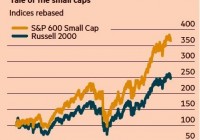
Summary ETFs are financial instruments that add an extra layer of risk that may not be suitable or ideal for all investors. Interestingly, since 2000, the S&P 600 has significantly outperformed it’s counterpart, the Russell 2000. Subconsciously, fund managers may be hurting their returns by stating they are “overweight” or “underweight” a stock, especially if using an easy to beat benchmark. Individual investors can gain an edge on professional fund managers by simply investing in indices and ETFs with a superior long-term track record. It’s conceivable that “brand names” will start to matter, as ETFs and Index Funds become more popular over the next decade. Introduction Warren Buffett has famously stated that Americans are better off investing in a simple index fund like the Vanguard S&P 500 ETF (NYSEARCA: VOO ). Investing in the S&P 500 exposes investors to American businesses and allows them to reap the benefits of an expanding and capitalistic economy. Branching away into different indices and ETFs introduces investors to varying degrees of risk and fall empty handed on the returns advertised. For example, an ETF that is composed of 30 securities is not only priced based on its underlying portfolio of securities, but also in accordance to the supply and demand of the ETF itself. This double jointed structure introduces several liquidity and volatility risks to investors in times of market turbulence and downturns. Furthermore, there are all sorts of differentiated structures that provide for excessive risk in hopes to achieve higher returns. Notably, all levered bull and bear ETFs. These structures introduce another layer of unknowns and risks for investors, with the speculative potential to increase returns. However, an investor is likely to achieve not only a lower risk profile, but higher returns by simply scrutinizing their portfolio with a careful eye– looking for an edge. The Russell 2000 vs The S&P 600 For the conservative investor, a seemingly simple question of investing in an ETF covering the Russell 2000 (like the iShares Russell 2000 ETF ( IWM)) or the S&P 600 (like the SPDR S&P 600 Small Cap ETF ( SLY)) can yield dramatically different results. As reported by the Financial Times on Monday August 17, 2015, the S&P 600 has outperformed its counterpart the Russell 2000 since year 2000–by a significant margin. Specifically, since the beginning of 2000, the S&P 600 would have turned a $100 investment into a little over $360 and a $100 investment in the Russel 2000 would have turned into approximately $250. Image Sourced from Finanical Times Hence, the framework on an underlying index can have a profound influence on an index’s performance, the related ETF’s performance, and an investor’s overall return. The S&P 600 may cover a slimmer portion of the small cap universe, but this may be for good reason. After all, an investor only needs to own 30 stocks to be amply diversified from systemic market risk. According to the Financial Times, the S&P 600 index requires companies to have a record of making profits before it is included in the index. Furthermore, it sets a far higher standard for liquidity (compared to Russell 2000). It’s no wonder then that small-cap investment firms use the Russell 2000 to track their performance against. It’s easier to beat! It’s amazing how two simple rules can create significant long-term value for clients and investors. As such, it appears reasonable to assume that an index’s brand and portfolio construction will have even more of an impact on investors’ decisions going forward. How robot advisors and, to an extent, human advisors, will account for these seemingly minute details remains to be seen. Regardless, a wise and enterprising investor will have an edge. A passive minded investor, with an enterprising spirit, would be able to increase their returns by sacrificing a small amount of time to discover discrepancies such as this-especially long-term investors who have 15+ year time horizons. Index Business Growing In Size and Power Building ETFs based on indexes has become a huge business, with hundreds of billions riding on the skirts of simple structures. The owners of these indexes, whether it’s MSCI (NYSE: MSCI ), FTSE Russell, or the S&P (NYSE: MHFI ) will continue to have more and more power and influence on the financial markets-along with their clients like Vanguard and Blackrock (NYSE: BLK ). Whether or not they use this power wisely is another question, one that I’m not overly optimistic about. Furthermore, transparency can be a double-edged sword. For instance, the Russell 2000 follows very transparent rules by alerting investors in advance which stocks will move in and out on the day each June when the index is reshuffled (making it easier to beat). The S&P 500 Index has discretion to include companies that have a history of recording a profit, maintaining a balance between sectors, and typically only includes new companies when a vacancy is created (often through a merger). Invariably this causes the stock to pop as it is added to the S&P 500 Index, creating agony among fund managers attempting to beat it. Psychology of the Index Behavior psychology (or anything to do with human behavior) continues to have a heavy influence on the performance of fund managers. It’s well-known that investors and fund managers must account for self-bias and over-confidence once they buy a particular security, otherwise their judgment may become impaired and make mistakes. Recently, there has been a change in the way fund managers and analysts talk about their portfolios. For instance, they often speak of being “overweight” or “underweight” a particular stock, rather than stating they “own” a stock. By stating that they are “overweight” or “underweight,” fund manager’s are subconsciously increasing the influence a benchmark index has on their portfolio allocation and investment returns. It’s well known that the majority of actively managed mutual funds fail to beat their benchmarks. Therefore, it stands to reason that individual investors should outperform fund manager’s who chose the Russell 2000 as their benchmark–by simply investing in the S&P 600! While past performances do not guarantee future returns, it’s hard to argue the long-term track-record of the S&P 600 compared to the Russell 2000 over the past 15 years. In essence, investors who look at a stock as a fractional ownership of an underlying business will have both a psychological and fundamental advantage over other investors during a long-term time horizon. Fund managers that state they “own” a stock are still subject to subconscious self-bias and overconfidence; however, it’s likely they would focus more of their time on the fundamentals of the business, rather than the makeup of a particular benchmark. A stock’s total return, after all, is proportional to the company’s long-term operating performance and returns on capital, not because of its weighting in a particular index. Conclusion Just like it’s never wise to ask your barber if you need a haircut, investors shouldn’t accept over-simplified financial products and investments, especially from Wall Street. A little bit of research and passion to find an edge can go a long way. Remember that in a group of 100 investors, only 49 can be better than average-despite everyone’s opinions that they are in the top 20%. Managing your time wisely and performing diligent research has the potential to add a percentage or two to your total returns over your lifetime. In addition, you will incur fewer trading and tax expenses due to mistakes and disappointments. Apply diligent research, patience, and a long-term time horizon to maximize the benefits you receive from the miracles of compound interest. Don’t let sloppy benchmark indices get in your way–invest in the best ones. Disclosure: I/we have no positions in any stocks mentioned, and no plans to initiate any positions within the next 72 hours. (More…) I wrote this article myself, and it expresses my own opinions. I am not receiving compensation for it (other than from Seeking Alpha). I have no business relationship with any company whose stock is mentioned in this article.