Tag Archives: alternative

Tsunami Of Level 1 Indian ADRs Expected In U.S. OTC Markets
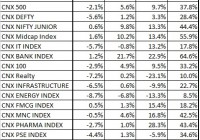
Summary The Indian finance ministry has allowed the issuance of sponsored and unsponsored Level 1 ADRs. DRs can be issued against any underlying permissible security such as equity, corporate debt, mutual funds, ETFs etc. Provides an exciting opportunity for overseas investors to invest in the Indian growth story. What are unsponsored ADRs? There are 4 types of American depository receipts, in increasing order of regulatory requirements: 1. Unsponsored ADRs 2. Sponsored Level 1 ADRs (OTC) 3. Sponsored Level 2 ADRs (listed) 4. Sponsored Level 3 ADRs (offering)… these were the only type of ADRs available for Indian companies. They have the most stringent regulatory requirements Level 1 and Level 2 ADRs have less stringent requirements than Level 3 ADRs, but all of them are sponsored (issued) by the issuer. In contrast, an unsponsored ADR is one in which there is no deposit agreement and no legal relationship between the depository bank and the issuer. There are no regulatory disclosure requirements for the issuer to comply with the Sarbanes-Oxley and no requirement to adhere to US GAAP requirements. In fact, an unsponsored ADR can be issued without the consent of the issuer. These instruments can be traded in the over-the-counter (OTC) markets in the United States. During the Union Budget of July 2014, Arun Jaitley, India’s Finance Minister, had accepted the Sahoo Committee’s recommendation for liberalization in ADR/GDR issues. As per the new Depository Receipts Scheme, a foreign depository bank is permitted to issue unsponsored ADRs for the first time. Since that announcement, BNY Mellon (NYSE: BK ) has confirmed that it has filed with the US SEC to establish several unsponsored depository receipts program from India. The proverbial home bias A US investor is more likely to invest a large proportion of his investments in domestic equities. This is mainly due to their familiarity with local regulations and settlement procedures. Also their investment mandate may force them to invest in only USD-denominated stocks. However, portfolio theory states that there are significant diversification benefits from investing in foreign equities as it lowers systemic risks from domestic factors. The credit crisis of 2007 and the various currency crisis that continue to occur over time shows that contagion spreads during a crisis. And the benefits of international diversification are considerably reduced during times of stress. But aside from these “Black swan events,” investment in foreign equities is likely to provide direct exposure to high-growth companies in emerging markets. What does it mean for investors in the US? Indian bourses have given returns in excess of 30% in the last one year. This has been on the back of positive sentiments arising due to the new business friendly prime minister. Also as per the latest economic indicators, it is likely that the economy is on a recovery path. This could lead to a multi-year bull run, similar to one seen in the US stock markets. In light of these very favorable circumstances, the announcement by the Indian finance minister to liberalize the ADR/GDR norms comes at a very appropriate time. I have listed below the sectoral returns from the Indian markets. A study by BNY Mellon notes that more than 50% of the Tier 2 and Tier 3 institutional investors ($1bn to $10bn in AUM) who wanted to invest in India did it through DRs as they couldn’t invest directly in India equities. These non capital-raising DRs will provide access to investors who can’t establish their Indian operations or who do not want to invest in equity derivatives or ETFs, but want to buy Indian equities in US-dollar denominated form. The Sahoo committee, which had proposed these policies, envisioned that there should be competitive neutrality, where all the economic agents (Indian or foreign investors and Indian or foreign firms) have the full freedom to invest/or issue DRs for permissible securities within the existing capital control regime. This freedom is given as long as the following two conditions are satisfied: 1) the permissible securities (as defined under the Securities Contracts Act), should be in dematerialized form and 2) DRs must be issued only in permissible jurisdictions. This is to make sure that interests of investors are protected and money is not laundered through these channels. Risks Before listing the key takeaways from the article, let’s first look at the risks involved in buying these securities. The biggest risk is if the depository banks are unable to attract sufficient liquidity in these OTC stocks. Volumes in unsponsored ADRs are far less than in sponsored ADRs. Hence the bid/ask spread is quite high. Low liquidity and high spreads make it difficult for investors to quickly enter or exit the stock. Investors who buy into these stocks also carry the risk of a fluctuating Indian rupee. Key Takeaways So here are the key takeaways: Unsponsored or sponsored Level 1 ADRs. DRs can be issued on any permissible security: equity, debt, MFs, ETFs, convertible debt etc. The DR can be issued for a listed or unlisted company. Conversion of DRs into underlying securities and vice versa is not taxable, since there is no change in beneficial ownership. Not regulated under Sarbanes-Oxley Act. No GAAP reconciliation requirement. No end restrictions on funds raised other than imposed under Foreign Exchange Management Act (FEMA). Shareholding under unsponsored ADR will be classified under the FDI cap. Voting rights to be retained by the investors. DRs to be listed on an exchange. Additional sources: IFR India Offshore Financing Roundtable 2014 , Neil Atkinson, BNY Mellon “The Depositary Receipt: Market Review” BNY Mellon, January 2015 CPI probably rose in Jan on base year shift , Reuters February 12, 2015 “Unsponsored ADRs: Evolution and opportunities” – Deutsche Bank Disclosure: The author has no positions in any stocks mentioned, and no plans to initiate any positions within the next 72 hours. (More…) The author wrote this article themselves, and it expresses their own opinions. The author is not receiving compensation for it (other than from Seeking Alpha). The author has no business relationship with any company whose stock is mentioned in this article.
Tap China’s Bond Market With 3 New ETFs

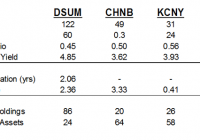
Summary Three new ETFs open up China’s onshore bond market to individual investors. CBON offers a longer duration portfolio and a lower yield due to China’s flat yield curve; CHNB has shorter maturity and higher yield. KCNY has the highest yield and shortest duration of the three new funds, but it still yields less than DSUM, a 3-year-old fund covering the offshore bond market. A small opening in China’s bond market led to a flurry of activity in the ETF world last year, with three Chinese bond ETFs launching in late 2014. These new funds are trying to grab market share from the largest Chinese offshore bond ETF, the PowerShares Chinese Yuan Dim Sum Bond ETF (NYSEARCA: DSUM ), which has faced little competition since its launch in 2011. Dim sum bonds are renminbi-denominated bonds that trade offshore. Issuers are usually Chinese firms, but there are also foreign companies that have issued renminbi bonds, including McDonald’s (NYSE: MCD ). The market for new dim sum bonds has shrunk in 2015 as traders increasingly expect a weaker Chinese yuan. Interest rates on interbank loans using offshore yuan in Hong Kong have tripled from last year while average interest rates on yuan bonds have risen 30 percent. Last year, Chinese government bonds sold at a premium in Hong Kong; this year, they sell at a discount due to investors’ expectations of weaker yuan. Borrowers have been opting for U.S. dollar bonds instead due to lowering borrowing costs. Offshore bond investors are also more wary of Chinese debt given the situation with Chinese developer Kaisa. The firm missed a loan and a bond payment, and recently found a white knight that will rescue it, pending everything goes well. However, the firm still may need to restructure its debt , and offshore bond holders are last in line unable to take the quick legal action available to mainland creditors who have already successfully frozen Kaisa’s assets. The bonds in this case are U.S. dollar denominated, but it highlights the risk for foreign investors who are now demanding higher interest payments. The newer funds, the Global X GF China Bond ETF (NYSEARCA: CHNB ), the KraneShares E Fund China Commercial Paper ETF (NYSEARCA: KCNY ), and the Market Vectors ChinaAMC China Bond ETF (NYSEARCA: CBON ), all offer exposure to onshore bonds traded on mainland exchanges in China. While the funds offer direct access, it comes through partnering with firms that are RQFII (renminbi-qualified foreign institutional investors). Most likely, China will open its markets faster than these funds attract assets, but if not, it’s possible the funds could run into quota limits. All three firms use sub-advisors: GF International, China AMC, and E Fund, as noted in the funds’ names. The Chinese bond market is not completely open to foreign investors yet, and the number of securities available to these funds is limited. All three have more than 50 percent of assets in the top 10 holdings and the number of holdings ranges from 20 to 33, an extremely small number for a bond fund. Here’s more data from the provider websites: DSUM , KCNY , CBON , CHNB . (click to enlarge) Currently, the main risk faced by these bonds is credit risk and depreciation in the Chinese yuan. The Chinese currency is effectively pegged to the U.S. dollar, and official policy is to maintain a stable currency. Nevertheless, each time China’s forex reserves have fallen, the currency has weakened. Chinese reserves peaked in June of last year and pressure on the yuan has been rising as Chinese investors increasingly move capital abroad, thanks in part to reforms that have opened up the financial system. Chinese investors swap yuan for dollars and invest abroad, causing the yuan to drop. They are also swapping yuan for dollars and immediately buying yuan in Hong Kong because the offshore yuan is cheaper. This arbitrage also causes the forex reserves of China to decline. Tight credit conditions in China have pushed yields higher on many forms of debt, as has been seen in the dim sum bond market. The People’s Bank of China (PBOC) might lower interest rates this year to help the slowing Chinese economy, a widely expected move following weaker-than-expected trade data from January. A cut in interest rates would be good news for bond investors hoping for capital gains, but it could also increase the depreciation pressure on the yuan. As for credit risk, all three of the onshore funds hold state-owned and government debt unlikely to default. Conclusion This doesn’t appear to be the best time to buy Chinese debt, but for investors who are long-term bullish on China and the yuan, these are funds to keep an eye on. All three could be winners in the long run as China opens its capital account and the yuan plays a larger role in global finance. Investors who expect a rising or stable yuan in the near term should consider the funds right now since the PBOC might ease as soon as March and these funds could see capital gains as yields decline. For investors interested in liquidity and yield, DSUM is the best choice. It’s diversified, yields nearly 5 percent, and shares are actively traded. For investors who want to bet on a cut in rates, the higher-duration CBON is a better choice. Shares aren’t as heavily traded, so investors need to watch the bid/ask spread and deviation from NAV. From a risk/reward perspective, KCNY appears the best bet as it holds short-term commercial paper. China’s yield curve is flat at the moment, and investors can receive a relatively high yield for such a low-duration portfolio. Disclosure: The author has no positions in any stocks mentioned, and no plans to initiate any positions within the next 72 hours. (More…) The author wrote this article themselves, and it expresses their own opinions. The author is not receiving compensation for it (other than from Seeking Alpha). The author has no business relationship with any company whose stock is mentioned in this article.

Excessive Bullishness Toward Gold Points To A Retreat

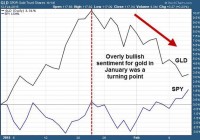
By Ronald Delegge Sentiment extremes, regardless of whether they’re bullish or bearish, invariably point to a readjustment in prices. This undeniable truth applies to all asset classes in all time frames. Nothing is immune to the forces of crowd behavior (see Beanie Babies and Pokemon cards). On Jan.23, 2015 the Wall Street Journal declared “Buyers Take a Shine to Metals Again.” When this headline was published, the SPDR Gold Trust ETF (NYSEARCA: GLD ), which follows the price of gold bullion, had jumped 9.38% against a modest loss of 0.28% for the S&P 500. Since Aug. 2011, gold prices have crashed 28%, so naturally, enthusiasm for a rally – especially among survivalists and Peter Schiff groupies, has been building. The WSJ article correctly observed how the amount of gold owned by exchange-traded products (ETPs) jumped by more than 1.2 million ounces in January, making it the biggest increase since Aug. 2012. Likewise, silver coins sales have been rising. (click to enlarge) Just as bullish enthusiasm for gold was peaking, the Feb. 2015 ETF Profit Strategy Newsletter (released on 1/24/15) alerted readers: Ahead of a potential pullback, we’re buying the ProShares UltraShort Gold (NYSEARCA: GLL ) at $83.75 up to a buy limit of $84.25. GLL aims for double daily opposite performance to gold bullion. Our tandem options trade is to buy the GLD MAR 2015 124 put options (GLD150320P00124000) at $350 up to a buy limit of $375. We bagged a +32% one-week gain on the GLD calls and our GLL position is already +10% higher from where we bought it. Not only did we understand the market dynamic of sentiment extremes, but we took advantage of it. These principles used in conjunction with technicals can be applied in any market, not just metals. The chart above illustrates how capitalizing on short term overly bullish extremes in gold has been great for contrarian traders. The red dotted line coincides with GLD’s yearly top (so far) and is where we executed our bearish gold trade. It also reinforces an age old truth: Do the opposite of the crowd and you’ll always get what they wish they had. Disclosure: No positions Link to the original article on ETFguide.com