Tag Archives: alt-investing

Bearish GLD Trend After Greece Won Its Gamble
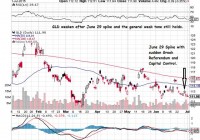
Summary The sudden Greek referendum and capital control gave the impression that events would spiral out of control and GLD spike up. U.S. and China intervened to keep the status quo and even the IMF which was defaulted on by Greece considered debt relief. Even the EU backed away from its demands and prepared to spend $35 billion euros to keep Greece within the EU. Still Greek PM wants a ‘No’ vote to increase negotiation leverage for greater concession. In short, Greece called the EU’s bluff and won the gamble. Financial stability concern had subsided but the world would still flock to USD. Bearish trend for GLD is now in place. The value of gold in our current fiat monetary system would be to serve as a hedge against inflation and financial instability. Inflation remains subtle today and major Centrals Banks only expect inflation to return to the 2% target in the next 2-5 years. Hence there is no reason to purchase gold from an inflation perspective. The financial stability argument is now in vogue with the whole Grexit saga that is playing out in real time. This has been expected after the Syriza government seized power back in January 2015 with the conflicting mandate of overthrowing austerity imposed by its European partners and to stay in the Eurozone at the same time. This is doomed for failure because the internal devaluation (cutting of wages and pensions, etc) would still go against the constraint of the strong euro in Greece’s competitiveness. Hence the Greek economy had shrunk year after year which would increase the debt to GDP ratio and make its debt untenable. Greek Referendum Card Therefore the only way forward would be for the Syriza government to play with the only card they have to force debt relief. That is the card of brinkmanship. It is only when Syriza threaten to burn the Eurozone apart with its default and the threat of leaving the European Union, then would the creditor nations be willing to grant them the much needed debt relief. It is important to understand this whole dynamics because it would in Greece’s interest to keep pushing Europe to the brink of collapse but at the same time maintain its membership in the Eurozone as long as the mandate of the Greek sways towards staying in the Eurozone. The Syriza government had to keep pushing the envelope to scare its creditors and it did a big scare on June 27. Greek Prime Minister Alexis Tsipras called for a sudden referendum on July 5 when the deadline for the EU bailout package on June 30. This worked wonders and was broadcasted worldwide for its sudden and irrational nature. At that point in time, shocked EU finance ministers expressed their angry clearly and closed the negotiations with Greece. On the next working day of June 29, Greece installed capital controls and limited the withdrawals of ATM cash to $60 euros per day. Banks were closed as the ECB refused to increase its emergency lending to deal with the bank run. Ratings agency such as Fitch and Standard and Poor downgraded Greeks banks and sovereign debt respectively. For a while, it would appear that things are rapidly spiraling out of control. I was shocked too and I wrote an article about the irrational nature of the Greek government as seen here . As the SPDR Gold Trust ETF (NYSEARCA: GLD ) chart below would show, gold prices actually spiked up that day as the threat of unconstrained disaster of Grexit appears imminent. The risk was that it would move out of Europe to the wider global economy. USD weakened as it was exchanged for gold. However this extreme extrapolation was a result of shock rather than a comprehensive assessment of the global economy. Foreign Intervention It turned out that the global will to keep the status quo was underestimated. Global leaders such as U.S. President Barack Obama, China’s Premier Li Keqiang and even IMF Christine Lagarde were not willing to rock the boat too hard. On June 30, the New York Times reported that President Obama intervened in the talks to urge creditors to soften their stance and come to a resolution. Obama was concerned over the financial stability concerns as the situation unfolded as described above. The U.S. President had grounds to believe that the unraveling of Europe could easily cause the contagion to spread not only in weaker European countries like Spain and Italy but also to the global economy including the U.S. In addition to the economic damage, there would also be geopolitical damage as Greece is part of NATO which is used to actively counteract the influence of Russia in Europe. This is especially after Russia annexed part of Ukraine in 2014 and this is still an existing concern. Obama was concerned enough for him to dispatch a senior Treasury officer to Europe to follow the status of the talks. For China , they had substantial investments in Greece and want Greece to stay within the EU framework for the safety of their investment. When the new government came into power, they tried to tear apart signed infrastructure contracts which unnerved Beijing. Things would only worsen if Greece were to leave the EU under desperate circumstances. Lastly we have the IMF which was at the losing end of Greece’s struggle with the EU. Greece failed to pay the $1.6 billion euros due on June 30 as the bailout negotiations failed. However the IMF had not taken action against Greece. Instead IMF Managing Director Christine Lagarde is entertaining the option of debt relief in exchange for reforms. Calling The EU Bluff Meanwhile the EU President Jean-Claude Juncker urged the Greeks to vote yes on the July 5 referendum and to stay within the Eurozone. This indicated that the EU would bend over backwards to accommodate the Greeks. In fact, the EU had already backed away from its proposal to rise the Value Added Tax from 13% to 23% and was prepared to give away another $35 billion in bailout. This is despite their doubts over the ability of the current Greek government to implement any reforms as demanded for the creditors. In fact even with these concessions on the table, the Greek PM is still urging his people to vote ‘no’ so that they can have more leverage on the EU for even more concession. The creditors are losing ground step by step with the negotiations with the current Greek government. The recent referendum, flawed as it is, is not used to primarily as a means for the Greek people to express their opinion. It is used as negotiation tool. In short, Tsipras had called the EU’s bluff. Even if the EU was willing to let go of Greece and go against its strong political will to unite the European nations on the frustrations of the creditor nations, international pressure would not allow it to happen so soon after a major recession and with the ongoing Russian aggression. In short, Tsipras took a gamble politically and he won. We can now expect to see more debt relief for Greece even if its record for implementation of reforms are doubted. Tsipras had won and Greece can stay within the Eurozone and not pay its debt. Conclusion The GLD chart below shows the recent impact of the Grexit drama. It spiked on June 29 as pointed out in the chart but it softened shortly after. It is clear that the financial stability concerns had faded and what is left is the rush to safety which would benefit the USD. (click to enlarge) Hence we should continue to sell GLD on any spikes in prices but we should not push it too far as there will be residual demand for gold in case events escalate beyond control suddenly. In other words, there will be a gradual weakening of GLD with periodic strength which should be sold. Disclosure: I/we have no positions in any stocks mentioned, and no plans to initiate any positions within the next 72 hours. (More…) I wrote this article myself, and it expresses my own opinions. I am not receiving compensation for it (other than from Seeking Alpha). I have no business relationship with any company whose stock is mentioned in this article.
ETF Asset Report Of H1: Currency Hedging Tops; U.S. Flops

As we step into the second half of 2015, it might be useful to look at how the $2.16-billion ETF industry performed in the first half of the year. After analyzing, we can conclude that currency-hedged ETFs and developed markets were the star performers in terms of asset gathering, as these saw maximum inflows, while the broader U.S. market was the laggard. Though “Grexit” worries in June had a last-minute impact on the half-yearly asset report, it could not totally derail the original sentiments. Let’s find out the top gainers and losers in terms of asset growth in the first half of 2015 (Source: etf.com ). Gainers Currency Hedging – WisdomTree Europe Hedged Equity ETF (NYSEARCA: HEDJ ) Currency hedging as a technique rocked in the first half of this year when it came to playing the developed economies like Europe. The rounds of monetary easing and the launch of the QE policy revived the eurozone this year. While policy easing devalued European currencies, the greenback strengthened on rising rate worries in the U.S. This policy differential made the currency hedging theme a shining star in 1H. Thanks to this trend, HEDJ, an ultra popular Europe ETF, was at the helm, having amassed over $14 billion in assets so far. Another exchange-traded fund, the Deutsche X-trackers MSCI EAFE Hedged Equity ETF (NYSEARCA: DBEF ), which tracks the stocks from Europe, Australia and the Fast East, also added about $10.7 billion to its asset base and took the second spot. Developed Economies – iShares MSCI EAFE ETF (NYSEARCA: EFA ) Since accommodative policies were common in developed nations, from Europe to Japan to Australia and some emerging economies, EFA and the Vanguard FTSE Developed Markets ETF (NYSEARCA: VEA ) took the third and tenth spots in the list, respectively. EFA hauled in about $6 billion, while VEA gathered about $2.7 billion in assets. Among the developed economies, Japan drew sizeable investor attention on stepped-up economic stimulus and after having come out of a technical recession in the final quarter of 2014. Though aggressive stimulus devalued the yen and bolstered the appeal for the hedged Japan ETFs, regular funds also did well in the first half. As a result, the WisdomTree Japan Hedged Equity ETF (NYSEARCA: DXJ ) and the iShares MSCI Japan ETF (NYSEARCA: EWJ ) – taking the sixth and seventh spots – saw inflows of $4.4 billion and $3.24 billion, respectively. Europe ETFs also gave an all-star performance, despite Greek debt default worries. Accordingly, the Vanguard FTSE Europe ETF (NYSEARCA: VGK ) and the iShares MSCI Germany ETF (NYSEARCA: EWG ) – the eighth and ninth position holders, each stacked up over $2.7 billion in assets. Vanguard ETFs – Vanguard Total Stock Market ETF (NYSEARCA: VTI ) and Vanguard S&P 500 ETF (NYSEARCA: VOO ) Since the relatively smaller market cap U.S. stocks rocked the show in 1H being better bets to guard from the rising dollar, the success behind VTI was self-explanatory. As the name suggests, VTI targets stocks across the capitalization spectrum and amassed about $4.9 billion assets. However, this does not seem the sole reason for the fund’s success. Vanguard’s low-cost approach was immensely popular in the last few years, which is why the issuer saw its asset base growing by leaps and bounds. Probably this was why VOO saw net asset inflows of $4.5 billion in 1H, despite the broader market underperformance. Losers U.S. – SPDR S&P 500 ETF Trust (NYSEARCA: SPY ) SPY, having witnessed an outflow of $42.7 billion in assets to-date, was the hardest hit. Though it started to gain traction on several occasions this year in line with the broader U.S. economic recovery, it could not woo investors. After all, the S&P 500 was flat in the first half. A soaring greenback and a harsh winter in the first quarter wrecked havoc on this benchmark index. Another fund by iShares, the iShares Core S&P 500 ETF (NYSEARCA: IVV ), also lost about $2.37 billion in assets. Investors should note that other ultra-popular ETFs that track key U.S. bourses like the Nasdaq and Dow Jones saw assets bleeding out of their products. The PowerShares QQQ Trust ETF (NASDAQ: QQQ ), which looks to track the tech-heavy Nasdaq, shed about $2.83 billion in assets and became the third-highest loser of 1H. The SPDR Dow Jones Industrial Average ETF (NYSEARCA: DIA ) too was in no better position, having lost about $1.67 billion in assets. Emerging Markets – iShares MSCI Emerging Markets (NYSEARCA: EEM ) The fund comes as a distant second, seeing a net exodus of about $3 billion in assets. The Fed rate hike worry was the major reason for investors’ aversion to the space. An anticipation of a cease in cheap dollar inflows may have caused investors to flee the space. Rate-Sensitive Sectors – Consumer Staples Select SPDR ETF (NYSEARCA: XLP ) and iShares U.S. Real Estate ETF (NYSEARCA: IYR ) Rate hike concerns sent jitters in the high-yielding sectors of the U.S. economy, leading investors to shy away from consumer staples and REIT ETFs, known for their high dividend yield. As a result, XLP had to sacrifice about $2.66 billion in net assets, while IYR surrendered about $1.61 billion. Original Post

Prediction Is Difficult. Especially About The Future

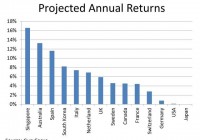
In the immortal words of the physicist Niels Bohr, “Prediction is very difficult. Especially if it’s about the future.” I rarely make firm market forecasts. But I do like to look at broad valuation numbers and see what they imply about future returns. You know the refrain: Past performance is no guarantee of future results. But the following returns estimates, courtesy of data site GuruFocus , give us a little historical perspective. GuruFocus bases its estimates on three factors: Expected economic growth, based on the average growth over the last business cycle. Expected dividend returns, based on the average dividend yield of the past five years. Change in market valuation (the assumption is that the ratio of market cap-to-GDP will revert to its average over a full market cycle, or 7-8 years). So, what do the numbers suggest? (click to enlarge) I’ll start with the good news. Several world markets are priced to deliver solid returns over the next eight years. In particular, Singapore, Australia and Spain are priced particularly attractively, with implied future returns well over 10% per year. Now, keep in mind that Singapore’s economic growth is highly dependent on trade flows between China and the West, Australia is highly dependent on selling commodities to China, and Spain is at the center of the eurozone sovereign debt crisis. All of these countries have murky near-term outlooks, and the projections for economic growth based on the past might not be realistic for the future. But once the dust settles, all might make for attractive “fishing ponds” for investment. Now for the bad news. The US market – where you’re most likely to have the bulk of your assets invested – is priced to deliver annual returns of approximately zero over the next eight years. And it’s not just the market cap-to-GDP ratio that suggests this. As I wrote recently , other metrics, such as the cyclically-adjusted price/earnings ratio (“CAPE”), point to similarly disappointing returns going forward. And allocating your funds to European or Asia-Pacific funds might not help you much. Germany and Japan, which tend to dominate European and Asian-Pacific funds, are priced to deliver equally disappointing returns going forward. So, what’s the takeaway here? In order to avoid lousy returns over the next several years, you’re going to have to invest differently than you might have in the past. You’re going to have to look more aggressively overseas, and within the overseas universe, you’ll need to underweight the most common international markets. This article first appeared on Sizemore Insights as Prediction is Difficult. Especially About the Future Disclaimer: This article is for informational purposes only and should not be considered specific investment advice or as a solicitation to buy or sell any securities. Sizemore Capital personnel and clients will often have an interest in the securities mentioned. There is risk in any investment in traded securities, and all Sizemore Capital investment strategies have the possibility of loss. Past performance is no guarantee of future results. Original Post