Category Archives: oud

Hungary Too In The Rate-Cut Club: ETFs In Focus

Hungary slashed its benchmark three-month deposit rate to a new low of 1.20% from 1.35%. It also lowered the overnight lending rate to 1.45% from 2.1%. The overnight deposit rate is now in negative territory from 0.1%.to -0.05%. The central bank took the step citing low imported inflation, European Central Bank (ECB) easing measures and continued slump in oil prices. Meanwhile, the bank also lowered its forecast for inflation this year. The bank now expects inflation to be around 0.3% as compared to the previous expectation of 1.7% announced in December. The target inflation the bank seeks to achieve is 3%. Thus, it plans to set a benchmark rate at such levels, which can be maintained for an extended period to reach its inflation target. Earlier this month, the ECB came up with a more intensified economic stimulus and opted for multiple rate cuts and the expansion of its quantitative easing program to boost the economy. Meanwhile, several other countries are undertaking easing measures and cutting rates. Last week, Norway indicated that it could join other European countries Sweden, Denmark and Switzerland in sub-zero levels of interest rate. On the other side of the pond, the Fed kept a dovish stance and dialed back its number of rate hikes to two instead of four as was projected last December. The rate cut measures by the Hungarian central bank, which was undertaking initiatives like cheap lending to small firms, subsidized funds to retail banks and buying government bonds, represent a huge shift in policy. Although the possibility of further rate cuts can’t be excluded, the central bank warned that too low rates may be counterproductive, forcing the banks to tighten lending conditions. Keeping these points in mind, we highlight four ETFs – RevenueShares Global Growth ETF (NYSEARCA: RGRO ), Cambria Global Value ETF (NYSEARCA: GVAL ), Guggenheim MSCI Emerging Markets Equal Weight ETF (NYSEARCA: EWEM ) and EGShares Low Volatility Emerging Markets Dividend ETF (NYSEARCA: HILO ) – that have high exposure of 11.7%, 7.7%, 5% and 4.8%, respectively, to Hungary. RGRO This ETF looks to track the RevenueShares Global Growth Index comprising the top five developed and top five emerging countries in the Standard & Poor’s Global Broad Market Index based on year-over-year GDP growth from the prior two quarters. The fund charges 70 basis points a year and has 95 stocks in its basket. Energy takes 21% of the fund’s exposure followed by basic materials and financials. As much as 74% stocks in the fund are large caps. The fund has total assets of $2.1 million with paltry volumes of less than 1,000 shares. It has gained 6% so far this year (as of March 23, 2016). GVAL GVAL seeks to match the performance of the Cambria Global Value Index. With 126 stocks in its basket, the fund is well diversified with none of the stocks holding more than 3% weight while financials has the highest exposure at 23%. With total assets of $65.7 million, the fund has average volume of 17,000 shares and an expense ratio of 69 basis points. It has returned 3.3% so far this year. EWEM EWEM is based on the MSCI Emerging Markets Equal Country Weighted Index and has 346 stocks in its basket with none holding more than 4% of total assets. The fund has an AUM of $11 million and trades in average volumes of 5,000. Financials dominates in terms of sector exposure, accounting for an almost 39% of total assets. The fund charges an expense ratio of 76 basis points. It has gained 7.1% in the year-to-date period. HILO HILO is based on the EGAI Emerging Markets Quality Dividend Index and has 49 stocks in its basket with none holding more than 2.3% of total assets. The fund has an AUM of $17.3 million and trades in average volumes of 6,000. Financials dominates in terms of sector exposure with telecommunication services and materials rounding off the top three. The fund charges an expense ratio of 85 basis points. It is up 9.8% in the year-to-date period. Original post
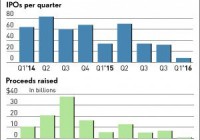
IPO Market Freeze In Q1 Hit Lowest Point Since Great Recession

A chill that hit the IPO market in December turned into an all-out freeze in the first quarter, with the number of initial public offerings hitting a low not seen since the Great Recession of 2007-09. Just eight IPOs got out the door in Q1, down 76% from 34 in Q1 2015. That was the fewest IPOs since Q1 2009, which had just one. The $700 million in proceeds raised was the lowest total in 20 years, down 87% from the $5.5 billion raised in Q1 2015, according to Renaissance Capital, which manages two IPO-focused exchange traded funds . All eight IPOs were in the medical sector, and most of those only happened thanks to substantial buying of shares by existing shareholders and a reduction in the initial asking prices. Insider buying accounted for 67% of shares sold in the IPO of Editas Medicine ( EDIT ), and 48% at Corvus Pharmaceuticals ( CRVS ), for example. Recent trends provide hope that the IPO window will reopen in the second quarter, though the big names expected to be waiting for an opening — companies such as Uber and Snapchat — have been quiet on the IPO front. “While the IPO market has been frozen, we know it will open up again,” said Kathleen Smith, principal at Renaissance Capital. “There’s a buildup of companies waiting for the appropriate time to raise capital.” The primary cause of IPO droughts has always been weakness in the stock market. Markets started tanking in late December and bottomed in mid-February. The uptrend in market indexes could ease jitters and bring institutional investors — and companies — back to the IPO table. The IPO rebound will likely proceed slowly at first, as it did in 2009, Smith says, but she see signs some IPO icebreakers could hit the market in April or May. Companies that could debut include US Foods, the second-largest food-service distributor, which submitted an IPO filing in early February that could raise up to $1 billion. Another is MGM Growth Properties, a real-estate investment trust backed by MGM Resorts ( MGM ) that also could raise up to $1 billion, Renaissance estimates. But there’s no sign yet that any high-profile names will come forward soon to spark a heat wave. This week, Uber CEO Travis Kalanick said the ride-hailing company would wait as long as possible before coming public. It’s among a large number of private companies that have raised hundreds of millions, in some cases billions, of dollars, with estimated market valuations well above $1 billion. An IPO is about the only route for investors in those privately held companies to get a healthy return from those investments. The IPO chill has been worsened by the sickly performance of last year’s high-profile new offerings. Among them was Fitbit ( FIT ), the maker of wearable fitness devices. Fitbit had a heart-pounding start, with the stock jumping 48% on its first trading day June 18, pricing at 20 and closing above 29. Fitbit stock peaked at 51.90 in August, but now trades near 13. Box ( BOX ), the online storage service provider, had a similar story. It popped 66% on the first trading in January and closed at 24.73 on day one, which is still its peak. Box now trades near 12.50. Among all IPOs of 2015, their stocks are down 18% on average from their IPO price and down 28% after the first trading day, Renaissance says. The firm says the ultimate pace of the 2016 IPO market remains tough to call, yet it does expect some eye-catching IPOs to launch and deliver attractive returns to investors. Image provided by Shutterstock .

My ‘Wisdom’ On Smart Beta And Factor Investing

The latest installment from Tadas Viskantas’s series on “financial blogger wisdom” (is that an oxymoron?) asked a bunch of smart people (and also me) about smart beta. I was short: Smart beta and factor investing are the newest versions of high(er) fee active management promising the fairy tale of “market beating” returns in exchange for higher fees and usually delivering lower returns (after taxes and fees). Regulars know I am not a big fan of Smart Beta and Factor Investing (sorry to all my friends in the industry who love these approaches!). For the uninitiated, Smart Beta basically involves taking an index fund and changing it so it captures a “smarter” type of return. For instance, you might take a market cap weighted index fund like the S&P 500 and equal weight it so that it doesn’t expose you to the procyclical tendencies of the market cap weighted fund which will tend to be overweight the riskiest stocks at the riskiest points in the market cycle. The evidence that this is countercyclical is weak as Vanguard has shown and as I expressed in my new paper . Further, you will generally pay higher taxes and fees in these funds without a high probability of better results. For instance, the equal weight S&P 500 has a pretty mixed performance versus the market cap weighted S&P as it’s performed better on a 10-year basis, but underperformed on all periods shorter than 10 years. The nominal returns are slightly better over longer periods, but that’s only because the equal weight fund has a much higher standard deviation with 95% of the total correlation. So, the intelligent asset allocator has to ask themselves why they’d pay for 95% of the correlation while guaranteeing higher taxes and fees without a reasonably high probability of better risk-adjusted performance? Should you really pay higher fees for the empty promise of “market-beating returns”? I say no. The same basic story can be laid out for factor investing. There’s a great irony in the idea that the founder of the Efficient Market Hypothesis says you can’t pick stocks that will beat the market, but you can construct index funds that will be comprised of the stocks that will beat the market. The problem is no one knows what are the right stocks to put in a “momentum” index before they earn the momentum premium. And just like active mutual funds, no one should pay a premium for an asset manager who claims that they can construct an index that will be comprised of stocks that will benefit from “market beating” returns in the future. You just end up guaranteeing higher fees and taxes in exchange for the empty promise of market-beating returns. To me, these are just the new forms of “active” investing charging people higher taxes and fees for indexing strategies that won’t outperform.