Author Archives: Scalper1

Invest Like Henry Kissinger

By Carlton Delfeld “I’ve always acted alone. Americans like that immensely.” – Henry Kissinger Have you seen Henry Kissinger lately? At 92, he’s as fluent as ever on foreign affairs. It makes you wonder whether, even at this advanced stage of life, he could do a better job managing American foreign policy than our current leaders. This brings me to Ukraine, Russia, and China. They look like a beautiful mess right now – but within a reasonable period, American foreign policy will gravitate back to a Kissinger dictum: America can only afford one big power adversary at a time. At this time, the one adversary is clearly China. In short, the whole Ukraine-Crimea-Russia fiasco could’ve and should’ve been avoided. Unfortunately, Ukraine is a prisoner of geography and history. It’s a bridge between East and West – a classic buffer state. The country will always need to balance closer ties to Europe with good relations with Russia, and this practical consideration should be reflected in American diplomacy. Pushing Russia closer to China is certainly not in American interests. Lord Palmerston once said, “Nations have no permanent friends or allies – they only have permanent interests.” Thus, the probability is on the side of U.S.-Russia relations improving in the long run. The stakes are simply too large and the logic of some sort of rapprochement too clear and convincing. In fact, while headlines have created a perception of a crisis in U.S.-Russia relations, the reality is that diplomats on both sides are working hard on “alliance management.” As an emerging bond trader active in Russia put it to me, “A lot of this is elaborate political theatre.” I believe that the gap between perception and reality is where fortunes are made, and Russia is the perfect example. Despite the country’s reputation as being a non-competitive, monopolistic economy, there were over 21,300 foreign capital enterprises operating in Russia by the end of the second quarter. And American companies invested $1.18 billion in Russia in 2014, nearly double the $667.2 million recorded in 2013. What’s more, Russia’s stock market is trading at astoundingly cheap valuation multiples right now. We know the reasons: economic sanctions imposed by Western democracies, falling energy prices, and, finally, the falling ruble, which is down sharply against the dollar this year. The stocks in the Market Vectors Russia ETF (NYSEARCA: RSX ) are trading at an 80% discount to the S&P 500 Index and at less than 65% of break-up value. Howard Marks of Oaktree Capital puts price and value at the center of his book, The Most Important Thing: For a value investor, price has to be the starting point. It has been demonstrated time and time again that no asset is so good that it can’t become a bad investment if bought at too high a price. And there are few assets so bad that they can’t be a good investment when bought cheap enough. Plus, we don’t need a miracle to profit from the situation, either. An American hedge fund trader active in Russian markets put it to me this way: “Things don’t have to turn around in Russia for me to make money. They just have to get a little bit better.” This is the key. If energy prices stabilize or rise, if the situation in Ukraine improves, if the ruble bounces back – any one of these catalysts could spark a sharp rally. RSX is down 32% over the past year and has pulled back 16% from its recent peak in mid-May. So it’s a good time to get ready to pull the trigger on one of the largest oil and gas companies in the world, Lukoil ( OTCPK:LUKOY ). Lukoil exceeds even Exxon Mobil (NYSE: XOM ) in total proven oil reserves. Even more impressive, the company has remained free cash flow positive during the entire past decade. The company also has a very low risk of government intervention, with a professional board and management at the helm. Despite this, Lukoil is trading at 37% of break-up value and 4.4 times trailing earnings. Right now, I’d nibble on a position and take a more sizable stake when a clear uptrend develops in the stock. Like Kissinger, don’t fear acting alone. Investing in undervalued – even hated – stocks when they turn is the most consistent way to build substantial wealth. Original Post Editor’s Note: This article discusses one or more securities that do not trade on a major U.S. exchange. Please be aware of the risks associated with these stocks.
Evaluating U.S. Low-Volatility ETFs: USMV Vs. SPLV

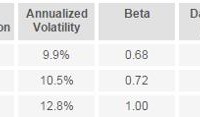
Low-volatility ETFs have close to $20 billion in AUM. Both USMV and SPLV achieve their objectives against the benchmark. USMV has been the more efficient and cheaper choice than SPLV thus far. Ever since I wrote my thesis on minimum-variance portfolios six years ago, I have maintained a strong interest in low-volatility investing. This type of investment has gained popularity over the last few years with the US markets now featuring 21 low-volatility ETFs that have combined assets under management of almost $20 billion. I have decided to take a look at how the largest funds in this space have performed from the risk perspective. For the purpose of this analysis, I have focused on the two flagship low-volatility ETFs – the iShares MSCI USA Minimum Volatility ETF (NYSEARCA: USMV ) and the PowerShares S&P 500 Low Volatility Portfolio ETF (NYSEARCA: SPLV ) – which have around $5 billion of AUM each. Both of these funds invest solely in the US stock market, making them easy to compare. The SPDR S&P 500 Trust ETF (NYSEARCA: SPY ) is used as the benchmark. Utilizing the freely available investor tool on InvestSpy and using the full data history, I obtained the following results: (click to enlarge) The table above reveals that both USMV and SPLV demonstrated substantially reduced beta and realized volatility than SPY. However, the degree of success differed, as USMV had a lower beta (0.68 vs. 0.72) and lower realized volatility (9.9% vs. 10.5%) compared to SPLV, making the former a superior performer from the risk perspective. In addition to that, USMV delivered a 6.7% higher total return than SPLV whilst both low-volatility ETFs trailed SPY. Looking at the correlations computed on the same analytical website, it turns out that both funds had a correlation with SPY of 0.88. Although the figure is relatively high, this is still a favorable finding given that these funds invest pretty much in the same universe of stocks as SPY. Analyzing the data only for the last year yields a similar result, as USMV again outperforms SPLV in all respects. However, the overall benefit from the low-volatility phenomenon has been weaker over the last 12 months, as beta values increased above 0.8 and annualized volatility was much closer to that of SPY’s, particularly in the SPLV’s case. (click to enlarge) The correlation coefficients have also changed in the past year with USMV and SPLV moving even closer together. It is interesting to note that USMV’s correlation coefficient with SPY has increased sharply to 0.95, making it a less desirable portfolio component from the diversification perspective. Summing up, USMV appears to have beaten SPLV thus far virtually in all respects, posting lower beta, lower realized volatility and higher returns. In addition to that, USMV was also a cheaper alternative, charging 0.15% as opposed to 0.25% by SPLV. However, it is important to note that markets constantly evolve and investors should monitor the performance of “smart beta” products on a regular basis. It is hard to make a case for SPLV now, but a simple change such as the recent spike in correlation with the S&P 500 may easily put USMV out of favor. Disclosure: I/we have no positions in any stocks mentioned, and no plans to initiate any positions within the next 72 hours. (More…) I wrote this article myself, and it expresses my own opinions. I am not receiving compensation for it (other than from Seeking Alpha). I have no business relationship with any company whose stock is mentioned in this article.

Energy ETF PSCE Hits New All-Time Low

For investors looking for momentum, the PowerShares S&P SmallCap Energy Portfolio ETF (NASDAQ: PSCE ) is probably on their radar now. The fund just touched a new record low, and shares of PSCE are down roughly 61% from their 52-week high price of $49.57/share. But is more pain in store for this ETF? Let’s take a quick look at the fund and the near-term outlook on it to get a better idea on where it might be headed: PSCE in Focus PSCE focuses on the energy segment of the U.S. market, holding 33 stocks in its basket. It is a small cap-centric fund with key holdings in the energy equipment & services and exploration & production segments. The fund charges investors 29 basis points a year in fees, and has its top holdings in PDC Energy (NASDAQ: PDCE ), Exterran Holdings (NYSE: EXH ) and Carrizo Oil & Gas (NASDAQ: CRZO ) (see: all the Energy ETFs here ). Why the Move? The Energy sector has been an area to watch lately as oil price resumed its decline and got trapped in the nastiest downward spiral joining the broader sell-off in commodities amid growing global glut and the China slowdown. Additionally, the latest downbeat economic data from both the U.S. and China led to the concerns over tepid oil demand growth. More Pain Ahead? Currently, PSCE has a Zacks ETF Rank #4 (Sell), suggesting its continued underperformance in the coming months. Further, many of the segments that make up this ETF have the worst Zacks Industry Ranks. So there is still some downside risk signaling caution, and investors should wait until the sector bottoms out before jumping into this ETF. Original Post Share this article with a colleague