Tag Archives: utilities

South Jersey Industries’ (SJI) CEO Michael Renna on Q2 2015 Results – Earnings Call Transcript

South Jersey Industries Inc. (NYSE: SJI ) Q2 2015 Results Earnings Conference Call August 7, 2015 11 AM ET Executives Ann Anthony – Treasurer Michael Renna – President & Chief Executive Officer Stephen Clark – Senior Vice President & Chief Financial Officer Jeffrey DuBois – Executive Vice President Marissa Travaline – Director Investor Relations Operator Good day, ladies and gentlemen, and welcome to the Q2 2015 South Jersey Industries Earnings Conference Call. My name is Scoda, and I’ll be your operator for today. At this time all participants are in listen-only mode. Later we will conduct a question-and-answer session. [Operator Instructions] I would now like to turn the conference over to your host for today, Ann Anthony, Treasurer. Please proceed. Ann Anthony Thank you. Good morning and welcome to the conference call for SJI’s second quarter fiscal 2015 results. I’m Ann Anthony, Treasurer for South Jersey Industries. And I’m joined today by members of our senior management team, including Mike Renna, President and CEO of SJI; Steve Clark, our CFO; Jeff DuBois, President of South Jersey Gas; and Marissa Travaline, our Director, overseeing Investor Relations. As you may know, we issued a news release this morning announcing the results we will be discussing on the call today. That release includes an in-depth review of earnings on both a GAAP and non-GAAP basis using our non-GAAP measure of Economic Earnings. This measure eliminates all unrealized gains and losses on commodity and on the ineffective portion of interest rate derivative transactions. It also adjusts for realized gains and losses attributed to hedges on inventory transactions and for the impact of transactions or contractual arrangements where the true economic impact will be realized in a future period. The news release is currently available on our website at www.sjindustries.com, in the Newsroom section. Throughout today’s call, we will be making references to future expectations, plans and opportunities for South Jersey Industries. These remarks constitute forward-looking statements for purposes of the Safe Harbor provisions under the Private Securities Litigation Reform Act of 1995. Actual future results may differ materially from those indicated by these statements as a result of various important factors, including those discussed in the company’s Form 10-K on file with the SEC. We assume no duty to update today’s statements should actual events differ from expectations. Also note that our 2014 numbers have been adjusted to reflect the impacts of the stock split that occurred on May 8. With that said, I’d like to turn the call over to our CFO, Steve Clark, to detail our year to date and second quarter 2015 results. Stephen Clark Thank you, Ann, good morning to everyone on the call and thanks for joining us. As we stated in the release, earnings were impacted by a write-down of our investment in cost associated with the central energy facility that previously served the former Revel property in Atlantic City. We’ve discussed on previous calls Revel’s bankruptcy and closing in mid-2014 in a long drawn-out sale process that was completed in April of this year. Since our central energy facility is the logical source of power for the Revel property, we anticipated that our contract provides heating, cooling and power to the facility would be renegotiated to some reduced level with the new owner. Unfortunately, the new owner has shown little to no interest in reopening Revel or striking a deal for energy services. While we remain ready to provide service to Revel, a lack of any recent and meaningful progress toward this new deal awarded the write down we took in the second quarter. This write down reflects our investment in central energy facility of Revel. It does not include the value of our cogeneration equipment located within the facility as we expect to be able to repurpose that equipment to serve better customers. Now, let’s review results. Year to date, economic earnings totaled $60.8 million. Excluding the year to date Revel related write down of $11.1 million, operating results would have reflected economic earnings of $71.9 million for the first half of 2015, as compared with $76.2 million for the first half of 2014.The remaining variance between These year over year periods largely reflects the significant contribution to economic earnings from our wholesale gas marketing business in the first quarter of 2014, which directly resulted from the Polar Vortex we experienced in the early part of the year. The variance also reflects a reduction in investment tax credits from solar development. First the second quarter, economic earnings totaled $1.9 million in 2015. Excluding the write down of $10.9 million for the quarter, operating results would have reflected economic earnings of $12.8 million as compared with $10 million in the second quarter of 2014. The biggest drivers of the quarterly improvement in operating results between 2014 and 2015 are contributions from our utility due to infrastructure investment and customer growth, as well as significantly improved performance from our wholesale commodity business. Actual economic earnings per share through June 30, 2015 were $0.89 as compared with $1.16 for the first six months of 2014. For the quarter, economic EPS totaled $0.03 as compared with $0.15 in the prior year period. Excluding the impact of the thermal facility write down, 2015 economic earnings per share would have totaled $0.19 for the year to date and $1.05 for the second quarter. Now, I will detail the results of specific areas of our business, noting those business lines or segments where the write down had a major impact on economic earnings. Within the utilities, South Jersey Gas’ net income for the first half of 2015 was up 15% at $47.8 million as compared with $41.5 million for the first half of 2014. For the quarter, utility net income was $5.2 million, significant increase over the second quarter of 2014 contribution of $3.8 million. This improvement reflects the benefits of last year’s rate case, our accelerated infrastructure programs and customer additions. Infrastructure investments under our accelerated programs totaled $28.7 million year-to-date and added an incremental $1.7 million of net income for the first half of 2015. With planned investments of nearly $65 million for 2015, our AIRP and SHARP programs will continue to reinforce our system for the replacement of bare steel and cast-iron gas main and the replacement of low pressure gas main with high pressure main along barrier islands. Also worth noting, we are moving forward again in our pipeline project to provide natural gas to the BL England electric generation station and enhance service reliability to customers in the southernmost portions of our operating territory. In May, South Jersey Gas filed an amendment to our 2013 project application still pending with the New Jersey Pinelands Commission. The amended application highlights the enhanced reliability and environmental benefits this project will provide customers across the region. We remain optimistic of the compelling benefits of this project to all residents in Southern New Jersey or ultimately result in its successful completion. Customer growth continues to be significant, up over 6,400 customers [or 1.8%] for the 12 month period ending June 30, 2015. On an annualized basis, these customers will be worth approximately $1.7 million of net income in future years. Our growth continues to benefit from strong conversion activity with nearly 2,800 new customers coming from conversions during the first half of 2015 and a target of 6,500 for the full year. I do want to point out that the collection of deferred gas cost from the winter of 2014 combined with the extremely cold winter this past year has resulted in high receivable balances as of the end of June, which in turn have resulted in higher receivable reserves of the utility. We boosted reserves by roughly $800,000 for the quarter or $500,000 after tax, reflect a situation that we will continue to monitor closely. Now, I’ll move over to the non-utility side of our business and discuss results from South Jersey Energy Services and South Jersey Energy Group. Energy Services largely reflects our energy production assets within Marina Energy and our energy project joint venture Energenic. Energy Group reflects our wholesale gas and retail gas and electric commodity business activities. The first six months of 2015, these non-utility businesses contributed a combined $13 million as compared with $34.7 million in 2014. Year over year variance stems from two major events, first being the previously noted write down of our central energy facility assets, second is the non-recurring benefit to our wholesale business realized from the Polar Vortex in the winter of 2014 that drove gas volatility and ultimately net income in the first quarter of that year. Reduction in solar ITC also played a smaller role in the year over year decline. In the second quarter of 2015, our non-utility businesses reflected a loss of $3.3 million as compared with economic earnings of $6.2 million in the prior year period. We will take a look at the other drivers of these results as I detail each of the business lines. Beginning with South Jersey Energy Services, this part of our business directly absorb the full write down noted previously. However, for the purpose of comparing operating results in the context of this discussion, I think it is more meaningful to [prevent] economic earnings that exclude the impacts of the write down, which amounted to $11.1 million for the first half of the year and $10.9 million for the second quarter. With this in mind, economic earnings for the first half of 2015 for South Jersey Energy Services, excluding the write down, were $15.7 million as compared with $20.8 million for the same period in 2014. For the quarter, results were $6.9 million as compared with $10.1 million for the second quarter of 2014. Lower levels of ITC recorded for both the 2015 year to date and second quarter periods accounted for the majority of the variance. First quarter 2014 Polar Vortex related performance in our wholesale gas marketing business and 2014 earnings from our energy facilities serving Revel were obviously not repeated. Excluding the impact of the write down, operating performance from our CHP business line reflected economic earnings of $2.6 million per year to date, as compared with economic earnings of $4.9 million in the first half of 2014. For the quarter, operating performance for this business produced economic earnings of $300,000 as compared with $1.5 million in the second quarter of 2014. In addition to legal costs incurred and income loss from operations at Revel, 2015 did not see a repeat of the benefits incurred from optimizing these assets, here I’m specifically talking about the energy production assets, around extreme gas price volatility that existed during the winter of 2014. Going forward, we expect our operating projects to be steady and positive contributors to economic earnings. Turning to renewables, our solar operating performance improved by nearly $400,000 year over year. This is reflected in our year to date solar economic earnings of $15.1 million, which included investment tax credits of $17.3 million as compared with the prior year economic earnings of $17.5 million, which contained ITC of $20.1 million. For the second quarter, solar contributed $7.2 million, including $7.1 million of ITC, as compared with $9.8 million that included $9.6 million of ITC in the prior year period. The increase in 2015 solar energy production, particularly in the second quarter, has not yet been fully recognized in earnings due to the timing of certification of renewable energy certificates, particularly as it relates to Massachusetts. That certification process can take up to six months. We expect to see those benefits in the second half of this year. We do expect to see improved operating performance through year end. We remain on track for full year SREC production of 135,000 SRECs. SREC values in New Jersey continue to strengthen, spot market price is now around $237. We also remain very active in the Massachusetts market, where SREC spot market values are closer to $465. For the first half of 2015, our landfills produced a loss totaling $2.3 million as compared with a loss of $2.2 million in the prior year period. However, the second quarter saw operating performance improve their reduced loss of $900,000 in 2015 as compared to a loss of $1.3 million for the second quarter of 2014. We remain optimistic that the operational initiatives implemented over the last two quarters will help drive continuing improvement for these projects. Turning to South Jersey Energy Group, the commodity segment of our business, the first half of the year reflected solid performance with economic earnings totaling $8.5 million as compared with $13.9 million for the first half of 2014. These results reflect a benefit price volatility associated with the 2014 Polar Vortex. As we told you to expect on previous calls, performance for this business improved significantly in the second quarter. This segment contributed $671,000 as compared to a loss of $4.3 million in the second quarter of 2014. With the declining drag from what’s profitable legacy marketing contracts that began rolling off at the end of March and the contributions from the two fuel management contracts that are currently active and with another pending to commence later this year, we expect continued improvements from this business throughout 2015. Finally, taking a look at the balance sheet, our equity-to-cap ratio was 43% at the end of the second quarter, as compared to 44% in the second quarter of 2014. We use our dividend reinvestment plan to issue equity and we’ll continue to do so in 2015 in support of our significant capital programs. We also [indiscernible] $300 million of deferred tax benefits related to our investments that we expect to realize between now and 2020 that will support our goal of delivering – delevering the balance sheet. At this time, I’ll turn the call over to Mike to discuss the forward view for our business. Michael Renna Thanks, Steve. Good morning. As Steve highlighted in his comments, the write down of our investment in the energy facilities serving Revel mitigated much of the positive performance for the quarter. I think most of the detail around that transaction is already been articulated here today, as well as within our earnings release and 10-Q filing. The one think I’d like to add is that we’re encouraged by what we see happening in Atlantic City, we look forward to the day when the former Revel property, part of the City’s broader success, but ultimately we decided that the best thing for our company is to look forward. Doing so will allow us to fully focus on strengthening the business lines that are the foundation of our growth. Businesses, that after backing out the impact of Revel, actually supported economic earnings per share growth 4% to 8% in 2015. In an emphasis on earnings quality, we look forward to continued strong performance in our utility, increase contributions from our commodity businesses, stable performance from our operating energy production assets. As we move forward, we do so with a model that emphasizes our regulated businesses and those areas of our non-regulated business. We have a demonstrated ability to compete and succeed. Most importantly, we will remain confident in our ability to deliver economic earnings of $150 million by 2020. I think focusing on earnings from operations provides a meaningful year over year comparison performance, while also highlighting the strong potential for our business overall. Year to date performance of our utility highlights the potential of South Jersey Gas, increase its contribution to SJI earnings from roughly 60% to 65% to upwards of 70% to 75% as we approach 2020. Significant customer growth fuelled by the compelling economics of natural gas as the heating fuel, we expect to add an incremental $11.8 million by 2020. Accelerated utility infrastructure investment is projected at nearly $350 million over the next five years, adding roughly $18 million in incremental net income by 2020. These initiatives combined with the benefits from new CNG infrastructure, the development of a reliability pipeline to serve BL England, construction of a liquefier at our Nat LNG storage site and a future rate case position our utility for an incremental net income contribution of roughly $13 million again by 2020. On the non-regulated side, strong margins in our commodity business, commencement of at least five new fuel management contracts and improving operating performance across our energy production assets support earnings contributions of $30 million to $40 million by 2020. Most importantly, this growth is targeted without reliance on investment tax credits from renewable projects, coming instead from expanded and improved performance across our core businesses. Finally, we expect our investment in the Penn East pipeline to contribute at least 10% of total net income by 2018. This fully subscribed pipeline is being driven by [climates] of more than 800,000 decatherms from regional utilities and utility affiliates, and is expected to be in service by late 2017. While there is certainly vocal opposition to some pipelines, including Penn East, we expect the overwhelming benefit will provide the region to ultimately overcome the opposition. Before we conclude, I’d like to highlight strategic priorities we shared during the second quarter’s AGA conference. As we work toward our goal of achieving $150 million in economic earnings by 2020, we’re committed to strengthening our balance sheet, maintaining a lot to moderate risk profile, perhaps most importantly improving quality of earnings to ensure that the foundation of our business is built on regulated, repeatable, and reliable income streams. Thank you. Now, I’ll turn the call back to the operator for Q&A.
Upcoming Political Risks For TransCanada Corp And The Keystone XL Pipeline

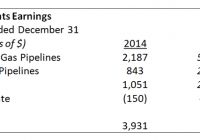
Summary Upcoming Canadian Federal Elections present significant risks for TransCanada Corp. The proposed Keystone XL and Energy East Pipeline projects will face strong headwinds if the NDP wins a minority. Expect increased short term volatility as these events unwind and the possible outcomes become more clear to investors. TransCanada Corporation (NYSE: TRP ) is a Canadian midstream oil and gas company operating in three main business segments: Natural Gas Pipelines, Liquids (crude) Pipelines and Energy. Its pipeline operations extend from Canada to the U.S and Mexico. Revenue breakdown for 2014 between these segments can be seen bellow: (click to enlarge) ( 2014 Annual Report ) TRP currently has two large proposed pipeline projects that have created a lot of public reaction recently and have become hot topic for the media and politicians from both the U.S and Canada. These projects are the Keystone XL and Energy East pipelines. With the Canadian Federal election to be held on October 19th, 2015, it is critical to evaluate each party’s stance on these two proposed projects. Keystone XL Pipeline Overview: The Keystone XL pipeline would transport crude oil for Alberta to Nebraska, expanding the current and operational Keystone Pipeline System. The proposed pipeline would measure 1,897 km long, possess a capacity of 830,000 barrels of oil per day and is estimated to cost $8 billion with $2.4 billion already invested. The pipeline faces a difficult regulatory environment. Since it crosses international borders between Canada and the United States, it is required to obtain a Presidential Permit from the Department of State. The Permit is awarded if the proposed Project serves the national interest, which is a very broad term and requires the consideration of many factors such as energy security, environmental, cultural and economic impacts. Energy East Pipeline Overview: The Energy East Pipeline would transport crude oil from Alberta and Saskatchewan to the eastern Canadian refineries as well as other export markets. In terms of length, this pipeline would span 4,600 km, have a capacity of 1.1 million barrels per day and is estimated to cost $12 billion. The regulatory environment for this project is administered by the NEB (National Energy Board) in Canada, which likely stands to approve the project providing the environmental requirements are met and political support remains. Upcoming Canadian Elections: The outcome of the upcoming Canadian Federal Elections slated for October 19th 2015 will have a significant impact on the likelihood of the Keystone XL and Energy East pipelines being completed. While both Harper’s Conservative party and Trudeau’s Liberals support both projects, the NDP led by Tom Mulcair is currently opposed. While the NDP has yet to win a federal election, this year may be its best chance yet. After a break through election in 2011 in which the NDP replaced the Liberals as the current opposition party. To add to the fact, the Alberta NDP recently won the Albertan provincial election, widely considered a Conservative stronghold and native land of Stephen Harper. The Tory’s have called an early election with the hopes of outspending their opponents. New rules introduced increase the spending limit for longer campaigns. The hope is that this will allow them to outspend the NDP and Liberals on advertising during the critical final weeks leading to the election. While still extremely early in the race, it is worth noting that the NDP currently holds a small but growing lead over the Tories. (click to enlarge) Source: CBC.ca . United States Political Front: As for the U.S political front, Obama has strongly opposed the Keystone XL project and it is extremely unlikely this position will change during the remainder of his term in office. TRP’s hopes lie with the next administration from which they can expect a better odds that they will receive support. Hillary Clinton recently refused to provide a direct answer to whether or not she supports the Project, stating that her current position and the potential for he involvement in a possible lawsuit prevents it. While she is unable to provide any comments at this time, her refusal to offer outright support for Obama on this issue signals that she may be more supportive of the project. As for the Republicans, Jeb Bush tweeted his support : “Keystone is a no-brainer. Moves us toward energy independence & creates jobs. President Obama must stop playing politics & sign the bill.” The economic benefits of the project throughout the U.S would make it difficult for any Republican candidate to oppose it. Conclusion: The impact of an NDP victory in the upcoming Canadian Federal Election presents a significant risk for TransCanada Corp. Two of TRP’s flagship pipeline projects, Keystone XL and Energy East, currently supported by the Tories, are strongly opposed by the NDP. While TRP appears to be a sound value play in the midstream O&G market, offering a juicy 4.31% yield and stable operating cash flows, the upcoming political risks should not be underestimated. Disclosure: I/we have no positions in any stocks mentioned, and no plans to initiate any positions within the next 72 hours. (More…) I wrote this article myself, and it expresses my own opinions. I am not receiving compensation for it (other than from Seeking Alpha). I have no business relationship with any company whose stock is mentioned in this article.

Atmos Energy’s (ATO) CEO Kim Cocklin on Q3 2015 Results – Earnings Call Transcript

Atmos Energy Corporation (NYSE: ATO ) Q3 2015 Results Earnings Conference August 06, 2015, 10:00 PM ET Executives Susan Giles – VP of IR Kim Cocklin – CEO, President and Director Bret Eckert – CFO and SVP Analysts Brian Russo – Ladenburg Thalmann & Company Charles Fishman – Morningstar Research Spencer Joyce – Hilliard Lyons Operator Greetings, and welcome to the Atmos Energy Fiscal 2015 Third Quarter Earnings Conference Call. At this time, all participants are in a listen-only mode. A brief question-and-answer session will follow the formal presentation. [Operator Instructions] As a reminder, this conference is being recorded. It is now my pleasure to introduce your host, Susan Giles , Vice President of Investor Relations for Atmos Energy. Thank you Ms. Giles. You may begin. Susan Giles Good morning, everyone. Thank you for joining us. Our speakers this morning are Kim Cocklin, President and CEO; and Bret Eckert, Senior Vice President and CFO. There are other members of our leadership team here to assist with questions as needed. Our earnings release, conference call slide presentation and our Form 10-Q we filed last night are available on our website at atmosenergy.com. We will refer to just a few of the slides during this live call, but we’ll take questions on any of them at the end of our prepared remarks. As we review these financial results and discuss future expectations, please keep in mind that some of our discussion might contain forward-looking statements within the meaning of the Securities Act and the Securities Exchange Act. Please see Slide 21 for more information regarding the risks and uncertainties we consider in making these forward-looking statements and where to go to get more information on these risks and uncertainties. Now I would like to turn the call over to our President and CEO Mr. Kim Cocklin. Kim. Kim Cocklin Thank you very much, Susan, and good morning everyone. We certainly appreciate you joining us this morning and your continued interest in our company Atmos Energy. Yesterday as you are aware we reported consiolidated net income of about $56 million or $0.55 per diluted share. For the first nine months of fiscal 2015 the reported consolidated debt income was about $292 million or $2.86 per diluted share. Company’s performance during the quarter offers yet another confirmation at our long-term strategy to grow by investing in the safety and reliability of our regulated infrastructure continues to generate consistent operational and financial results. As a result we are pleased to increase our fiscal 2015 earnings guidance to a range between $3.10 from the previously announced ranges between $2.90 and $3.05 per diluted share. Bret will provide a little bit more color around that in his remarks. The execution of our strategy has also allowed us to strengthen our financial position and this was recognized was Fitch when they upgraded our long-term debt rating to A from A minus on July 1. Our debt capital ratio of June 30 was 45.5 % and all liquidity remained strong with over $1 billion of capacity available from our credit facilities. Yesterday our board declared our 127 consecutive quarterly cash dividend. The indicated annual dividend rate for fiscal 2015 is a $1.56 per share. I’m going to turn the call over to our CFO Bret Eckert for more detailed discussion of the results. Bret. Bret Eckert Thanks Kim, and good morning to everyone. Slides 2 and 3 detail reported net income an income excluding net unrealized margins to the three and nine month periods of fiscal year 2015 and 2014. Earnings excluding unrealized margins for the current three month were $55 million or $0.54 per diluted share versus $46 million $0.45 per diluted share in prior year quarter. Earnings excluding unrealized margins for the current nine months were $287 million or $2.81 per diluted share compared with $259 million or $2.69 per diluted share of last year. Remember last year’s nine months results included the favorable impact was significantly colder than normal weather. Slides 4and 5, provides financial highlights for our regulated operations. In the quarter rate increases lifted distribution gross profit by $16 million and about $62 million for the current nine-months. At APT approved GRIP filings in fiscal 2014 and 2015 listed margins by over $9 million in the quarter and $37 million for the nine-months. However, period-over-period results in our distribution segment were negatively impacted that by weather that was 31% warmer than the prior year quarter and 9% warmer than the prior year nine-months. This reduced gross profit by about $1 million for the quarter and $9 million for the nine-month period. On non regulated segment is detailed on Slide 15 and 16, delivered gas increased in both the quarter and year-to-date period driven by stronger per unit margin offset by a slight decrease in delivered gas volumes. Other margins decreased about $3 million in the quarter and $17 million in the current nine-month as less volatile market conditions created few opportunities to capture incremental gross profit compared to the same periods one year ago. Shifting now to the income statement O&M increase by about $7 million in the quarter and about $18 million for the current nine-months. As we expected both period of experience higher levels of pipeline maintenance writeaway expenses despite a very wet spring that impacted the amount of maintenance that could to be performed. We do anticipate the maintenance expenses to continue and accelerate fourth quarter as the whether rise out. In addition, the current quarter saw increased employee related costs associated with the timing of the recognition of higher variable incentive compensation expense as a result of increased operating results these increases will partially offset by lower legal expense. Interest charges decreased by $4 in the quarter and about $10 million for the nine-months primarily due to replacing the $500 million of 10 year debt with $500 million of debt at a lower rate back in October 2014. Details of capital spending represented on Slide 6, over 80% of our capital expenditures were associated with safety and reliability spending, as we activated CapEx increased by about $115 million current nine month period compared to one year ago. Moving now earnings guidance for fiscal 2015 and you may want to turn to Slide 18 where we’ve detailed revised contributions from our regulated and our non-regulated operations as well as selected expenses for the year. As Kim mentioned, we have tightened and slightly increased the earnings guidance range for fiscal 2015 with earnings per diluted share now expected to range from $3 to $3.10 excluding unrealized margin. We now project regulated operations generate net income in the range of $290 million and $305 million and non-regulated operations to generate net income in the range of $14 million to $18 million. The updated guidance primarily reflects stronger than anticipated consumption in our distributions segment. This increased consumption levels not only reflect the impact of colder than normal experienced during the winter heating season, but also higher than anticipated residential and commercial consumption level following the winter heating season. We also expect higher realized non-regulated gross profit as a result of the improved delivered gas performance. Consolidated O&M expense is now expected to range from $525 million to $535 million driven by increased regulated pipeline maintenance activities and higher employee related variable incentive compensation expense. Turning to Slide 28, we now anticipate the annual operating income impact for rate outcome implemented in fiscal 2015 to range from $85 million to $95 million. This is slightly different than our original projection largely due to increased customer consumption experienced in the prior fiscal year. As a result, test period revenues were higher which reduced the size of requested rate increases. Thank you for your time and now I’ll hand the call back over to Kim. Kim Cocklin Thank you very much for that report, Bret. Our performance again confirms that what we’re doing is working. We are experiencing very good results all around both operationally and financially as we strive to become the nation’s safest gas utility. We’ve fostered good relationship with our regulators who are tasked with balancing the needs to consumers and businesses like Atmos Energy and we’ve also built and established partnership with them as well as our customers, employees, in the cities we serve. Our regulated operations as Bret said continue to provide stable and predictable earnings for the enterprise. As of August 5, rate outcomes and incremental differals that provided annual operating increases of about $87 million thus far in fiscal 2015. Rate actions that are filed and pending total about another $9 million of requested annual operating increases. We expect to file another three to four cases this fiscal year that combined that would request anywhere from $15 million to $20 million of additional increases to operating income. As you are well aware safety is our number one priority and it does require significant investment both capital and expense. As gas prices remain low for the foreseeable future, the price dynamic continues to facilitate the investment we’re committed to making. This year we’ll spend from $900 million to $1 billion of capital to fortify our system. You’ve heard this bfore, we may sound like a broken record or you might think you are watching the movie Ground Hog Day, but we have been and will continue to delivery on our promises and commitment. Investing in the safety and reliability of our system is the highest and best use of our capital. These capital investments should grow rate base by 9% to 10% and earnings per share by 6% to 8% on an annual basis and provide a projected total return to shareholders of between 9% and 11%. In November, we’ll look forward to meeting with you and communicating our refreshed five year plan, which will provide projections through fiscal 2020. We certainly appreciate your time this morning and now we’ll take any questions that you have, Kevin. Question-and-Answer Session Operator Thank you. [Operator Instructions] Our first question comes from the line of Brian Russo with Ladenburg Thalmann. Please proceed with your question. Brian Russo Hi, good morning. Bret Eckert Good morning, Brian. Brian Russo Just in terms of the increased guidance, if you kind of back into the EPS for the reg or non-reg, it looks like it’s split fairly evenly $0.05 of EPS increase on reg another $0.05 on regulated side. Is that just sustainable or is it related to weather and it’s not – and it shouldn’t really re-occur when meeting is the base earnings power $0.10 higher now than it was previously? Bret Eckert Well as we had said last call Brian it’s few questions, we expect weather to weather consumption to contribute about $0.04 to $0.06 to earnings in fiscal 2015, we talked about the delivery gas business with the slight increase in our guidance that really is driven by the delivery gas business, we see per unit margins strengthened though in end of the year expecting margins in the $0.10 to $0.11 range you see in margins closer to the $0.11 to $0.12 range and that is really what is causing the lift in that business. So we’re only coming out with guidance for fiscal 2016 as we announce our full-year results in November but those are the main drivers of the increase in earnings this year. Brian Russo Now the increase in unit margins on the non-reg side, is that sustainable? Bret Eckert That’s a good question Brian. I mean we didn’t experience that same performance last year from them and this year was then the trend increase for their margins and we’re also seeing increased consumption in on the regulated side of the business. I think that there is some traction that is being gained nationwide by energy consumers that are recognized that natural gas is an extremely good purchase and it continues to lead the way. So we’re seeing that, they are seeing some of that in the industrial sector but and the other thing is that their delivered share gas focus is continuing to emphasize providing additional value to customers that are willing to recognize that value. So they’re being the non-regulated group of being a little bit more focused on the selection of who they’re serving and so they are high-grading their customer base which has translated at least this year into those better margins that we’re seeing. So we’re going to continue to have that strategy of emphasizing service to customers that are recognizing the additional value they bring to the table in terms of just all of the energy services that are available and then providing the premium product in the form of natural gas that they are getting. But so some folks are willing to pay up right now because of the competitive edge that gas brings to their product and their process. Brian Russo Got it okay and then just the it looks like you’ve got about 55% equity ratio, can you talk about maybe the trends you see there, is that kind of a good target trend lower as you raise that financial CapEx? Bret Eckert We continue today, we are committed to kind of growing this spending of $900 billion to $1.1 billion through 2018 in a balanced form. The 55% is the product to the equity issuance we did back in February of 2014. Brian Russo Okay. And then just lastly the upcoming regulated pipeline, GRC filing I think it is December 2016 any – can you just comment what are the major drivers there and I think we should be aware of that this time? Bret Eckert Generally there are no unusual drivers; it is going to be a typical rate case with the focus on cap structure, on return and on service levels and rights. But it won’t be anything unusual. Brian Russo Okay, great. Thank you very much. Bret Eckert Thank you, Brian. Operator Thank you. Our next question comes from the line of Spencer Joyce with Hilliard Lyons. Please proceed with your question. Bret Eckert Spencer? He dropped off, lost Spencer. Operator Our next question comes from the line of Charles Fishman with Morningstar. Please proceed with your question. Charles Fishman Good morning. The variance on O&M which were attributed to the employee incentive plan is that something you just recognize that in the third quarter that is not ongoing, we won’t see that next quarter, is that correct? Bret Eckert You recognize an incentive comp base on your initial targets and then with revision of the guidance upwards with only come in higher, on the quarter once you change that is when we catch up on the higher level of expense and so this time we got recorded in the third quarter. Charles Fishman Okay, got it. And then the second question was Bret you made the comment that you were experiencing higher consumptions following the heating season, I appreciate if you have add some color to that total whatever you can . Bret Eckert Yeah, we have seen, through the nine month period consumption higher than historical norms coming through and so we have always got consumption driven by weather and then you’ll just got a modest consumption consumer will use on a average degree day and we have seen that be higher than historical norms continue into the first nine months of this fiscal year. Charles Fishman Whats going on? Bret Eckert And it’s hard to highlight exactly what’s driving consumer consumption patterns, but we have seen higher consumption this year. Kim Cocklin Charles, I mean that’s kind of national, nationwide circumstance we flipped it some of the tests that are coming out we looked at AGA statistics that recently came out I think last week or two weeks ago and it indicated the better reversal of the trend for declining use of natural gas and for the last two years running there has been an increase in the consumption trend by residential customers. Again, I think, the traction associated with our industry getting out a little bit and promoting the competitiveness in the abundance and the environmental qualities of natural gas. Charles Fishman Okay. Bret Eckert Certainly in the competitive against other alternative fuel sources. Charles Fishman Okay, thank you for that. Kim Cocklin The industry and I think you know we are just experiencing because we were, one of the biggest R&D utilities on the planet. Charles Fishman Okay, thanks a lot. Operator Thank you. [Operator Instructions]. Our next question comes from the line of Spencer Joyce with Hilliard Lyons. Please proceed with your question. Spencer Joyce Let’s try out this again user error on my part. I apologize. Kim Cocklin Okay. Bret Eckert Well first mistake of the year for you. Spencer Joyce Yes, I got to say so keeping with the Bill Merry movies it is clear that the Cinderella story continues to execute here, nice quarter. Right, what becomes of the broken it is and another one when that comes to mind on if you are not in the stock by the four tops? What in the world applies with what is the sector doing? Kim Cocklin It is flattish, it is mostly interest rates on say, we are kind of drawn to tough comp of where lot of the stocks ended last year, but optimistic here is we look towards the back half. Spencer Joyce Yes. I guess to be long-term. In any case just want to kind of have question from me, we are inching kind of ever closer here to the endpoint of kind of standing 2018 guidance if you will, but I know we are still a couple of years out but can you talk about any clarity that maybe developing as we look maybe towards the tips of the decade here and potentially when we can see you all maybe roll that target out another year or two? Bret Eckert Great question, Spencer we do plan in November when we released earnings of fiscal 2015 to come out and extend that plan to four, five years through 2020, we have launched the plan updated the plan last in 2014 to 2018 we didn’t want to getting practice of rolling out another year, every year. So we kind of do it every two years but we will put out revised plan or updated plan if you will through 2020 we will put guidance out there, guidance range out there in 2020 and as we talked before imagine for 2018 we continue to see the ability to invest at these levels enhancing the safety into the liability for systems. So we expect that in our analyst meeting in November. Spencer Joyce Perfect, we will eagerly await that roll out there. Again good quarter and nice year, shaping out to be a good one. That is all I have. Kim Cocklin Thanks Spencer. End of Q&A Operator Thank you. There are no further questions at this time. I would like to turn the floor back over to management for closing comments. Susan Giles Thank you, Debin. I just want to remind you all recording of the call is available through November 4 and I am here if you have any additional questions. Thank you so much for joining us. Bye, bye. Copyright policy: All transcripts on this site are the copyright of Seeking Alpha. However, we view them as an important resource for bloggers and journalists, and are excited to contribute to the democratization of financial information on the Internet. (Until now investors have had to pay thousands of dollars in subscription fees for transcripts.) So our reproduction policy is as follows: You may quote up to 400 words of any transcript on the condition that you attribute the transcript to Seeking Alpha and either link to the original transcript or to www.SeekingAlpha.com. All other use is prohibited. THE INFORMATION CONTAINED HERE IS A TEXTUAL REPRESENTATION OF THE APPLICABLE COMPANY’S CONFERENCE CALL, CONFERENCE PRESENTATION OR OTHER AUDIO PRESENTATION, AND WHILE EFFORTS ARE MADE TO PROVIDE AN ACCURATE TRANSCRIPTION, THERE MAY BE MATERIAL ERRORS, OMISSIONS, OR INACCURACIES IN THE REPORTING OF THE SUBSTANCE OF THE AUDIO PRESENTATIONS. IN NO WAY DOES SEEKING ALPHA ASSUME ANY RESPONSIBILITY FOR ANY INVESTMENT OR OTHER DECISIONS MADE BASED UPON THE INFORMATION PROVIDED ON THIS WEB SITE OR IN ANY TRANSCRIPT. USERS ARE ADVISED TO REVIEW THE APPLICABLE COMPANY’S AUDIO PRESENTATION ITSELF AND THE APPLICABLE COMPANY’S SEC FILINGS BEFORE MAKING ANY INVESTMENT OR OTHER DECISIONS. If you have any additional questions about our online transcripts, please contact us at: transcripts@seekingalpha.com . Thank you!