Tag Archives: stocks

Market Lab Report – Pocket Pivot and BGU Review for the Week of 11/30-12/4/15
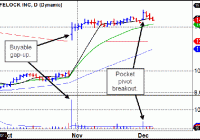
Trading Journal Notes from Dr.K and Gil regarding this past week’s pocket pivot and buyable gap-up reports: Lifelock (LOCK)  GM – another one of these thin stocks that can easily run into trouble during a general market sell-off. Volume has not been heavy over the past three days following Tuesday’s pocket pivot, so this might be buyable with the idea of looking for a snap back from here if this pullback is merely temporary. DRK - LOCK showed strength by trading sideways the first half of November when the NASDAQ Composite corrected 4.9%. It has since retraced its pocket pivot on lower, constructive volume. That said, it is a thinner name so may be subject to greater volatility. Its gap down in July was redeemed by its gap higher on strong earnings at the end of October.   Fleetmatics (FLTX) GM – this pocket pivot breakout to all-time highs is holding up tight. A pullback into the 10-day line is your best entry, in my view. DRK - Its higher volume reversal day last Thursday occurred when the majors were down substantially on higher volume. So in context with such weakness, its higher volume reversal day was forgivable since it did not close at its low and volume was only 12% above its 50-day average volume.   Interactive Brokers (IBKR) GM – IBKR has moved higher since Wednesday’s pocket pivot. It pulled into the 10-day line on Thursday on light volume, and was buyable the next day at the line as the market began to recover. I would continue to look for low-volume pullbacks into the 10-day line as offering a better entry. DRK - The stock is acting right but it is best to buy a stock as close to its moving average as possible as the market this year has been very unforgiving. That said, to avoid missing a truly powerful stock, one could size down their position the further away from the moving average it trades.   Jet Blue Airways (JBLU) GM – airline stocks have been acting well lately, with LUV and ALK breaking out strongly on Friday and VA holding well above its 50-day moving average. JBLU is a bit of the slow animal in this herd, but as a leader that is basing could come out of here at any time. It has shown a tendency to hold support around the 24.50 price level, so that would serve as a selling guide if one were to take a shot on this one here. DRK - Airline company JBLU had a pocket pivot earlier in the day but closed near the low of its trading range in the face of a weak market. It is always better to see a stock buck market weakness when it is having a pocket pivot. If you bought this one earlier on its pocket pivot day when it was showing strength, and did not sell near the close, you should keep stops extra tight on this one. Further, final volume tallies were adjusted thus show a very close call or a near miss in terms of having barely enough pocket pivot volume, depending on which service one uses.   Cytokinetics (CYTK) GM – this stock underscores the risk in buying speculative, smaller names. CYTK got pummeled on Thursday during the market sell-off, and then stabilized at the 20-day moving average. It’s possible this is an “Ugly Duckling” entry using the 20-day moving average as a guide for a tight downside stop if it doesn’t rebound quickly. DRK - Smaller cap biotech names always carry greater risk so if such a stock fits in with your trading personality and risk tolerance levels, a small position may be warranted. That said, know that while the potential upside can be great in a hurry, the failure rate is also considerably greater for such names. We include them as some of our members enjoy taking their shots with such names.   Wayfair (W) GM – W is holding tight along the confluence of its 10-day, 20-day, and 50-day moving averages with volume drying up in “voodoo” fashion. This could be bought here using the 50-day line as your selling guide. DRK - “Voodoo” can be good “joo joo”. Of course, luck should never play a role in a good trading strategy as statistics always win. Fortunately, voodoo setups are statistically significant.   Servicenow (NOW) GM – this stalling pocket pivot on Wednesday didn’t look too promising based on the close near the lows of the intraday price range, but it has managed to move higher since. Probably best to wait for a constructive pullback into the 10-day line. DRK – While NOW stalled on Wednesday, the general market was down both Wednesday and Thursday while NOW managed to finish both days higher, thus showed strength relative to the majors. It is now a bit extended so if you didn’t buy any yet, it may be better to wait for a pullback closer to its 10-day moving average.   Take-Two Interactive (TTWO) GM – A pocket pivot breakout to all time highs. This stock tends to pull in after showing initial strength, so I’d prefer to look for a pullback to the 10-day line before pulling the trigger on this one.  DRK – Breakouts often pull back in this environment so it may be better to wait for a better entry point.   Vantive (VNTV) GM – After getting pummeled on Thursday during the general market sell-off, VNTV recovered and posted a pocket pivot off the 20-day moving average. Volume on the pocket pivot exceeds the prior day’s downside volume, which has the makings of a healthy rebound. The 20-day line would serve as my selling guide on this one. DRK – Its gap higher on its prior earnings report is a sign of strength. It has also managed to behave stronger than the general markets. It is in position to buy, but keep stops tight as always. An undercut of the last Thursday’s or Friday’s low would be suitable sell stops.         

Asset Class Performance During The First Week Of December

Below is a look at recent asset class performance using our key ETF matrix. Gains of roughly 2% were seen across the board in U.S. equities today, with the Nasdaq 100 (NASDAQ: QQQ ) leading the way at +2.34%. Today’s move higher left major indices back in the black for the month, but only by a small amount. On a sector basis, everything was higher today except for Energy (NYSEARCA: XLE ), which fell 0.63% and is now down nearly 5% on the month. Year-to-date, Energy is now down 18.27% – by far the most of any sector. On the positive side, Consumer Discretionary is up the most at 12.57% year-to-date. Have a look at the right side of the matrix for international equity performance, commodities and fixed income.

An Aggressive Portfolio For Investors Using Modern Portfolio Theory

Summary The aggressive allocation strategy incorporates a mere 15% of the portfolio to bonds. The portfolio also contains 8% to utilities and 25% to equity REITs which are sensitive to movements in interest rates. This kind of portfolio is designed for an investor that can bear substantial risk and is willing to have the portfolio rebalanced at regular intervals. I’ve selected a combination of the Schwab and Vanguard funds that I find attractive. Several are in my portfolio. Facing expectations for an increase in domestic short-term rates, portfolio strategy has been on my mind. Frequent readers will know that I cover mREITs a great deal and invest a material portion of my portfolio in the mREITs that I consider most attractive. In this piece, I want to talk about a strategy that I think would be very reasonable for the rest of the portfolio. Before we get into the allocations, I want to stress that this is designed as an aggressive portfolio and for many investors, this portfolio would simply be too risky. I have a long-time horizon, and aggressive allocations make sense for me. Each investor should carefully consider their circumstances. The Strategy I feel that a portfolio like this would be most useful under MPT (Modern Portfolio Theory). The portfolio would be designed with the expectation of frequently rebalancing positions. That can be a problem for investors that are holding their positions across several accounts or don’t have free trading on the securities. Several of these ETFs will qualify for free trading through either Schwab or Vanguard but not both. I’d love to see each of those brokerages bring out additional funds to make it possible for an investor to select funds from only one brokerage for this strategy. It might be possible through Vanguard, but I’m more familiar with Schwab’s international options. Tax Exempt For the purpose of this article, I’m assuming the accounts are retirement accounts that are tax exempt. Some investors may figure that this would be a problem because the employer sponsored 401k is unlikely to have all of these options, but I’ve personally had success with rolling former employer 401k accounts into IRA accounts. The heavy weight for domestic equity REITs would be fairly strange for an investor facing higher income taxes on the position. Asset Allocation That domestic total allocation of 65% could be treated as a home country bias and there may be some arguments for moving that combined position down to 60% of the total portfolio so that international positions and bonds can be increased. For now, I’m going to go with 65% in the combination of domestic equity and domestic equity REITs. Many investors may think 40% into traditional equity with 25% into equity REITs is incredibly heavy on equity REITs, but I see the lack of corporate taxation as a huge and durable advantage for providing superior growth. Domestic Equity The first 40% gets broken up between three funds: I’ve used the Schwab U.S. Broad Market ETF (NYSEARCA: SCHB ) over the Vanguard Total Stock Market ETF (NYSEARCA: VTI ) on the basis of a .01% lower expense ratio. This is fairly small, but I’m long both ETFs in different accounts. I’m also using the Schwab U.S. Dividend Equity ETF (NYSEARCA: SCHD ) and love the defensive allocations. In this case, I opted to use the broad market ETF because I’m combining it with the Vanguard Consumer Staples ETF (NYSEARCA: VDC ) and the Vanguard Utilities ETF (NYSEARCA: VPU ) to make the combined domestic equity position significantly more defensive. Equity REITs This is fairly simple. Investors could use the Vanguard REIT Index ETF (NYSEARCA: VNQ ) or the Schwab U.S. REIT ETF (NYSEARCA: SCHH ). For investors seeking higher dividend payouts, the easy answer is VNQ. Since I have a very long time until the retirement and the portfolios are very similar, I’ve been adding more to my SCHH holdings since it has free trading a lower expense ratio. International As I noted at the start of the article, I’m more familiar with Schwab’s international options than with Vanguard’s. The Schwab International Equity ETF (NYSEARCA: SCHF ) gets only 5% of the portfolio and matches the Schwab Emerging Markets ETF (NYSEARCA: SCHE ). The heaviest weight goes to the Schwab International Small-Cap Equity ETF (NYSEARCA: SCHC ) because I want the international equity allocations to favor smaller companies on the assumption that they will earn more of their revenues from the international market. I don’t have much use for overweighting multinational companies that happen to have their headquarters in a different country. Therefore, I prefer the smaller companies in this space. Bonds I went with a mix of the Schwab U.S. Aggregate Bond ETF to get very high credit quality (including treasuries) and fairly moderate duration and the Vanguard Long-Term Corporate Bond Index ETF (NASDAQ: VCLT ) for a higher yield. The long duration on high credit quality corporate issues allows the fund to still exhibit a negative correlation with the S&P 500 while offering significantly stronger yields than treasury securities of the same long maturity. One Problem Using a portfolio like this would be ideal for an aggressive investor that is ready to put a rebalancing plan in place. Some of the brokerages will offer options to create an automatic portfolio and will allow users to influence the allocations. When I tested out Schwab’s feature for it, I was disappointed to find that some of my favorite Schwab funds were not included in the options. Of course, Schwab also does not have an equivalent option to VDC or VPU in its group of funds with extremely low expense ratios. If it rolls out an option that would allow automatic rebalancing across the account with my favorite ETFs included, I would be very interested in trying it. I wouldn’t want to incorporate my mREIT positions into that part of the portfolio, but I would feel comfortable designing a weighting system for the rest of my portfolio that would be automatically rebalanced. One of the funds I was disappointed to see excluded from the system was SCHH. Since this kind of rebalancing system would be problematic outside of tax-exempt accounts, I would really want to be able to run a heavy equity REIT allocation. Conclusion I’d love to see brokers continue to develop their portfolio management tools so that it is simple for investors to set up a portfolio like this. They would need to be careful about handling things such as rebalancing and allow investors to set a goal like to rebalance individual positions when the bid-ask spread is only one cent.