Tag Archives: stocks

A Way To Own The Next Tech Unicorns

By Tim Maverick What investor wouldn’t want to own a tech unicorn? That is, a technology company, still private, that has a billion dollar-plus valuation based on its fundraising. Initial investors cash in on unicorns in a big way when these companies are either bought out or go public in an IPO. But that’s the realm of Wall Street and venture capital types… right? Wrong! There’s an obscure type of investment, tucked away in a recess of Wall Street, that allows everyday investors to get in on tech unicorns. Closed-End Interval Fund These closed-end interval funds have been in existence since the Investment Company Act of 1940. There are 58 such funds currently active. In effect, a closed-end interval fund is a strange mutual fund. It offers the same transparency and regulatory benefits of a normal mutual fund, and it’s continuously offered and priced every day. But, as the name suggests, closed-end interval funds are highly illiquid. Such a fund can only be sold at specified intervals . In many cases, such a fund can be sold only quarterly, and the fund will only buy back a portion of your shares. Thus, any money invested into such a fund isn’t money you’ll need anytime soon. It has to be very long-term, serious investment money. SharesPost 100 Fund But where do the tech unicorns come in? Well, one closed-end interval fund focuses on private firms that the fund manager believes are just a few years away from going public. In other words, late-stage tech companies. The fund is the SharesPost 100 Fund (MUTF: PRIVX ), and the investment minimum is only $2,500. Just to be clear to readers, I do not own the fund, and I have no affiliation with the fund. SharesPost 100 is currently invested in 31 companies. You can look at the current portfolio here . The fund’s eventual goal is to ramp to holding 70 to 90 names as more people invest. Ultimately, it aims to include more names from the SharesPost 100 list . According to Bloomberg, the fund has $68 million under management. Fund manager Sven Weber told Reuters he’d like to have $200 million under management within two years. Since its inception last year, the fund is up about 25%. But it hasn’t been very active recently, since the market for such companies has cooled in the past few months. It’s important to note that the fund will offer to buy back 5% of the outstanding shares from shareholders each quarter. If more than 5% of the shareholders want to bail out, they’d receive a pro-rated amount of the quantity they wanted to actually sell. The fund can suspend redemption privileges, as well. SharesPost also charges a sales load of 5.75% on amounts under $50,000, though the load drops as you invest more money. There’s also an advisory fee of 1.9%. So there you have it – a way to invest in tech unicorns, albeit one with a few warts. Personally, I could handle the fees and the risk of owning these shares, but the illiquidity is a big hang-up. What do you think? Leave us your thoughts in the comments section. And if you do decide to invest in the fund, please read the prospectus for a full look at the risks involved. Original post
Market Lab Report – Review of Pocket Pivots for the Week of 12/14-12/18/15

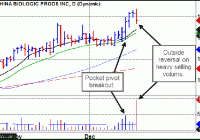
Trading Journal Notes from Gil and Dr. K regarding this past week’s pocket pivot alerts: China Biologic Products (CBPO) GM – Thinly traded Chinese stocks always make me nervous. This one had a pocket pivot on what is basically a flag breakout, and I am not a fan of buying into breakouts, especially one this extended. The stock has been able to edge higher, but a big outside reversal to the downside on Friday came on heavy options expiration volume. This might be better to look at if the pullback carries into the 10-day line as volume dries up. DrK – Volumes are always exaggerated on quadruple witching day, thus a stock should not be penalized for heavy volumes on such a day. A constructive pullback to the 10-day moving average in context with the general market could be bought. Average daily dollar volume is about $25 million so it is on the thinner side but not so thin it cant be considered. That said, the more liquid the Chinese stock, the better, especially in this market environment.  Stamps.com (STMP) GM – Another flag breakout following a buyable gap-up in early November. Again, I am not a fan of buying breakouts like this, and the pullback into the 10-day line following the breakout makes my point. This might be buyable here along the 10-day line, which offers a much lower-risk entry point, but whether it is able to hold will depend heavily on what the general market does this next week. DrK – Buying the stock as close to its 10dma lowers the risk. A stop could be placed just under the lows of Friday which would also place it just under its 10dma. Were the stop hit, the stock would then have dropped back into its prior base where it could be sold.  Ligand Pharmaceuticals (LGND) GM – this is a pocket pivot base breakout from a sloppy base so, again, I’m not looking to buy this on such strength. The stock was shoved back into its 10-day line on Friday, but showed some spunk by rebounding and closing in the upper half of its intraday price range. It seems to me that if you were looking to buy this you had to hold your nose and buy it right at the 10-day line on Friday. If one were going to try and buy this in the face of the weak general market action over the prior two trading days, one would certainly want to use the 10-day line as a guide for a reasonably tight downside stop. DrK – LGND shows resilience by closing midbar in the face of a heavy down day in the major averages. Had one bought LGND on Friday as it neared its 10dma, you are sitting in a good position as a sell stop placed just under the lows of Friday works well as it uses the 10dma as a selling guide. That said, it is not easy to buy a stock when markets are aggressively selling off as they did on Friday. In such an event, one strategy is to keep a one percent stop under the moving average being used as a selling guideline to keep risk to a minimum while preventing whipsaws. If you are looking to buy LGND, you could either wait for it to trade closer to its 10dma, or alternatively, should markets recover and should LGND show strength not giving an option to buy closer to its 10dma, it could be bought knowing your risk is based on a sell stop placed just under Friday’s lows.  Weibo (WB) GM – The best place to buy this one was on the extreme VDU or “voodoo” pullback into the 20-day moving average six days ago on the chart. The subtle pocket pivot three days ago on the chart also was a reasonable entry given that the stock wasn’t very extended from the 10-day line at the time. Friday’s reversal to the downside shows why it might have been a good idea to sell into the strength on Thursday since the move from the voodoo pulback six days ago to the Thursday highs was about 10%. In this market, that is a gift that is usually best accepted and banked! DrK – Breakouts that look obvious usually have not worked in this market environment, so Thursday’s strong action could have been used to take at least partial profits. If you did not buy WB when we reported on this stock on November 25, or bought on constructive weakness when it had a low volume “voodoo” pullback for a few days leading up to December 11, you could still buy it provided it is not too far from its 10dma.         

Solar ETFs Soar On Tax Credit Extension

Congress’ vote for an environmental tax credit extension on Wednesday helped the solar sector to register healthy gains thereafter. After getting a boost from historical Paris deal, credit extension news set the tone for the solar sector, which is on a track to finish the week on a positive note. ETFs having significant exposure to the solar energy sector are also poised to gain from this scenario. Extension in Focus The legislation approves an additional five years of an investment tax credit (ITC) which will allow solar power companies to keep claiming federal ITC at 30% of the price of solar energy systems which was set earlier to expire at the end of 2016. However, the credit will be slashed gradually to 10% in 2022. Any solar project that starts before the end of 2021 will get the benefit. Moreover, the solar sector is also poised to be benefited from the production tax credit (PTC) extension. The PTC pays 2.3 cents per kilowatt-hour of electricity generated and technically expired at 2014 end due to Congressional gridlock. It has been decided that the PTC will be extended through 2020 but will be gradually reduced over the next four years before being completely phased out. The environmental tax credit extension came as part of the $1.15 trillion federal spending bill which prevented a government shutdown and lifted the 40-year-old ban on exporting American crude oil. The extension initiative along with the historic Paris meet that struck a deal to limit greenhouse gas emissions and shift toward clean energy indicated that investments in clean energy sectors may prove fruitful in the near future. What’s Store for Solar? It has been clearly indicated that most of the nations want the world to be free from pollution and be a better place to live in. This signals that importance and demand of clean energy, including solar, over fossil fuels will increase with time. The Zacks Industry Rank for Solar is #16 out of 257, also confirming the bright prospect of this sector. Meanwhile, recent trends also showed growing demand of solar in the U.S. The Solar Energy Industries Association (SEIA) forecast that 2015 may prove to be a record-breaking year. Installation of 1,361 megawatt DC in the third quarter helped the market to increase installations to 4.1 gigawatt (GW) DC through the first nine months of 2015. Meanwhile, SEIA said: “the extension is likely to add another 140,000 jobs or more.” 2 Solar ETFs to Watch Like solar stocks, solar ETFs also got a massive boost from these developments throughout the week. In this scenario, we have highlighted two solar ETFs that are likely to remain on investors’ radar in the coming months. Guggenheim Solar ETF (NYSEARCA: TAN ) This ETF follows the MAC Global Solar Energy Index, holding 31 stocks in the basket. American firms dominate the fund’s portfolio with nearly 50.9% share, followed by Hong Kong (19.8%) and China (17.5%). The product has amassed $290.9 million in its asset base and trades in moderate volume of around 216,000 shares a day. It charges investors 70 bps in fees per year. The fund has returned 16.8% over the past five trading days. Market Vectors Solar Energy ETF (NYSEARCA: KWT ) This fund manages $18.8 million in its asset base and provides global exposure to 28 solar stocks by tracking the Market Vectors Global Solar Energy Index. In terms of country exposure, the U.S. and China account for the top two countries with 27.5% and 32.9% allocation, respectively, closely followed by Taiwan (20.5%). The product has an expense ratio of 0.65% and sees paltry volume of about 2,000 shares a day. The ETF has returned 15.6% over the past five trading days. Original Post